
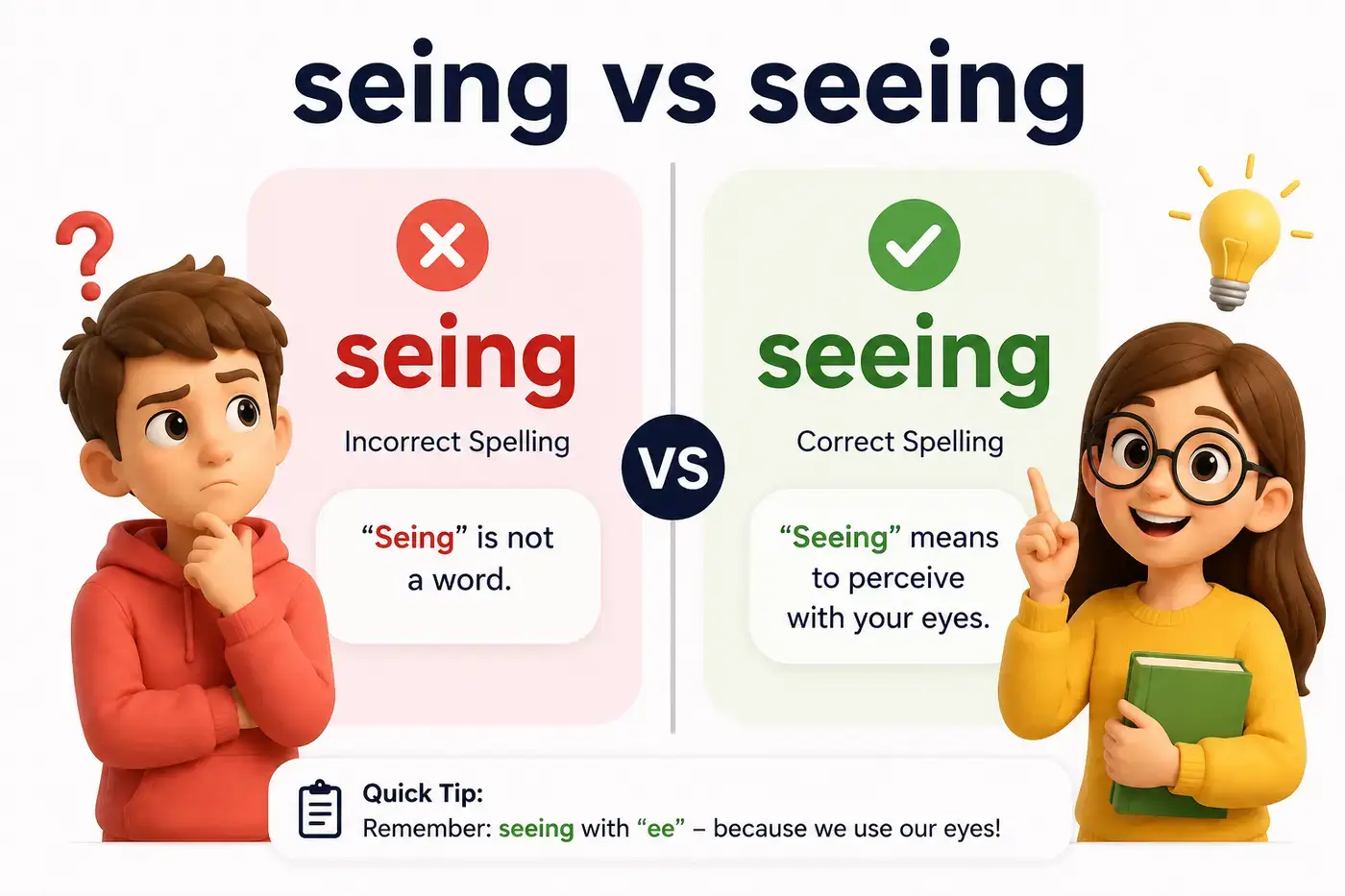
Have you ever typed seing vs seeing and wondered which one is the correct spelling? This is a common mistake because both words look almost identical. The difference is only one extra letter, but that small change completely affects correctness.
The correct spelling is seeing. The word seing is a misspelling and is not accepted in standard English. The confusion usually happens because people forget the second e when adding the ending ing to the verb see.
English spelling rules can feel tricky because many verbs change slightly when they receive suffixes like ing. Words that look simple often create mistakes because our brains try to follow patterns from other verbs.
In this guide, you’ll learn the correct spelling, the grammar behind seeing, why people write seing, pronunciation tips, common mistakes, and examples that show how native English speakers use the word naturally.
Need another quick comparison? Read Immerse Vs Emerse Which Word Is Correct 2026 Guide.
Quick Answer
The correct spelling is seeing. It is the present participle or gerund form of the verb see. The word seing is incorrect because the verb see keeps both vowels when adding ing. Example: I am seeing a movie tonight.
Seing Vs Seeing Comparison Table
| Feature | Seeing | Seing |
|---|---|---|
| Correct spelling | Yes | No |
| Word type | Verb form and gerund | Misspelling |
| Base word | See | Incorrect form |
| Meaning | Looking at something or understanding something | No standard meaning |
| Pronunciation | SEE ing | Usually intended as seeing |
| Usage | Everyday English | Avoid in writing |
| Formal writing | Accepted | Incorrect |
| Example | She is seeing her doctor today. | She is seing her doctor today. |

What Does Seeing Mean
Seeing is the correct form of the verb see.
It can have several meanings depending on the context. The most common meaning is using your eyes to notice or observe something. It can also mean understanding something, meeting someone, or experiencing something.
Seeing As A Verb Form
The word seeing is the present participle form of see.
It is often used with helping verbs like:
- Am.
- Is.
- Are.
- Was.
- Were.
Examples:
- I am seeing a beautiful view from my window.
- She is seeing her friend after work.
- They are seeing a new movie this weekend.
- We were seeing different results during the experiment.
Seeing As A Gerund
A gerund is an ing form that works as a noun.
Examples:
- Seeing the ocean for the first time was unforgettable.
- Seeing is believing.
- I enjoy seeing new places.
In these sentences, seeing acts like a thing or activity.
What Does Seing Mean
Seing is not a correct English word.
It is usually a spelling mistake caused by dropping one of the two vowels in seeing.
Many English learners write seing because they think the word should follow a pattern like:
- Make becomes making.
- Take becomes taking.
- Write becomes writing.
In those examples, the final e disappears before adding ing. However, see is different because it already has a double vowel sound.
The correct form keeps both e letters:
See + ing = Seeing.
Not:
See + ing = Seing.
Which One Is Correct
The correct spelling is seeing.
The word seing should not be used in English writing, exams, emails, or professional communication.
Examples:
Correct:
✔ I am seeing my teacher tomorrow.
✔ We are seeing improvements in sales.
Incorrect:
✘ I am seing my teacher tomorrow.
✘ We are seing improvements in sales.
The extra e in seeing is not optional. It is part of the correct spelling.
Why People Confuse Seing And Seeing
The confusion comes from several spelling patterns in English.
Dropping The Final E Rule
Many learners know that some verbs remove their final e before adding ing.
Examples:
- Write becomes writing.
- Drive becomes driving.
- Make becomes making.
Because of this rule, people may assume:
See becomes seing.
But see does not follow that pattern.
The verb already ends with two vowels, so both e letters stay.
Visual Similarity
The difference between the two words is very small.
Seeing.
Seing.
When people type quickly, the second e is easy to miss.
Fast Typing Mistakes
On phones and keyboards, people often remove repeated letters without noticing. Since English has many words where double letters change during word formation, autocorrect may not always catch this mistake.
Pronunciation Confusion
Both spellings are often intended to sound the same. Because pronunciation does not clearly reveal the spelling, learners must remember the written form.
Social Media Influence
Online writing often contains informal spelling mistakes. Seeing seing repeatedly on social platforms can make an incorrect spelling look familiar.
Familiar does not always mean correct.
Key Differences Between Seing And Seeing
Meaning
Seeing has meaning. It refers to observing, understanding, meeting, or experiencing something.
Seing has no accepted meaning in standard English.
Grammar
Seeing works as a verb form and noun form.
Seing does not function grammatically.
Spelling
The correct structure is:
See + ing = Seeing.
The incorrect structure is:
See + ing = Seing.
Usage
Native English speakers use seeing in conversations, writing, books, news articles, and formal communication.
They do not use seing in correct English.
Grammar Explanation For Seeing
Understanding the grammar behind seeing makes the spelling easier to remember.
Base Verb
The original verb is:
See.
Meaning:
To notice something with your eyes or understand something.
Present Continuous Tense
The present continuous uses:
Subject + am/is/are + verb ending in ing.
Examples:
- I am seeing a doctor tomorrow.
- She is seeing the problem now.
- They are seeing better results.
Past Continuous Tense
The past continuous uses:
Subject + was/were + verb ending in ing.
Examples:
- I was seeing strange lights.
- They were seeing changes in the system.
Gerund Form
A gerund uses an ing word as a noun.
Examples:
- Seeing the mountains was amazing.
- Seeing mistakes helps you improve.
Internal Link Opportunity
A helpful related article could be:
Common English Spelling Mistakes And How To Avoid Them.
Seing Vs Seeing Spelling Rules
English spelling can feel confusing because different verbs follow different patterns when adding ing. The key to spelling seeing correctly is understanding why the word keeps both vowels.
The verb see already ends with a double vowel combination:
See.
When adding ing, English keeps the original spelling:
See + ing = Seeing.
The final e is not removed because the word does not follow the silent e rule.
Why See Becomes Seeing
Many verbs ending in e drop the final e before adding ing.
Examples:
- Make becomes making.
- Hope becomes hoping.
- Dance becomes dancing.
However, verbs ending in ee usually keep both letters.
Examples:
- See becomes seeing.
- Agree becomes agreeing.
- Free becomes freeing.
This pattern helps explain why seing is incorrect.
Common Spelling Pattern
Remember this simple rule:
Words ending in a single silent e often lose the e.
Words ending in ee usually keep both e letters.
Examples:
Correct:
✔ Seeing.
✔ Freeing.
Incorrect:
✘ Seing.
✘ Agreeing without the second e.
Need another quick comparison? Read Specialty Or Speciality Which Spelling Is Correct 2026 Guide.
Pronunciation Guide For Seeing
The pronunciation of seeing is simple once you understand the sound.
IPA Pronunciation
American English:
/ˈsiːɪŋ/
Syllables
See ing.
The word has two syllables.
Stress Pattern
The stress falls on the first syllable.
SEE ing.
The first part sounds stronger than the second.
Common Pronunciation Mistakes
Some learners pronounce seeing like one quick sound instead of two syllables.
Incorrect:
Sing the word too quickly so it sounds like a different word.
Correct:
SEE ing.
The pronunciation helps separate seeing from words like sing or singing, which have a different vowel sound.
Word Origin And History Of Seeing
Understanding the history of a word can make spelling easier to remember.
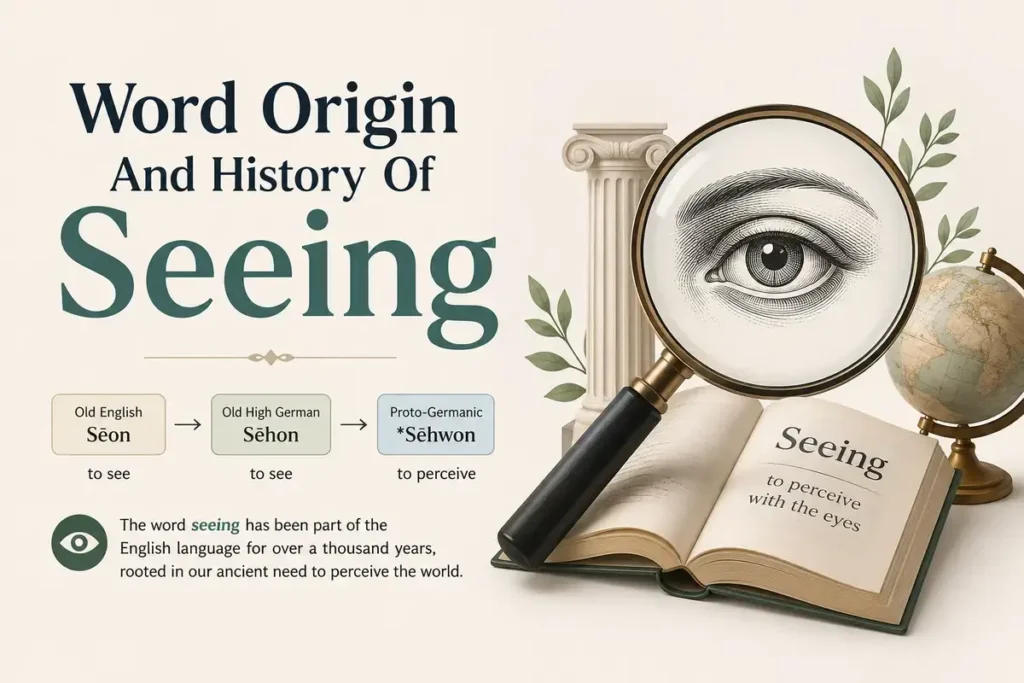
The verb see comes from Old English seon, which meant to look at or perceive with the eyes.
Over centuries, the spelling changed, but the meaning stayed connected to vision and understanding.
The modern form see became part of everyday English. When English speakers added the ing ending, the spelling developed into seeing.
The word now carries several meanings:
- Using your eyes.
- Understanding an idea.
- Meeting someone.
- Experiencing something.
British And American English Usage
There is no spelling difference between British English and American English for seeing.
Both use:
✔ Seeing.
Both reject:
✘ Seing.
The same spelling is also used in:
- Canadian English.
- Australian English.
- New Zealand English.
Unlike some words that change between regions, such as color and colour, seeing remains consistent worldwide.
Real Life Examples Of Seeing
Seeing appears in daily conversations, professional writing, academic work, and casual communication.
Daily Conversation
- I am seeing my cousin this weekend.
- Are you seeing what I mean?
- She is seeing a beautiful sunset.
- We are seeing a lot of changes lately.
- I can’t believe what I am seeing right now.
Workplace Examples
- The company is seeing growth after the new strategy.
- We are seeing positive results from the project.
- I am seeing improvements in customer feedback.
- The team is seeing better performance this quarter.
- Managers are seeing the benefits of flexible work.
Email Examples
- I am seeing your message for the first time today.
- We are seeing some delays with the order.
- I look forward to seeing your response.
- Thank you for seeing the issue from our perspective.
Academic Writing Examples
- Researchers are seeing patterns in the collected data.
- Students improve by seeing examples of correct writing.
- The study shows what scientists are seeing in the results.
Literature Examples
- The character is seeing the world differently after the experience.
- The author describes seeing nature as a powerful emotional moment.
Social Media Examples
- Seeing this photo brought back great memories.
- I can’t stop seeing this amazing artwork.
- You are seeing the reason behind this trend.
Common Mistakes With Seeing
Even experienced writers sometimes make spelling mistakes with simple words.
Mistake One Forgetting The Second E
Incorrect:
✘ I am seing my friend tomorrow.
Correct:
✔ I am seeing my friend tomorrow.
The word needs both e letters before adding ing.
Mistake Two Applying The Wrong Spelling Rule
Incorrect thinking:
See ends with e, so remove it.
Correct thinking:
See ends with ee, so keep both letters.
Mistake Three Confusing Seeing And Seeing
Some learners confuse the word with similar looking forms.
Examples:
Seeing.
Seeking.
Singing.
These words have different meanings and sounds.
Mistake Four Using Seing In Formal Writing
A spelling mistake may reduce trust in professional writing.
Avoid seing in:
- Emails.
- Essays.
- Reports.
- Resumes.
- Academic assignments.
Memory Tricks To Remember Seeing
A good memory trick makes spelling easier.
Double E Stays Together
Think:
Two eyes help you see.
Two e letters help you spell seeing.
SEE + ING = SEEING.
Picture The Word
Imagine the word seeing as:
SEE + ING.
The two e letters represent your two eyes looking forward.
Compare Similar Words
Remember:
See becomes seeing.
Agree becomes agreeing.
Free becomes freeing.
Words ending in ee usually keep both letters.
Related Words And Similar Expressions
Learning related words improves vocabulary and helps prevent mistakes.
Words Related To Seeing
- See.
- Seen.
- Sight.
- Vision.
- Observe.
- Notice.
- Watch.
- View.
- Look.
- Notice.
Difference Between See And Seeing
See is the base form.
Example:
I see the mountains.
Seeing shows an ongoing action or works as a noun.
Example:
I am seeing the mountains.
Difference Between Seeing And Seen
Seeing describes an action happening.
Example:
She is seeing the doctor.
Seen is the past participle form.
Example:
I have seen that movie.
Difference Between Seeing And Watching
Seeing often means noticing something naturally.
Example:
I saw a bird outside.
Watching usually means paying attention to something for a period of time.
Example:
I am watching a movie.
Expert Editor’s Note On Seing Vs Seeing
Professional editors and English teachers agree on one simple rule.
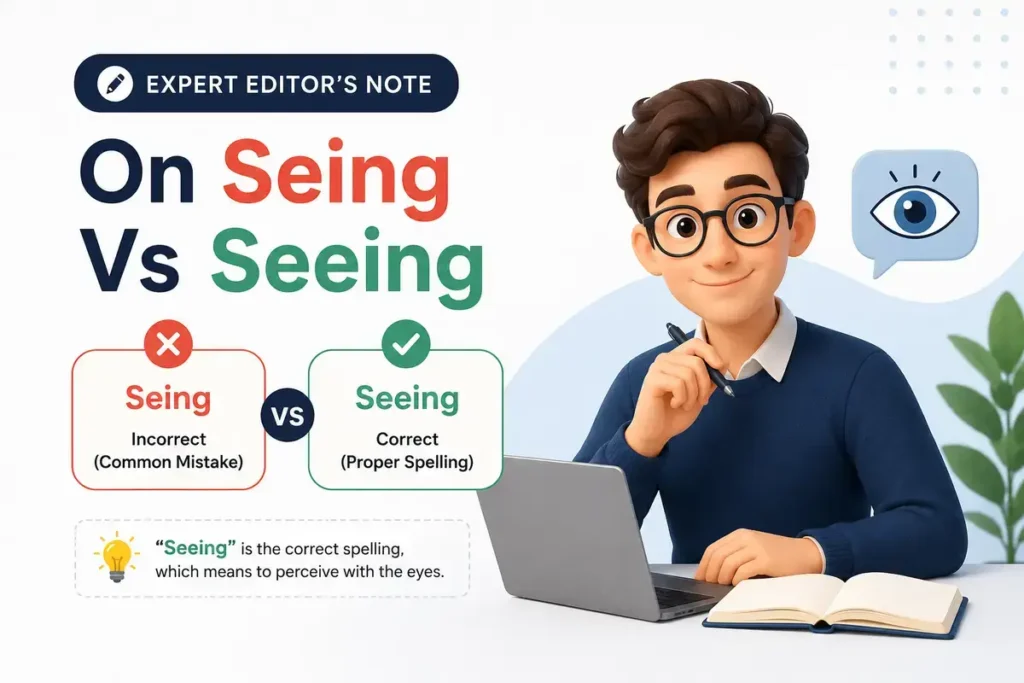
Seeing is the only correct spelling.
The word seing is a spelling error and should be corrected in any type of writing. Dictionaries list seeing as the standard form because it follows the normal spelling pattern of the verb see when adding the ing suffix.
Experienced editors often notice that learners make this mistake because they apply a common spelling rule too broadly. They remember that many verbs drop their final e before adding ing, but they forget that verbs ending in ee behave differently.
For example:
Make becomes making.
Write becomes writing.
See becomes seeing.
The spelling depends on the ending of the original verb, not just the presence of the letter e.
In professional writing, academic work, emails, and published content, always choose seeing. A small spelling mistake can distract readers and reduce confidence in the quality of the writing.
Why Seeing Is More Natural For Native Speakers
Native English speakers learn seeing as a fixed word pattern from childhood. They rarely think about the spelling rule because the correct form feels natural.
Words like:
- Seeing.
- Agreeing.
- Freeing.
are familiar because English keeps the double e in these words.
The incorrect spelling seing looks unusual to native speakers because it breaks a common spelling pattern.
Frequently Asked Questions
Is Seing A Correct English Word?
No. Seing is not a correct English spelling. It is a common mistake caused by removing the second e from seeing. The correct form is always seeing, which comes from the verb see plus the ending ing.
Why Is Seeing Spelled With Two E Letters?
The word seeing keeps both e letters because the base verb see ends with ee. When adding ing, English usually keeps the original spelling for verbs ending in ee, creating the correct form seeing.
Is Seeing A Verb Or A Noun?
Seeing can work as both a verb form and a noun. As a verb, it describes an ongoing action, such as “She is seeing her doctor.” As a noun, it describes an activity, such as “Seeing is believing.”
What Is The Difference Between See And Seeing?
See is the base form of the verb. It describes the general action of noticing something. Seeing shows an ongoing action or works as a gerund. For example, “I see the bird” and “I am seeing the bird.”
Can Seeing Be Used In Formal Writing?
Yes. Seeing is completely acceptable in formal writing. It appears in academic papers, professional reports, news articles, and everyday communication. The word is standard English and does not have an informal limitation.
Why Do People Write Seing Instead Of Seeing?
People usually write seing because they apply the wrong spelling rule. They remember that some verbs remove the final e before adding ing, but they do not realize that verbs ending in ee keep both vowels.
How Do You Remember The Spelling Of Seeing?
Remember that your eyes come in pairs, and the word seeing also keeps two e letters. Think of it as:
SEE + ING = SEEING.
This simple pattern helps prevent the most common spelling mistake.
Is Seeing The Same In British And American English?
Yes. Both British English and American English use the same spelling: seeing. The word does not change across English speaking regions, including Canada and Australia.
Still confused? Compare Affend Vs Offend Which Word Is Correct 2026.
Conclusion
The correct spelling is seing vs seeing not seing.The difference is simple. Seeing is the correct ing form of the verb see, while seing is a spelling mistake that should be avoided.The most important rule to remember is this:When a verb ends with ee, keep both e letters before adding ing.See becomes seeing.Once you remember this pattern, you will avoid one of the most common English spelling mistakes and write with more confidence.Small spelling choices create clear communication. The right letters make your message easier to trust and understand.

Editorial Reviewer & Proofreader
Grace Mitchell reviews Gramlify’s articles for clarity, consistency, and readability. She is passionate about creating accurate, approachable content that helps English learners build confidence.
1 thought on “Seing Vs Seeing Which Spelling Is Correct 2026 Guide”