
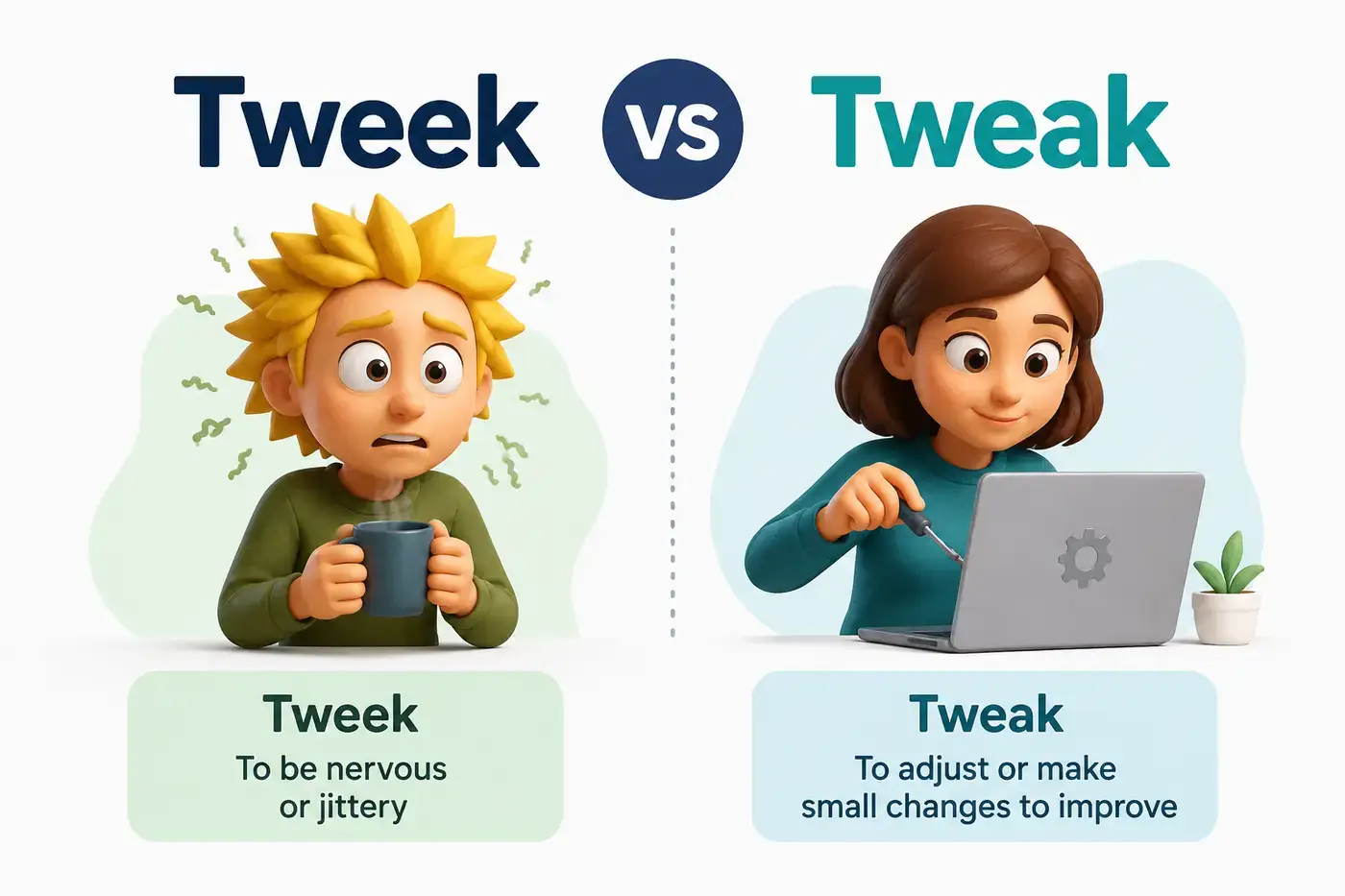
If you’ve searched for tweek vs tweak, you’re probably trying to figure out which spelling is correct. The short answer is simple. Tweak is the correct English word. Tweek is almost always a misspelling.
The confusion is easy to understand. Both words sound exactly alike when spoken. A quick typing mistake or relying on autocorrect can also lead people to write tweek instead of tweak. Since the incorrect spelling appears on forums, social media, and even some websites, many English learners start to wonder if both spellings are acceptable.
They are not.
The word tweak has been part of English for many years. It means to make a small adjustment or slight improvement. You can tweak a document, tweak a recipe, tweak your website, or tweak your schedule. The spelling tweek does not appear as a standard English word in major dictionaries.
This guide explains the difference between tweek vs tweak, why people confuse them, how to remember the correct spelling, and how to use tweak confidently in everyday conversations, professional writing, and academic English.
Suggested Internal Link: Commonly Misspelled English Words Every Writer Should Know.
Still confused? Compare Different or Diffrent: Which Spelling Is Correct 2026 Guide.
Quick Answer
Tweak is the correct spelling. It means to make a small change or adjustment to improve something. Tweek is a misspelling and should not be used in standard English writing. If you want to describe making a minor improvement, always choose tweak.
Tweek Vs Tweak Comparison Table
| Feature | Tweek | Tweak |
|---|---|---|
| Correct spelling | No | Yes |
| Meaning | None in standard English | A small adjustment or improvement |
| Part of speech | None | Verb and noun |
| Dictionary entry | No | Yes |
| Formal writing | Never recommended | Standard English |
| Informal writing | Misspelling | Correct |
| Common use | Typing error | Everyday English |
| Example | Incorrect | We need to tweak the design. |
Which One Is Correct
The correct spelling is tweak.
The spelling tweek is considered a mistake in modern English. You should avoid using it in emails, school assignments, business documents, articles, and professional communication.
Correct examples.
- I need to tweak the presentation before the meeting.
- She tweaked the recipe by adding fresh herbs.
- The designer made a few tweaks to the homepage.
Incorrect examples.
- I need to tweek the presentation.
- She tweeked the recipe yesterday.
- The website needs a few tweeks.
Replacing every form of tweek with tweak instantly fixes the spelling.
What Does Tweak Mean
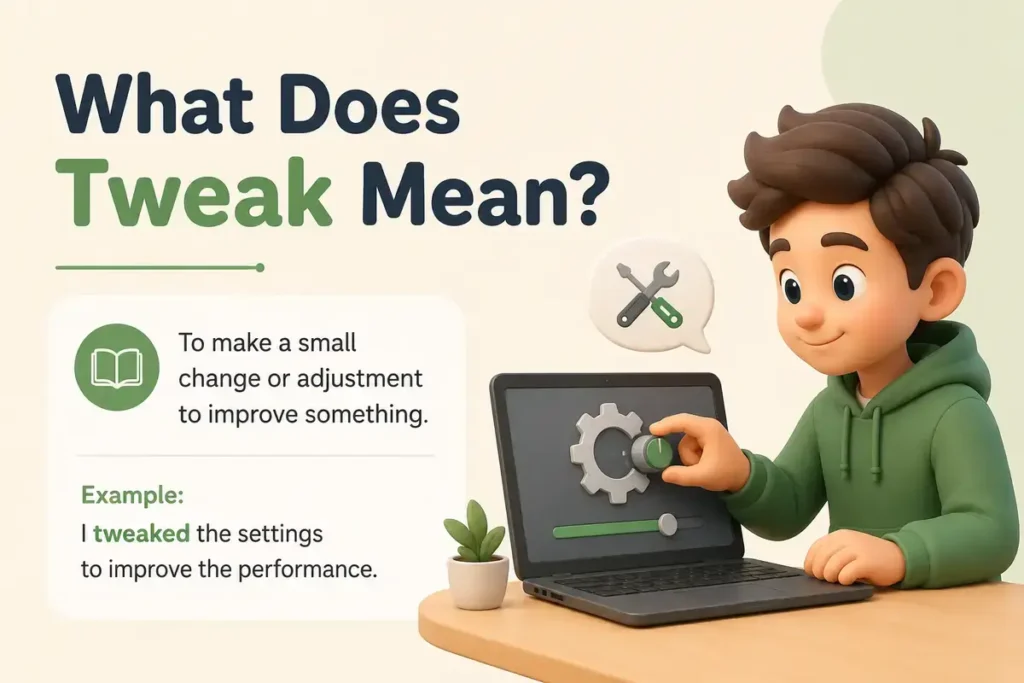
The word tweak can work as both a verb and a noun.
As a verb, it means to make a small change that improves something.
As a noun, it refers to the small change itself.
Tweak As A Verb
When used as a verb, tweak describes adjusting something without changing it completely.
Examples.
- Please tweak the headline before publishing the article.
- We tweaked the budget after reviewing the costs.
- The chef tweaked the recipe until it tasted perfect.
- She tweaked her speech before stepping onto the stage.
- The developer tweaked the software settings.
Tweak As A Noun
As a noun, tweak refers to a small improvement or adjustment.
Examples.
- The report only needs one final tweak.
- A few tweaks made the app much easier to use.
- His latest tweak improved battery life.
- That small tweak solved the problem.
- The editor suggested several useful tweaks.
Why People Write Tweek Instead Of Tweak
Several reasons explain this common spelling mistake.
Similar Pronunciation
The words sound identical in everyday speech.
People often spell words based on how they hear them. Since the long ee sound can appear in many spellings, some writers naturally type tweek.
Keyboard Mistakes
The letters ea and ee often get mixed up while typing quickly.
A simple typing error can turn tweak into tweek without the writer noticing.
Social Media And Online Posts
Misspellings spread quickly online.
When people repeatedly see tweek, they may assume it is another accepted spelling.
It is not.
Limited Vocabulary
Many English learners hear the word long before they see it in print.
Without checking a dictionary, they guess the spelling from pronunciation.
That guess often becomes tweek.
Tweek Vs Tweak Key Differences
| Feature | Tweek | Tweak |
|---|---|---|
| Standard English | No | Yes |
| Dictionary recognition | No | Yes |
| Used by native speakers | Only as a mistake | Frequently |
| Suitable for professional writing | No | Yes |
| Meaning | None | Small adjustment or improvement |
The easiest way to remember the difference is simple.
If you’re talking about making a small improvement, the word is always tweak.
Grammar Explanation
Understanding the grammar makes the correct spelling much easier to remember.
Tweak As A Verb
A verb shows an action.
Examples.
- I need to tweak this paragraph.
- They tweaked the design yesterday.
- We are tweaking the settings now.
Verb forms.
- Base form. Tweak.
- Present tense. Tweak or tweaks.
- Past tense. Tweaked.
- Present participle. Tweaking.
- Past participle. Tweaked.
Tweak As A Noun
A noun names a person, place, thing, or idea.
Examples.
- One small tweak improved the website.
- Every tweak made the product better.
- Her latest tweak increased efficiency.
Because tweak works as both a noun and a verb, it is useful in many different situations.
Pronunciation Guide
Tweak
IPA
American English.
/twiːk/
Syllables
One syllable.
Stress
The entire word carries one natural stress because it has only one syllable.
Common Pronunciation Mistake
The pronunciation is correct even though the spelling contains ea instead of ee.
Many English words follow this pattern.
Examples include.
- Speak.
- Weak.
- Freak.
Learning these spelling patterns helps reduce mistakes.
Spelling Rules Behind Tweak
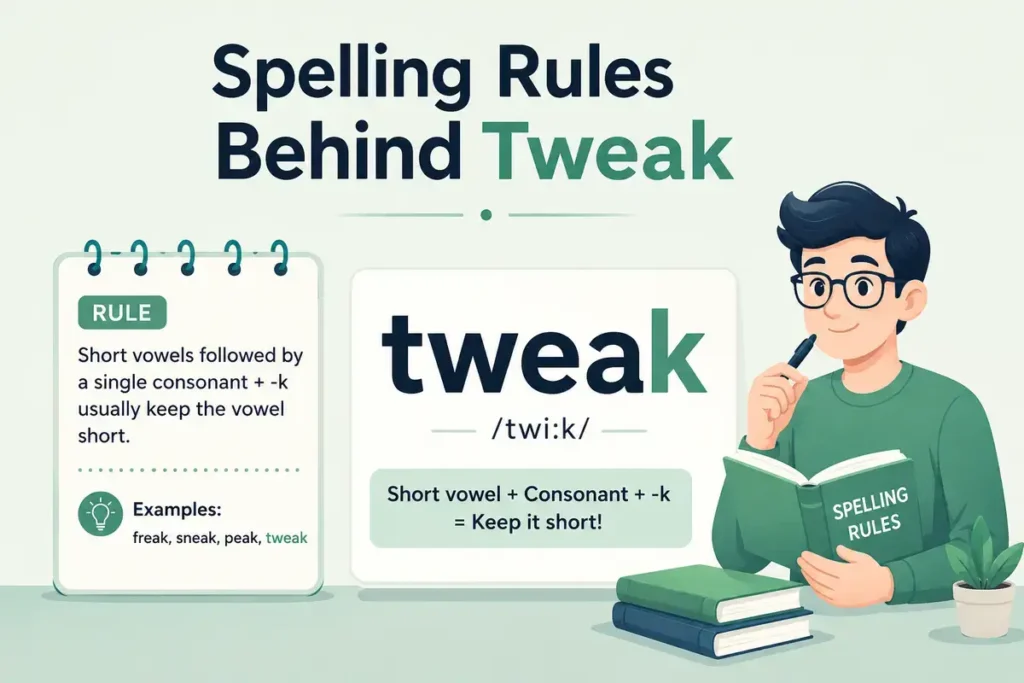
English spelling does not always match pronunciation. That is exactly why tweak causes confusion.
The long ee sound can be written in several ways.
Examples include.
- Speak.
- Weak.
- Dream.
- Team.
- Teach.
The word tweak follows the same spelling pattern. Even though it sounds like it could be spelled tweek, standard English uses ea.
There is no accepted spelling rule that supports tweek.
When you mean a small adjustment or improvement, always write tweak.
Word Origin And History
The word tweak has been part of English for centuries.
It originally meant to pinch or pull sharply with a quick twisting motion. Over time, its meaning expanded. Today, people use it to describe making a small change that improves something without changing it completely.
Modern English uses tweak in many fields, including technology, writing, business, education, engineering, photography, cooking, and design.
Although its meaning has evolved, the spelling has remained the same.
Need another quick comparison? Read Natzi Or Nazi Which Spelling Is Correct 2026.
British American Canadian And Australian English
There is no spelling difference across major English speaking countries.
People in the United States, the United Kingdom, Canada, Australia, and New Zealand all use tweak.
The spelling tweek is considered incorrect everywhere.
Examples.
American English.
We need to tweak the software before launch.
British English.
The engineer tweaked the design after testing.
Canadian English.
A few tweaks improved the presentation.
Australian English.
She tweaked the schedule to save time.
No matter where English is spoken, tweak is the correct spelling.
Real Life Examples
Seeing the word in natural situations makes it much easier to remember.
Daily Conversation
- I need to tweak my morning routine.
- She tweaked the playlist before the party.
- We only need one small tweak.
- He tweaked the recipe and everyone loved it.
Workplace
- The manager asked us to tweak the proposal.
- Our team tweaked the marketing plan.
- Please tweak the report before sending it.
- We made several tweaks after the client meeting.
Emails
- I’ll tweak the document and send the final version this afternoon.
- Could you tweak the wording in the introduction?
Academic Writing
- The researcher tweaked the experiment to improve accuracy.
- The professor suggested a small tweak to the conclusion.
Technology
- I tweaked the app settings for better performance.
- A quick tweak fixed the software bug.
- The developer tweaked the code before release.
Journalism
- The editor tweaked the headline to make it clearer.
- The article needed only one final tweak.
Social Media
- I tweaked my profile picture.
- This simple tweak changed everything.
- Just one tweak made the video much better.
Home And Everyday Life
- She tweaked the furniture layout.
- We tweaked the travel plans because of the weather.
- He tweaked the budget to save money.
- A few tweaks turned the room into a comfortable workspace.
Common Phrases With Tweak
Native English speakers use tweak in many common expressions.
- Tweak the settings.
- Tweak the design.
- Tweak the schedule.
- Tweak the budget.
- Tweak the strategy.
- Tweak the recipe.
- Tweak the wording.
- Tweak the layout.
- Make a few tweaks.
- Fine tune and tweak.
These expressions appear regularly in business, education, technology, and everyday conversation.
Common Mistakes
Here are the mistakes editors notice most often.
Writing Tweek Instead Of Tweak
Incorrect.
Please tweek the report.
Correct.
Please tweak the report.
Misspelling Other Forms
Incorrect.
Tweeked.
Tweeking.
Tweeks.
Correct.
Tweaked.
Tweaking.
Tweaks.
Every form should keep the original spelling tweak.
Thinking Tweek Is An Alternative Spelling
Some people believe tweek is accepted in informal English.
It is not.
Major dictionaries recognize only tweak.
Confusing Tweak With Twick
Occasionally, writers accidentally type twick or twik.
These are also spelling mistakes.
Only tweak is correct.
Tweak In Formal And Informal Writing
One reason tweak is so useful is that it works well in almost every type of writing.
Formal Writing
Professional writers often use tweak when discussing small improvements.
Examples.
- The committee tweaked the policy after public feedback.
- The editor suggested a few minor tweaks.
- Engineers tweaked the design to improve safety.
Informal Writing
The word is just as common in casual conversation.
Examples.
- I’ll tweak it later.
- Just tweak the settings.
- We only need one more tweak.
Because the word sounds natural in every setting, it has become part of everyday English.

Memory Tricks To Remember The Correct Spelling
A simple memory trick can save you from making this mistake again.
Think Of Speak
The word tweak follows the same spelling pattern as speak.
Both words use ea.
If you remember speak, you’ll remember tweak.
Think Of Weak
Another helpful comparison is weak.
Although it sounds like it could use ee, the correct spelling uses ea.
The same rule applies to tweak.
Remember The Meaning
A tweak is a tiny improvement.
Both words begin with the letter T.
When you think about making a tiny change, think tweak.
Related Words
Expanding your vocabulary makes it easier to choose the right word in different situations.
Synonyms Of Tweak
- Adjust.
- Modify.
- Improve.
- Refine.
- Fine tune.
- Revise.
- Alter.
- Optimize.
Opposites Of Tweak
- Ignore.
- Neglect.
- Damage.
- Worsen.
- Undo.
Related Words
- Adjustment.
- Modification.
- Improvement.
- Revision.
- Configuration.
- Calibration.
- Editing.
- Optimization.
Frequently Confused Words
Some words are commonly confused with tweak because they have similar spelling or pronunciation.
- Tweak and twick.
- Tweak and tweaker.
- Peak and peek.
- Brake and break.
- Affect and effect.
Learning these common pairs improves both your spelling and your confidence.
Expert Editor’s Note
Professional editors recommend using tweak in every situation that involves making a small adjustment or improvement.
Major dictionaries recognize tweak as the standard spelling. They do not list tweek as an accepted alternative.
During proofreading, one of the quickest ways to improve writing is to search for tweek and replace it with tweak.
Native English speakers naturally expect to see tweak in emails, articles, reports, books, websites, and everyday conversation. Using the correct spelling immediately makes your writing look more polished and professional.
Frequently Asked Questions
Is Tweek A Real Word?
No. Tweek is not recognized as a standard English word. In almost every case, it is simply a misspelling of tweak.
Is Tweak The Correct Spelling?
Yes. Tweak is the correct spelling. It means to make a small adjustment or improvement. It can be used as both a verb and a noun.
Why Do People Spell Tweak As Tweek?
The mistake happens because both spellings sound the same when spoken. Fast typing, pronunciation, and seeing the misspelling online also contribute to the confusion.
Can I Use Tweek In Informal Writing?
No. Even in casual messages and social media posts, tweak is the correct spelling. Using tweek may make your writing appear careless.
What Is The Past Tense Of Tweak?
The past tense is tweaked.
Example.
She tweaked the presentation before sending it.
Can Tweak Be Used As A Noun?
Yes. As a noun, tweak refers to a small adjustment or improvement.
Example.
The software only needed one final tweak.
Is There A Difference Between Tweak And Adjust?
Both words describe making changes, but tweak usually refers to a smaller and more precise improvement. Adjust can describe changes of any size.
You may also want to read Attornies or Attorneys Which Spelling Is Correct (2026).
Conclusion
The answer to tweek vs tweak is straightforward.
Tweak is the only correct spelling in standard English. It works as both a verb and a noun and describes making a small adjustment or improvement.
Tweek is simply a spelling mistake. It does not appear as a standard dictionary word and should be avoided in every type of writing.
A simple way to remember the correct spelling is to connect tweak with words like speak and weak. They all share the same ea spelling pattern.
The next time you write about improving, refining, or adjusting something, choose tweak with confidence. One correct letter can make your writing look much more professional.

Editorial Reviewer & Proofreader
Grace Mitchell reviews Gramlify’s articles for clarity, consistency, and readability. She is passionate about creating accurate, approachable content that helps English learners build confidence.
1 thought on “Tweek Vs Tweak Which Spelling Is Correct 2026”