
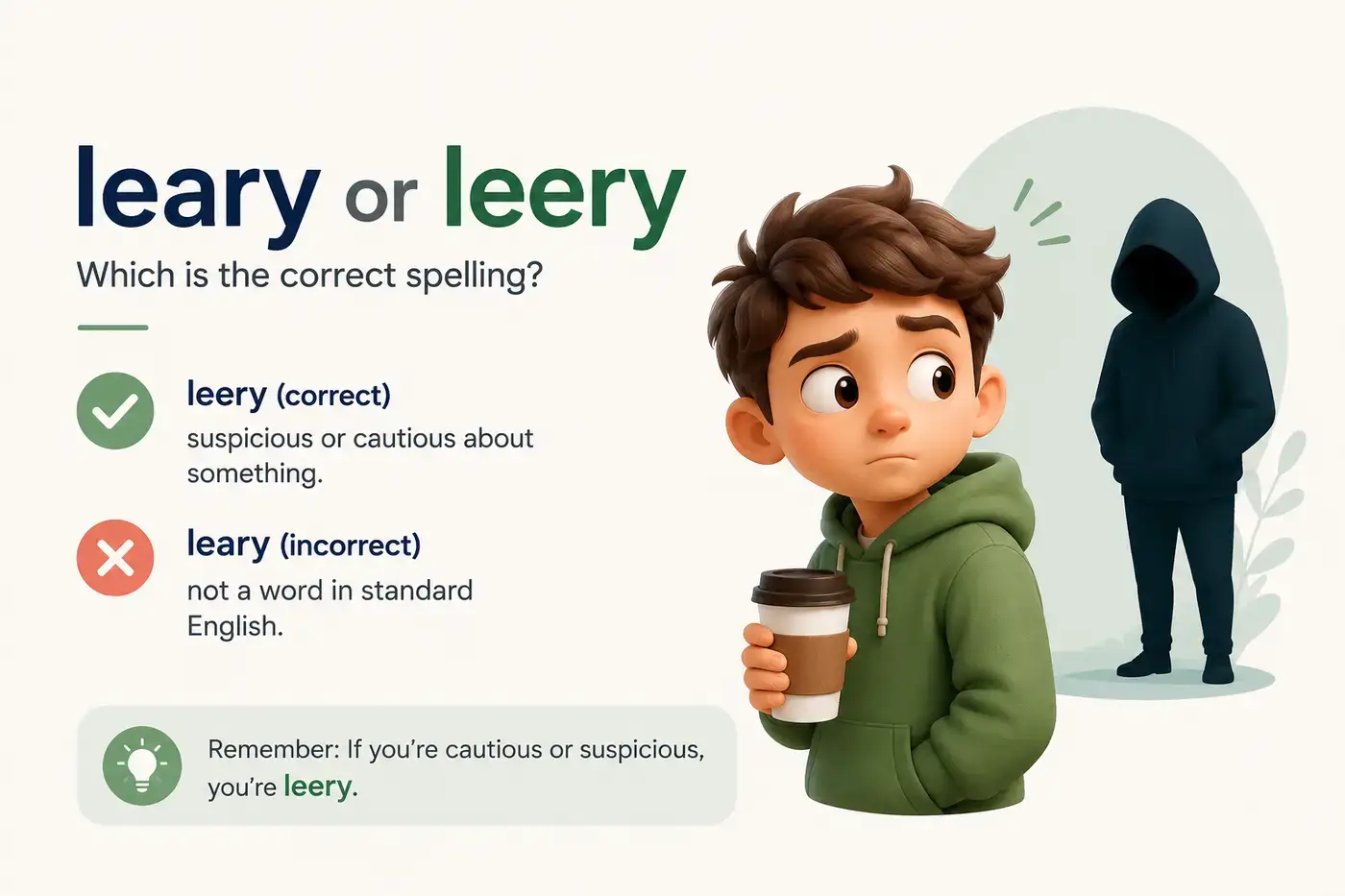
If you’ve searched for leary or leery, you’re probably trying to figure out which spelling is correct. You’re not alone. These two words appear so often online that it’s easy to think both belong in standard English. In reality, only one is correct in modern English.
The confusion usually comes from pronunciation. Many people hear leery in conversation but assume it’s spelled leary. Spell check may not always catch the mistake, and social media has made the incorrect spelling even more visible.
The good news is the rule is simple. Leery is the correct English word. It means cautious, suspicious, or unwilling to trust someone or something. Leary is almost always a misspelling of leery, though it can appear as a surname or proper name.
This guide explains the difference between leary or leery, why the confusion happens, how dictionaries treat the words, and how to use the correct spelling with confidence. You’ll also find grammar tips, real life examples, common mistakes, memory tricks, and expert editing advice that will help you avoid this error for good.
Still confused? Compare Tweek Vs Tweak Which Spelling Is Correct 2026.
Quick Answer
Leery is the correct spelling when you mean cautious, suspicious, or reluctant to trust someone or something. Leary is usually an incorrect spelling in everyday English, although it may appear as a family name or proper noun. For almost all writing, choose leery.
Leary Or Leery Comparison Table
| Feature | Leery | Leary |
|---|---|---|
| Standard English word | Yes | No in normal usage |
| Meaning | Cautious suspicious or distrustful | Usually a misspelling of leery |
| Part of speech | Adjective | Proper noun or misspelling |
| Used in dictionaries | Yes | Only as a name |
| Common in formal writing | Yes | No |
| Common mistake | Rarely | Very common |
| Example | I’m leery of online scams. | Incorrect in this context |
Which One Is Correct
The correct spelling is leery.
Use leery any time you want to describe someone who feels cautious, suspicious, or hesitant.
Examples.
- I’m leery of clicking unknown links.
- She’s leery about sharing personal information online.
- They were leery of signing the contract without legal advice.
The spelling leary is almost always incorrect in this context.
The only time leary is correct is when it refers to a person’s name, such as the surname Leary.
Examples.
- Timothy Leary was a well known American writer.
- Ms. Leary joined the meeting this morning.
If you’re writing about caution or suspicion, always choose leery.
What Does Leery Mean
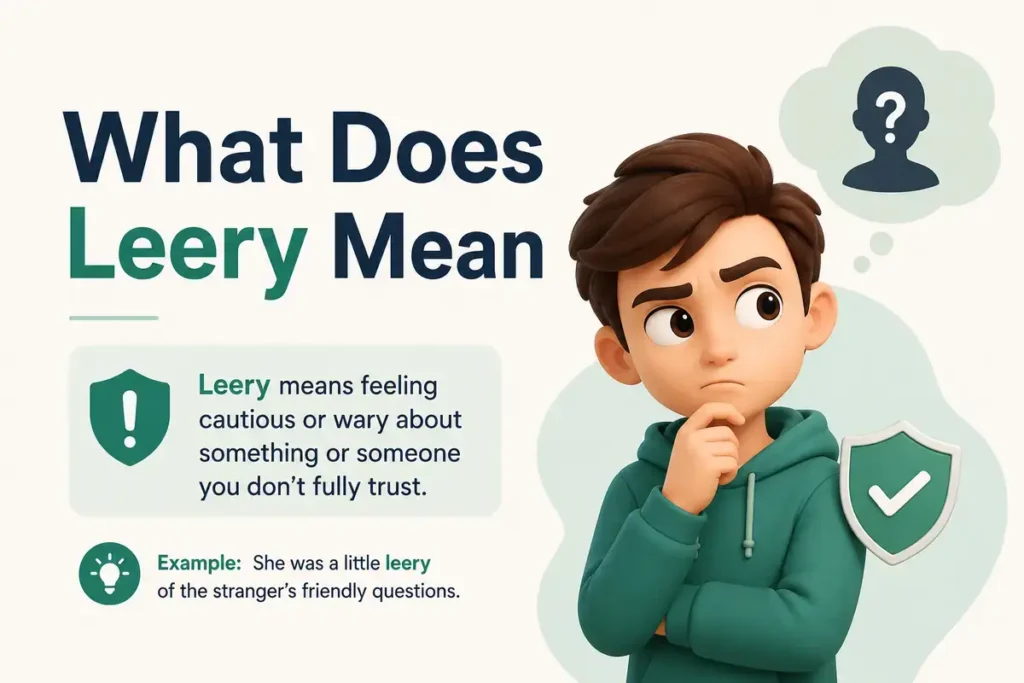
Leery is an adjective that describes someone who feels cautious, doubtful, or suspicious.
People become leery when they think something may not be safe, honest, or reliable.
Simple Definition
Leery means careful because you do not completely trust someone or something.
Common Synonyms
- Wary.
- Cautious.
- Suspicious.
- Doubtful.
- Guarded.
- Skeptical.
Although these words are similar, leery often suggests a feeling of distrust based on experience or instinct.
Everyday Meaning
Imagine someone receives an email promising free money. Most people would feel leery because the offer sounds suspicious.
The word often appears in situations involving risk, strangers, scams, promises, or uncertain decisions.
How To Use Leery Correctly
The adjective leery usually comes after linking verbs such as be, feel, become, seem, and remain.
Examples.
- I’m leery of buying a used car without an inspection.
- She’s leery about investing all her savings.
- We became leery after reading the online reviews.
- The customer remained leery despite the discount.
- Many travelers are leery of fake booking websites.
Notice that leery is commonly followed by of or about.
Examples.
✔ He’s leery of strangers.
✔ She’s leery about making quick decisions.
Both patterns are natural in American English.
What Does Leary Mean
In standard English, leary does not carry the meaning of cautious or suspicious.
Instead, it is mainly found as a proper noun.
For example.
- Timothy Leary was a psychologist and writer.
- Officer Leary spoke at the community event.
Outside names, using leary instead of leery is considered a spelling mistake.
Professional editors, teachers, and dictionaries recommend correcting it before publishing.
Why People Confuse Leary And Leery
This spelling mistake has been around for years because several factors make it easy to miss.
Similar Pronunciation
Many English speakers pronounce leery in a way that sounds close to leary. People often spell words based on what they hear.
Typing Habits
The letters a and e are close enough in common spelling patterns that many writers type leary without noticing.
Internet Influence
Incorrect spellings spread quickly through blogs, comments, forums, and social media. Seeing the mistake repeatedly can make it seem correct.
Autocorrect And Search Engines
Some search engines understand that people often type leary when they really mean leery. This keeps the misspelling visible online even though dictionaries still mark leery as the standard spelling.
Lack Of Familiarity
Unlike words such as happy or careful, leery isn’t used every day by every speaker. Less familiar words are easier to misspell.
Key Differences Between Leary And Leery
| Feature | Leery | Leary |
|---|---|---|
| Correct spelling | Yes | No for normal English |
| Meaning | Cautious or suspicious | Usually a surname |
| Dictionary entry | Standard adjective | Proper noun |
| Grammar | Adjective | Proper noun |
| Formal writing | Recommended | Incorrect unless referring to a name |
| Everyday usage | Common | Rare |
The easiest way to remember the difference is simple.
If you’re describing caution or distrust, write leery.
If you’re referring to someone’s last name, Leary is correct.
Here’s Section 2 of the article.
Grammar Explanation
Understanding the grammar makes it much easier to remember the correct spelling.
Leery Is An Adjective
Leery is an adjective because it describes a person’s feelings or attitude.
Examples.
- She is leery of strangers.
- They became leery after hearing the news.
- I’m leery about giving out my phone number.
In each sentence, leery describes how someone feels.

Leary Is Not An Adjective
The spelling leary is not accepted as an adjective in standard English.
If you write:
✘ I’m leary of that website.
Most editors will mark it as a spelling mistake.
The correct sentence is:
✔ I’m leery of that website.
Common Sentence Patterns
Native English speakers usually use leery in these patterns.
- Leery of something.
- Leery about something.
- Become leery.
- Feel leery.
Examples.
- She’s leery of online scams.
- We’re leery about changing the plan.
- I became leery after reading the reviews.
- Many customers feel leery about sharing credit card details.
Spelling Rules
Unlike many confusing English words, this one has a simple rule.
The correct adjective is always spelled leery.
The spelling leary should only be used as part of a person’s name.
There are no British or American spelling differences.
There are no grammar exceptions.
If you’re talking about caution or suspicion, write leery every time.
For another common grammar confusion, see Different or Diffrent: Which Spelling Is Correct 2026 Guide.
Pronunciation Guide
Correct pronunciation also helps you remember the spelling.
Leery
IPA
American English.
/ˈlɪri/
Syllables
Leer y.
Stress
The first syllable receives the primary stress.
Common Pronunciation Mistakes
Some learners pronounce the word like Larry or leary with a long a sound.
The correct pronunciation begins with the same sound as leer.
Think of these words.
- Leer.
- Leery.
Both begin with the same sound.
Word Origin
The history of leery explains why its spelling looks unusual.
The word appeared in English during the eighteenth century.
Language experts believe it developed from British slang. It originally described someone who was alert, watchful, or clever enough to notice danger.
Over time, the meaning shifted from being alert to being cautious or suspicious.
Today, dictionaries define leery as feeling distrustful or unwilling to trust something completely.
The spelling leary never developed into a standard English adjective.
Instead, it survives mainly as a surname.
British American Canadian And Australian English
One helpful fact is that English speaking countries all follow the same spelling.
American English
Uses leery.
Example.
I’m leery of giving personal information online.
British English
Also uses leery.
Example.
She’s leery of offers that seem too good to be true.
Canadian English
Canadian writers also use leery.
Australian English
Australian English follows the same standard spelling.
There is no regional spelling difference.
If you see leary used as an adjective, it is almost always a spelling mistake instead of a regional variation.
Real Life Examples
The best way to remember leery is to see it in everyday situations.
Daily Conversation
- I’m leery of walking home alone at night.
- She’s leery about answering unknown calls.
- My parents are leery of online shopping scams.
- He’s always been leery of quick promises.
Workplace
- Our manager is leery of unrealistic deadlines.
- Employees were leery about the sudden policy change.
- The finance team stayed leery of unexpected expenses.
- Investors remain leery after the market decline.
Emails
- I’m a little leery about approving this request today.
- We’re leery of moving forward without more information.
Academic Writing
- Researchers remain leery of drawing conclusions from limited data.
- The study found that consumers were leery of misleading advertisements.
Journalism
- Residents are leery after several reports of online fraud.
- Travelers remain leery as severe weather approaches.
Social Media
- I’m leery of every message asking for my password.
- People are getting leery of fake giveaways.
- Stay leery of links from unknown accounts.
- Many users are leery about sharing personal photos.
Everyday Life
- She’s leery of buying expensive products without reviews.
- We were leery about signing the agreement too quickly.
These examples show that leery naturally fits situations involving caution, uncertainty, or distrust.
Related Words
Expanding your vocabulary also helps you remember the correct word.
Synonyms
- Wary.
- Cautious.
- Suspicious.
- Guarded.
- Skeptical.
- Doubtful.
- Careful.
Opposites
- Trusting.
- Confident.
- Fearless.
- Certain.
- Relaxed.
Frequently Confused Words
Several English words have similar meanings but different shades of meaning.
Leery suggests suspicion based on instinct or experience.
Wary suggests being careful because danger is possible.
Weary means tired, not cautious.
For example.
✔ I’m weary after working all day.
✔ I’m leery of that investment opportunity.
Learning these differences helps you choose the most accurate word in every situation.
Common Mistakes
Many writers make the same errors when using leery. Knowing these mistakes will help you avoid them.
Misspelling Leery As Leary
This is the most common mistake.
Incorrect.
✘ I’m leary of buying that car.
Correct.
✔ I’m leery of buying that car.
Confusing Leery With Weary
These words have different meanings.
Leery means cautious or suspicious.
Weary means tired.
Correct examples.
✔ I’m leery of online scams.
✔ I’m weary after working all day.
Confusing Leery With Wary
These words are close in meaning but not identical.
Wary means careful because danger may exist.
Leery often suggests suspicion or distrust.
Many situations allow either word, but leery usually carries a stronger feeling of doubt.
Assuming Leary Is An Accepted Alternative
It is not.
Major dictionaries recognize leery as the correct spelling.
Outside a person’s name, leary is considered a spelling error.
Memory Tricks
A simple trick can help you remember the correct spelling forever.
Think Of Leer
The word leery begins with leer.
A leer is a suspicious or unpleasant look.
If someone gives you a suspicious look, you become leery.
Both words begin with the same letters.
Remember The Double E
The double e appears in words related to seeing.
Think of.
- See.
- Peek.
- Leery.
The double e can remind you to stay alert and watch carefully.
Use This Question
Ask yourself.
Am I talking about someone being cautious?
If the answer is yes, write leery.
Expert Editor’s Note
Professional editors consistently recommend leery for all standard English writing.
Leading dictionaries define leery as cautious, suspicious, or reluctant to trust.
Style guides also use leery in newspapers, books, magazines, academic writing, and business communication.
The spelling leary should only appear when it is part of a person’s name.
If you’re proofreading your work and see leary, stop for a moment and ask yourself if you’re referring to a name. If not, the correct spelling is almost certainly leery.
Choosing the correct spelling improves clarity and helps your writing look polished and professional.
Frequently Asked Questions
Is It Leary Or Leery?
Leery is the correct spelling when you mean cautious or suspicious. Leary is usually a misspelling unless it refers to someone’s surname.
Is Leary A Real Word?
Yes, but only as a proper noun. It appears as a family name, such as Timothy Leary. It is not the correct adjective for describing caution or distrust.
What Does Leery Mean?
Leery means cautious, suspicious, doubtful, or unwilling to trust someone or something completely.
Is Leery Formal Or Informal?
Leery works in both formal and informal English. You can use it in everyday conversations, business writing, journalism, and academic writing.
What Is Another Word For Leery?
Common synonyms include wary, cautious, guarded, skeptical, suspicious, and doubtful. The best choice depends on the situation and the level of caution you want to express.
Can I Say Leery Of Or Leery About?
Yes. Both expressions are natural.
People commonly say leery of when referring to a person or thing.
People also say leery about before an action or situation.
Why Do So Many People Spell It Leary?
Most people spell it incorrectly because the pronunciation can sound similar. Online mistakes, typing habits, and repeated exposure to the misspelling have also contributed to the confusion.
A related grammar guide is Unphased Or Unfazed Which Word Is Correct 2026 Guide.
Conclusion
The answer to leary or leery is straightforward.
Leery is the correct spelling when you mean cautious, suspicious, or hesitant to trust someone or something.
Leary is not an accepted alternative in standard English. It is mainly used as a surname.
The easiest way to remember the difference is to connect leery with leer. Both begin with the same letters, and both relate to suspicion.
The next time you write about caution or distrust, choose leery with confidence. It’s the spelling professional editors, dictionaries, and native English speakers expect.

Editorial Reviewer & Proofreader
Grace Mitchell reviews Gramlify’s articles for clarity, consistency, and readability. She is passionate about creating accurate, approachable content that helps English learners build confidence.
1 thought on “Leary Or Leery Which Word Is Correct 2026 Guide”