
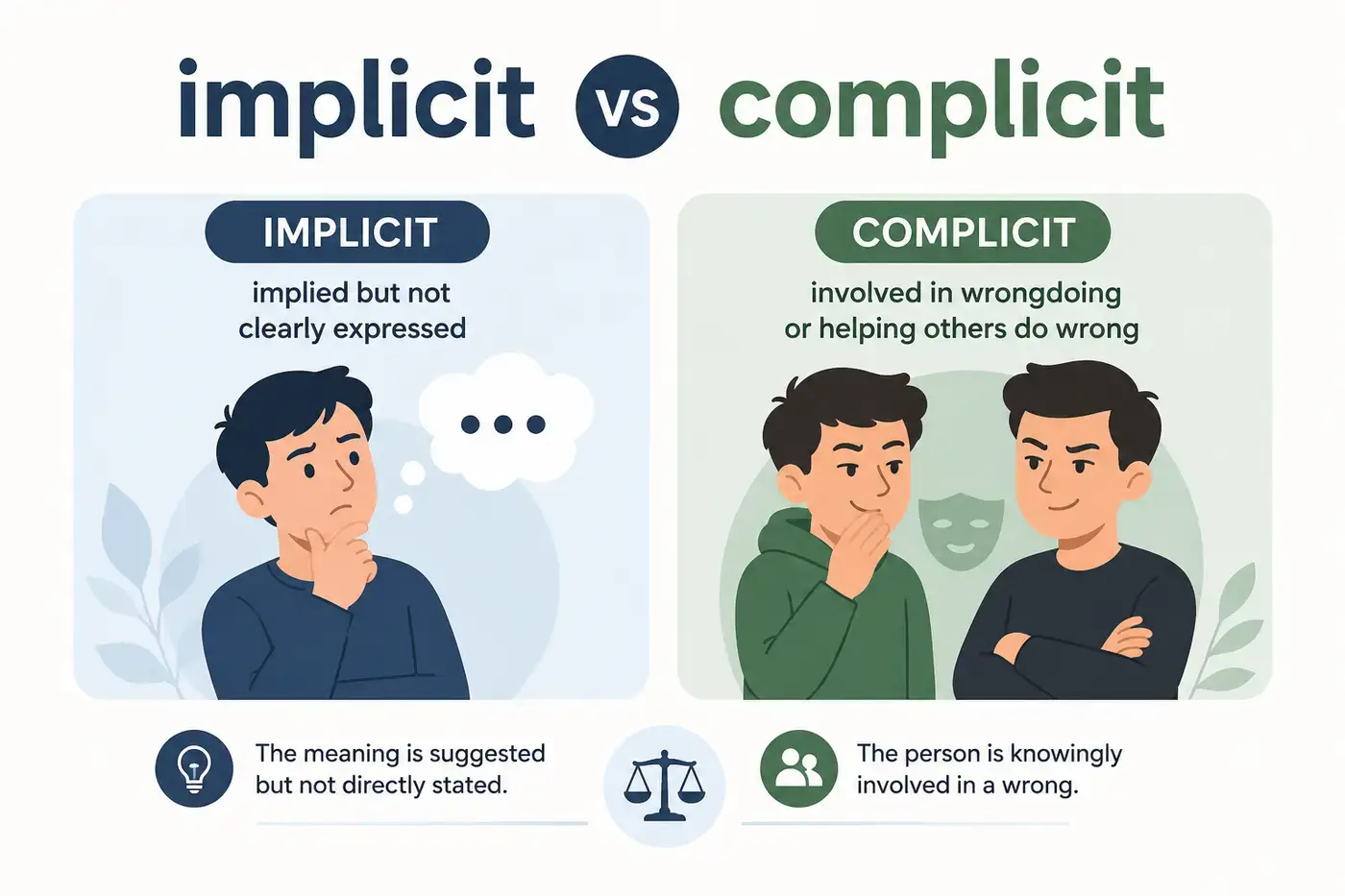
If you’ve searched for implicit vs complicit, you’re likely trying to figure out if these words have similar meanings or if you’ve been using one in place of the other. They sound alike, share several letters, and often appear in serious discussions. Still, they mean completely different things.
This confusion is common among English learners and native speakers alike. You might read about implicit bias in a news article and then see someone described as complicit in a crime. Since both words appear in formal writing and public discussions, it’s easy to assume they’re related. They are not.
The key difference is simple. Implicit describes something that is suggested or understood without being stated directly. Complicit describes someone involved in wrongdoing or someone who helps another person commit it, even if their role is indirect.
Once you understand that distinction, choosing the correct word becomes much easier. This guide explains each word in plain English, compares their meanings, explores the grammar behind them, and provides plenty of real life examples so you can use both confidently.
Still confused? Compare Touchbase Or Touch Base Which One Is Correct 2026 Guide.
Quick Answer
Implicit means implied or understood without being directly expressed. Complicit means involved in or responsible for wrongdoing. Although the words look and sound similar, they have different meanings, different grammar roles, and cannot replace each other in a sentence.
Implicit Vs Complicit Comparison Table
| Feature | Implicit | Complicit |
|---|---|---|
| Part of speech | Adjective | Adjective |
| Meaning | Implied but not directly stated | Involved in wrongdoing |
| Positive or negative | Usually neutral | Strongly negative |
| Common contexts | Communication psychology writing instructions | Crime ethics law business journalism |
| Formal writing | Very common | Very common |
| Everyday conversation | Common | Less common |
| Can replace the other | No | No |
| Example | There was implicit trust between them. | He was complicit in the fraud. |
What Does Implicit Mean
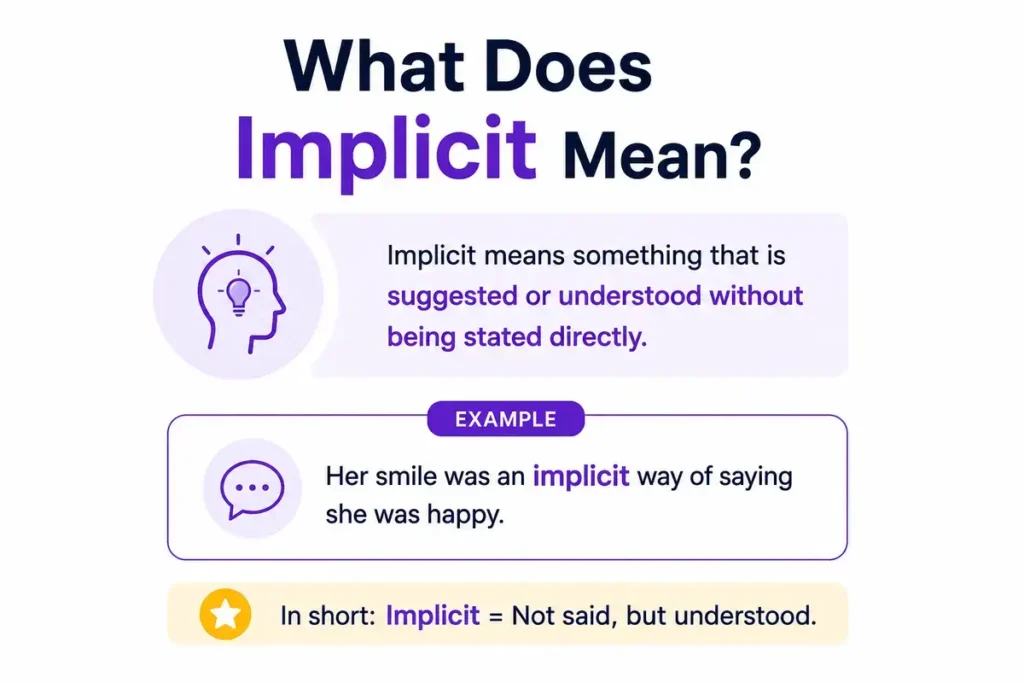
Implicit describes something that is understood without anyone saying it directly.
The idea exists beneath the surface. People understand it from actions, context, or shared knowledge instead of clear words.
Simple Definition
Implicit means implied rather than openly stated.
Common Uses Of Implicit
You often see implicit in conversations about communication, psychology, education, relationships, and business.
Examples include.
- There was implicit trust between the two friends.
- She gave implicit approval by smiling.
- The contract included an implicit promise of confidentiality.
- His silence showed implicit agreement.
- Good leaders build implicit trust over time.
Implicit In Different Contexts
Daily conversation.
There was an implicit understanding that everyone would help clean up.
Workplace.
The manager gave implicit permission by approving the budget.
Academic writing.
Researchers examined implicit learning in young children.
Psychology.
Implicit memory influences behavior without conscious awareness.
Journalism.
The article criticized the company’s implicit support of outdated policies.
What Does Complicit Mean
Complicit describes a person who is involved in illegal, dishonest, or unethical behavior.
Someone can be complicit through direct action or by knowingly allowing something wrong to happen.
Simple Definition
Complicit means helping with or sharing responsibility for wrongdoing.
Common Uses Of Complicit
The word often appears in legal writing, news reports, ethics discussions, and political commentary.
Examples include.
- Several employees were complicit in the fraud.
- She refused to stay silent because she didn’t want to become complicit.
- Anyone who hides evidence may be complicit in the crime.
- The investigation found no proof that he was complicit.
- Leaders cannot remain complicit when serious problems are ignored.
Which One Is Correct
Both implicit and complicit are correct English words.
The correct choice depends entirely on your meaning.
Use implicit when something is suggested, understood, or unstated.
Use complicit when someone is involved in wrongdoing or shares responsibility for it.
Compare these examples.
✔ We had an implicit agreement.
✔ She was complicit in the scam.
Incorrect examples.
✘ We had a complicit agreement.
✘ He gave implicit help in the robbery.
Those sentences fail because the words describe completely different ideas.
Why People Confuse Implicit And Complicit
The confusion isn’t surprising. Several factors make these words easy to mix up.
Similar Spelling
Both words share most of their letters.
At a quick glance they appear almost identical.
Similar Pronunciation
Their endings sound very similar in everyday speech.
Many people hear one word and assume it is the other.
Both Are Formal Words
Unlike many commonly confused words, implicit and complicit usually appear in books, newspapers, legal writing, and academic discussions.
People don’t encounter them every day, making mistakes more likely.
Both End With The Same Suffix
The ending it and similar letter pattern make them easy to confuse during fast typing or reading.
The beginning of each word provides the real clue.
Im in implicit relates to something inside or implied.
Com in complicit points to involvement with others.
Key Differences Between Implicit And Complicit
| Feature | Implicit | Complicit |
|---|---|---|
| Meaning | Suggested but unstated | Involved in wrongdoing |
| Tone | Neutral | Negative |
| Describes | Ideas, messages, trust, assumptions | People and sometimes organizations |
| Common subjects | Communication, psychology, language | Crime, ethics, law, corruption |
| Emotional impact | Mild | Serious |
One simple observation helps.
If the sentence talks about an idea, meaning, or understanding, choose implicit.
If the sentence talks about responsibility for something wrong, choose complicit.
Grammar Explanation
Both words are adjectives, but they modify very different kinds of nouns.
Implicit As An Adjective
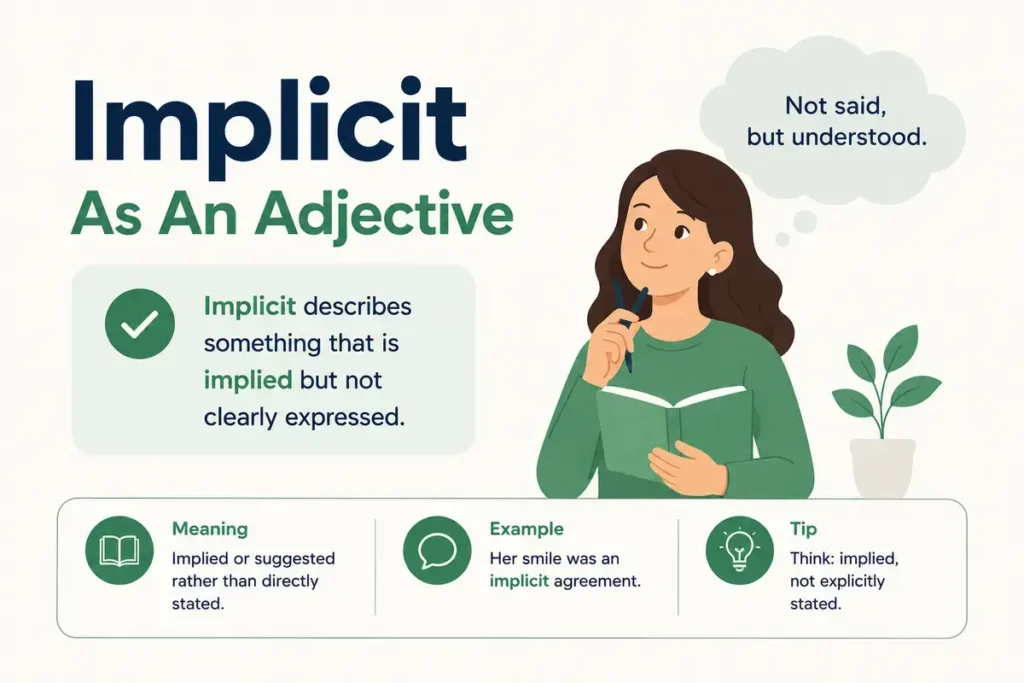
Implicit describes ideas, meanings, assumptions, expectations, trust, permission, or understanding.
Examples.
- There was implicit confidence in her ability.
- The instructions contained implicit warnings.
- Their friendship depended on implicit trust.
Complicit As An Adjective
Complicit describes people, groups, or organizations connected with wrongdoing.
Examples.
- Several officials were complicit in the scheme.
- No employee wanted to appear complicit.
- Anyone who knowingly helps can become complicit.
Notice the pattern.
Implicit usually modifies abstract ideas.
Complicit usually modifies people or organizations.
That difference alone prevents most mistakes.
Pronunciation Guide
Although implicit and complicit look alike, their pronunciation begins differently. Paying attention to the first syllable makes them easier to tell apart.
Implicit
IPA
American English
/ɪmˈplɪs.ɪt/
Syllables
Im pli cit.
Stress
The second syllable receives the primary stress.
Complicit
IPA
American English
/kəmˈplɪs.ɪt/
Syllables
Com pli cit.
Stress
The second syllable also receives the primary stress.
Common Pronunciation Mistakes
Many learners pronounce the first syllable too strongly or blend the two words together because the endings sound nearly identical.
Listen carefully to the beginning of each word.
Implicit starts with the short im sound.
Complicit starts with the softer com sound.
Learn the difference in Home Made Or Homemade Which One Is Correct 2026 Guide.
Word Origin And Etymology
The history of these words explains why they look similar but mean different things.
Origin Of Implicit
Implicit comes from the Latin word implicitus, meaning folded in, entangled, or included without being expressed directly.
Over time, English adopted the word to describe ideas, meanings, or messages that are understood without being stated.
Origin Of Complicit
Complicit comes from the Latin word complicare, meaning to fold together or to become involved with.
Its modern English meaning developed around shared involvement in wrongdoing or illegal activity.
Although both words have Latin roots related to folding or being connected, their meanings evolved in completely different directions.
British American Canadian And Australian English
There is no meaningful spelling difference across major English speaking countries.
American English, British English, Canadian English, and Australian English all use the same spellings.
Implicit
Widely used in education, psychology, business, science, and everyday communication.
Complicit
Common in legal writing, journalism, politics, ethics, and discussions about responsibility.
The meanings stay the same across all major English varieties.
Real Life Examples
Seeing these words in different situations makes the difference much easier to remember.
Daily Conversation
- There was implicit trust between us from the beginning.
- She gave implicit permission with a simple nod.
- I refuse to stay complicit in dishonest behavior.
- Nobody wanted to become complicit in the argument.
Workplace
- The manager gave implicit approval during the meeting.
- Employees who ignored the fraud became complicit.
- Our team’s success depends on implicit trust.
- Leaders should never become complicit in unethical decisions.
Emails
- Your message included an implicit request for more information.
- We cannot appear complicit by ignoring the policy violation.
Academic Writing
- Researchers studied implicit memory in older adults.
- The paper examined complicit behavior during historical conflicts.
Journalism
- The report described implicit bias in hiring practices.
- Several executives were found complicit in the financial scandal.
- The investigation found no evidence that she was complicit.
Literature
- The novel explores implicit emotions through silence.
- One character becomes complicit after hiding important evidence.
Social Media
- His post carried an implicit message about friendship.
- Many users criticized brands they believed were complicit.
- The comment contained implicit criticism without naming anyone.
Common Mistakes
These words are often confused because they share similar spelling and pronunciation.
Using Complicit Instead Of Implicit
Incorrect.
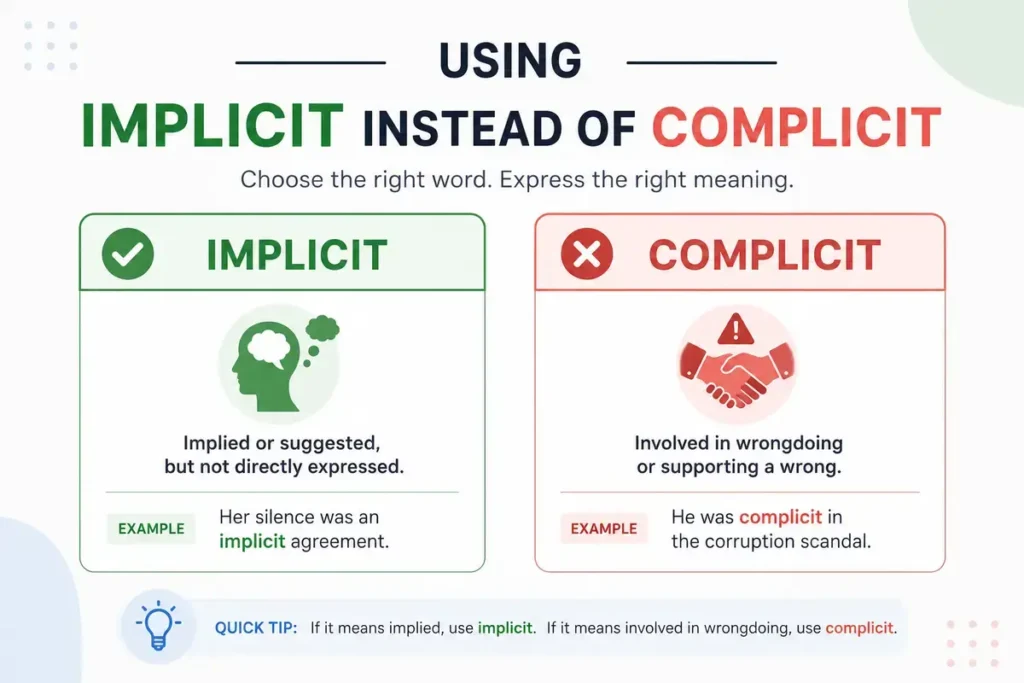
There was complicit trust between the partners.
Correct.
There was implicit trust between the partners.
Trust is an idea or understanding, not involvement in wrongdoing.
Using Implicit Instead Of Complicit
Incorrect.
The employee was implicit in the fraud.
Correct.
The employee was complicit in the fraud.
The sentence describes participation in wrongdoing, so complicit is the correct choice.
Thinking The Words Are Synonyms
Some learners believe both words simply mean connected.
They do not.
Implicit refers to ideas that are understood.
Complicit refers to participation in something wrong.
Assuming Complicit Always Means Criminal
Someone can be complicit in unethical behavior even if no law has been broken.
For example.
She stayed silent while others cheated, making her complicit in the deception.
Easy Memory Tricks
These simple tricks help you remember the difference.
Think About The First Letter
Implicit begins with I.
Think Implied.
Both words begin with the same letters.
Think About Company
Complicit begins with Com.
Think about company.
Someone who is complicit keeps company with wrongdoing or joins in.
Ask Yourself One Question
Is the sentence talking about an idea or an action?
If it is an idea, assumption, or message, choose implicit.
If it is helping or allowing wrongdoing, choose complicit.
Related Words
Expanding your vocabulary helps you understand these words even better.
Synonyms For Implicit
- Implied.
- Unspoken.
- Understood.
- Indirect.
- Assumed.
Synonyms For Complicit
- Involved.
- Guilty.
- Responsible.
- Accomplice.
- Culpable.
Related Words
- Explicit.
- Imply.
- Inference.
- Bias.
- Accomplice.
- Accountability.
- Responsibility.
- Ethics.
- Transparency.
- Honesty.
Frequently Confused Words
- Explicit and implicit.
- Complicit and accomplice.
- Imply and infer.
- Moral and ethical.
- Responsible and accountable.
Expert Editor’s Note
Professional editors rarely confuse implicit and complicit because they focus on the role each word plays in a sentence instead of how it sounds.
Major dictionaries define implicit as something implied, understood, or unstated. They define complicit as being involved in or responsible for wrongdoing.
Style guides also treat these words differently.
Use implicit when discussing communication, assumptions, trust, expectations, or meaning.
Use complicit when discussing ethics, crime, misconduct, corruption, or shared responsibility.
A simple editorial tip is to look at the noun after the adjective.
If you are describing an idea, message, agreement, or understanding, choose implicit.
If you are describing a person, group, or organization involved in something wrong, choose complicit.
This small habit prevents nearly every mistake.
Frequently Asked Questions
What Is The Difference Between Implicit And Complicit?
Implicit means implied or understood without being directly stated. Complicit means involved in or responsible for wrongdoing. Although they look and sound similar, they express completely different ideas and cannot replace each other.
Is Implicit Positive Or Negative?
Implicit is usually neutral. It simply describes something that is understood without being spoken directly. The context determines if the overall meaning is positive, negative, or neither.
Is Complicit Always About Crime?
No. Complicit can describe involvement in illegal acts, but it also applies to unethical or dishonest behavior. A person can be complicit by knowingly supporting or ignoring something wrong.
Can A Person Be Implicit?
Not usually. Native speakers rarely describe a person as implicit. Instead, they describe a person’s actions, agreement, trust, or intentions as implicit. A person, however, can certainly be complicit.
What Is An Example Of Implicit?
There was implicit trust between the two business partners.
In this sentence, the trust existed without anyone saying it directly.
What Is An Example Of Complicit?
The employee became complicit by helping hide important documents.
Here, the person shared responsibility for dishonest behavior.
Why Do People Mix Up These Words?
The words have similar spelling, similar pronunciation, and both appear in formal English. Their meanings, however, come from completely different concepts.
How Can I Remember The Difference?
Think of implicit as implied because both words begin with Im.
Think of complicit as company because someone who is complicit joins others in wrongdoing.
Many readers also check Bearer vs Barer Which One Is Correct (2026 Guide).
Conclusion
Understanding implicit vs complicit becomes much easier once you focus on meaning instead of spelling.Use implicit when something is suggested, understood, or communicated without being stated directly.Use complicit when someone shares responsibility for dishonest, unethical, or illegal behavior.The biggest mistake is assuming these words are interchangeable simply because they look alike. They belong in very different situations.When you are unsure, ask yourself one question.Am I talking about an idea or a person’s involvement in wrongdoing?If it is an idea, choose implicit.If it is responsibility for something wrong, choose complicit.Master this distinction, and you’ll sound more confident and precise every time you write.

Vocabulary & Language Research Writer
Ethan Parker researches English vocabulary, word meanings, slang, idioms, and commonly confused words. His goal is to help readers understand how English is actually used in everyday conversations and writing.
1 thought on “Implicit Vs Complicit Differences Meanings And Correct 2026”