
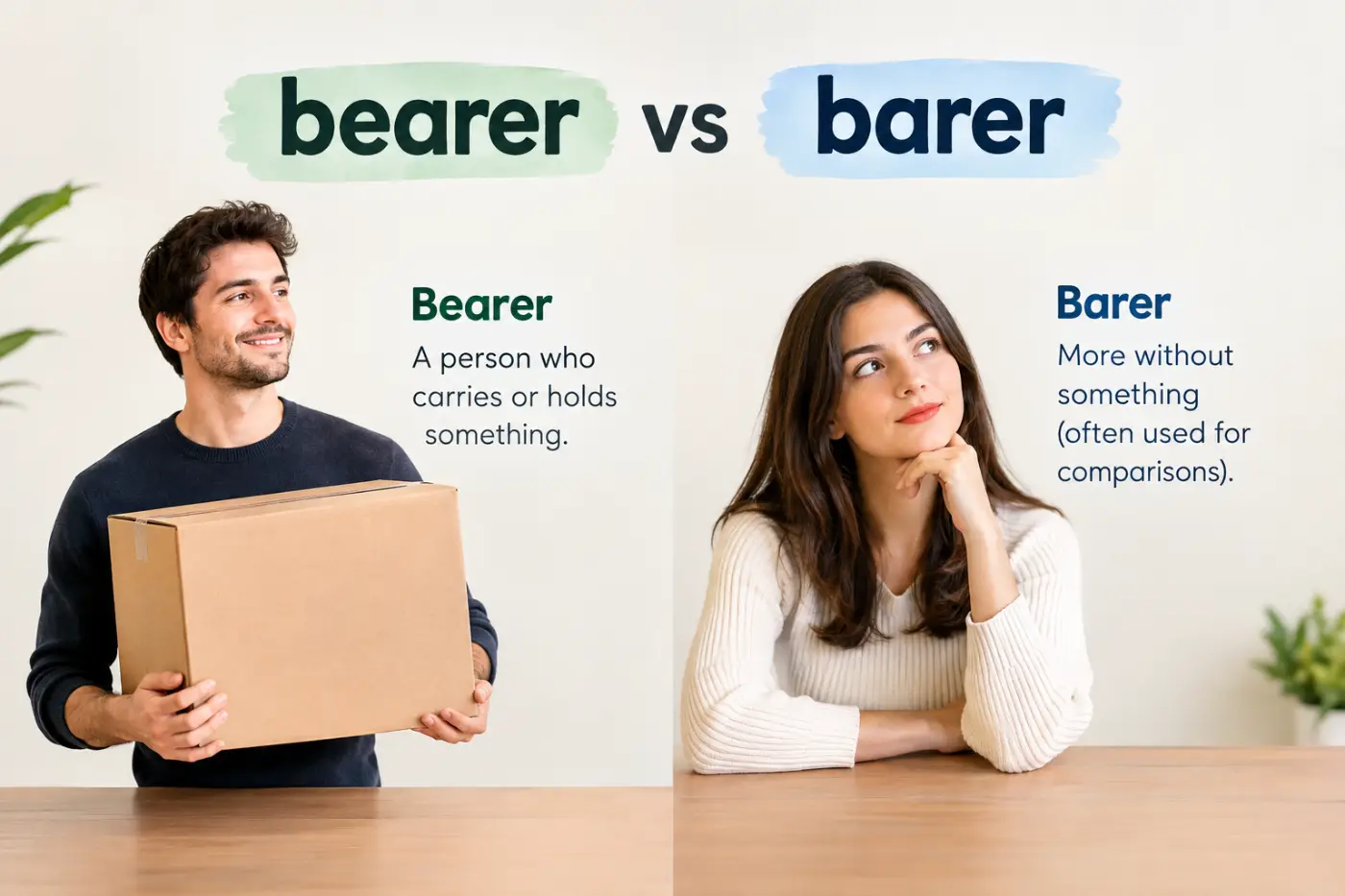
If you’ve ever stopped while writing and wondered about bearer vs barer you’re not alone. The two words sound almost exactly the same in ordinary speech and look nearly identical on the page. Yet they have completely different meanings and grammatical jobs. Choosing the wrong one can change the meaning of a sentence in an instant.
The good news is simple. Bearer is usually a noun for a person or thing that carries holds or presents something. Barer is the comparative form of bare and means more uncovered more exposed or less covered. So you might write the bearer of the letter but the room looked barer after the furniture was removed.
This difference becomes much easier once you connect each word to its base word. Bearer comes from bear in the sense of carrying or holding. Barer comes from bare meaning uncovered or lacking something. In this guide you’ll see the difference through clear definitions natural examples grammar notes pronunciation word history common mistakes and practical memory tricks.
A related grammar guide is Filed Vs Filled Which Word Is Correct 2026 Guide.
Quick Answer
Bearer is the correct word when you mean a person who carries holds or presents something. Barer is the comparative form of bare and means more uncovered or more lacking in something. The words can sound alike but their meanings and grammatical roles are different.
Bearer vs Barer Comparison
| Feature | Bearer | Barer |
|---|---|---|
| Correct spelling | Bearer | Barer |
| Base word | Bear | Bare |
| Main meaning | Someone or something that carries or presents something | More bare or more uncovered |
| Part of speech | Usually noun | Comparative adjective |
| Pronunciation | Usually /ˈberər/ | Usually /ˈberər/ |
| Main use | A person or thing carrying something | A comparison involving a state of being bare |
| Common context | Message bearer passport bearer bearer of news | A barer wall barer room barer landscape |
| Example | The bearer delivered the message. | The room looked barer without the curtains. |
The central difference is easy to remember.
Bearer carries something. Barer has less covering.
That small distinction solves most spelling and usage questions.
What Does Bearer Mean
Bearer is a noun formed from the verb bear. In this context bear means to carry hold support or bring something.
A bearer can be a person who physically carries something. The word can also describe someone who presents a document or possesses something that gives them a particular right.
For example:
The bearer carried the flag during the ceremony.
Here bearer refers to the person carrying the flag.
The word also appears in expressions such as bearer of good news and bearer of bad news. In these expressions the person brings or delivers information rather than physically carrying an object.
For example:
She was the bearer of good news.
The person brought good news to someone else.
Another common use appears in formal documents and financial language. A bearer can be the person who possesses a document or instrument that gives them a particular right.
You may see phrases such as:
- bearer of the ticket
- bearer of the document
- bearer of the certificate
- bearer of the message
- bearer of the title
- bearer of the news
The word can therefore have a physical meaning and a figurative meaning.
Bearer As Someone Who Carries Something
The most direct meaning involves carrying.
The flag bearer walked at the front of the group.
The torch bearer entered the stadium.
The letter bearer arrived before noon.
In each sentence the person carries or delivers something.
Bearer As Someone Who Brings Something
The word can also refer to someone who brings information.
Don’t blame the bearer of bad news.
He became the bearer of wonderful news.
This use is especially familiar in the expression bearer of bad news.
Bearer In Formal Language
You’ll also find bearer in formal and legal contexts.
For example:
The bearer of this document may enter the building.
Here the word identifies the person who possesses or presents the document.
This use is more formal than the everyday sense of someone carrying an object. Still the underlying idea stays the same. The bearer carries or possesses something.
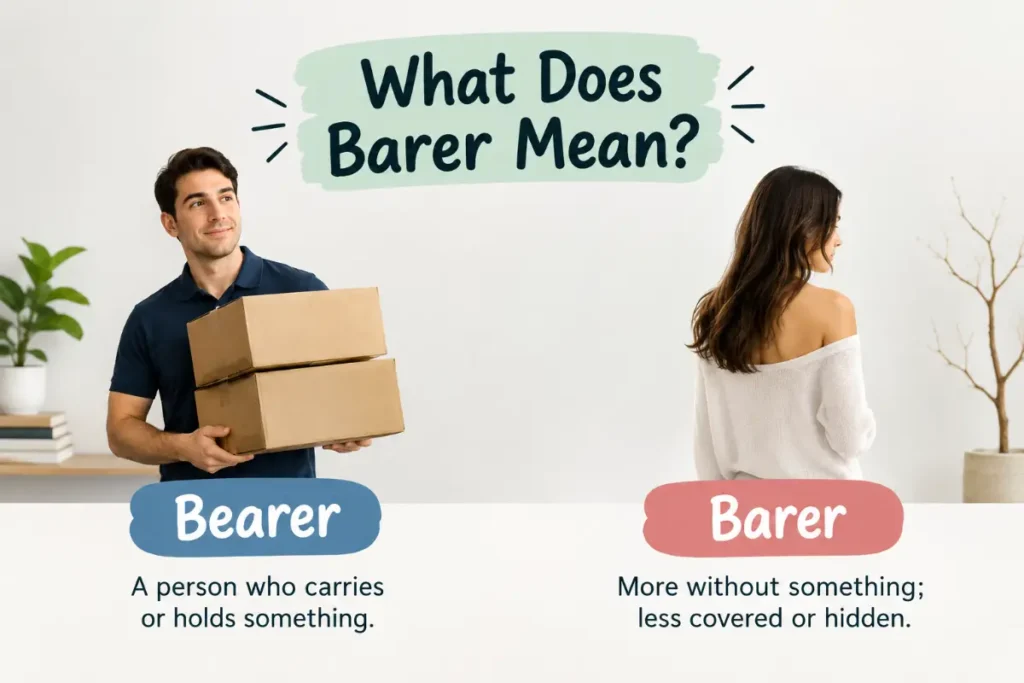
What Does Barer Mean
Barer is the comparative form of the adjective bare.
The adjective bare can mean uncovered exposed empty or lacking the usual covering or contents.
Adding er creates the comparative form.
bare → barer
So:
The wall is bare.
means the wall has little or nothing covering it.
If you compare two walls and one has less covering than the other you can say:
This wall is barer than the other one.
That is the correct use of barer.
The same pattern works with many other adjectives.
The room became barer after the furniture was removed.
The landscape looked barer in winter.
His office is barer than mine.
The shelves looked barer after the books were packed.
In each example barer compares one thing with another.
Barer Means More Bare
The easiest way to understand barer is to replace it mentally with more bare.
For example:
The room looked barer.
means:
The room looked more bare.
The shorter comparative form sounds more natural in many sentences.
However barer can sound slightly formal or literary in some contexts. Writers often choose phrases such as more bare when they want to avoid an unusual sounding comparative.
Which One Is Correct
Both bearer and barer are correct words. Neither spelling is automatically right or wrong.
The correct choice depends on meaning.
Use bearer when you mean someone or something that carries holds presents or brings something.
Use barer when you mean more bare more exposed more uncovered or more empty.
Compare these sentences:
The bearer of the letter waited outside.
The wall looked barer after the painting was removed.
The first sentence is about a person who carries or presents something.
The second sentence compares the condition of a wall.
A useful editing question is simple.
Ask what the word is doing in the sentence.
If it refers to a person or thing that carries something use bearer.
If it describes something that has become more exposed or less covered use barer.
Why People Confuse Bearer and Barer
The confusion comes mainly from sound and spelling.
Both words contain the familiar bear sound. In many varieties of English they are pronounced the same or almost the same. That makes the distinction difficult when someone hears the word before seeing it written.
The spelling also creates trouble.
bearer
barer
Only one letter separates them. The difference looks small but the meanings are far apart.
They Sound Alike
In common English pronunciation both words are often pronounced close to BAIR er.
That means someone saying:
The bearer arrived.
and someone saying:
The wall was barer.
may produce nearly identical sounds for the key word.
Context does the work in speech.
Writing gives you a different problem because you have to choose the correct spelling.
Their Base Words Are Different
The strongest clue is the base word.
bearer → bear
barer → bare
Once you identify the base word the spelling becomes much easier.
If the idea is carrying or bringing something the base word is bear.
If the idea is being uncovered or lacking something the base word is bare.
Fast Typing Can Cause Errors
Because the words differ by only one letter writers can easily type the wrong form.
Autocorrect can make this worse. A spell checker may recognize both words as valid English words and therefore fail to flag the mistake.
That is an important point. A correctly spelled word can still be the wrong word.
Internet Use Can Add Confusion
Online writing often spreads words without much editing. A person may use barer when they mean bearer or the other way around. Readers then encounter the incorrect form repeatedly.
Seeing a spelling many times does not make it correct.
For word pairs like this one the safest approach is to check the meaning rather than rely on frequency.
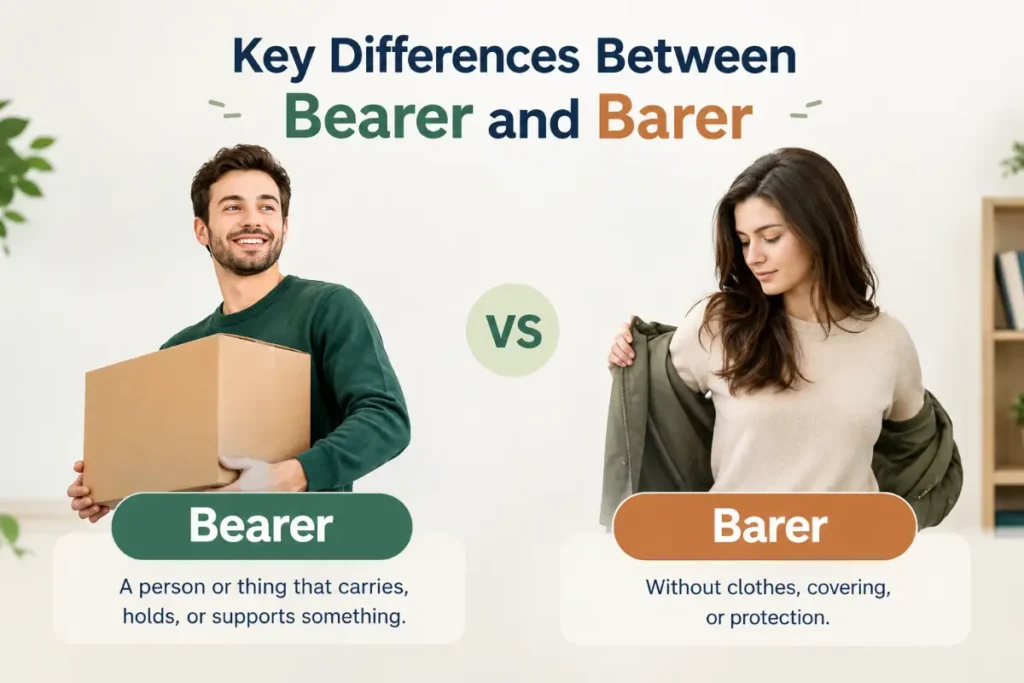
Key Differences Between Bearer and Barer
The clearest distinction involves meaning and part of speech.
Bearer Is Usually A Noun
A noun names a person thing place or idea.
Bearer usually names a person or thing that carries or presents something.
The bearer delivered the package.
Here bearer identifies a person.
Barer Is A Comparative Adjective
An adjective describes a noun.
Barer compares the degree to which something is bare.
The room became barer after the move.
Here barer describes the room.
This grammatical difference provides a powerful clue.
If you can replace the word with person who carries something then bearer is probably right.
If you can replace it with more bare then barer is probably right.
Their Meanings Are Not Related
The words look related but they come from different base words in their relevant senses.
Bearer comes from bear.
Barer comes from bare.
That distinction matters more than their similar pronunciation.
Grammar Of Bearer
The noun bearer follows normal noun grammar.
You can use it as a singular noun.
The bearer is waiting outside.
You can make it plural.
The bearers carried the ceremonial object.
You can also use possessive forms.
The bearer’s name was written on the document.
For multiple bearers:
The bearers’ responsibilities were clearly explained.
The word can also appear after another noun to create a compound expression.
Examples include:
- flag bearer
- torch bearer
- standard bearer
- message bearer
- news bearer
The exact expression depends on context.
Bearer With Articles
Because bearer is a countable noun you can use a or the with it.
A bearer delivered the message.
The bearer presented the document.
You can also use plural forms without an article.
Bearers carried the flags.
Grammar Of Barer
Barer is not normally a noun in the sense confused with bearer. In this comparison it is the comparative form of bare.
The basic pattern is:
bare → barer → barest
For example:
The wall is bare.
The wall is barer than before.
The wall is the barest part of the room.
The comparative form normally appears when you compare two things or two states.
The second room is barer than the first.
You can also use barer after verbs such as look, seem, become, and appear.
The house looked barer after the furniture was removed.
The landscape became barer as winter continued.
Bearer vs Barer Pronunciation
Pronunciation is one of the biggest reasons this word pair causes trouble.
In many standard varieties of English both words are pronounced approximately:
Bearer: /ˈberər/
Barer: /ˈberər/
They usually have two syllables.
The first syllable receives the main stress.
BEAR er
BARE er
Because bear and bare are commonly pronounced alike the added ending does not create a useful sound difference.
That means pronunciation alone cannot reliably tell you which spelling to use.
Context matters.
Common Pronunciation Mistake
Some learners assume that the different spelling must produce a clearly different sound. It often doesn’t.
Instead of trying to force a sound difference remember the base words.
If the meaning involves carrying use bear.
If the meaning involves being uncovered use bare.
That strategy is much more reliable than listening for a sound difference that native speakers may not make.
Spelling Rules To Remember
The spelling of bearer follows the base word bear.
bear + er = bearer
The spelling of barer follows the adjective bare.
bare + er = barer
The final e in bare stays when the comparative ending is added.
So:
bare → barer
not:
bare → bearer
That extra e is not the key distinction. The real difference is the internal vowel pattern and the base word.
Compare:
bear → bearer
bare → barer
This is why memorizing the pair as two separate word families works better than trying to memorize the two spellings in isolation.
Bearer vs Barer In Real Life
The difference becomes much easier once you see these words in natural sentences. The examples below show how bearer works as a noun while barer works as a comparative adjective.
Daily Conversation Examples
- The bearer of the invitation arrived at the door.
- She was the bearer of some exciting news.
- The room looked barer after we removed the shelves.
- His apartment became barer after the move.
- The messenger was the bearer of an important letter.
- The walls looked barer without the family photographs.
- The flag bearer led the parade.
- The garden seemed barer after the leaves fell.
Workplace Examples
In professional writing bearer often appears when someone carries or presents a document or message.
- The bearer of this pass may enter the restricted area.
- The courier acted as the bearer of the signed contract.
- The bearer presented the required identification.
- The office looked barer after the old furniture was removed.
Notice that barer is less common in ordinary workplace writing. Writers often choose more bare or another clearer phrase instead.
For example:
The office looked more empty after the renovation.
That sentence may sound more natural than:
The office looked barer after the renovation.
Both can be grammatically correct. The best choice depends on the intended meaning and tone.
Academic Writing Examples
Academic writing usually favors precise wording. Bearer can appear in historical literary or cultural discussions.
- The messenger served as the bearer of the king’s decree.
- The artifact was considered a bearer of cultural meaning.
- The landscape became barer as human activity increased.
- The final scene presents the protagonist as the bearer of responsibility.
In academic prose the figurative use of bearer can be especially useful when discussing ideas traditions symbols or responsibilities.
Literature And Journalism Examples
- The traveler became the bearer of a secret message.
- The messenger arrived as the bearer of tragic news.
- The mountain looked barer beneath the winter sky.
- The village appeared barer after the storm.
- The character is portrayed as the bearer of an old family tradition.
- The valley grew barer as the drought continued.
These examples show why context matters. Literature often uses both words in descriptive ways but their grammatical functions remain different.
Social Media Examples
- Finally met the bearer of the good news.
- My living room looks barer after spring cleaning.
- Who’s the bearer of this mysterious package?
- The walls look barer without those pictures.
Social media writing tends to be informal. Still the spelling rule doesn’t change.
Still confused? Compare Distress Vs Duress Which Word Is Correct 2026.
Bearer And Barer In Formal Writing
For formal writing the safest approach is to identify the base word before choosing the spelling.
Ask yourself:
Does this word come from bear?
If the answer is yes and the meaning involves carrying bringing holding or presenting something then bearer is appropriate.
Ask another question:
Does this word come from bare?
If the answer is yes and you’re comparing something that has become more uncovered or empty then barer is appropriate.
This simple test works well in emails reports essays and professional documents.
When Bearer Sounds Natural
Bearer is completely natural in established expressions.
Examples include:
- bearer of bad news
- bearer of good news
- bearer of a message
- bearer of a title
- bearer of a document
- flag bearer
- torch bearer
- standard bearer
Some of these expressions are formal. Others are common in everyday English.
When Barer Sounds Natural
Barer works best when the comparison is clear.
The walls are barer than they were before.
The landscape looked barer after the trees were cut down.
Her new apartment was much barer than her old one.
Still many writers prefer more bare in certain contexts because it sounds more natural and immediately clear.
For example:
The room looked more bare after the furniture was removed.
That doesn’t mean barer is wrong. It simply reflects a common editorial preference for natural phrasing.
Bearer vs Barer And Comparative Adjectives
Understanding comparative adjectives helps explain why barer exists.
English often forms comparisons by adding er to short adjectives.
Examples include:
- cold → colder
- small → smaller
- bright → brighter
- clean → cleaner
- bare → barer
Therefore:
This wall is bare.
becomes:
This wall is barer than that wall.
The construction usually compares two things.
The word than often appears with the comparative form.
The second room is barer than the first.
However you can also use barer when the comparison is understood from context.
After the move the house looked barer.
The reader understands that the house has less furniture or decoration than it had before.
Can Barer Mean More Empty
Yes. Bare has several related meanings. It can describe something uncovered or lacking its usual contents.
For that reason barer can mean more empty or more stripped of contents depending on the context.
For example:
The shelves looked barer after the books were packed.
The shelves aren’t necessarily physically uncovered. They simply contain fewer objects.
Similarly:
The kitchen looked barer after the appliances were removed.
Here barer suggests that the space has fewer things in it.
The exact meaning comes from context.
Can Bearer Refer To A Thing
Yes. Although bearer often refers to a person it can also describe something that carries or conveys something.
For example:
The tree became a bearer of fruit.
In more formal or figurative writing bearer can describe something that carries a quality idea message or meaning.
You might encounter phrases such as:
a bearer of tradition
a bearer of cultural meaning
a bearer of responsibility
The underlying idea remains the same. Something bears or carries something.
Common Mistakes With Bearer And Barer
The most common mistake is choosing the word based only on sound.
Because the two words can sound identical you need to focus on meaning.
Mistake One Using Barer For Someone Who Carries Something
Incorrect:
He was the barer of the message.
Correct:
He was the bearer of the message.
The person carries or delivers the message. The base word is bear.
Mistake Two Using Bearer For Something That Is More Bare
Incorrect:
The room looked bearer after the furniture was removed.
Correct:
The room looked barer after the furniture was removed.
The room has become more bare. The comparative adjective is barer.
Mistake Three Assuming One Word Is Wrong
Both words are legitimate English words.
The problem isn’t spelling alone. It’s word choice.
This is an important lesson for English learners. Spell checkers often identify spelling errors but they can’t always identify incorrect word selection.
Mistake Four Confusing Bare With Bear
These base words have different meanings.
Bear can mean to carry or support.
Bare can mean uncovered or without the usual covering.
Compare:
She couldn’t bear the pain.
Her feet were bare.
The words sound alike in many accents but their meanings are completely different.

Bearer And Barer In British And American English
There is no major British versus American spelling difference between these two words.
American English uses:
bearer
barer
British English also uses:
bearer
barer
Canadian English and Australian English use the same standard spellings as well.
Therefore you don’t need to change the spelling based on the variety of English you’re writing.
The important distinction is semantic rather than regional.
A US writer and a UK writer would normally choose bearer for someone who carries something and barer for the comparative form of bare.
Bearer And Barer Word Origins
The two words have different histories even though they look and sound similar.
The Origin Of Bearer
Bearer comes from bear. The verb bear has a long history in English and traces back to Old English forms connected with carrying supporting enduring and bringing.
Over time the verb developed many related meanings.
You can:
- bear a burden
- bear responsibility
- bear a name
- bear a message
- bear a child
- bear evidence
- bear a resemblance
The noun bearer developed from the idea of someone or something that bears or carries something.
The Origin Of Barer
Barer comes from bare.
The adjective bare has Old English roots associated with being uncovered or without clothing or covering. Its meaning later expanded into ideas such as empty exposed plain or lacking something.
The comparative form follows the normal English pattern:
bare → barer
So the two words developed from different linguistic families despite their modern similarity.
Related Words To Bearer
Several words connect naturally with bearer.
Carrier
A carrier is a person or thing that carries something.
The carrier delivered the package.
Depending on context carrier can be more common than bearer.
Messenger
A messenger brings or delivers a message.
The messenger delivered the letter.
A messenger can therefore act as a bearer of news or information.
Holder
A holder is someone who possesses or controls something.
The ticket holder entered the theater.
In some formal contexts bearer and holder can overlap in meaning.
Standard Bearer
A standard bearer traditionally refers to someone who carries a flag or standard. It can also describe a person who represents or promotes a particular idea.
She became a standard bearer for educational reform.
This figurative use is common in formal writing.
Related Words To Barer
Because barer comes from bare its related words come from that adjective.
Bare
Something bare has little or no covering.
The walls were bare.
Barest
Barest is the superlative form.
This was the barest room in the house.
Uncovered
Uncovered can often express a similar idea.
The floor was uncovered.
Exposed
Exposed emphasizes a lack of protection or covering.
The pipes were exposed.
Empty
Empty can overlap with bare when something lacks contents.
The shelves were empty.
However these words aren’t perfect substitutes in every sentence. Good editing depends on the exact meaning.
Memory Tricks For Bearer And Barer
A simple memory trick can prevent most mistakes.
Think Carry For Bearer
Remember:
Bear means carry.
Therefore:
bear → bearer
If someone carries something they can be its bearer.
Think:
Bearer carries.
Think Bare For Barer
Remember:
Bare means uncovered.
Therefore:
bare → barer
If something becomes more uncovered or empty it becomes barer.
Think:
Barer has less.
Use The Two Word Test
When you’re unsure ask:
Who carries it?
If the answer is the word you need then use bearer.
Then ask:
What has less covering?
If that’s the idea use barer.
This works especially well when you’re proofreading quickly.
Expert Editor’s Note
As an editor I’d treat bearer and barer as a meaning based word choice issue rather than a simple spelling test.
Both forms are standard English. The important question is the base word behind the form.
If your sentence describes someone carrying delivering presenting or conveying something then bearer is the natural choice. If your sentence compares something that has become more uncovered empty plain or stripped down then barer is correct.
One useful proofreading habit is to replace the word with its longer meaning.
Try person who carries or presents for bearer.
Try more bare or more uncovered for barer.
If the sentence still makes sense after that substitution you’ve probably found the right form.
Professional editors also pay attention to style. Although barer is grammatically correct some sentences sound smoother with more bare or a more specific adjective such as emptier more exposed or less decorated.
For example:
The room looked barer after the move.
is correct.
However:
The room looked emptier after the move.
may communicate the intended meaning more precisely if the writer means that the room contains fewer objects.
Good editing isn’t only about choosing a technically correct word. It’s about choosing the word that expresses the intended meaning most clearly.
Bearer vs Barer In A Nutshell
The distinction is easier than it first appears.
Bearer is a noun. It comes from bear and refers to someone or something that carries holds presents or brings something.
Barer is a comparative adjective. It comes from bare and means more bare more uncovered or more lacking in contents.
Compare these two sentences:
The bearer delivered the letter.
The room looked barer after the furniture was removed.
The first sentence is about carrying or presenting something.
The second sentence is about a change in appearance or condition.
That is the core difference.
FAQs About Bearer vs Barer
Is bearer or barer the correct spelling
Both spellings are correct but they have different meanings. Bearer refers to someone or something that carries holds presents or brings something. Barer is the comparative form of bare and means more uncovered more exposed or more empty. Choose the word based on meaning rather than pronunciation.
What is the difference between bearer and barer
Bearer is usually a noun connected with the verb bear. It can describe someone who carries a message document flag or responsibility. Barer is the comparative form of bare. It describes something that has become more uncovered empty plain or lacking in contents.
How do you remember bearer vs barer
Connect each word to its base word. Bearer comes from bear and bear can mean carry. Barer comes from bare and bare means uncovered. So you can remember the pair as bearer carries and barer has less covering.
Is barer a real word
Yes. Barer is a standard comparative form of bare. For example you can say that one room is barer than another when it has less furniture decoration or covering. It may sound less common than some alternatives such as more bare or emptier but it is grammatically valid.
Is bearer a noun or an adjective
Bearer is normally a noun in this usage. It identifies a person or thing that carries holds presents or brings something. Examples include bearer of good news and bearer of a document. It can also appear in compound nouns such as flag bearer and torch bearer.
Are bearer and barer pronounced the same
In many varieties of English they are pronounced the same or very similarly. Both can sound like BAIR er. This is one reason writers confuse them. Since pronunciation often doesn’t provide a useful distinction you should rely on meaning and the base word when choosing the spelling.
Can barer mean more empty
Yes. Bare can describe something with little or nothing in it. Therefore barer can describe something that has become more empty or stripped of contents. For example The shelves looked barer after the books were removed means the shelves had fewer things on them than before.
What does bearer mean in bearer of bad news
In bearer of bad news the word means someone who brings or delivers bad news. The person isn’t necessarily carrying a physical object. The expression uses the broader meaning of bear which includes bringing or conveying something.
Is bearer used in legal writing
Yes. Bearer appears in formal legal and financial contexts. It can refer to the person who possesses or presents a document or instrument. You may see phrases such as bearer of the document or bearer of the certificate. The exact legal meaning depends on the document and its governing rules.
Is there a British spelling difference
No major British and American spelling difference applies to bearer and barer. Both varieties use the same spellings. Canadian and Australian English also generally use these forms. The important issue is meaning rather than regional spelling.
Learn the difference in Afterward Vs Afterword Which Word Is Correct 2026.
Final Recommendation
When you see bearer vs barer in your writing don’t try to solve the problem by sound alone. Instead go back to the base word.
Use bearer when something is being carried brought held or presented.
Use barer when something is becoming more uncovered empty plain or exposed.
The fastest memory trick is:
Bearer carries. Barer has less.
Once you connect each word to its base form the confusion largely disappears. When in doubt check the meaning first and let the meaning choose the spelling.

Vocabulary & Language Research Writer
Ethan Parker researches English vocabulary, word meanings, slang, idioms, and commonly confused words. His goal is to help readers understand how English is actually used in everyday conversations and writing.