
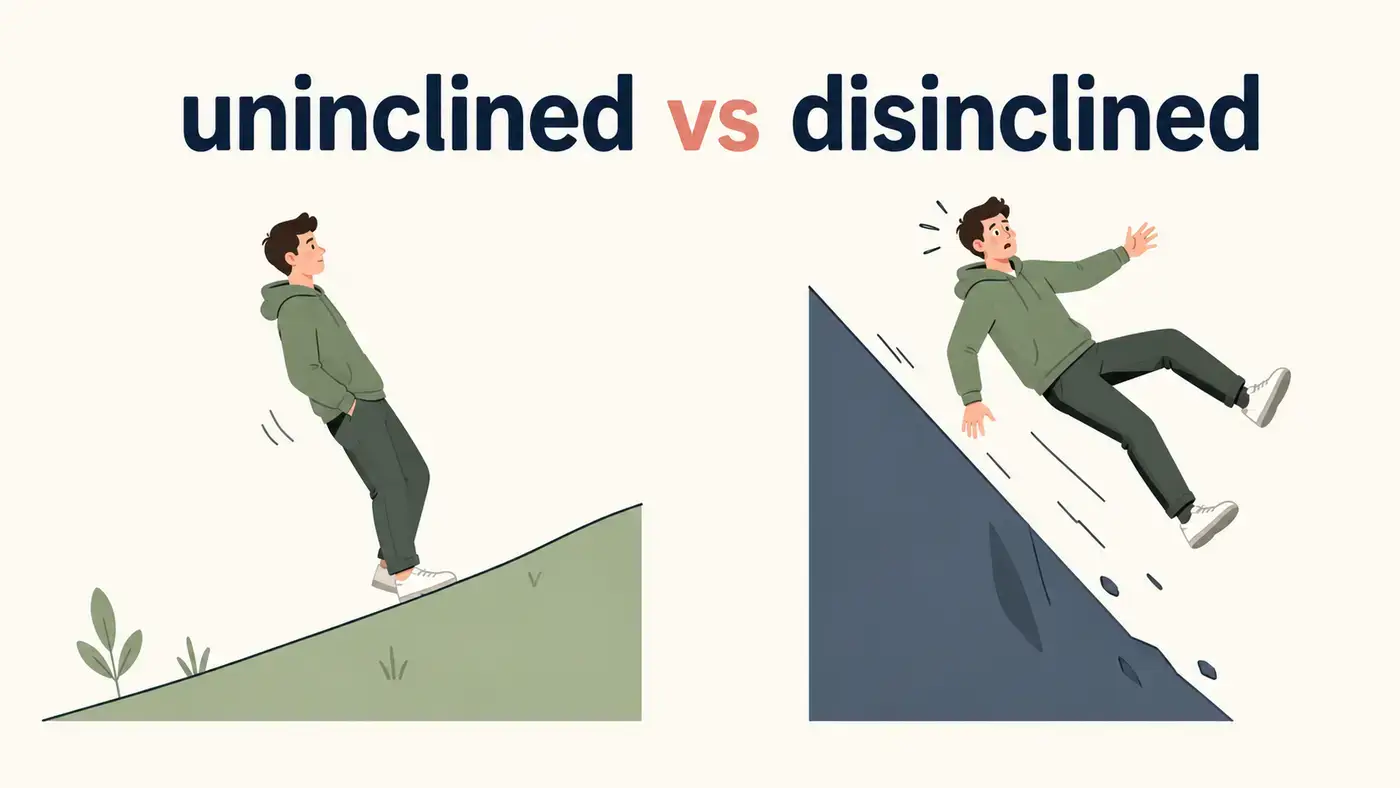
Have you ever paused while writing because you couldn’t decide between uninclined vs disinclined? At first glance, they seem interchangeable. Both describe a lack of desire or willingness to do something. Still, they are not perfect substitutes in every situation.
The biggest difference is in tone and usage. Disinclined is far more common in modern English and sounds natural in both formal and everyday writing. Uninclined is also a correct English word, but it appears much less often and has a slightly dated or literary feel. Native speakers rarely use it in casual conversation.
Understanding this small distinction can make your writing sound more polished and natural. It also helps you choose the word that best matches your audience and context.
In this guide, you’ll learn the meaning of each word, their grammar, usage, pronunciation, common examples, and the subtle differences that dictionaries and professional editors recognize. By the end, you’ll know exactly when to use each word with confidence.
Need another quick comparison? Read Next Friday Vs This Friday Which One Should You Use 2026 Guide.
Quick Answer
Both uninclined and disinclined are correct English adjectives that mean not willing or not interested in doing something. However, disinclined is the preferred choice because it is much more common in modern English. Uninclined is rare and often sounds old fashioned or literary.
Uninclined Vs Disinclined Comparison Table
| Feature | Uninclined | Disinclined |
|---|---|---|
| Correct English word | Yes | Yes |
| Part of speech | Adjective | Adjective |
| Meaning | Not willing or not inclined | Not willing or reluctant |
| Common usage | Rare | Very common |
| Tone | Literary or old fashioned | Neutral and modern |
| Formal writing | Occasionally used | Frequently used |
| Everyday conversation | Uncommon | Common |
| American English | Rare | Preferred |
| British English | Rare | Preferred |
| Example | She seemed uninclined to argue. | She was disinclined to argue. |
What Does Uninclined Mean
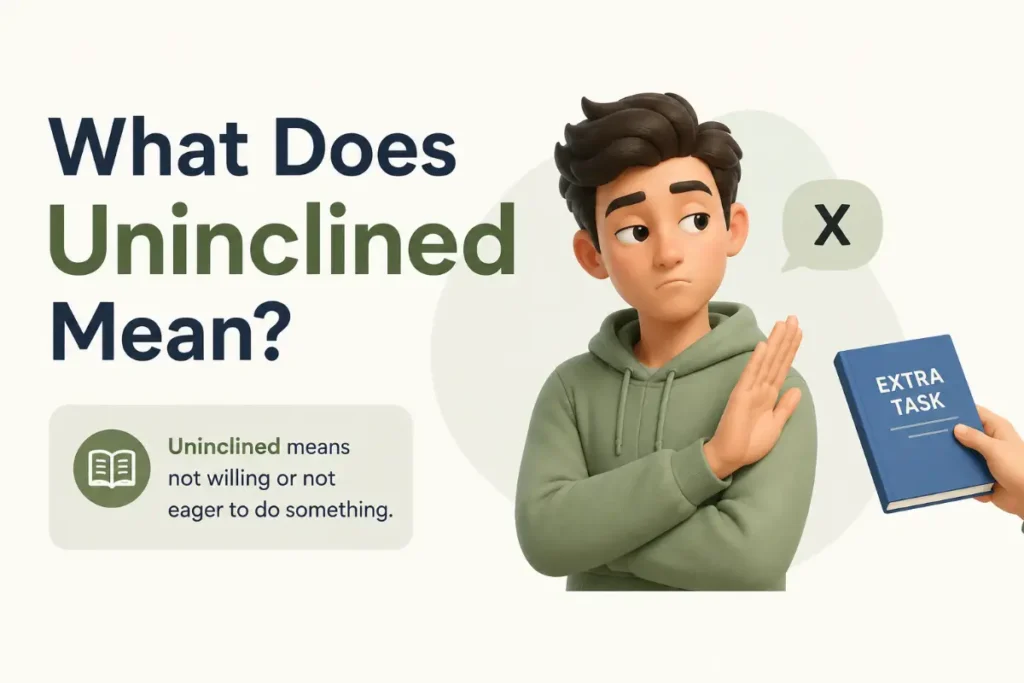
Uninclined is an adjective that describes someone who does not feel willing, interested, or ready to do something.
Although the word is grammatically correct, it appears far less often than disinclined in modern English. You are more likely to find it in older books, formal literature, or historical writing.
Simple Definition
Uninclined means not willing or not having the desire to do something.
How To Use Uninclined
Use uninclined when you want to describe a lack of interest or willingness, especially in formal or literary contexts.
Examples.
- She felt uninclined to continue the discussion.
- The witness remained uninclined to answer additional questions.
- After a long week, I was uninclined to leave the house.
- He appeared uninclined to accept the invitation.
- The committee seemed uninclined to change the original proposal.
Uninclined In Different Contexts
Daily conversation.
I felt uninclined to cook dinner after work.
Workplace.
Several employees were uninclined to work overtime.
Academic writing.
The participants were uninclined to alter their responses.
Literature.
The old sailor remained uninclined to speak about the storm.
What Does Disinclined Mean
Disinclined is also an adjective. It describes someone who is unwilling, reluctant, or not eager to do something.
Unlike uninclined, disinclined is widely used in modern English. It sounds natural in conversation, journalism, business writing, and academic work.
Simple Definition
Disinclined means unwilling or reluctant to do something.
How To Use Disinclined
Choose disinclined when you want to express hesitation, reluctance, or a lack of interest in a natural and modern way.
Examples.
- She was disinclined to discuss her private life.
- I’m disinclined to believe the rumor without evidence.
- The manager seemed disinclined to approve the request.
- Many voters were disinclined to support the proposal.
- He felt disinclined to interrupt the meeting.
Disinclined In Different Contexts
Daily conversation.
I’m disinclined to stay out late tonight.
Workplace.
Our team is disinclined to make changes without more data.
Emails.
I am disinclined to move the deadline at this stage.
Journalism.
Officials were disinclined to comment before the investigation ended.
Which One Is Correct
The short answer is simple.
Both uninclined and disinclined are correct English words.
However, disinclined is almost always the better choice in modern English because it sounds more natural and is much more common.
Choose uninclined if you intentionally want a literary, formal, or slightly old fashioned style.
Choose disinclined for everyday writing, business communication, journalism, academic work, and conversation.
For example.
✔ She was disinclined to accept the offer.
✔ He seemed uninclined to argue with the judge.
Both sentences are correct, but the first sounds more natural to most native English speakers today.
A quick way to remember the difference is this.
If you’re writing for a modern audience, disinclined is usually the safest and most natural choice.
Why People Confuse Uninclined And Disinclined
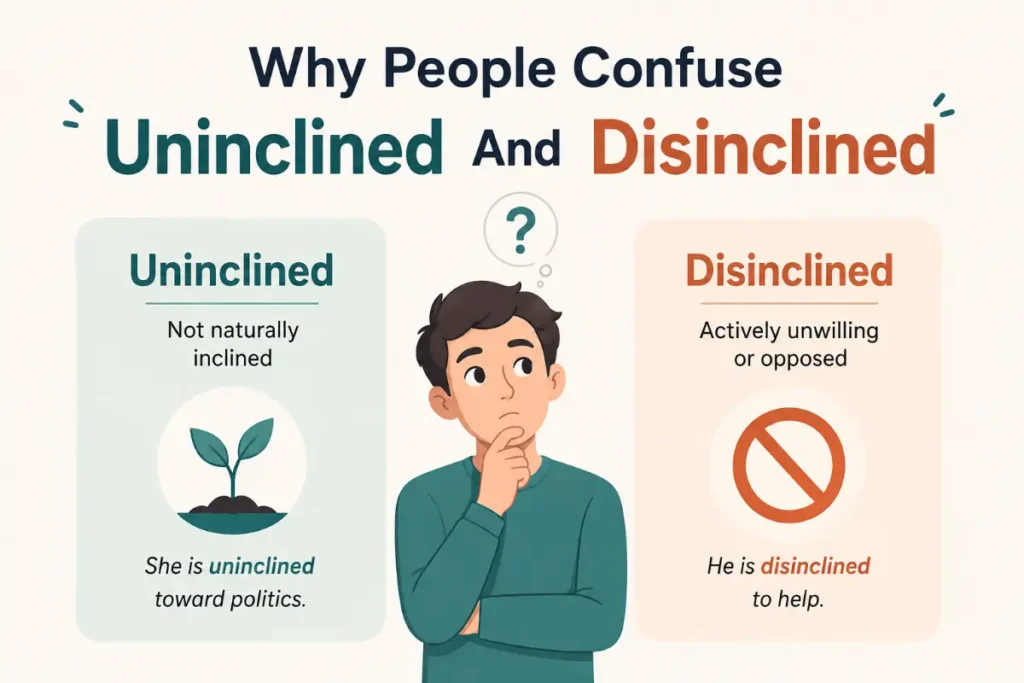
Many English learners assume uninclined and disinclined mean exactly the same thing because both describe a lack of willingness. While their meanings overlap, their usage has changed over time.
Today, disinclined is the word native speakers naturally choose. Uninclined still appears in English, but it is much less common and often sounds literary or old fashioned.
Several factors contribute to the confusion.
Similar Meanings
Both words describe someone who does not want to do something.
For example.
She was disinclined to answer.
She was uninclined to answer.
Both sentences are grammatically correct.
Shared Root Word
Both adjectives come from the word inclined, which means willing, likely, or having a tendency toward something.
The prefixes un and dis simply create the opposite meaning.
Similar Pronunciation
The words sound alike, especially in fast conversation. Most listeners understand the intended meaning from context instead of pronunciation.
Older Literature
Many classic books use uninclined more often than modern writers do. Readers sometimes assume it remains the preferred choice in everyday English.
Dictionary Definitions
Most dictionaries define both words in nearly the same way. They differ more in frequency and style than in meaning.
Key Differences Between Uninclined And Disinclined
Although the meanings overlap, several differences make one word a better choice than the other in modern writing.
| Feature | Uninclined | Disinclined |
|---|---|---|
| Meaning | Not willing | Not willing or reluctant |
| Modern usage | Rare | Very common |
| Tone | Literary | Neutral |
| Everyday speech | Uncommon | Common |
| Business writing | Rare | Preferred |
| Academic writing | Limited | Common |
| Natural sounding | Less natural | More natural |
The simplest rule is easy to remember.
Use disinclined in most situations.
Use uninclined only when you want a formal, literary, or historical tone.
Grammar Explanation
Understanding the grammar removes most of the confusion.
Both uninclined and disinclined are adjectives.
They describe a person’s attitude, willingness, or preference.
Sentence Structure
The most common pattern is.
Subject plus be verb plus adjective plus infinitive.
Examples.
- She is disinclined to complain.
- He was uninclined to participate.
- They seemed disinclined to continue.
Another common pattern uses toward.
Examples.
- I’m disinclined toward unnecessary risks.
- She felt uninclined toward public attention.
Both structures are grammatically correct.
Common Grammar Mistakes
Incorrect.
She is a disinclined.
Correct.
She is disinclined.
Incorrect.
He was an uninclined.
Correct.
He was uninclined.
Remember that both words function as adjectives, not nouns.
Spelling Guide
There are no alternative spellings for either word.
Correct spellings.
- Uninclined.
- Disinclined.
Incorrect spellings include.
- Uninclinded.
- Disinclinded.
- Disinclinied.
- Uninclinied.
A simple spelling trick helps.
Uninclined begins with un, which often means not.
Disinclined begins with dis, another common negative prefix found in words like disagree and disapprove.
A related grammar guide is Drier Vs Dryer Which Word Is Correct 2026 Guide.
Pronunciation Guide
Uninclined
IPA
American English.
/ˌʌn ɪn ˈklaɪnd/
Syllables
Un in clined.
Stress
The strongest stress falls on clined.
Disinclined
IPA
American English.
/ˌdɪs ɪn ˈklaɪnd/
Syllables
Dis in clined.
Stress
The primary stress also falls on clined.
Common Pronunciation Mistakes
Some learners drop the middle syllable and pronounce the words too quickly.
Say each syllable clearly.
Un in clined.
Dis in clined.
This makes your speech easier to understand.
Word Origin And History
Learning the history of these words explains why both exist today.
Inclined
The base word inclined comes from the Latin word inclinare, meaning to bend or to lean. English gradually expanded the meaning to include a tendency or willingness toward something.
Uninclined
The prefix un creates the opposite meaning.
So uninclined literally means not inclined.
This form appeared in English centuries ago and was once more common than it is today.
Disinclined
The prefix dis also creates an opposite meaning but often suggests reluctance or a change away from something.
Over time, disinclined became the preferred choice in modern English because it sounded more natural and appeared more often in published writing.
British And American English
There is very little regional difference between these words.
American English strongly prefers disinclined.
British English also favors disinclined, although older British literature contains more examples of uninclined.
Canadian English and Australian English follow the same pattern.
No major dictionary recommends one spelling for one country and another spelling elsewhere.
The difference is based on frequency, not geography.
Real Life Examples
Seeing both words in real situations makes the difference easier to remember.
Daily Conversation
- I’m disinclined to go out tonight.
- She felt uninclined to join the discussion.
- He’s disinclined to waste time arguing.
- We were uninclined to change our plans.
Workplace
- The manager seemed disinclined to approve the request.
- Several employees were disinclined to relocate.
- The director appeared uninclined to delay the project.
- Our team is disinclined to make quick decisions.
Emails
- I am disinclined to extend the deadline.
- She was uninclined to accept additional responsibilities.
Academic Writing
- Participants were disinclined to revise their answers.
- The researcher remained uninclined to draw early conclusions.
Journalism
- Officials were disinclined to comment.
- Analysts appeared disinclined to predict immediate changes.
Social Media
- I’m disinclined to argue online today.
- He seemed completely uninclined to reply.
Literature
- The old king was uninclined to forgive his enemies.
- The hero remained disinclined to trust strangers.
Everyday Life
- My parents were disinclined to buy another car.
- After the long hike, everyone felt uninclined to cook dinner.
Common Mistakes
Many learners understand the meanings of uninclined and disinclined, but they still make small usage mistakes. Here are the ones professional editors notice most often.
Using Uninclined In Everyday Writing
Incorrect.
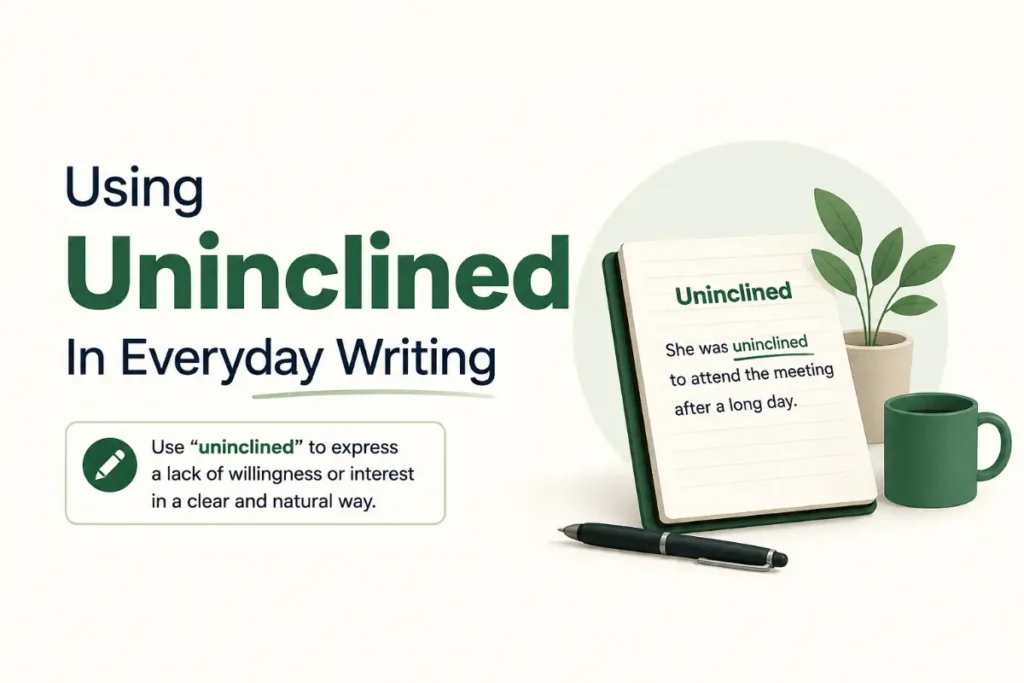
She was uninclined to join the meeting.
Correct.
She was disinclined to join the meeting.
Both sentences are correct, but disinclined sounds much more natural in modern English.
Thinking One Word Is Wrong
Some writers believe uninclined is an incorrect word because they rarely hear it.
It is a legitimate English adjective. It is simply much less common today.
Using Them As Nouns
Incorrect.
He is a disinclined.
Correct.
He is disinclined to travel.
Both words are adjectives and cannot be used as nouns.
Confusing Disinclined With Unwilling
These words are close in meaning, but not always identical.
Unwilling often sounds stronger and more direct.
Disinclined usually suggests hesitation or preference instead of complete refusal.
Compare these examples.
She was unwilling to sign the contract.
She was disinclined to sign the contract.
The second sentence leaves room for persuasion. The first suggests a firmer refusal.
Easy Memory Tricks
A few simple tricks make these words easy to remember.
Think About Modern English
If you are writing for today’s readers, choose disinclined.
It is the word native speakers naturally expect.
Remember The Prefixes
Un often means simply not.
Dis often suggests reluctance or moving away from something.
Although both create opposite meanings, disinclined became the more popular choice.
Use This Simple Rule
If you pause and wonder which word sounds more natural, pick disinclined.
Most of the time, you will be right.
Related Words
Learning nearby vocabulary helps you express ideas more precisely.
Synonyms
- Reluctant.
- Unwilling.
- Hesitant.
- Resistant.
- Opposed.
- Hesitant.
- Indifferent.
Opposites
- Inclined.
- Willing.
- Eager.
- Enthusiastic.
- Ready.
- Interested.
Related Expressions
- Not interested.
- Not eager.
- Have no desire.
- Be reluctant to.
- Feel unwilling.
Frequently Confused Words
- Unwilling and disinclined.
- Reluctant and hesitant.
- Inclined and likely.
- Interested and willing.
Understanding these words makes your vocabulary richer and your writing more precise.
Expert Editor’s Note
Professional editors rarely replace disinclined because it is clear, familiar, and widely accepted in modern English.
Major dictionaries recognize both uninclined and disinclined as correct. The difference is not grammar but usage.
If you are writing an academic paper, business email, blog post, news article, or everyday message, disinclined is usually the better choice.
Use uninclined only if you intentionally want a literary voice or you are quoting older writing.
When two correct words exist, experienced writers usually choose the one readers recognize immediately. That makes the writing smoother and easier to understand.
Frequently Asked Questions
Is Uninclined A Real Word?
Yes. Uninclined is a correct English adjective. It means not willing or not inclined to do something. Although it is less common today, dictionaries still recognize it as standard English.
Is Disinclined More Common Than Uninclined?
Yes. Disinclined appears far more often in modern English. Native speakers commonly use it in conversation, journalism, business communication, and academic writing.
Can I Use Uninclined And Disinclined Interchangeably?
In many sentences, yes. Both express a lack of willingness. Still, disinclined usually sounds more natural, while uninclined often gives the writing a literary or old fashioned tone.
Which Word Should I Use In Formal Writing?
Choose disinclined unless you have a specific stylistic reason to use uninclined. It is the preferred word in most professional and academic contexts.
Do American And British English Prefer Different Words?
No. Both American and British English strongly favor disinclined. Canadian and Australian English follow the same pattern.
What Is The Difference Between Disinclined And Unwilling?
Disinclined suggests reluctance or hesitation. Unwilling often expresses a stronger refusal. The difference is subtle, but it can affect the tone of your sentence.
Why Does Uninclined Sound Old Fashioned?
The word was more common in earlier English. Over time, disinclined became the preferred choice in everyday writing and speech, leaving uninclined with a more literary feel.
Many readers also check Distress Vs Duress Which Word Is Correct 2026.
Conclusion
The answer to uninclined vs disinclined is straightforward.
Both words are correct and share nearly the same meaning. They describe someone who is not willing or does not want to do something.
The important difference is usage.
Disinclined is the word native speakers use most often. It sounds natural in conversation, business writing, journalism, and academic English.
The best writing is not about choosing the rarer word. It is about choosing the clearest one for your readers.

Vocabulary & Language Research Writer
Ethan Parker researches English vocabulary, word meanings, slang, idioms, and commonly confused words. His goal is to help readers understand how English is actually used in everyday conversations and writing.
1 thought on “Uninclined Vs Disinclined Differences Meanings And Correct 2026”