
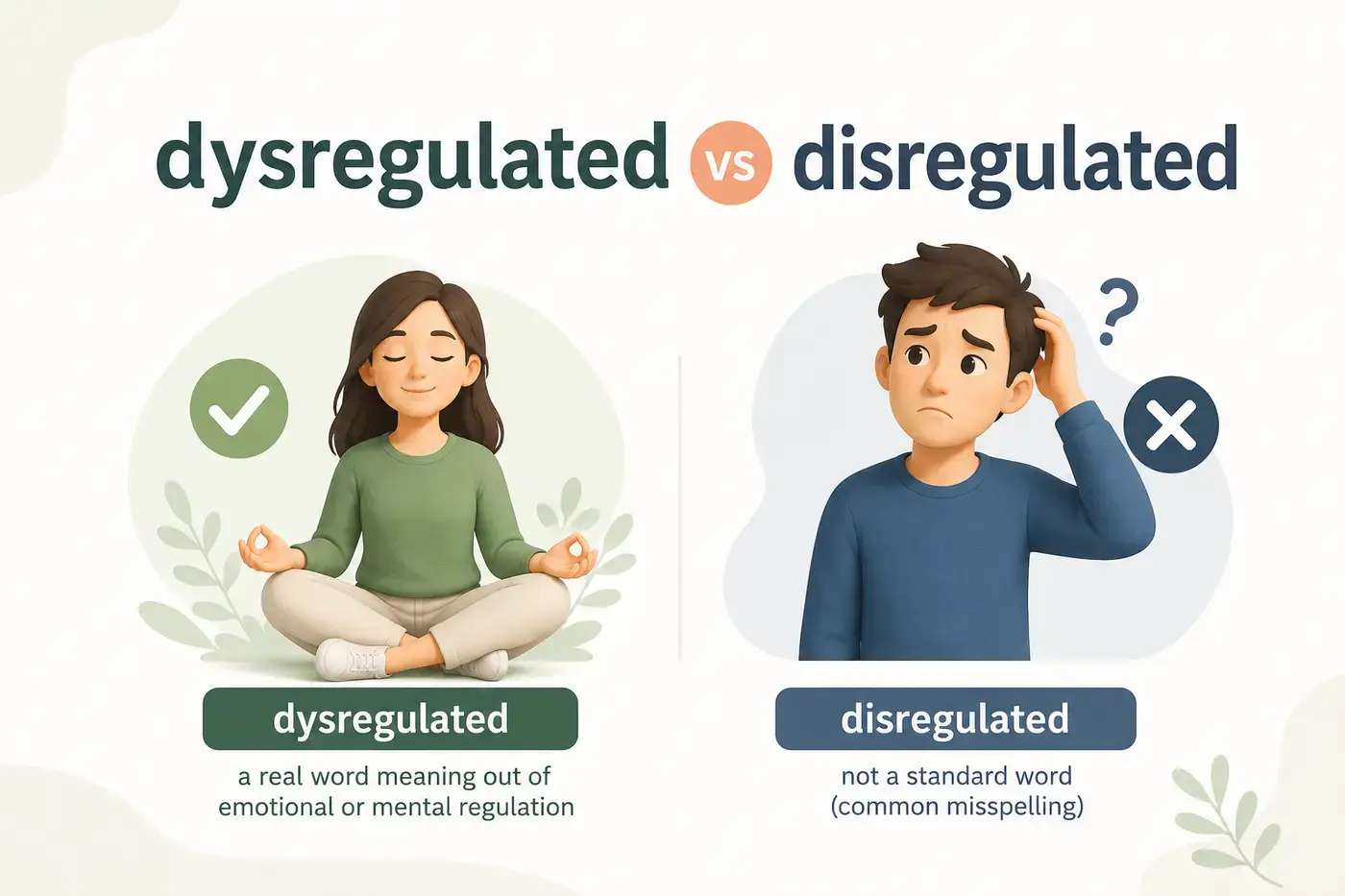
If you’ve searched for dysregulated vs disregulated, you’re probably trying to figure out which spelling is correct. The short answer is simple. Dysregulated is the correct spelling. Disregulated is a misspelling and is not recognized as a standard English word.
The confusion is easy to understand. Both words begin with a prefix that changes the meaning of the base word, and the prefixes dys and dis appear in many English terms. At a quick glance, they look similar enough to make people second guess themselves. The mistake is even more common in medical, psychological, and scientific writing, where dysregulated appears frequently.
Understanding the difference is important because dysregulated has a specific meaning. It describes something that is not functioning or controlled properly. You will often see it in discussions about emotions, the nervous system, hormones, the immune system, and mental health.
In this guide, you’ll learn the correct spelling, the meaning of dysregulated, why disregulated is incorrect, the grammar behind the word, and practical examples that help you use it confidently in everyday and professional writing.
Need another quick comparison? Read Specialty Or Speciality Which Spelling Is Correct 2026 Guide.
Quick Answer
Dysregulated is the correct spelling. It means something is functioning or controlled abnormally or improperly. Disregulated is an incorrect spelling and should be avoided in formal, academic, medical, and everyday writing.
Dysregulated Vs Disregulated Comparison Table
| Feature | Dysregulated | Disregulated |
|---|---|---|
| Correct spelling | Yes | No |
| Dictionary recognized | Yes | No |
| Part of speech | Adjective or past participle | Not a standard English word |
| Meaning | Not functioning or controlled properly | None in standard English |
| Common use | Medicine psychology biology neuroscience | Misspelling |
| Formal writing | Correct | Incorrect |
| Everyday writing | Correct | Incorrect |
| Example | Her emotions became dysregulated after the stressful event. | Incorrect spelling |
What Does Dysregulated Mean
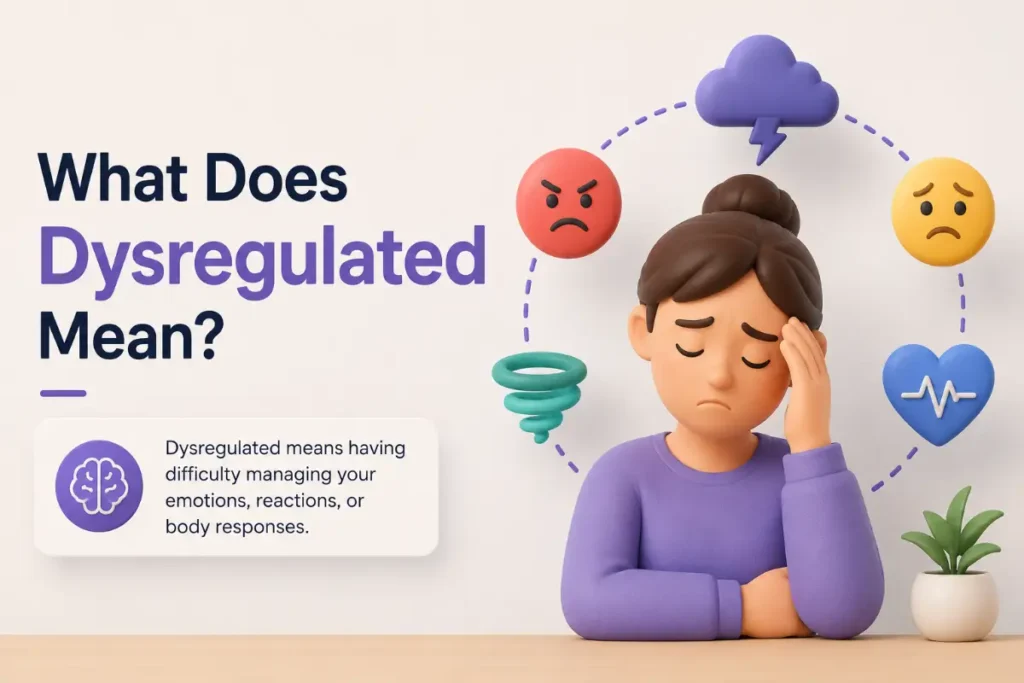
Dysregulated describes something that is not working, responding, or being controlled as it should.
The word appears most often in medicine, psychology, biology, neuroscience, and health care. It can describe emotions, behavior, hormones, body systems, brain function, or biological processes that have lost their normal balance.
Simple Definition
Dysregulated means functioning abnormally or being poorly controlled.
Common Uses
People use dysregulated in many different situations.
- Emotional regulation.
- Mental health.
- Hormone balance.
- Immune system function.
- Nervous system activity.
- Child development.
- Brain function.
- Medical research.
Examples
- The child became dysregulated after the loud noise.
- Chronic stress can leave the nervous system dysregulated.
- Doctors found several dysregulated immune responses during the study.
- Emotional support helped him recover from a dysregulated state.
- The therapist explained how trauma may contribute to dysregulated emotions.
Dysregulated In Different Contexts
Everyday conversation.
I’ve been feeling emotionally dysregulated since the move.
Workplace.
Stress can make employees feel mentally dysregulated during busy periods.
Medical writing.
The researchers observed dysregulated inflammatory pathways.
Psychology.
Children sometimes become dysregulated when routines change suddenly.
What Does Disregulated Mean
Disregulated is not the correct spelling in standard English.
Most dictionaries, style guides, and professional editors treat it as a spelling mistake. In almost every situation where someone writes disregulated, they actually mean dysregulated.
The mistake usually happens because people are familiar with words that begin with the prefix dis, such as:
- Disagree.
- Disappear.
- Disconnect.
- Disorganized.
- Discomfort.
Because dis is a very common English prefix, many writers accidentally replace dys with dis.
If your spell checker flags disregulated, it is doing exactly what it should.
Which One Is Correct
The correct spelling is dysregulated.
Use dysregulated every time you describe a person, emotion, body system, biological process, or behavior that is functioning abnormally or is poorly controlled.
Do not use disregulated because it is not accepted in standard English.
Examples.
✔ The patient’s emotions became dysregulated after the traumatic event.
✔ Anxiety can lead to dysregulated breathing patterns.
✘ The patient’s emotions became disregulated after the traumatic event.
✘ Researchers studied disregulated hormones.
Those last two examples contain a spelling error.
Why People Confuse Dysregulated And Disregulated
The confusion is surprisingly common because several factors work together.
Similar Appearance
The words differ by only one letter. Many people overlook the change while reading quickly.
Familiar Prefix
The prefix dis appears in thousands of English words. Since it is so common, writers naturally type it without thinking.
Medical Vocabulary
The prefix dys appears mostly in medical and scientific terms. People who do not regularly read health related material may be less familiar with it.
Examples include.
- Dysfunction.
- Dyslexia.
- Dysplasia.
- Dysphagia.
- Dyspepsia.
- Dyskinesia.
Once you recognize the dys prefix, the correct spelling becomes much easier to remember.
Keyboard Habits
The letters dis are typed far more often than dys, so muscle memory can lead to accidental spelling mistakes.
Autocorrect And Online Errors
Some online posts contain the misspelling disregulated, and readers may assume it is correct simply because they have seen it before. Repeated exposure does not make the spelling correct. Always rely on trusted dictionaries and professional medical sources when checking technical vocabulary.
Key Differences Between Dysregulated And Disregulated
Although these words look almost identical, only one belongs in correct English. Understanding the differences makes it much easier to avoid the mistake.
| Feature | Dysregulated | Disregulated |
|---|---|---|
| Correct spelling | Yes | No |
| Dictionary entry | Yes | No |
| Accepted in medical writing | Yes | No |
| Used by native speakers | Yes | Rarely and only as a misspelling |
| Meaning | Poorly regulated or functioning abnormally | None in standard English |
| Recommended by editors | Yes | No |
The simplest rule is this.
If you’re writing about abnormal regulation or impaired function, always use dysregulated.
Grammar Explanation
Understanding the grammar behind the word helps explain why dysregulated is correct.
Dysregulated Is An Adjective
Most often, dysregulated functions as an adjective. It describes a noun.
Examples.
- A dysregulated nervous system.
- Dysregulated emotions.
- Dysregulated hormone levels.
- A dysregulated immune response.
In each sentence, the word describes the condition of something.
Dysregulated Can Also Be A Past Participle
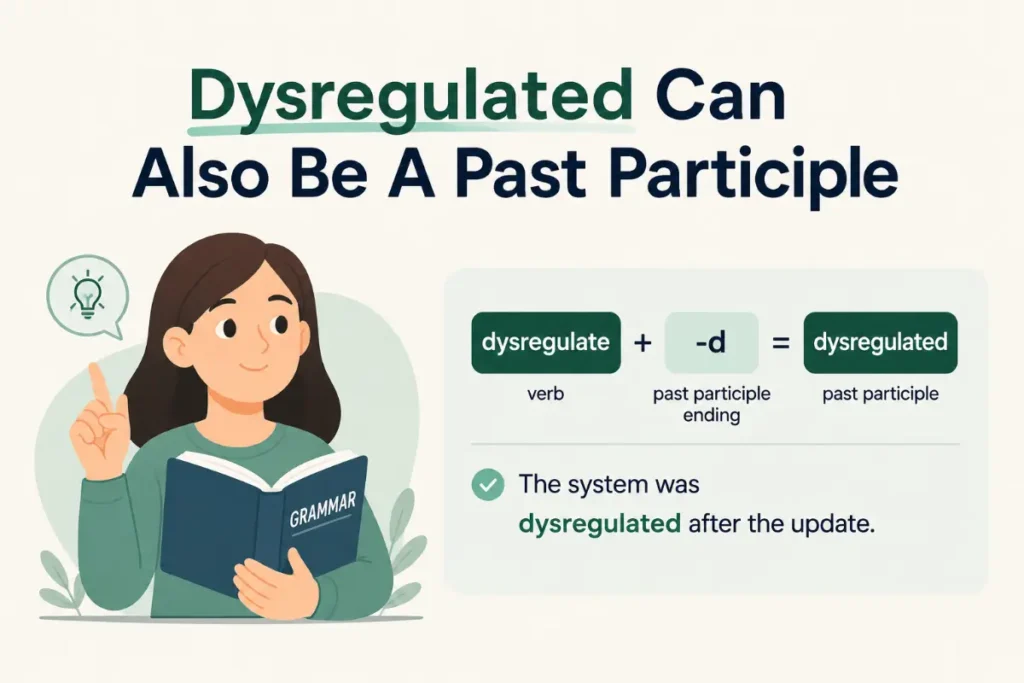
The word also works as the past participle of the verb dysregulate.
Examples.
- The stress response became dysregulated over time.
- Researchers discovered several dysregulated biological pathways.
- Certain genes were dysregulated during the experiment.
In scientific writing, this use is very common.
Disregulated Has No Accepted Grammar Role
Since disregulated is not a recognized English word, it has no accepted grammatical function.
Professional editors replace it with dysregulated.
Spelling Rules
The correct spelling follows a common pattern found in medical English.
Understanding The Prefix Dys
The prefix dys comes from Greek and means:
- Bad.
- Abnormal.
- Difficult.
- Impaired.
You can see the same prefix in many familiar words.
- Dysfunction.
- Dyslexia.
- Dysphonia.
- Dysgraphia.
- Dyspepsia.
- Dysplasia.
Each word describes something that is not functioning normally.
Why Dis Is Incorrect
The prefix dis usually means:
- Not.
- Opposite.
- Remove.
- Reverse.
Examples include.
- Disagree.
- Disconnect.
- Disapprove.
- Disappear.
Those meanings do not fit the medical idea behind dysregulated, which is why disregulated is incorrect.
Learn the difference in Busing Or Bussing Which Spelling Is Correct (2026 Guide).
Pronunciation Guide
Knowing how the word is pronounced can improve both speaking and listening skills.
Dysregulated
IPA
American English.
/dɪs ˈrɛɡ jə leɪ tɪd/
Syllables
Dys reg u lat ed.
Primary Stress
The strongest stress falls on reg.
Common Pronunciation Mistakes
Some learners pronounce the beginning as dies instead of diss.
Others emphasize the wrong syllable.
A slow pronunciation sounds like this.
Diss REG yuh lay tid.
Listening to medical professionals or reputable dictionaries is the best way to master the pronunciation.
Word Origin
The history of the word explains why the spelling matters.
The prefix dys comes from Ancient Greek, where it meant bad, difficult, impaired, or abnormal.
The base word regulate comes from the Latin word regula, meaning rule or standard.
Together they create dysregulate, which literally means to regulate improperly or function abnormally.
The adjective dysregulated developed naturally from that verb and is now widely used in medicine, psychology, neuroscience, immunology, endocrinology, and behavioral science.
The spelling disregulated has no historical origin in English dictionaries.
British American Canadian And Australian English
There is no regional spelling difference.
English speakers in the United States, the United Kingdom, Canada, Australia, and New Zealand all use dysregulated.
Medical journals, universities, hospitals, and healthcare organizations across these countries follow the same spelling.
Unlike words such as color and colour, there is no British and American variation here.
The spelling remains dysregulated everywhere.
Real Life Examples
Seeing the word in natural sentences helps build confidence.
Daily Conversation
- I felt emotionally dysregulated after the stressful meeting.
- Lack of sleep left me feeling completely dysregulated.
- My child became dysregulated when the routine changed.
- Deep breathing helped me feel less dysregulated.
Workplace
- Constant pressure can leave employees emotionally dysregulated.
- The manager noticed several team members seemed dysregulated after the announcement.
- Taking regular breaks reduces the chance of becoming mentally dysregulated.
Emails
- The client appeared emotionally dysregulated during today’s discussion.
- Several participants seemed dysregulated after the unexpected schedule change.
Medical Writing
- The patient presented with dysregulated cortisol levels.
- Researchers identified dysregulated immune pathways.
- The study examined dysregulated inflammatory responses.
- Scientists observed dysregulated gene expression.
- The treatment improved dysregulated nervous system activity.
Psychology
- Trauma may contribute to dysregulated emotional responses.
- Children can become dysregulated when they feel overwhelmed.
- Therapy teaches strategies for managing dysregulated behavior.
Journalism
- Experts explained how chronic stress can create dysregulated biological systems.
- Researchers continue studying dysregulated brain activity.
Social Media
- Learning emotional regulation helped me stop feeling dysregulated every day.
- Mental health professionals often discuss dysregulated emotions online.
- Understanding your nervous system makes it easier to recognize dysregulated responses.
Common Mistakes
Even experienced writers occasionally misspell dysregulated because the word appears mostly in medical and psychological contexts. Here are the mistakes editors see most often.
Replacing Dys With Dis
Incorrect.
The patient’s emotions became disregulated.
Correct.
The patient’s emotions became dysregulated.
The prefix dys is part of the correct word. Changing it to dis creates a spelling mistake.
Assuming Disregulated Is An Alternative Spelling
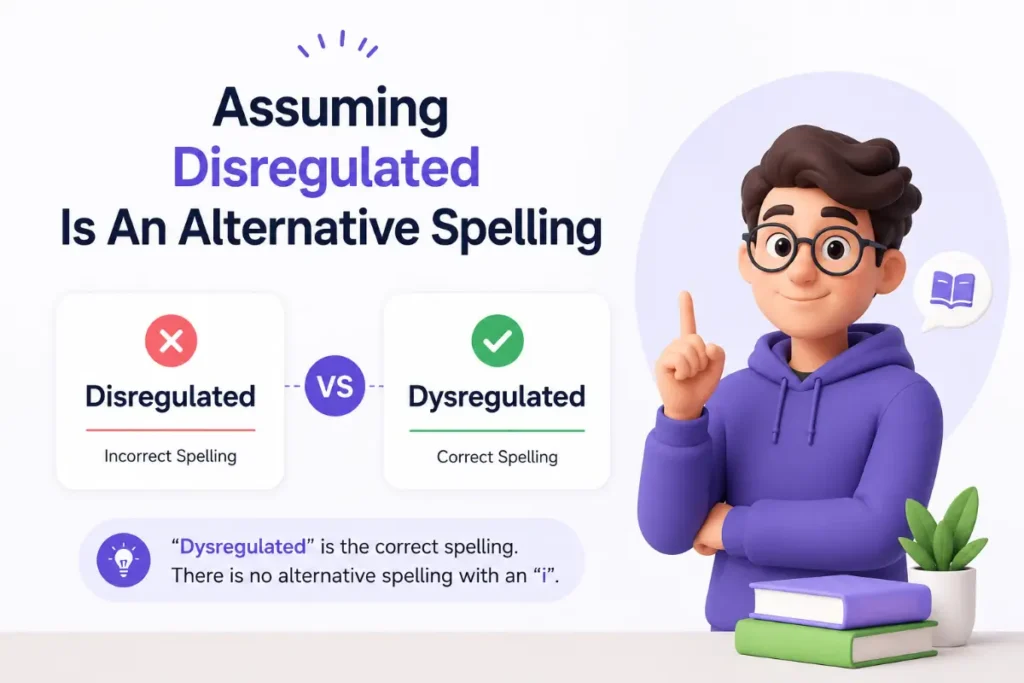
Some people believe disregulated is a British spelling or an American variation.
It is not.
English speaking countries all use dysregulated.
Confusing Dysregulated With Unregulated
These words have different meanings.
Dysregulated means functioning abnormally or being poorly controlled.
Unregulated means not controlled by rules, laws, or oversight.
Examples.
✔ The patient’s emotions became dysregulated.
✔ The industry remained largely unregulated.
Using Dysregulated Outside Its Meaning
The word usually refers to biological, psychological, emotional, or physiological regulation.
Using it for unrelated situations can sound unnatural.
Less natural.
The classroom became dysregulated.
Better.
The students became emotionally dysregulated.
Memory Tricks
A simple memory trick can prevent this spelling mistake for good.
Remember The Prefix
Think of familiar medical words.
- Dyslexia.
- Dysfunction.
- Dysplasia.
- Dysphagia.
All begin with dys, not dis.
Think Of Dysfunction
If something is dysregulated, it is not functioning normally.
Both words begin with dys, making them easy to connect in your memory.
One Question To Ask Yourself
Ask this before writing.
Am I describing something that is functioning abnormally?
If the answer is yes, the correct spelling is almost certainly dysregulated.
Related Words
Expanding your vocabulary helps you understand the word more naturally.
Synonyms
- Impaired.
- Malfunctioning.
- Unbalanced.
- Disrupted.
- Abnormal.
- Unstable.
- Irregular.
Related Medical Terms
- Dysregulation.
- Dysregulate.
- Dysfunction.
- Homeostasis.
- Emotional regulation.
- Self regulation.
- Nervous system.
- Stress response.
Frequently Confused Words
- Dysregulated and disregulated.
- Dysregulation and dysregulate.
- Dysfunction and malfunction.
- Regulated and unregulated.
- Emotional regulation and emotional suppression.
Learning these related terms makes medical and psychological writing much easier to understand.
Expert Editor’s Note
From an editorial standpoint, the answer is clear.
Professional dictionaries, medical journals, university publications, and healthcare organizations consistently use dysregulated.
If you write about psychology, neuroscience, biology, medicine, education, or mental health, always choose dysregulated.
Even outside technical writing, using the correct spelling shows attention to detail and strengthens your credibility.
Frequently Asked Questions
Is Dysregulated Or Disregulated Correct?
Dysregulated is the correct spelling. Disregulated is a misspelling and should not be used in standard English.
Is Disregulated A Real Word?
No. Standard dictionaries do not recognize disregulated as an accepted English word. It is almost always a spelling mistake for dysregulated.
What Does Dysregulated Mean?
It means something is functioning abnormally or is poorly controlled. The word commonly describes emotions, hormones, the nervous system, genes, and other biological or psychological processes.
Why Do People Spell It Disregulated?
The mistake happens because the prefix dis appears in many common English words. People naturally type dis instead of the less familiar medical prefix dys.
Is Dysregulated Used Only In Psychology?
No. It is widely used in psychology, medicine, neuroscience, biology, immunology, endocrinology, genetics, and other health sciences.
Is Dysregulated Formal English?
Yes. It is standard English and appears regularly in academic journals, textbooks, healthcare publications, and professional writing.
How Can I Remember The Correct Spelling?
Remember that many medical words begin with dys, such as dyslexia and dysfunction. If the word relates to abnormal function, dys is usually the correct prefix.
For another common grammar confusion, see Natzi Or Nazi Which Spelling Is Correct 2026.
Conclusion
The comparison between dysregulated vs disregulated has one clear answer.
Dysregulated is the correct spelling and the only form accepted in standard English. It describes something that is functioning abnormally or is poorly regulated, especially in medical, psychological, and scientific contexts.
Disregulated is simply a misspelling. It does not appear as a standard dictionary entry and should be avoided in professional, academic, and everyday writing.
When you are unsure, remember one simple rule. Medical words that describe abnormal function often begin with dys, not dis. That small detail will help you choose the correct spelling every time.

Editorial Reviewer & Proofreader
Grace Mitchell reviews Gramlify’s articles for clarity, consistency, and readability. She is passionate about creating accurate, approachable content that helps English learners build confidence.