
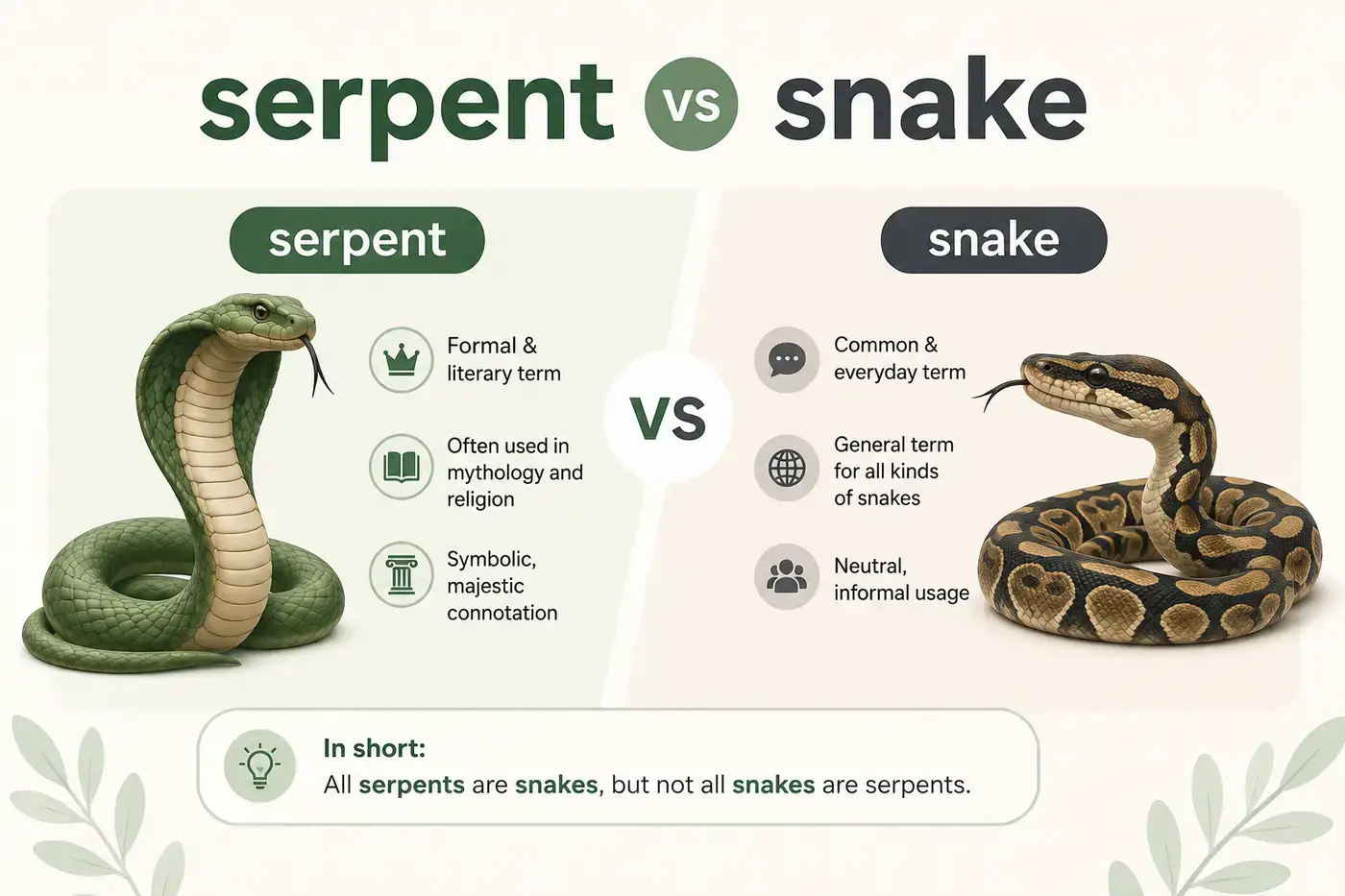
If you’ve searched for serpent vs snake, you’re probably trying to figure out if the two words mean exactly the same thing or if one fits better in certain situations. The short answer is that both words refer to the same type of reptile, but they carry different meanings, tones, and contexts. Choosing the right one depends on what you’re writing and who you’re writing for.
The confusion comes from history, literature, religion, and everyday language. Most people use snake in daily conversation, while serpent appears more often in the Bible, mythology, poetry, and formal writing. Because both words describe the same animal, many English learners assume they are always interchangeable. They are not.
Understanding the difference helps you write more naturally, avoid awkward wording, and recognize the tone that native speakers expect. It also makes reading books, news articles, and historical texts much easier.
This guide explains the meaning of each word, their differences, grammar, pronunciation, usage, history, and real life examples. By the end, you’ll know exactly when to use serpent and when snake is the better choice.
For another common grammar confusion, see Rug Vs Rag Key Differences Explained 2026 Guide.
Quick Answer
Both serpent and snake refer to the same legless reptile. Snake is the everyday word used in modern English, while serpent is a more formal, literary, or symbolic term. In most conversations, snake sounds more natural. Use serpent in religious, historical, poetic, or symbolic contexts.
Serpent Vs Snake Comparison Table
| Feature | Serpent | Snake |
|---|---|---|
| Meaning | A snake, often with symbolic or literary meaning | A legless reptile |
| Part of speech | Noun | Noun |
| Correct English | Yes | Yes |
| Common use | Religion, mythology, literature, symbolism | Everyday speech, education, science |
| Tone | Formal, poetic, dramatic | Neutral and conversational |
| Scientific writing | Rare | Very common |
| Biblical writing | Very common | Sometimes |
| Everyday conversation | Less common | Standard choice |
| Example | The serpent tempted Eve. | A snake crossed the road. |
What Does Snake Mean
A snake is a long, legless reptile that belongs to the suborder Serpentes. It is the standard word that English speakers use in everyday conversation.
The word can describe any species of snake, from harmless garden snakes to large pythons and venomous cobras.
Simple Definition
A snake is a legless reptile with a long body that moves by slithering across the ground.
How People Use Snake
Most people use snake when talking about animals in everyday life.
Examples.
- We saw a snake near the river.
- The ranger safely moved the snake away from the trail.
- My children enjoy learning about snakes at the zoo.
- Scientists discovered a new snake species.
- A snake shed its skin near our garden.
The word also has a figurative meaning.
Sometimes snake describes a dishonest or untrustworthy person.
Example.
Don’t trust him. He’s a snake.
This meaning is informal and usually negative.
What Does Serpent Mean
A serpent is also a snake, but the word carries a more formal, historical, religious, or symbolic meaning.
You’ll often find serpent in the Bible, myths, fairy tales, poetry, and classic literature.
Simple Definition
A serpent is a snake, especially one mentioned in religious stories, myths, or literary works.
Common Uses
Examples.
- The serpent appears in the Garden of Eden.
- Ancient cultures often treated the serpent as a symbol of wisdom.
- The painting shows a giant serpent protecting the temple.
- The hero battled a sea serpent.
- The poet compared fear to a silent serpent.
In many stories, serpent represents temptation, mystery, evil, wisdom, healing, or transformation.
Its meaning depends entirely on the context.
Which One Is Correct
Both serpent and snake are correct English words.
The best choice depends on the situation.
Use snake when talking about the actual animal in everyday conversation, science, education, or news.
Use serpent when writing about religion, mythology, symbolism, literature, or historical events.
Think of it this way.
If you’re describing an animal you saw while hiking, say snake.
If you’re discussing the Garden of Eden or an ancient legend, serpent usually sounds more natural.
Examples.
✔ A snake was hiding under the rock.
✔ The ancient sculpture featured a golden serpent.
Although the words refer to the same animal, they create different impressions for the reader.
Why People Confuse Serpent And Snake
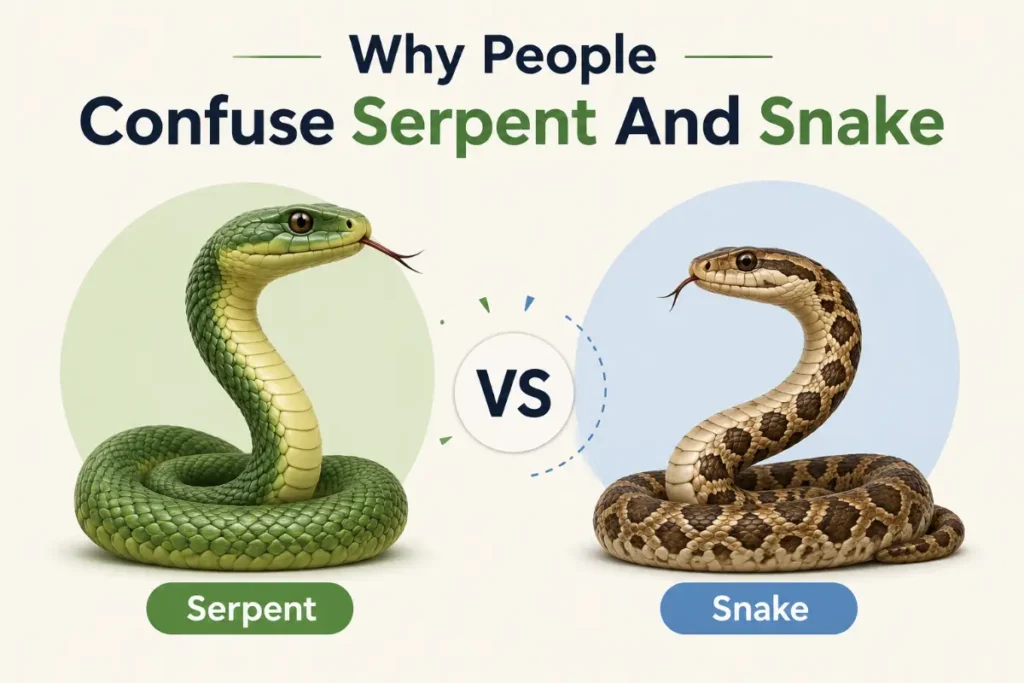
Several reasons explain why these words are mixed up.
They Refer To The Same Animal
This is the biggest reason.
Both words describe a legless reptile, so people naturally assume they always mean the same thing.
Literature Uses Serpent More Often
Many people first encounter serpent while reading the Bible, myths, or classic novels.
Later they hear everyone say snake in daily life.
That difference creates uncertainty.
Movies And Fantasy Stories
Fantasy films, adventure stories, and video games often choose serpent because it sounds mysterious and dramatic.
That makes some learners believe it names a different creature.
Symbolic Meaning
The word serpent often represents ideas instead of simply describing an animal.
It may symbolize.
- Wisdom.
- Evil.
- Healing.
- Rebirth.
- Temptation.
By contrast, snake usually refers to the actual reptile unless used as an insult.
Key Differences Between Serpent And Snake
| Feature | Serpent | Snake |
|---|---|---|
| Everyday use | Rare | Very common |
| Literature | Common | Less common |
| Religion | Very common | Less common |
| Scientific writing | Rare | Standard |
| Symbolism | Strong | Limited |
| Emotional tone | Dramatic and symbolic | Neutral |
| Modern conversation | Less natural | Most natural |
The easiest way to remember the difference is simple.
A snake is usually the animal.
A serpent is often the symbol, character, or literary version of the same animal.
Grammar And Usage
Both serpent and snake are nouns. They refer to the same animal, but they are not always interchangeable because each creates a different tone.
Snake In Everyday English
Snake is the standard word in modern English. It works in almost every situation.
Examples.
- A snake was resting beside the trail.
- We learned about snakes in science class.
- The wildlife guide identified the snake as harmless.
- The zoo has more than fifty snake species.
Serpent In Literary And Symbolic English
Serpent appears more often in literature, religion, mythology, and historical writing.
Examples.
- The serpent guarded the ancient treasure.
- The story describes a giant sea serpent.
- The serpent became a symbol of temptation.
- The artist painted a serpent around the tree.
Can They Replace Each Other
Sometimes yes, but not always.
For example.
✔ The snake slithered across the path.
✔ The serpent slithered across the path.
Both are grammatically correct, but the second sentence sounds more dramatic and literary.
Now compare these.
✔ Scientists studied the snake.
✘ Scientists studied the serpent.
The second sentence sounds unusual in modern scientific writing because experts almost always use snake.
Pronunciation Guide
Although the meanings overlap, the pronunciation is different.
Snake
IPA
American English
/sneɪk/
Syllables
One syllable.
Stress
The single syllable receives full stress.
Serpent
IPA
American English
/ˈsɝː pənt/
Syllables
Ser pent.
Stress
The first syllable carries the primary stress.
Common Pronunciation Mistakes
Some English learners pronounce serpent with equal stress on both syllables.
Native speakers emphasize the first syllable and soften the second.
Many readers also check Unorganized Vs Disorganized Differences Meanings And Correct.
Word Origin And History
The history of these words explains why both still exist in English.
Origin Of Snake
The word snake comes from Old English snaca, meaning a crawling reptile.
It has been the everyday English word for hundreds of years.
Today it is the standard term used in schools, science, news reports, and daily conversation.
Origin Of Serpent
The word serpent comes from the Latin word serpens, which means creeping or crawling.
It entered English through Old French after the Norman Conquest.
Because of its Latin roots, serpent became common in religious writing, medieval literature, and poetry.
Many older English translations of the Bible use serpent instead of snake.
British American Canadian And Australian English
There is very little regional difference between these words.
People in the United States, the United Kingdom, Canada, Australia, and New Zealand all understand both.
The main difference is style rather than location.
Everyday Conversation
Native speakers almost always choose snake.
Examples.
- I saw a snake near the fence.
- Watch out for snakes on the trail.
Literature And Religion
Writers often choose serpent because it sounds timeless and symbolic.
Examples.
- The serpent whispered from the tree.
- The ancient serpent protected the kingdom.
Real Life Examples
Seeing the words in different situations makes the distinction much easier.
Daily Conversation
- We spotted a snake while hiking.
- The snake disappeared into the grass.
- My neighbor found a small snake in the garage.
- I have never touched a snake.
Workplace
- The park employee safely removed the snake.
- The wildlife expert explained how to avoid snake bites.
Emails
- We noticed a snake near the parking area this morning.
- Please contact wildlife services if another snake appears.
Academic Writing
- The researcher studied snake behavior in desert habitats.
- Several snake species are active at night.
- Snake populations play an important role in healthy ecosystems.
Literature
- The serpent circled the ancient tree.
- A wise serpent guided the young prince.
- The hero defeated the giant sea serpent.
Journalism
- Firefighters rescued a snake from the storm drain.
- Residents reported seeing several snakes after heavy rain.
Social Media
- That snake scared everyone on the hiking trail.
- The serpent tattoo looks incredible.
- This movie has an amazing sea serpent.
- The serpent in the painting symbolizes wisdom.
Why Writers Choose Serpent Instead Of Snake
Professional writers rarely choose words by accident.
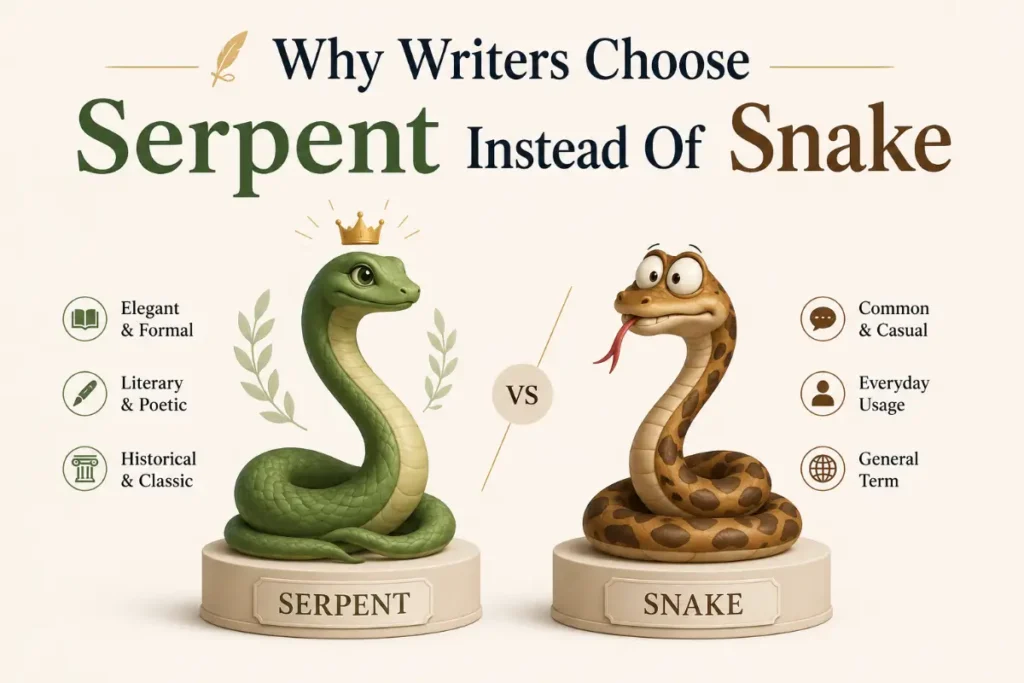
They select serpent because it creates a different mood.
A writer may use serpent to suggest mystery, danger, ancient history, wisdom, or evil without explaining those ideas directly.
For example.
The snake moved through the grass.
This sentence sounds simple and factual.
Now compare it with this.
The serpent glided through the shadows.
The second sentence immediately creates a stronger image. It feels older, darker, and more dramatic even though both sentences describe the same animal.
Novelists, poets, and screenwriters often rely on this subtle difference to shape the reader’s imagination.
Common Mistakes People Make
Many writers use serpent and snake as if they always mean the same thing. While both refer to the same reptile, the tone and context often make one choice sound much more natural.
Here are the mistakes editors notice most often.
Using Serpent In Everyday Conversation
Less natural.
I found a serpent under my car.
More natural.
I found a snake under my car.
In modern English, snake is the normal choice for daily conversation.
Using Snake In Biblical Or Mythological Contexts
Less natural.
The snake tempted Eve in the Garden of Eden.
More natural.
The serpent tempted Eve in the Garden of Eden.
Many religious texts and literary works traditionally use serpent because it matches the historical style.
Assuming They Describe Different Animals
Some people believe a serpent is a larger or more dangerous reptile.
That is incorrect.
Both words refer to the same type of animal. The difference is almost entirely in style, tone, and context.
Using Serpent In Scientific Writing
Scientific articles nearly always use snake.
Example.
✔ Researchers tracked snake populations for five years.
Using serpent here sounds old fashioned and unusual.
Easy Memory Tricks
A few simple tricks can help you remember the difference.
Think About Everyday Speech
If you would naturally say it while talking to a friend, choose snake.
Think About Ancient Stories
If the sentence sounds like it belongs in the Bible, mythology, or a fantasy novel, serpent is usually the better choice.
Remember The Mood
Snake sounds simple and factual.
Serpent sounds dramatic and symbolic.
One Easy Rule
When talking about a real reptile, start with snake.
Switch to serpent only if the writing calls for a formal, historical, or symbolic tone.
Related Words
Learning related vocabulary helps you understand both words more deeply.
Synonyms For Snake
- Reptile.
- Serpent.
- Python.
- Cobra.
- Viper.
Synonyms For Serpent
- Snake.
- Sea serpent.
- Mythical serpent.
- Great serpent.
- Sacred serpent.
Related Words
- Reptile.
- Venom.
- Poison.
- Slither.
- Scale.
- Fang.
- Cobra.
- Python.
- Boa.
- Viper.
Frequently Confused Words
- Snake and serpent.
- Venomous and poisonous.
- Lizard and snake.
- Dragon and serpent.
- Cobra and viper.
Expert Editor’s Note
Professional editors choose words based on the audience and purpose.
Modern dictionaries define serpent as another word for snake, but they also note that it appears more often in literary, biblical, or symbolic writing.
If you’re writing a school paper, science article, travel guide, or news story, snake is almost always the better choice.
If you’re writing fiction, poetry, mythology, or discussing religious texts, serpent often creates a richer and more traditional tone.
Native speakers understand both words immediately. The difference is not grammar. It is style.
Frequently Asked Questions
Is There A Difference Between A Serpent And A Snake?
Biologically, no. Both words refer to the same reptile. The difference lies in usage. Snake is the everyday word, while serpent is more common in literature, religion, mythology, and symbolic writing.
Which Word Is More Common?
Snake is far more common in modern English. You’ll hear it in conversation, classrooms, documentaries, newspapers, and scientific discussions.
Why Does The Bible Say Serpent Instead Of Snake?
Many English Bible translations use serpent because it reflects the traditional language of older translations and fits the formal tone of the text.
Is Serpent An Old English Word?
Not exactly. Serpent entered English through Old French from Latin. It has been part of English for centuries and still appears in formal and literary writing.
Can I Use Serpent In Everyday Conversation?
You can, but it may sound dramatic or old fashioned. Most native speakers naturally choose snake unless they are making a stylistic choice.
Is A Sea Serpent A Real Snake?
A sea serpent usually refers to a mythical creature from legends and folklore. It does not describe a real species of snake.
Why Is A Snake Sometimes Called A Symbol Of Evil?
Many cultures connect snakes with different ideas. In Christianity, the serpent often represents temptation. Other cultures see snakes as symbols of wisdom, healing, protection, or renewal.
Which Word Should English Learners Use?
Choose snake in almost every everyday situation. Learn serpent for reading literature, mythology, religious texts, and historical works.
Suggested Internal Link: Venomous Vs Poisonous Explained.
Need another quick comparison? Read Baloney Vs Bologna Which Word Is Correct 2026.
Conclusion
The answer to serpent vs snake is straightforward.
Both words describe the same animal, but they create different impressions.
Use snake for everyday conversation, education, science, and most modern writing.
Choose serpent for religion, mythology, literature, symbolism, or any situation where you want a more formal or dramatic tone.
The biggest mistake is thinking they describe different reptiles. They do not. The real difference is the feeling each word gives your reader.
Once you understand the context, choosing the right word becomes second nature.

Vocabulary & Language Research Writer
Ethan Parker researches English vocabulary, word meanings, slang, idioms, and commonly confused words. His goal is to help readers understand how English is actually used in everyday conversations and writing.