
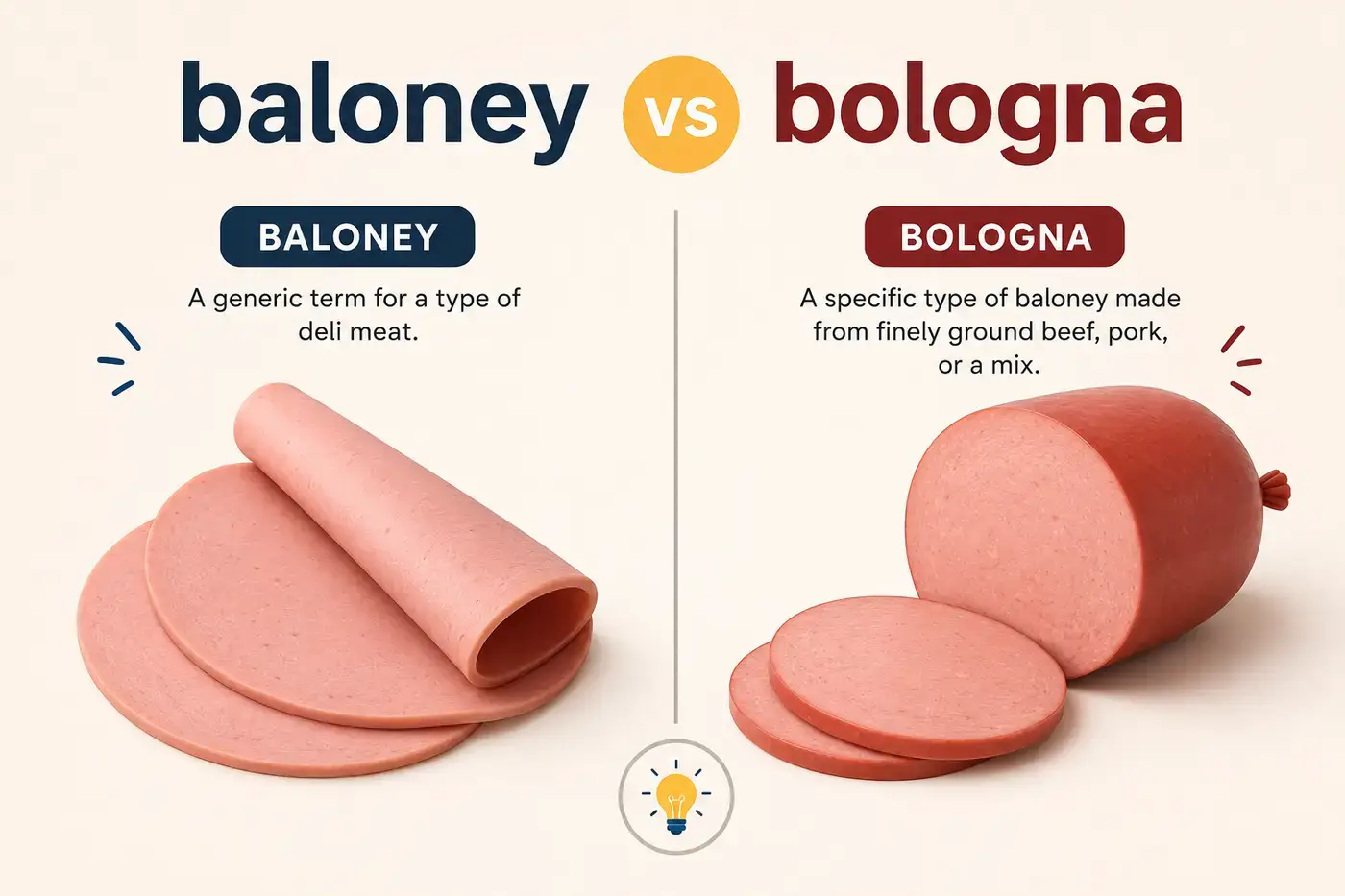
Have you ever seen baloney vs bologna and wondered if they are two different words or just two spellings of the same word? This confusion is common because both words look similar and they can even sound the same in everyday American English.
The answer depends on context. Bologna is the original spelling and has several meanings. It can refer to a type of sausage named after the Italian city of Bologna, or it can describe something foolish or untrue when used as a slang expression. Baloney is a different spelling that developed later and is mainly used to mean nonsense, foolish talk, or something unbelievable.
Many English learners struggle with these words because pronunciation does not clearly show the difference. When people hear someone say “baloney,” they often do not know which spelling fits. The confusion becomes stronger because American English uses both forms in different situations.
This guide explains the difference between baloney vs bologna, their meanings, pronunciation, history, grammar, examples, and common mistakes. You’ll learn how native speakers use each word and how to choose the correct spelling in everyday writing and formal communication.
Learn the difference in Signer or Signor Which Word Is Correct (2026).
Quick Answer
Bologna is the original spelling for Italian sausage and can also mean nonsense in American informal English. Baloney is an alternate spelling used mainly for the slang meaning of nonsense. Both are correct, but bologna is preferred for the food, while baloney is more common for informal expressions.
Baloney Vs Bologna Comparison Table
| Feature | Baloney | Bologna |
|---|---|---|
| Correct spelling | Yes | Yes |
| Main meaning | Nonsense or foolish talk | Italian sausage or nonsense |
| Part of speech | Noun | Noun |
| Pronunciation | buh LOH nee | buh LOH nee |
| Food meaning | Rare | Common |
| Slang meaning | Very common | Also used |
| Formal writing | Less common | More common for the food |
| Region | Mostly American English | Used internationally |
| Example | That excuse is baloney. | I bought bologna for sandwiches. |
What Does Baloney Mean
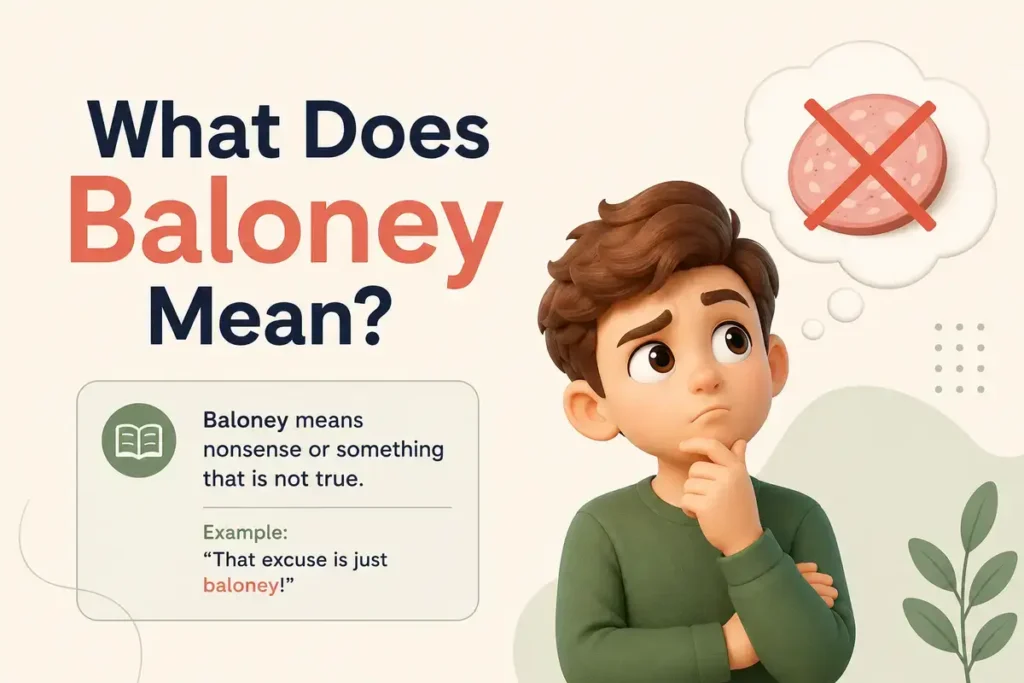
Baloney is an informal noun that means nonsense, foolishness, or something untrue.
When someone says something that sounds ridiculous or dishonest, another person may respond with “That’s baloney.”
The word usually expresses disagreement or disbelief.
Simple Definition
Baloney means a statement, idea, or explanation that someone thinks is foolish, false, or unreasonable.
Common Uses Of Baloney
People often use baloney when they want to reject an idea without using harsh language.
Examples.
- That story about winning the lottery sounds like baloney.
- The advertisement promised impossible results, and customers called it baloney.
- I don’t believe that excuse. It’s pure baloney.
- His explanation was nothing but baloney.
- Don’t listen to all that baloney online.
The word is casual and conversational. It appears often in everyday speech but is usually avoided in formal reports or academic writing.
What Does Bologna Mean
Bologna has two main meanings in English.
The first meaning is a type of sausage. The second meaning is informal and means nonsense, similar to baloney.
Bologna As Food
Bologna is a processed sausage traditionally connected to the Italian city of Bologna.
In the United States, bologna usually refers to a smooth, sliced deli meat often used in sandwiches.
Examples.
- I made a bologna sandwich for lunch.
- The deli sells several types of bologna.
- My grandfather used to eat bologna with cheese.
The food meaning always uses the spelling bologna.
Bologna As Nonsense
In American informal English, bologna can also mean foolish talk.
Examples.
- That claim is complete bologna.
- I’ve heard enough bologna from those advertisements.
- His argument was just bologna.
This use is less common than baloney, but many dictionaries recognize it.
Which One Is Correct
Both baloney and bologna are correct English words.
The right choice depends on the meaning.
Use bologna when talking about the sausage.
Example.
✔ She bought bologna for the sandwiches.
Use baloney when talking about nonsense or an unbelievable statement.
Example.
✔ That excuse is baloney.
You can also use bologna for nonsense, but baloney is usually more natural in modern American informal speech.
A simple rule helps:
Food equals bologna.
Nonsense equals baloney.
Why People Confuse Baloney And Bologna
The confusion comes from several interesting language changes.
Same Pronunciation
In American English, both words are usually pronounced the same way.
Most speakers say:
buh LOH nee
Because the sound does not change, people often choose the spelling based only on memory.
Similar Appearance
The words share almost the same letters.
Bologna.
Baloney.
Only a few letters change, which makes them easy to mix up when writing.
Historical Changes
The slang word baloney likely developed from bologna because people heard the word spoken and created a spelling that matched the pronunciation.
English has many examples where spoken language influences spelling over time.
Internet And Social Media Influence
Online conversations often use baloney because it feels casual and easy to understand.
People may see “That’s baloney” frequently and assume it is the only correct spelling.
Autocorrect Problems
Phones and writing tools can create confusion because both spellings are valid. A device may not know the intended meaning without context.
Key Differences Between Baloney And Bologna
The main difference is meaning.
Meaning Difference
Baloney usually means nonsense.
Example.
That explanation is baloney.
Bologna usually means sausage.
Example.
I ordered a bologna sandwich.
Usage Difference
Baloney appears mostly in informal expressions.
Bologna appears in food descriptions, menus, recipes, and grocery shopping.
Tone Difference
Baloney has a playful or dismissive tone.
Example.
That’s a bunch of baloney.
Bologna sounds neutral when discussing food.
Example.
The recipe uses sliced bologna.
Context Difference
The sentence usually reveals the correct spelling.
Compare these examples.
The politician’s promise was baloney.
The politician ordered a bologna sandwich.
The pronunciation is similar, but the meaning changes completely.
Grammar Explanation Of Baloney And Bologna
Understanding the grammar behind baloney vs bologna makes the difference easier to remember. Both words are nouns, but they work in different situations.
Baloney As A Noun
Baloney is a countable or uncountable noun depending on the meaning.
When it means nonsense, it is usually an uncountable noun.
Examples.
- That information is complete baloney.
- I don’t have time for this baloney.
- His explanation was just baloney.
You usually do not say:
✘ a baloney.
Instead, use phrases like:
✔ a piece of baloney.
✔ a lot of baloney.
✔ complete baloney.
Bologna As A Food Noun
When bologna refers to sausage, it is usually an uncountable food noun.
Examples.
- I bought some bologna from the grocery store.
- She added slices of bologna to the sandwich.
- This bologna tastes different from the brand I usually buy.
When talking about individual pieces, English speakers usually describe the slices rather than count the meat itself.
Example.
✔ I ate three slices of bologna.
Not:
✘ I ate three bolognas.
Bologna As A Slang Noun
When bologna means nonsense, it works similarly to baloney.
Examples.
- That excuse is bologna.
- The advertisement was full of bologna.
- Don’t believe that bologna.
This usage exists, but many American speakers prefer baloney for this meaning.
Spelling Rules And Patterns
The spelling difference between these words comes from pronunciation and language history rather than a simple spelling rule.
Why Bologna Has A Different Spelling
The word bologna comes from the Italian city of Bologna.
In Italian, the name is pronounced differently from the common American pronunciation.
Italian pronunciation is closer to:
boh LOH nyah.
American English changed the pronunciation over time and commonly says:
buh LOH nee.
Why Baloney Matches The Sound
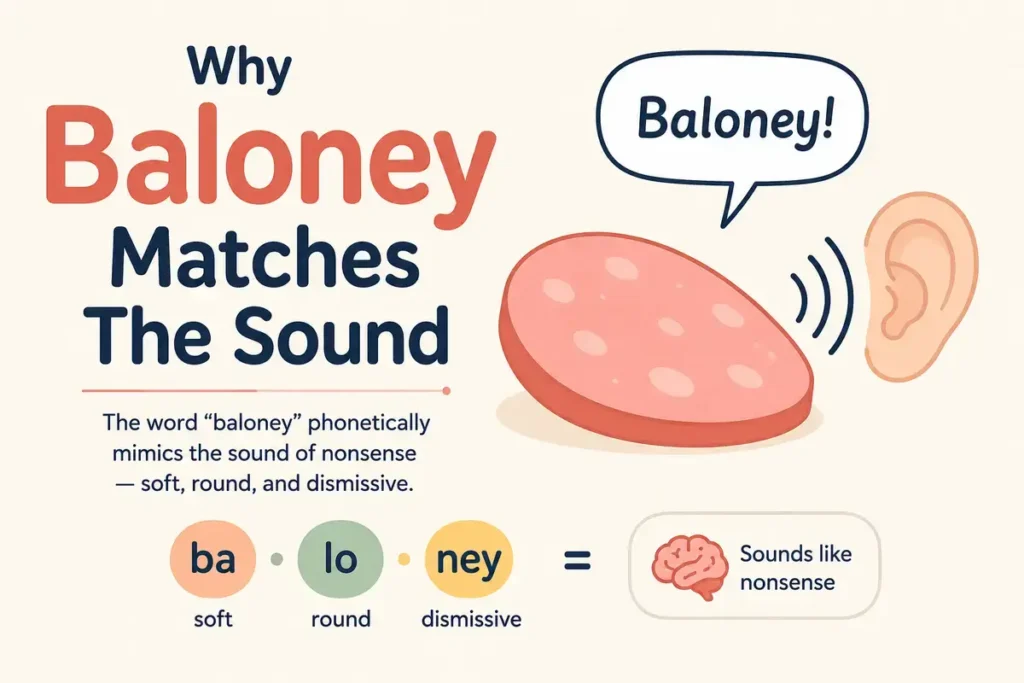
The spelling baloney developed because English speakers wanted a spelling that matched the way the slang word sounded.
This created a separate written form for the informal meaning.
English has many examples of words changing spelling as people adapt pronunciation.
Examples include:
- Fancy.
- Coach.
- Budget.
Language changes as speakers use it in everyday life.
Pronunciation Guide
Both words are usually pronounced the same in American English.
Baloney Pronunciation
IPA:
/bəˈloʊni/
Syllables:
Ba lo ney.
Stress pattern:
The second syllable receives the main stress.
ba LOH ney.
Example:
That excuse is baloney.
Bologna Pronunciation
American English:
IPA:
/bəˈloʊni/
Syllables:
Bo lo gna.
Stress pattern:
The second syllable receives the main stress.
ba LOH nee.
Example:
I made a bologna sandwich.
Common Pronunciation Mistake
Many learners try to pronounce every letter in bologna.
They may say:
bo log na.
This sounds incorrect in American English.
The final letters do not create a separate “gna” sound in the American pronunciation.
Many readers also check Deep Seated Vs Deep Seeded: Which One Is Correct (2026 Guide).
Word Origin And History
The history of these words explains why they look different but sound alike.
Origin Of Bologna
The word bologna comes from Bologna, a city in northern Italy.
The original sausage became known internationally because of its connection to the city.
Italian sausage traditions influenced many European and American food names.
When Italian immigrants brought food traditions to the United States, the word entered American English.
Origin Of Baloney
The exact history of baloney is less certain.
Most linguists believe it developed from the pronunciation of bologna.
At some point, English speakers began using the sound of the word as a slang expression for nonsense.
The spelling changed to match the pronunciation.
This process is common in language. Words often change when people use them in new ways.
British American Canadian And Australian English
The use of these words changes slightly across English speaking regions.
American English
In the United States, both words are recognized.
Bologna is common for the sandwich meat.
Example:
I bought bologna at the deli.
Baloney is more common for nonsense.
Example:
That excuse is baloney.
British English
British speakers know bologna mainly as a food term.
For the slang meaning, they often use words like:
- Nonsense.
- Rubbish.
- Nonsense talk.
The word baloney is understood but less common.
Canadian English
Canadian English often follows American usage.
Bologna refers to the meat.
Baloney can mean nonsense.
Australian English
Australian speakers may recognize both words, but other expressions are more common for nonsense.
Words like “rubbish” or “nonsense” are often preferred.
Real Life Examples Of Baloney And Bologna
Seeing both words in different situations helps build a natural understanding.
Everyday Conversation
- Don’t believe everything you hear online. Some of it is baloney.
- My dad used to make bologna sandwiches for school lunches.
- That excuse sounds like complete baloney.
- We need more bologna for the picnic sandwiches.
- I think that rumor is just baloney.
Workplace Examples
- The manager rejected the report because it contained incorrect information and baloney claims.
- The cafeteria added bologna sandwiches to the lunch menu.
- She ignored the rumors because she knew they were baloney.
- The company ordered extra bologna for the employee event.
- His sales promises sounded like marketing baloney.
Email And Professional Communication
- The team removed unsupported claims from the presentation.
- The customer complaint mentioned misleading information, not useful feedback.
Note:
In professional emails, avoid using baloney because it sounds informal. Words like incorrect information, false claims, or unsupported statements are usually better choices.
Academic Writing
- The researcher avoided unsupported arguments in the final paper.
- The article examined the history of bologna as a food product.
Academic writing usually avoids slang expressions like baloney.
Journalism
- The reporter questioned the accuracy of the politician’s statement.
- The article discussed the popularity of bologna sandwiches in American culture.
Social Media
- That excuse is pure baloney.
- This bologna sandwich deserves more attention.
- People are tired of online baloney.
- My favorite childhood lunch was a bologna sandwich.
Common Mistakes With Baloney And Bologna
Mistake One Using Bologna For Every Meaning
Some writers use bologna every time because it is the original spelling.
Example.
✘ His story is bologna.
This is not wrong, but many readers expect baloney for slang.
Better:
✔ His story is baloney.
Mistake Two Writing Baloney For Food
Example.
✘ I bought baloney for my sandwich.
This may confuse readers because many people understand it as nonsense.
Better:
✔ I bought bologna for my sandwich.
Mistake Three Thinking One Word Is Incorrect
Both spellings are accepted.
The difference is mostly about meaning and context.
Mistake Four Using Slang In Formal Writing
Example.
✘ The report contained a lot of baloney.
Better:
✔ The report contained several unsupported claims.
Formal writing requires more precise language.
Memory Tricks To Remember Baloney And Bologna
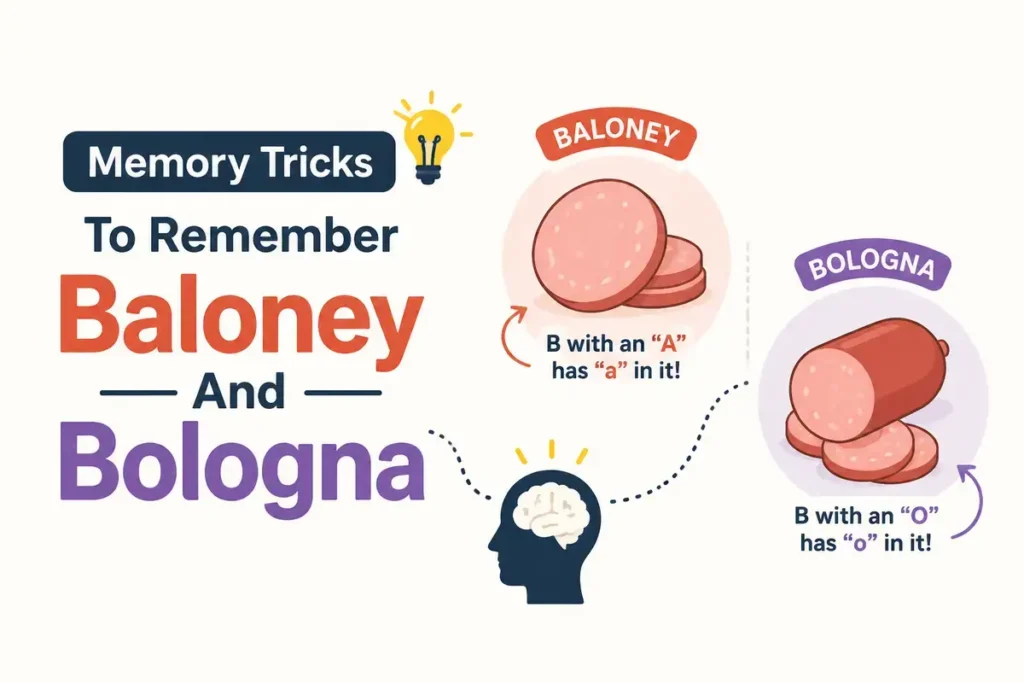
Remembering the difference between baloney vs bologna becomes easier when you connect each word with its main meaning.
Food Has The Original Spelling
Think:
Bologna comes from Bologna, Italy.
The sausage got its name from the Italian city, so the food version keeps the spelling bologna.
Example:
I made a bologna sandwich.
Baloney Means Nonsense
Think:
Baloney sounds like a playful way to call something silly.
When someone says something unbelievable, exaggerated, or false, use baloney.
Example:
That story is baloney.
A Simple Memory Formula
Remember this:
Bologna is on your plate.
Baloney is in a debate.
This quick comparison helps you choose the right spelling in most situations.
Related Words And Similar Expressions
Understanding related words can improve your vocabulary and help you avoid confusion.
Words Related To Baloney
Synonyms for baloney include:
- Nonsense.
- Rubbish.
- Foolishness.
- Garbage.
- Hogwash.
- Nonsense talk.
- False information.
Examples:
That explanation is nonsense.
Those claims are just hogwash.
Words Related To Bologna
Words connected with bologna include:
- Sausage.
- Deli meat.
- Cold cuts.
- Sandwich meat.
- Processed meat.
Examples:
I bought deli meat for lunch.
The store sells several types of sausage.
Similar Confused Words
English has many words that change meaning depending on spelling.
Examples include:
- Capital and capitol.
- Stationary and stationery.
- Advice and advise.
- Affect and effect.
- Principal and principle.
Like these pairs, baloney and bologna require attention to context.
Expert Editor’s Note
From an editor’s perspective, the best choice depends on clarity and audience.
Most dictionaries recognize both spellings, but they do not always emphasize the same use.
Professional editors usually recommend:
Use bologna when discussing the food product.
Use baloney when expressing that something is nonsense.
In formal writing, editors often replace baloney with clearer words such as:
- False claim.
- Incorrect statement.
- Unsupported idea.
- Misleading information.
The reason is simple. Formal writing values precision over conversational style.
In casual writing, however, baloney works well because it adds personality and emotion.
Example:
That excuse is baloney.
This sentence feels natural in conversation but would sound too informal in a research paper.
Frequently Asked Questions
Is Baloney Or Bologna The Correct Spelling?
Both spellings are correct, but they usually have different uses. Bologna is the standard spelling for the sausage. Baloney is the more common spelling for the informal meaning of nonsense or foolish talk.
Why Do Baloney And Bologna Sound The Same?
Both words developed from the same pronunciation pattern in American English. The spelling changed over time because English speakers adapted the original word for a slang meaning.
Is Baloney A Slang Word?
Yes. Baloney is an informal expression that means nonsense, foolishness, or something unbelievable. It is common in everyday conversations but less suitable for formal documents.
Can Bologna Mean Nonsense?
Yes. Bologna can also mean nonsense, and dictionaries recognize this use. However, many American speakers prefer baloney when using the word to mean foolish talk.
How Do You Pronounce Bologna?
In American English, bologna is usually pronounced like “buh LOH nee.” The letters do not sound the way they appear because the word comes from the Italian place name Bologna.
Is Bologna Only A Food Word?
No. Although bologna is best known as a type of sausage, it can also mean nonsense in informal American English. The food meaning is much more common.
Should I Use Baloney In Professional Writing?
Usually no. In professional writing, clearer terms like false claim, unsupported statement, or incorrect information are better choices. Baloney works best in casual conversation.
What Is The Easiest Way To Remember Baloney And Bologna?
Remember the phrase: Bologna is food. Baloney is nonsense. This simple connection helps most writers choose the correct spelling quickly.
Internal Linking Opportunities
- Add an internal link after the introduction with anchor text:
Commonly Confused English Words Explained
- Add an internal link before the conclusion with anchor text:
Real And Really Difference Explained
Need another quick comparison? Read Investor Vs Investee Which Word Is Correct 2026 Guide.
Conclusion
The difference between baloney vs bologna becomes simple once you focus on meaning.
Bologna is the correct spelling for the sausage and the original word connected to the Italian city of Bologna. Baloney is the spelling most people use when they mean nonsense or foolish talk.
Both words are correct, but they belong in different situations. The biggest mistake is choosing a spelling based only on sound because both words are pronounced the same in American English.
For everyday writing, remember this simple rule:
Bologna belongs in your sandwich. Baloney belongs in your conversations when something sounds untrue.
Choosing the right word is not about memorizing more rules. It is about understanding the meaning behind the words you use.

Vocabulary & Language Research Writer
Ethan Parker researches English vocabulary, word meanings, slang, idioms, and commonly confused words. His goal is to help readers understand how English is actually used in everyday conversations and writing.
1 thought on “Baloney Vs Bologna Which Word Is Correct 2026”