
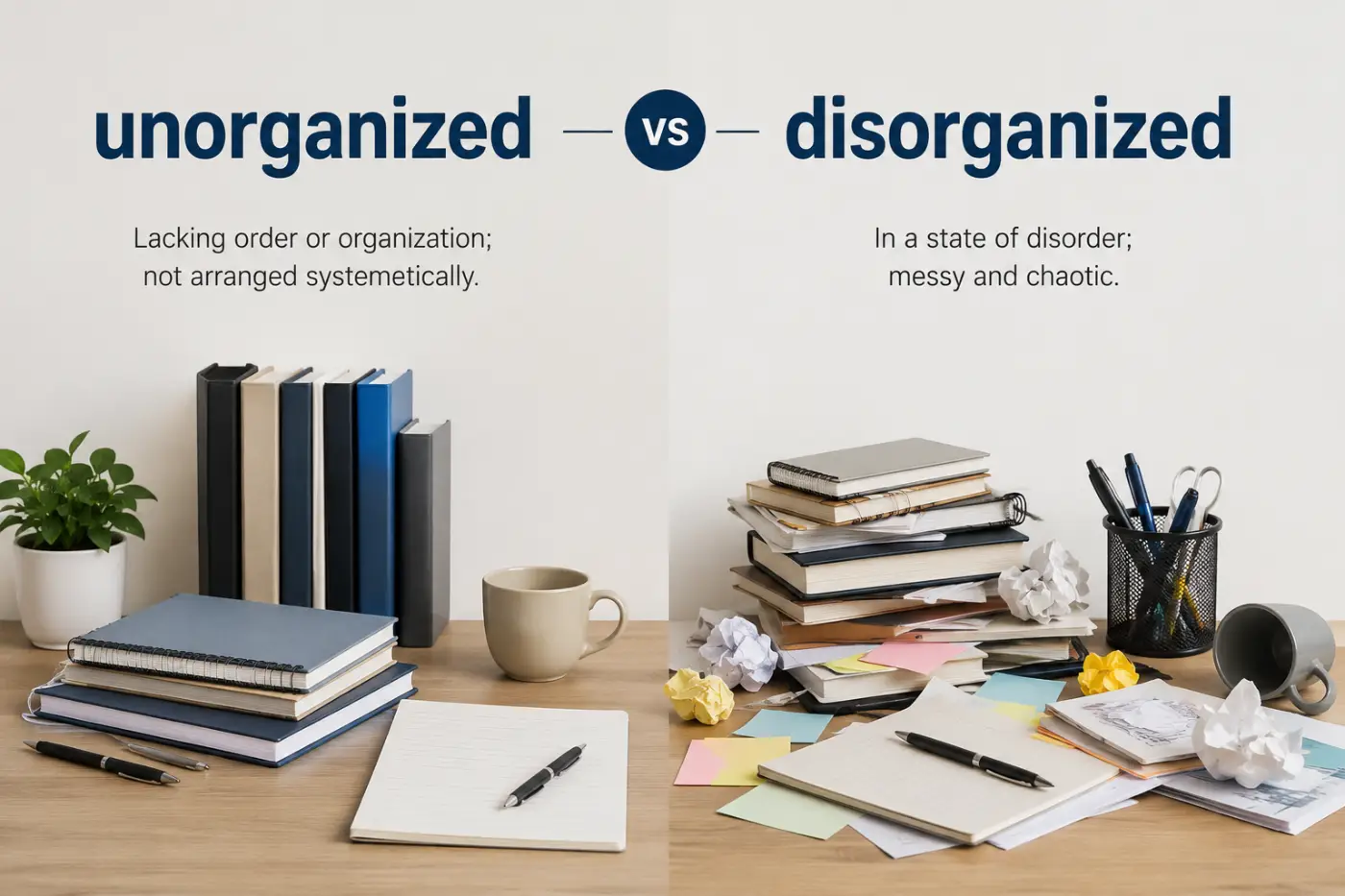
Have you ever described a messy desk as unorganized and then wondered if disorganized would have been a better choice? You’re not alone. These two words appear in everyday conversations, workplace emails, school assignments, and online discussions. Since they share a similar meaning, many people use them interchangeably.
The truth is both unorganized and disorganized are correct English words. They are not spelling mistakes. Still, they are not always the best substitutes for each other. In many situations, native speakers naturally prefer one over the other because each word carries a slightly different meaning and tone.
Understanding this difference helps you communicate more clearly. It also makes your writing sound more natural in professional, academic, and everyday settings.
In this guide, you’ll learn the exact meaning of each word, when to use one instead of the other, how dictionaries define them, why people confuse them, and how professional editors decide which one fits best. You’ll also find practical examples, grammar tips, and simple memory tricks that make the distinction easy to remember.
You may also want to read Maintained Vs Maintenanced Which Word Is Correct 2026 Guide.
Quick Answer
Both unorganized and disorganized are correct English words, but they are not always interchangeable. Unorganized usually means something has never been arranged or structured. Disorganized means something was organized before but has become messy, confused, or lacking order. In most everyday situations, native speakers use disorganized more often.
Unorganized Vs Disorganized Comparison Table
| Feature | Unorganized | Disorganized |
|---|---|---|
| Correct English | Yes | Yes |
| Part of speech | Adjective | Adjective |
| Basic meaning | Not organized | Lacking order or structure |
| Typical use | Never arranged or planned | Messy, confused, or poorly managed |
| Common in everyday English | Less common | Very common |
| Formal writing | Sometimes | Very common |
| Describes | Groups, systems, collections, information | People, places, work, ideas, events |
| Tone | Neutral | Often suggests inefficiency or confusion |
| Example | The files remain unorganized. | His desk is disorganized. |

What Does Unorganized Mean
Unorganized describes something that has not been organized or arranged.
It often refers to something that has never been put into a proper system or structure. The word focuses on the absence of organization rather than the loss of organization.
Simple Definition
Unorganized means not arranged, not structured, or not formally organized.
When To Use Unorganized
Use unorganized when something has not yet been sorted, planned, grouped, or structured.
Examples include.
- The documents are still unorganized after the move.
- The volunteer group remains unorganized.
- The data arrived in an unorganized format.
- We found several unorganized folders on the server.
- The notes were unorganized because nobody had reviewed them yet.
In each example, the focus is simply that organization has not happened.
What Does Disorganized Mean
Disorganized describes something that lacks order or has become difficult to manage.
Unlike unorganized, this word often suggests confusion, disorder, poor planning, or ineffective management.
Simple Definition
Disorganized means messy, poorly arranged, confused, or lacking an effective structure.
When To Use Disorganized
Use disorganized when someone or something functions poorly because of missing order.
Examples include.
- The meeting felt disorganized from beginning to end.
- Her office is always disorganized.
- The project became disorganized after the deadline changed.
- His presentation seemed disorganized.
- Their filing system grew disorganized over time.
Notice that these examples suggest disorder instead of simply missing organization.
Which Word Is Correct
Both words are correct.
The better choice depends on what you want to express.
Choose unorganized when something has not been organized yet.
Choose disorganized when something lacks order, has become messy, or operates inefficiently.
For example.
✔ The inventory is still unorganized because nobody has sorted it.
✔ The inventory became disorganized after the warehouse moved.
The first sentence explains that organization has not happened.
The second sentence shows that order existed but later disappeared.
This small difference changes the meaning of the sentence.
Why Native Speakers Usually Prefer Disorganized
Although both words appear in dictionaries, disorganized is far more common in modern English.
Native speakers often use it to describe people, workplaces, classrooms, schedules, thoughts, writing, and events.
Examples include.
- A disorganized employee.
- A disorganized classroom.
- A disorganized report.
- A disorganized kitchen.
- A disorganized schedule.
By comparison, unorganized appears less often because many situations involve disorder instead of something that has simply never been organized.
Unorganized Vs Disorganized Key Differences
Understanding the main differences makes choosing the right word much easier.
| Difference | Unorganized | Disorganized |
|---|---|---|
| Main idea | Organization has not happened | Order is missing or has broken down |
| Suggests confusion | Rarely | Often |
| Common with people | Sometimes | Very often |
| Common with places | Sometimes | Very often |
| Common with writing | Occasionally | Frequently |
| Common with business | Less common | Very common |
A simple way to remember the difference is this.
Unorganized describes something waiting to be organized.
Disorganized describes something that needs to become organized again.
Grammar Explanation
Both unorganized and disorganized are adjectives.
They describe nouns by explaining their condition.
Examples.
- The office is unorganized.
- The office is disorganized.
Both sentences are grammatically correct.
The meaning changes because the adjectives describe different situations.
You can also use them before nouns.
- An unorganized collection.
- A disorganized workspace.
- An unorganized database.
- A disorganized team.
These adjectives do not change form for singular or plural nouns.
Examples.
- The drawer is disorganized.
- The drawers are disorganized.
- The records are unorganized.
- The record is unorganized.
Can You Use Them Interchangeably
Sometimes.
If you simply want to say something lacks order, many readers will understand either word.
However, choosing the more precise word makes your writing stronger.
For example.
The archive is unorganized.
This tells readers the archive has not yet been sorted.
The archive is disorganized.
This suggests the archive is messy or difficult to use.
Professional editors usually choose the word that matches the exact situation instead of treating them as perfect synonyms.
In Section 2, I’ll cover:
- Why people confuse these words.
- Pronunciation guide.
- Spelling and prefix rules.
- Word origin and etymology.
- British, American, Canadian, and Australian English.
- More than 20 real life examples from conversations, work, emails, journalism, literature, academics, and social media.

Why People Confuse Unorganized And Disorganized
At first glance, these words seem interchangeable. They both describe a lack of order, share the same root word, and often appear in similar situations. Still, they are not exact synonyms.
Here are the main reasons people mix them up.
They Have Similar Meanings
Both words describe something that is not orderly. Without paying attention to the context, it’s easy to choose either one.
For example.
The files are unorganized.
The files are disorganized.
Both sentences are understandable, but they suggest slightly different ideas.
Both Begin With A Negative Prefix
The prefixes un and dis both create a negative meaning.
Even though they look similar, they do different jobs.
The prefix un usually means not.
The prefix dis often means lacking, opposite, apart, or no longer.
That small difference changes the meaning of many English words.
Everyday Speech Blurs The Difference
In casual conversations, people rarely stop to think about the distinction.
Someone might say.
My room is unorganized.
Another person might say.
My room is disorganized.
Native speakers understand both, but disorganized sounds more natural because the room is messy rather than simply waiting to be organized.
Dictionaries Overlap The Definitions
Many dictionaries define one word by using the other.
That makes the distinction harder for English learners.
Professional editors usually focus on the context instead of relying on a single dictionary definition.
Many readers also check Unregister Vs Deregister Which Word Should You Use.
Spelling Rules
There are no spelling differences between American English and British English for these words.
Both spellings remain the same across major English speaking countries.
The difference comes from their prefixes.
The Prefix Un
The prefix un usually means not.
Examples include.
- Unfinished.
- Unlocked.
- Unopened.
- Unorganized.
The idea is simple.
The action has not happened.
The Prefix Dis
The prefix dis often suggests separation, reversal, or loss.
Examples include.
- Disconnect.
- Disappear.
- Disagree.
- Disorganized.
The word often suggests that order is missing or has broken down.
Understanding these prefixes helps you understand hundreds of English words.
Pronunciation Guide
The pronunciation difference is small.
Unorganized
IPA
American English.
/ʌn ˈɔːr ɡə naɪzd/
Syllables
Un or gan ized.
Primary Stress
The strongest stress falls on or.
Disorganized
IPA
American English.
/dɪs ˈɔːr ɡə naɪzd/
Syllables
Dis or gan ized.
Primary Stress
The strongest stress also falls on or.
Common Pronunciation Mistakes
Some English learners place too much stress on the first syllable.
Instead, emphasize the second syllable.
Say them naturally.
Un OR ganized.
Dis OR ganized.
Word Origin And History
Learning where these words came from makes their meanings easier to remember.
Origin Of Organize
The verb organize comes from the Greek word organon, meaning tool or instrument.
Later, it entered Latin and French before becoming part of English.
Its meaning gradually expanded to include arranging, planning, and putting things into a useful system.
How Unorganized Developed
English adds the prefix un to many adjectives.
The result simply means not organized.
It does not automatically suggest confusion.
How Disorganized Developed
The prefix dis creates the idea of disorder or the loss of order.
As a result, disorganized gradually became the preferred word for describing confusion, messy systems, and ineffective planning.
Today, it appears much more often in newspapers, business writing, education, and everyday conversation.
British American Canadian And Australian English
There is almost no regional difference.
Speakers in the United States, the United Kingdom, Canada, Australia, and New Zealand recognize both words.
The difference is one of preference instead of geography.
Across all major varieties of English, disorganized appears far more often.
Professional writers usually choose it when describing messy work, poor planning, confusing ideas, or inefficient systems.
Unorganized appears more often when discussing groups, collections, records, or information that simply have not been arranged yet.
Real Life Examples
Seeing both words in natural situations makes the difference much clearer.
Daily Conversation
- My closet is still unorganized after the move.
- His bedroom looks completely disorganized.
- The photo albums remain unorganized.
- Their travel plans became disorganized overnight.
Workplace
- The client files are still unorganized.
- The project became disorganized after the manager resigned.
- Her desk looks disorganized, but she always finds everything.
- The inventory is unorganized because the shipment arrived this morning.
Emails
- The documents are currently unorganized and need to be sorted.
- Sorry for the disorganized report. I had very little time to finish it.
Academic Writing
- Researchers found the historical records largely unorganized.
- The paper presents a disorganized argument that is difficult to follow.
Journalism
- Emergency supplies remained unorganized for several hours.
- Witnesses described the evacuation as disorganized.
Literature
- The cabin looked disorganized after the storm.
- The old letters sat in unorganized piles.
Social Media
- My room is so disorganized today.
- My digital photos are completely unorganized.
- I finally organized years of unorganized paperwork.
- A disorganized morning usually leads to a stressful day.
These examples show a simple pattern.
If something has never been arranged, unorganized usually fits better.
If something feels messy, confusing, or poorly managed, disorganized is normally the stronger choice.
Common Mistakes
Many writers understand the basic meanings of unorganized and disorganized, but they still use the wrong word in context. These are the mistakes editors notice most often.

Using Unorganized For Something That Became Messy
Incorrect.
The meeting was unorganized.
Correct.
The meeting was disorganized.
Why?
A meeting usually has a plan before it begins. If it runs poorly or feels chaotic, disorganized is the natural choice.
Using Disorganized When Nothing Was Organized Yet
Incorrect.
The new files are disorganized because nobody has sorted them.
Better.
The new files are unorganized because nobody has sorted them.
Why?
The files have never been arranged. They are simply waiting to be organized.
Thinking One Word Is Always Better
Some writers believe disorganized has completely replaced unorganized.
That is not true.
Both words are correct. The context determines the better choice.
Assuming They Mean Exactly The Same Thing
The meanings overlap, but they are not identical.
Professional writing becomes clearer when you choose the word that matches the situation.
Memory Tricks
These simple tricks make the difference easy to remember.
Think About The Prefix
The prefix un usually means not.
Unorganized means not organized yet.
The prefix dis often suggests something has gone wrong or lost its order.
Disorganized means order is missing.
Picture Two Different Rooms
Imagine two bedrooms.
The first bedroom has never been unpacked after moving.
It is unorganized.
The second bedroom was clean yesterday but now clothes are scattered everywhere.
It is disorganized.
That picture helps many learners remember the difference.
Ask Yourself One Question
Has organization happened yet?
If the answer is no, unorganized is probably the better choice.
If the answer is yes but the order disappeared, disorganized usually fits best.
Related Words
Learning related vocabulary builds stronger English skills.
Synonyms For Unorganized
- Unsorted.
- Unarranged.
- Unplanned.
- Unstructured.
- Unclassified.
Synonyms For Disorganized
- Chaotic.
- Messy.
- Disorderly.
- Confused.
- Scattered.
- Untidy.
Opposites
- Organized.
- Orderly.
- Structured.
- Systematic.
- Well planned.
Frequently Confused Words
- Organized and orderly.
- Structured and organized.
- Messy and untidy.
- Chaotic and disorganized.
- Arrange and organize.
Expert Editor’s Note
Professional editors accept both unorganized and disorganized because both appear in respected dictionaries.
Even so, editors usually choose disorganized when describing people, workplaces, reports, presentations, meetings, schedules, or ideas. It sounds more natural and matches modern English usage.
They reserve unorganized for situations where something simply has not been arranged yet. This choice gives readers a clearer picture and avoids unnecessary confusion.
When you can express the exact meaning with one word instead of a close synonym, your writing becomes stronger and more precise.
Frequently Asked Questions
Is Unorganized A Correct Word?
Yes. Unorganized is a correct English adjective. It describes something that has not been arranged, sorted, or structured.
Is Disorganized More Common Than Unorganized?
Yes. Disorganized appears much more often in everyday conversation, business writing, news articles, and academic English because it naturally describes disorder and confusion.
Can I Use Unorganized And Disorganized Interchangeably?
Sometimes, but not always. They overlap in meaning, yet unorganized usually means not organized yet, while disorganized suggests missing order or poor organization.
Which Word Sounds More Natural?
For most situations, native speakers naturally choose disorganized. It fits people, workplaces, meetings, reports, schedules, and ideas more comfortably.
Is Unorganized Incorrect In American English?
No. It is completely correct in American English. It is simply less common than disorganized in everyday use.
Which Word Should I Use In Professional Writing?
Use the word that matches the situation. If something has never been arranged, choose unorganized. If something is messy, confusing, or poorly managed, disorganized is usually the better choice.
Does Disorganized Always Mean Messy?
Not always. It can describe physical clutter, but it also refers to confusing ideas, poor planning, ineffective management, or a lack of structure.
You may also want to read Impatient Vs Inpatient Differences Meanings And Correct 2026.
Conclusion
The difference between unorganized vs disorganized is small but important.
Unorganized describes something that has not been organized yet.
Disorganized describes something that lacks order or has become messy, confusing, or inefficient.
Both words are correct, but disorganized is far more common in modern English because it fits a wider range of situations.
The easiest way to choose the right word is to think about what happened.
If organization never took place, use unorganized.
If order existed and later disappeared or the situation feels chaotic, use disorganized.
That simple rule will help you write with confidence every time.

Vocabulary & Language Research Writer
Ethan Parker researches English vocabulary, word meanings, slang, idioms, and commonly confused words. His goal is to help readers understand how English is actually used in everyday conversations and writing.