
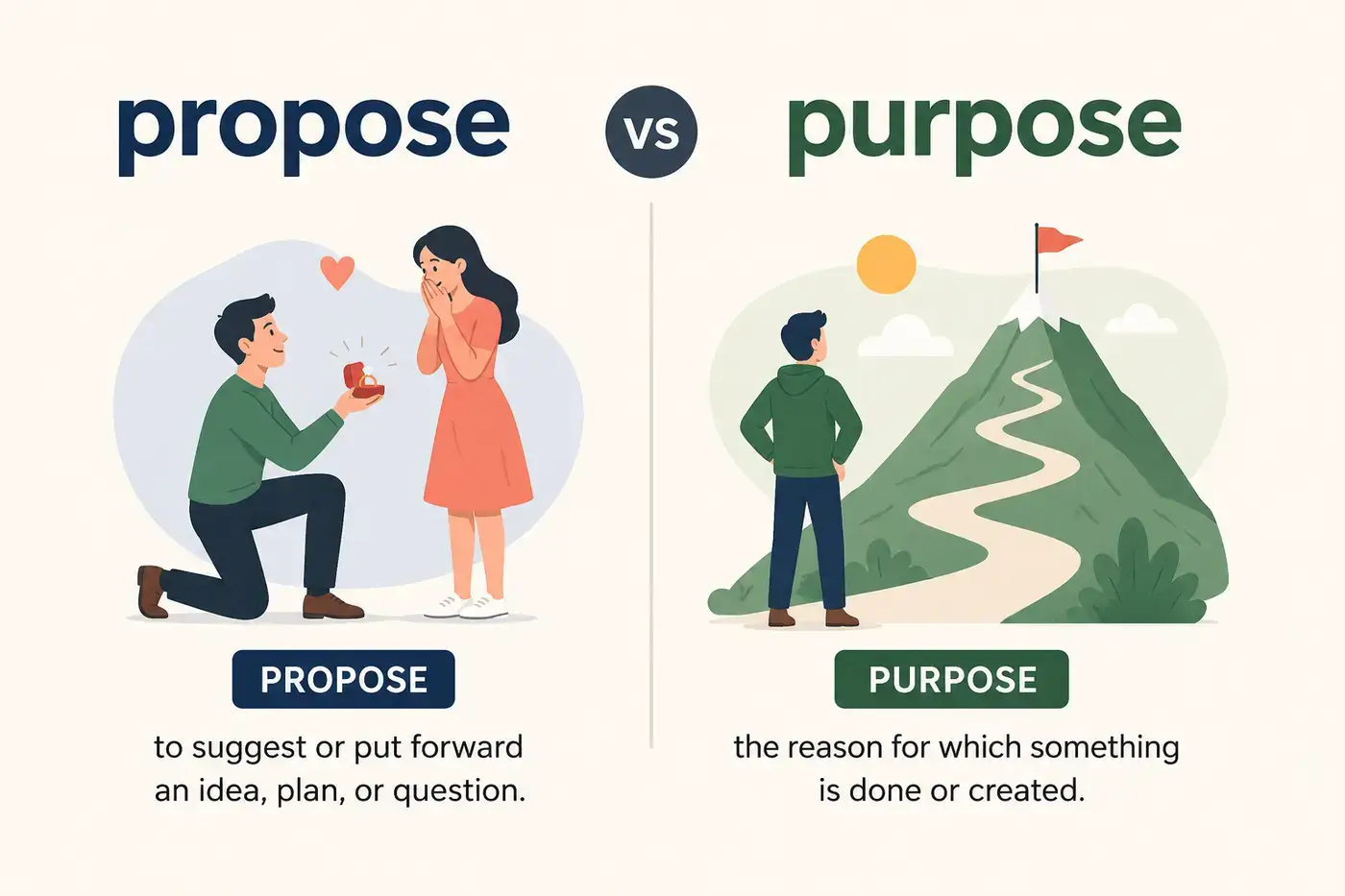
If you’ve searched for propose vs purpose, you’re probably trying to figure out if these words mean the same thing or if one is simply the wrong choice. They look similar, share several letters, and sound somewhat alike, so it’s easy to mix them up. Still, they have completely different meanings and grammar roles.
Many English learners accidentally write I purpose a new plan when they mean I propose a new plan. Others confuse purpose with proposal because the words come from related Latin roots. Autocorrect, fast typing, and similar pronunciation only add to the confusion.
The good news is that the difference is straightforward once you understand how each word works in a sentence. One word usually describes making a suggestion or asking an important question. The other refers to a reason, goal, or intention. They are not interchangeable.
This guide explains the meaning of each word, how native speakers use them, why people confuse them, and how to choose the correct one every time. You’ll also find grammar explanations, practical examples, and professional editing tips that make the distinction easy to remember.
A related grammar guide is Apposed Vs Opposed Which Word Is Correct 2026.
Quick Answer
Propose is a verb that means to suggest an idea, plan, or action, or to ask someone to marry you.
Purpose is usually a noun that means a reason, aim, or goal. It can also work as a verb in formal English, meaning to intend something. The two words have different meanings and grammar functions, so they cannot replace each other.
Propose Vs Purpose Comparison Table
| Feature | Propose | Purpose |
|---|---|---|
| Part of speech | Verb | Mainly noun and sometimes verb |
| Primary meaning | Suggest an idea or make an offer | Reason aim or intention |
| Correct English | Yes | Yes |
| Common use | Meetings discussions marriage proposals | Goals missions education business everyday conversation |
| Formal writing | Very common | Very common |
| Informal writing | Very common | Very common |
| Can replace the other | No | No |
| Example | I propose a new strategy. | The purpose of the meeting is to plan the launch. |
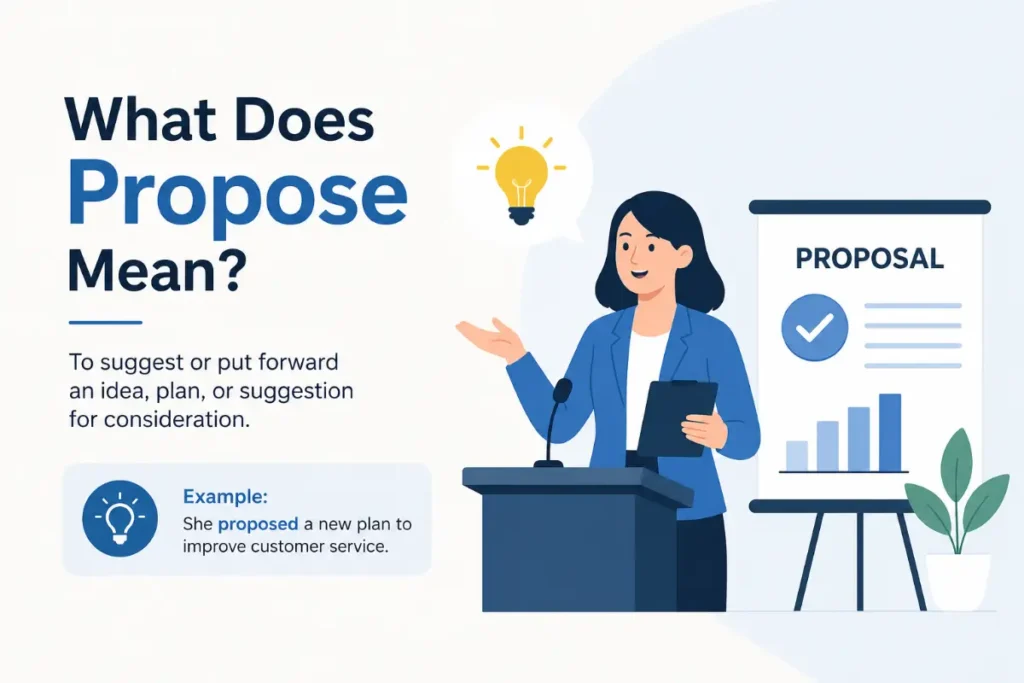
What Does Propose Mean
Propose is a verb. It means to put forward an idea, plan, solution, or suggestion for other people to consider.
It also means asking someone to marry you.
Simple Definition
Propose means to suggest something for discussion or acceptance.
Common Uses Of Propose
People use propose in many everyday situations.
- Suggesting a new idea.
- Presenting a solution.
- Recommending a change.
- Asking someone to marry you.
- Introducing a motion during a meeting.
Real Life Examples
Daily conversation.
I propose ordering dinner before everyone gets hungry.
Workplace.
The manager proposed a new training schedule.
Business meeting.
We propose reducing unnecessary expenses next quarter.
Academic writing.
The researchers propose a different explanation for the results.
Personal life.
He plans to propose during their vacation.
What Does Purpose Mean
Purpose is most commonly a noun. It refers to the reason something exists or the goal someone wants to achieve.
It answers questions like Why does this exist or Why are we doing this.
Simple Definition
Purpose means a reason, goal, intention, or objective.
Common Uses Of Purpose
People use purpose when talking about goals and intentions.
Examples include.
- The purpose of exercise is to improve health.
- Every lesson has a clear purpose.
- She found a new purpose after changing careers.
- The main purpose of this guide is to answer your question.
- Knowing your purpose helps you make better decisions.
Purpose As A Verb
Although much less common, purpose can also be used as a verb in formal English.
Examples.
- She purposed to finish the project before Friday.
- They purposed to help their community.
In modern American English, native speakers rarely use purpose as a verb. Most people say intend or plan instead.
Which One Is Correct
Both propose and purpose are correct English words.
The right choice depends entirely on your meaning.
Use propose when you are suggesting an idea or making an offer.
Use purpose when talking about a reason, objective, or intention.
Compare these examples.
✔ I propose changing the meeting time.
✔ His purpose was to help new employees succeed.
These examples are also incorrect.
✘ I purpose a new solution.
✘ The propose of this article is to explain grammar.
Those sentences sound unnatural because each word performs a different job.
Why People Confuse Propose And Purpose
These words confuse many English learners for several reasons.
Similar Spelling
Only a few letters are different.
When people read quickly, the words appear almost identical.
Similar Pronunciation
The words begin with the same sound.
Native speakers rely on context to understand which one is being used.
Shared Latin Roots
Both words trace back to Latin words related to placing something forward or setting an intention.
Their historical connection makes the spellings feel familiar even though their meanings developed differently.
Typing Mistakes
The endings ose and ose followed by purpose are easy to mistype, especially on mobile devices.
Vocabulary Confusion
Many learners accidentally connect propose, proposal, purpose, and proposal statement because they often appear in business and academic writing.
In reality, they belong to different grammar patterns and express different ideas.
Key Differences Between Propose And Purpose
| Feature | Propose | Purpose |
|---|---|---|
| Main function | Suggests an action | Explains a reason |
| Part of speech | Verb | Usually noun |
| Answers | What should we do | Why are we doing it |
| Focus | Recommendation | Goal or intention |
| Common contexts | Meetings projects marriage | Education business writing personal goals |
A quick way to remember the difference is this.
If someone is making a suggestion, choose propose.
If someone is explaining a reason or goal, choose purpose.
Grammar Explanation
Understanding the grammar is the easiest way to avoid confusing propose and purpose.
Propose Is A Verb
A verb shows an action.
Propose describes the act of suggesting an idea, plan, solution, or course of action. It can also describe asking someone to marry you.
Examples.
- I propose a different approach.
- She proposed several improvements.
- They proposed changing the schedule.
- He proposed to his partner last weekend.
Notice that propose always expresses an action.
Purpose Is Usually A Noun
A noun names a person, place, thing, or idea.
Most of the time, purpose refers to a reason, objective, or goal.
Examples.
- The purpose of this lesson is to improve your writing.
- Every project needs a clear purpose.
- Her purpose is to help others.
- The purpose of the meeting is to review the budget.
Here, purpose names an idea instead of describing an action.
Purpose As A Verb
Although uncommon, purpose can also function as a verb in formal English.
It means to intend or to plan.
Examples.
- She purposed to complete the work before Friday.
- They purposed to expand the business.
Modern American English rarely uses this verb form. Native speakers almost always choose intend or plan because they sound more natural.
A Simple Grammar Test
Ask yourself one question.
Are you suggesting something?
If yes, use propose.
Are you talking about a reason or goal?
If yes, use purpose.
This simple test works in almost every sentence.
Pronunciation Guide
The words look alike, but their pronunciation is slightly different.
Propose
IPA
American English
/prəˈpoʊz/
Syllables
Pro pose.
Stress
The second syllable receives the primary stress.
Purpose
IPA
American English
/ˈpɝː pəs/
Syllables
Pur pose.
Stress
The first syllable carries the strongest stress.
Common Pronunciation Mistakes
Many English learners pronounce both words the same because they focus on spelling.
Listen to the stressed syllable.
Propose stresses the second syllable.
Purpose stresses the first.
That difference helps native speakers recognize each word quickly.
You may also want to read Impatient Vs Inpatient Differences Meanings And Correct 2026.
Word Origin And History
Learning where these words came from makes their meanings easier to understand.
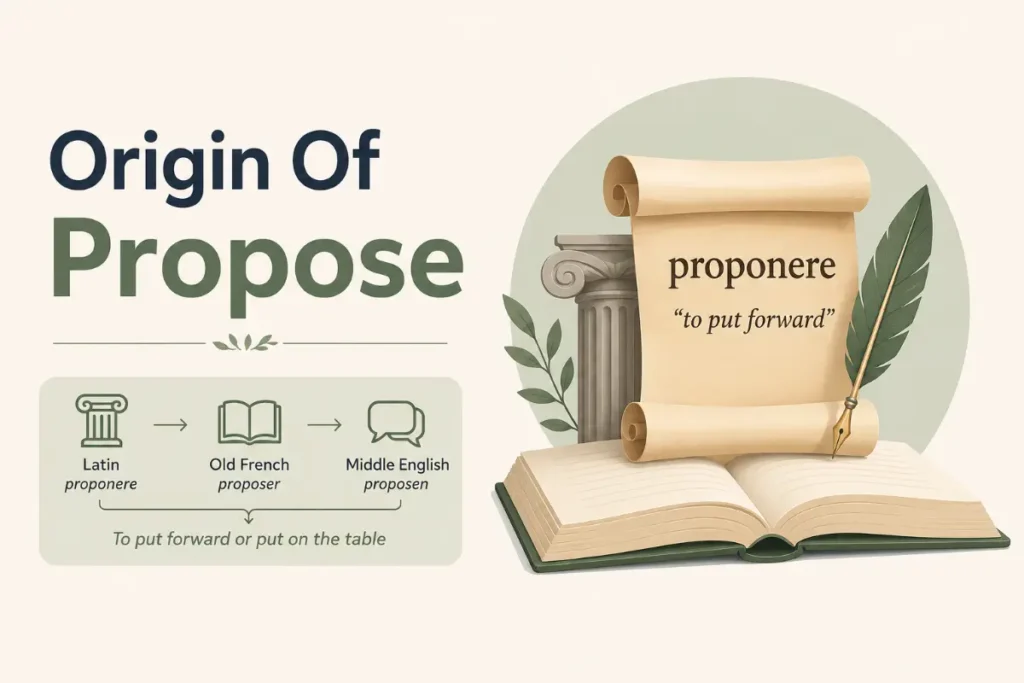
Origin Of Propose
Propose comes from the Latin word proponere, meaning to put forward.
English has used it for centuries to describe presenting an idea, suggestion, or offer.
Over time, it also became the standard verb for asking someone to marry.
Origin Of Purpose
Purpose comes from the Anglo French word purpos, which referred to intention, aim, or objective.
Its meaning has stayed remarkably consistent throughout the history of English.
Today, it still refers to someone’s goal or the reason something exists.
Although both words have historical connections to intention and planning, they evolved into separate vocabulary words with different grammar functions.
British American Canadian And Australian English
There is almost no regional difference between propose and purpose.
Speakers in the United States, the United Kingdom, Canada, Australia, and New Zealand use both words with the same meanings.
The only noticeable difference is style.
Formal Writing
Academic papers, legal documents, and business reports frequently use propose for recommendations and purpose for objectives.
Examples.
- We propose a revised policy.
- The purpose of this research is to examine language change.
Everyday Conversation
Native speakers naturally say.
- I want to propose a new idea.
- What’s the purpose of this app?
The meanings stay the same across English speaking countries.
Real Life Examples
Seeing both words in real situations makes the difference much easier to remember.
Daily Conversation
- I’d like to propose a different restaurant.
- The purpose of today’s trip is to visit Grandma.
- Can I propose another idea?
- She finally found her purpose in life.
Workplace
- Our team proposed a new marketing strategy.
- The purpose of the meeting is to review customer feedback.
- I propose extending the deadline by two days.
- Every department should understand its purpose.
Emails
- I would like to propose a change to next week’s schedule.
- The purpose of this email is to confirm your appointment.
- We propose holding the event online.
- Please explain the purpose of the attached document.
Academic Writing
- The researchers propose a new theory.
- The purpose of this experiment is to measure temperature changes.
- Several experts propose additional studies.
- The paper clearly states its research purpose.
Journalism
- Lawmakers proposed several amendments.
- The organization explained the purpose of the new program.
Social Media
- He finally proposed after five years together.
- Finding your purpose takes time.
Literature
- The hero proposes a bold plan to save the village.
- Her life’s purpose becomes clearer with every chapter.
These examples show a consistent pattern.
Propose introduces an idea or action.
Purpose explains the reason behind it.
Common Mistakes
Even experienced English learners sometimes confuse propose and purpose because the words look similar. Here are the mistakes editors see most often.
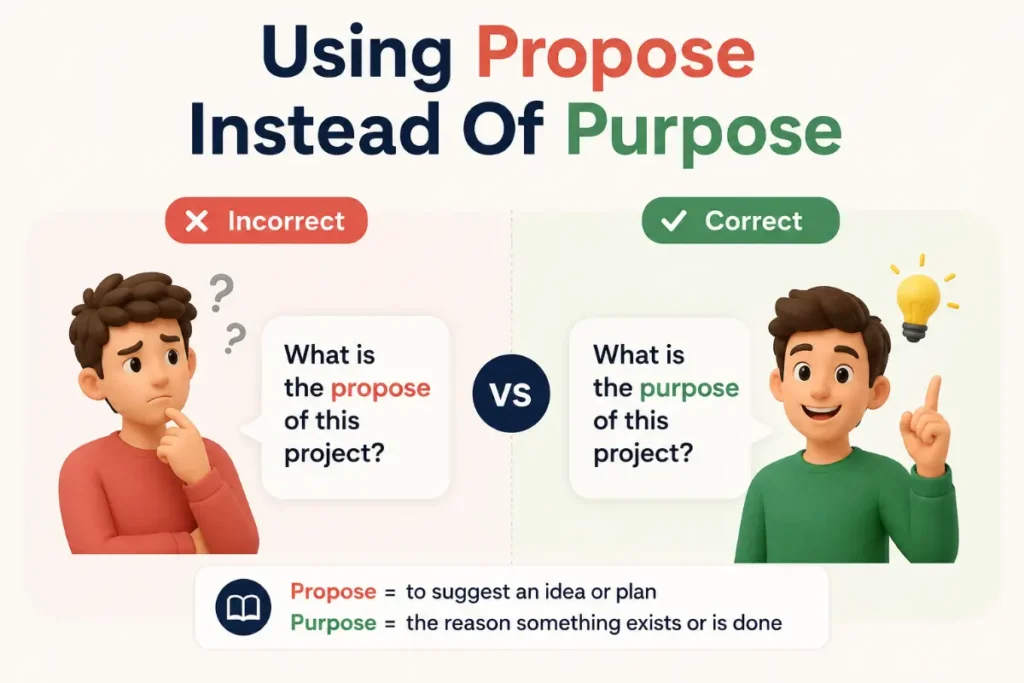
Using Purpose Instead Of Propose
Incorrect.
I purpose a new marketing strategy.
Correct.
I propose a new marketing strategy.
Why?
You are suggesting an idea, so you need the verb propose.
Using Propose Instead Of Purpose
Incorrect.
The propose of this lesson is to improve grammar.
Correct.
The purpose of this lesson is to improve grammar.
Why?
You are talking about a goal or reason, so the noun purpose is the correct choice.
Thinking Purpose Is Always A Noun
Many learners believe purpose can never be a verb.
It can be a verb in formal English, but native speakers rarely use it today.
Formal example.
She purposed to finish the project early.
Natural modern English.
She planned to finish the project early.
Confusing Proposal With Purpose
These words are related but have different meanings.
A proposal is a suggestion or formal offer.
A purpose is the reason behind that suggestion.
Example.
The proposal explained the purpose of the project.
Memory Tricks
These simple tricks make the difference easy to remember.
Propose Starts A Plan
Think of propose as the word that starts an idea.
If you are presenting something for people to consider, choose propose.
Purpose Explains Why
Think of purpose as the answer to Why.
Every goal, lesson, project, and meeting has a purpose.
Ask Yourself One Question
Complete this sentence.
The __________ of this meeting is to…
The only word that fits is purpose.
Now try this one.
I __________ changing the schedule.
The correct answer is propose.
Related Words
Building a stronger vocabulary helps you avoid future mistakes.
Words Related To Propose
- Suggest.
- Recommend.
- Present.
- Offer.
- Introduce.
- Advocate.
Words Related To Purpose
- Goal.
- Aim.
- Objective.
- Mission.
- Intention.
- Reason.
Frequently Confused Words
- Propose and proposal.
- Purpose and objective.
- Purpose and goal.
- Suggest and propose.
- Intent and intention.
Learning these words together makes it easier to understand the subtle differences.
Expert Editor’s Note
Professional editors recommend choosing the word based on its grammar role instead of its spelling.
Use propose only when introducing an idea, recommendation, or offer.
Use purpose when explaining the reason, objective, or intention behind something.
Major dictionaries consistently define propose as a verb and purpose primarily as a noun. Although purpose also functions as a verb, modern American English rarely uses that form outside formal or literary writing.
If your sentence sounds unnatural, ask yourself one simple question.
Am I suggesting something or explaining why something exists?
The answer almost always points you to the correct word.
Suggested Internal Link: Propose Vs Suggest Differences With Examples.
Frequently Asked Questions
Is It Propose Or Purpose?
Both are correct English words, but they have different meanings. Propose means to suggest an idea or make an offer. Purpose means a reason, goal, or objective.
Can Purpose Be Used As A Verb?
Yes. Purpose can be a verb meaning to intend. However, this usage is uncommon in modern American English. Most native speakers use intend or plan instead.
What Is The Difference Between Propose And Proposal?
Propose is the verb. Proposal is the noun created from that verb. You propose an idea, and the written or spoken suggestion becomes a proposal.
Why Do People Mix Up Propose And Purpose?
The words have similar spelling, share related historical roots, and appear in similar professional settings. Their meanings, however, are completely different.
Which Word Is More Common In Everyday English?
Both are common, but they appear in different situations. People use propose when making suggestions or marriage offers. They use purpose when discussing goals, reasons, or intentions.
Is Purpose The Same As Goal?
Not exactly. A goal is something you want to achieve. A purpose is the reason behind that goal. They are closely related but not interchangeable.
How Can I Remember The Difference?
Remember this simple rule.
Propose introduces an idea.
Purpose explains the reason behind it.
Many readers also check It Is Must vs It Is a Must: Which One Is Correct in 2026?.
Conclusion
The difference between propose vs purpose becomes clear once you understand their grammar and meaning.
Propose is a verb that means to suggest an idea, offer a solution, or ask someone to marry you.
Purpose is usually a noun that means a reason, objective, or intention. Although it can also work as a verb, that use is uncommon in modern English.
The biggest mistake is treating these words as interchangeable. They perform different jobs in a sentence and express different ideas.
Whenever you feel unsure, remember one simple question.
Are you suggesting something or explaining why it exists?
That quick check will help you choose the correct word every time.

Vocabulary & Language Research Writer
Ethan Parker researches English vocabulary, word meanings, slang, idioms, and commonly confused words. His goal is to help readers understand how English is actually used in everyday conversations and writing.