
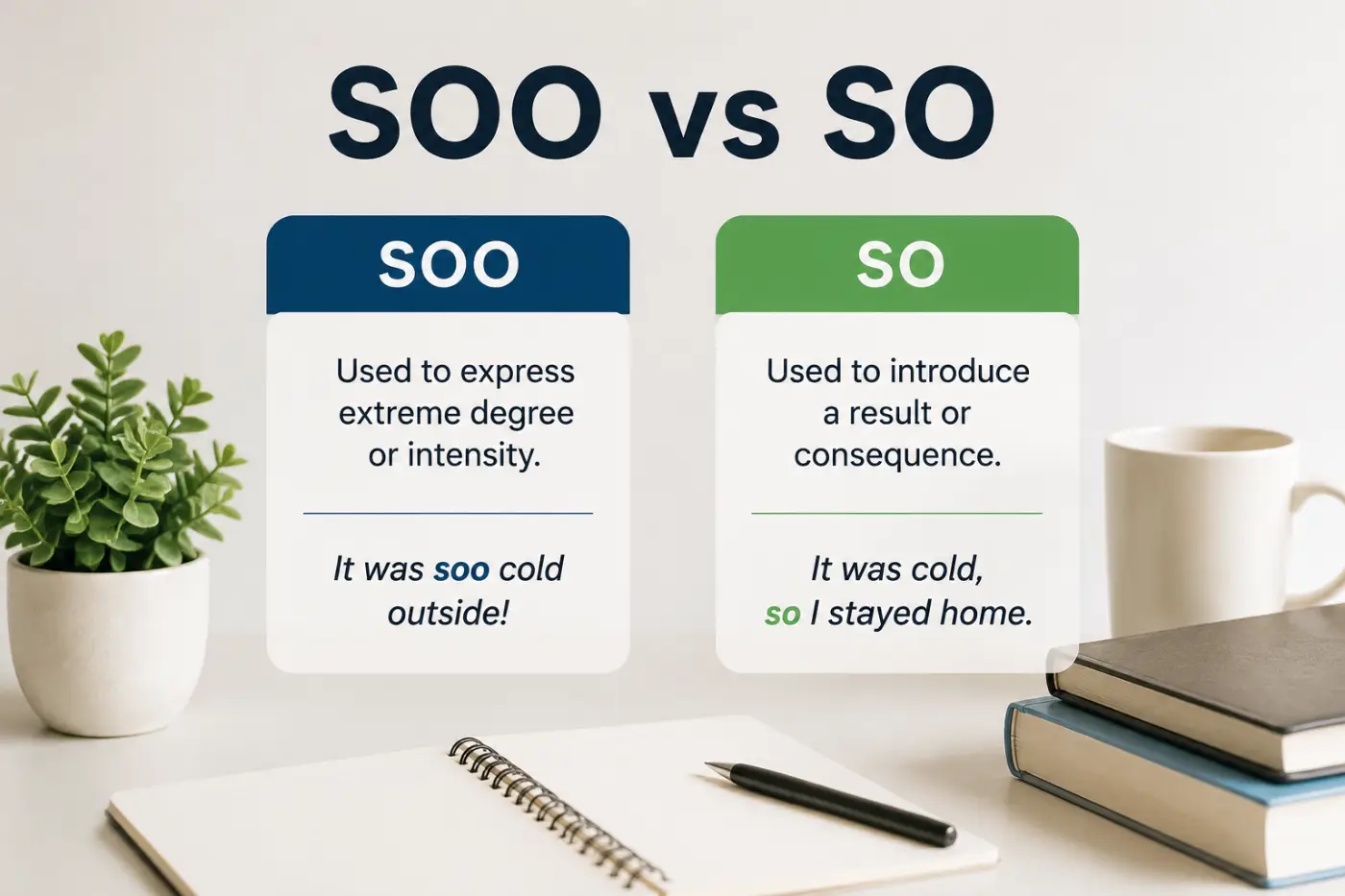
If you’ve searched for soo vs so, you’re probably trying to figure out if soo is a real English word or simply a common spelling mistake. The short answer is simple. In standard English, so is the correct spelling in almost every situation. Soo is usually an informal variation people use online to stretch the sound of the word for emphasis, excitement, or emotion.
The confusion has grown because social media, texting, memes, and online conversations often ignore standard spelling rules. You might read sentences like I’m soo happy or This is soo funny and wonder if the extra letter makes it acceptable English. It doesn’t in formal writing.
Knowing the difference matters because using the correct spelling helps your writing look polished and professional. At the same time, understanding why people intentionally write soo helps you recognize modern internet language without copying it into situations where it doesn’t belong.
In this guide, you’ll learn the difference between soo and so, when each appears, why people confuse them, how dictionaries and style guides treat them, and plenty of natural examples that make the rule easy to remember.
Learn the difference in Passerby Passersby Or Passerbyers Which Form Is Correct 2026.
Quick Answer
So is the correct English spelling. It works as an adverb, conjunction, pronoun, adjective, and intensifier. Soo is not a standard English word. It is an informal spelling people sometimes use in text messages and social media to show extra emotion or emphasis.
Soo Vs So Comparison Table
| Feature | So | Soo |
|---|---|---|
| Standard English | Yes | No |
| Dictionary word | Yes | No |
| Correct spelling | Yes | No |
| Part of speech | Adverb conjunction pronoun adjective | Informal internet spelling |
| Formal writing | Yes | No |
| Academic writing | Yes | No |
| Business emails | Yes | No |
| Text messages | Yes | Sometimes for emphasis |
| Meaning | Indicates degree result agreement or emphasis | Same intended meaning as so but exaggerated |
| Example | I am so excited. | I am soo excited. |
Which One Is Correct
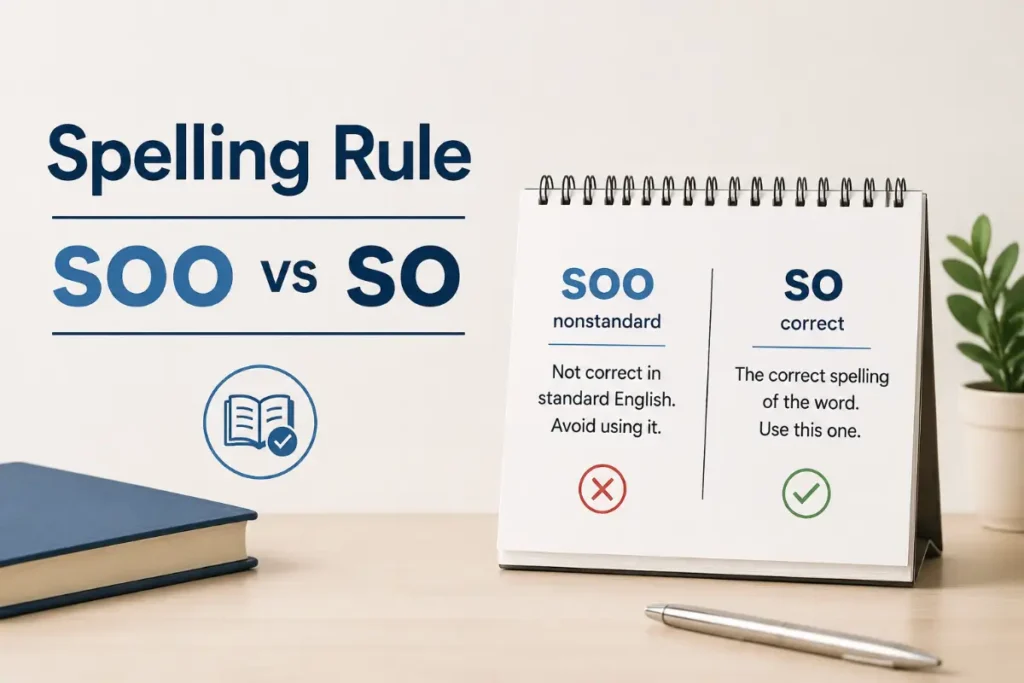
The correct spelling is so.
You should use so in school assignments, business emails, professional writing, books, articles, websites, and everyday communication.
The spelling soo is considered nonstandard English. People intentionally add another o to stretch the pronunciation and make the sentence sound more emotional.
Compare these examples.
✔ I’m so grateful for your help.
✔ She was so excited about the trip.
✔ Thank you so much.
✘ I’m soo grateful for your help.
✘ She was soo excited.
The last two examples may appear in casual texting, but they are not considered correct English.
What Does So Mean
So is one of the most common words in English. Its meaning changes depending on how it is used.
So As An Adverb
This is the most common use.
It means to a great degree or very.
Examples.
- The movie was so funny.
- I’m so tired today.
- She looks so happy.
- That puzzle was so difficult.
- Your idea is so creative.
So As A Conjunction
It can also connect two ideas and show a result.
Examples.
- It started raining, so we stayed inside.
- He studied every day, so he passed the exam.
- We left early, so we avoided traffic.
- She forgot her keys, so she called her roommate.
- The store was closed, so we came back later.
So As An Intensifier
Native speakers often use so to add emphasis.
Examples.
- That was so good.
- This coffee is so hot.
- I’m so proud of you.
- You’re so kind.
- The sunset looked so beautiful.
What Does Soo Mean
Unlike so, soo is not recognized as a standard English word.
People usually write it online to stretch the sound of so.
Think of it as adding extra emotion instead of changing the meaning.
For example.
I’m soo excited.
This cake is soo delicious.
You’re soo funny.
The writer still means so, but the extra letter makes the emotion feel stronger.
This style appears often in.
- Text messages.
- Social media captions.
- Online comments.
- Personal chats.
- Memes.
It should not appear in professional or academic writing.
Why People Write Soo
People rarely write soo because they think it is the correct spelling.
Most use it for expression.
Adding extra letters can make a sentence sound more emotional or playful.
For example.
So happy.
Soo happy.
Soooo happy.
Each version sounds a little more excited even though the meaning stays the same.
This style is common across many internet words.
Examples include.
- Pleeease.
- Yayyy.
- Noooo.
- Yessss.
- Okaay.
These spellings imitate how people stretch words while speaking.
Why People Confuse Soo And So
Several reasons explain the confusion.
Social Media
Millions of posts include soo, making it look like a legitimate spelling.
Text Messages
Friends often ignore grammar rules during casual conversations.
Visual Familiarity
The more people see soo, the more normal it begins to feel.
Voice Representation
Extra letters imitate spoken emphasis.
For example.
I’m so excited.
I’m sooo excited.
Both express excitement, but the second sentence sounds more dramatic.
Lack Of Grammar Knowledge
Some English learners assume soo is another accepted spelling instead of an informal internet variation.
Key Differences Between Soo And So
| Feature | So | Soo |
|---|---|---|
| Correct English spelling | Yes | No |
| Appears in dictionaries | Yes | No |
| Used in formal writing | Yes | No |
| Used in school | Yes | No |
| Used in business writing | Yes | No |
| Used online | Yes | Yes |
| Indicates emphasis | Yes | Yes |
| Standard grammar | Yes | No |
Grammar Explanation
Grammar makes the answer easy.
So belongs to standard English grammar.
It performs several grammatical jobs.
- Adverb.
- Conjunction.
- Pronoun in certain expressions.
- Adjective in limited cases.
Because it serves multiple grammatical functions, dictionaries recognize it as a complete English word.
Soo has no grammatical role.
It simply replaces so in informal writing for stylistic effect.
Grammar books, dictionaries, teachers, editors, and style guides all recommend using so in standard English.
Spelling Rule
English does not form emphasis by changing a word’s spelling.
Instead, writers create emphasis with punctuation, stronger vocabulary, or sentence structure.
For example.
Correct.
I was so surprised.
I was incredibly surprised.
I was extremely surprised.
Informal.
I was sooo surprised.
Professional writers almost always choose better vocabulary instead of adding extra letters.
Learn the difference in Vender Vs Vendor Which Spelling Is Correct 2026.
Pronunciation Guide
So
IPA
American English
/soʊ/
Syllables
One.
Stress
The entire word receives stress when emphasizing a sentence.
Soo
People pronounce soo exactly like so.
The extra letter does not change pronunciation.
It only suggests holding the vowel sound longer for dramatic effect.
For example.
Soooo good.
Native speakers simply stretch the o sound while speaking.
Word Origin And History
The word so has been part of English for centuries. It comes from Old English and has always been one of the language’s most useful words. Over time, it developed several meanings, including showing degree, introducing a result, adding emphasis, and replacing previously mentioned ideas.
Because so has existed for such a long time, it appears in every kind of English, from classic literature to modern conversations.
The spelling soo has a very different history.
It did not develop through grammar or dictionary rules. Instead, it grew from internet culture, text messaging, and social media. People began adding extra letters to words to imitate the way they stretch sounds while speaking.
Examples include.
- Nooo.
- Yessss.
- Pleeease.
- Soo.
- Okaaay.
These spellings express emotion instead of creating new words.
British American Canadian And Australian English
There is no regional spelling difference between so and soo.
English speakers in the United States, the United Kingdom, Canada, Australia, and New Zealand all use so as the standard spelling.
The informal spelling soo appears online in many English speaking countries, but it is still considered nonstandard.
Here is what you can expect.
Formal Writing
Always write so.
Academic Writing
Always write so.
Workplace Communication
Always write so.
Casual Texting
Many people write soo or even sooo to sound more expressive.
No major English style guide recommends using soo outside informal conversations.
Real Life Examples
Seeing both forms in context makes the difference much easier to remember.
Daily Conversation
- I’m so glad you came.
- She looked so surprised.
- The weather is so nice today.
- You’re so thoughtful.
Workplace
- Thank you so much for your quick response.
- The presentation was so clear.
- Our meeting ended so early.
- The client was so pleased with the results.
Emails
- I’m so grateful for your support.
- We appreciate your help so much.
Academic Writing
- The experiment produced so many interesting results.
- The evidence was so convincing that researchers repeated the study.
Journalism
- The crowd was so large that police closed nearby streets.
- The interview became so popular that millions watched it online.
Literature
- She loved him so deeply that she never forgot his kindness.
- The storm grew so fierce that everyone stayed indoors.
Social Media
- I’m soo excited for the weekend.
- This dessert is soo good.
- You’re sooo funny.
- That movie was sooo emotional.
Notice something important.
Examples seventeen through twenty reflect casual internet writing. They are appropriate for personal chats and social media but not for professional communication.
Common Mistakes
People make the same mistakes again and again with these words.
Thinking Soo Is A Correct Alternative
Incorrect.
I’m soo happy to meet you.
Correct.
I’m so happy to meet you.
The first sentence is acceptable only in casual texting.
Using Soo In Professional Writing
Incorrect.
Thank you soo much for your consideration.
Correct.
Thank you so much for your consideration.
Business writing should always follow standard spelling.
Assuming More Letters Mean Better English
Some learners believe adding extra letters makes writing stronger.
It doesn’t.
Good writers create emphasis through word choice instead.
Compare these examples.
I’m so excited.
I’m incredibly excited.
I’m absolutely thrilled.
The last two sentences sound more polished than simply adding extra letters.
Confusing Soo With A Different Word
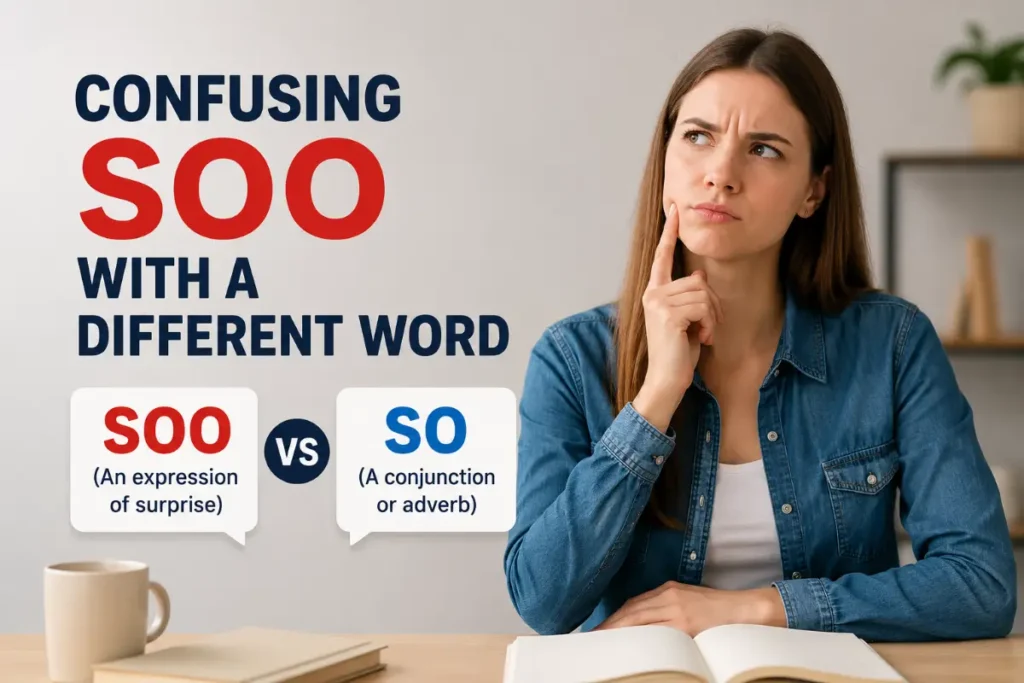
Some people wonder if soo has its own dictionary meaning.
It doesn’t.
It is simply an informal spelling variation of so.
Professional Writing Tips
Editors almost never recommend stretching words with extra letters.
Instead, they strengthen the sentence naturally.
Instead of writing.
I’m sooo happy.
Try writing.
- I’m absolutely thrilled.
- I’m incredibly happy.
- I’m genuinely excited.
- I’m delighted.
These choices sound more natural and professional while expressing the same feeling.
Memory Tricks
Remembering the correct spelling is simple once you know these tricks.
One Letter Makes It Correct
So has one o because it is the standard English word.
If you see another o, you’re probably looking at internet slang.
Think About Dictionaries
Open any English dictionary.
You’ll find so.
You won’t find soo as a standard English word.
Ask Yourself Where You’re Writing
If the answer is school, work, an email, or an article, choose so.
If you’re sending a playful text to a close friend, soo may appear for extra emotion, but remember it is still informal.
Related Words
Learning related words helps expand your vocabulary.
Synonyms For So
- Very.
- Extremely.
- Quite.
- Really.
- Highly.
Words That Show Results
- Therefore.
- Thus.
- Consequently.
- As a result.
Related Expressions
- So much.
- So far.
- So long.
- So what.
- So be it.
Frequently Confused Words
- Too and to.
- Then and than.
- Really and real.
- Very and so.
- Such and so.
These words often appear in similar situations, so learning their differences improves your overall writing.
Expert Editor’s Note
Professional editors, teachers, dictionaries, and style guides all agree on one point. So is the correct spelling in standard English.
The spelling soo is an intentional stylistic choice, not an accepted alternative. It works in casual text messages, social media posts, and playful conversations where the goal is to show emotion instead of following formal writing rules.
If you’re writing an email, school paper, article, resume, business proposal, or website content, always use so.
Many experienced editors also recommend expressing emphasis with stronger vocabulary instead of stretching words.
Instead of writing.
I’m sooo excited.
Write.
- I’m incredibly excited.
- I’m absolutely thrilled.
- I’m genuinely delighted.
These choices sound more polished and leave a stronger impression.
Frequently Asked Questions
Is Soo A Real English Word?
No. Soo is not a standard English word. It is an informal spelling people use online to make so sound longer or more emotional.
Is Soo Ever Grammatically Correct?
Not in standard English. Grammar books, dictionaries, and style guides recognize so as the correct spelling. Soo belongs only in casual digital communication.
Why Do People Write Soo Instead Of So?
People add an extra o to imitate spoken emphasis. It makes the sentence feel more expressive without changing the meaning.
Can I Use Soo In An Essay?
No. Essays, reports, research papers, and academic assignments should always use so. Informal spellings reduce the professionalism of your writing.
Is Soo Accepted In Business Emails?
No. Professional communication should always follow standard English spelling. Use so in emails, presentations, proposals, and workplace documents.
Is Sooo Also Incorrect?
Yes. Sooo, soooo, and similar spellings are informal variations used for dramatic effect. They are common in text messages but not in formal English.
What Is The Difference Between So And Very?
Both words add emphasis, but they are not always interchangeable. Very only works as an adverb before adjectives and adverbs. So has several grammar functions and can also introduce a result.
How Can I Remember The Correct Spelling?
Remember that dictionaries contain so with one o. Any extra letters usually signal internet slang rather than standard English.
Still confused? Compare Encorporate Vs Incorporate Which Spelling Is Correct 2026.
Conclusion
The answer to soo vs so is straightforward.
So is the correct spelling in standard English. It appears in dictionaries, grammar books, academic writing, business communication, journalism, and everyday conversation.
Soo is an informal spelling people use online to add emotion or stretch the pronunciation. It does not create a new word, and it should not appear in formal writing.
If you’re writing for school, work, or publication, always choose so.
If you’re chatting with friends, you may see soo or sooo, but remember that they are stylistic choices rather than correct spellings.
A simple rule will keep you on track every time.
One o is standard English. Extra o’s are for casual expression.

Editorial Reviewer & Proofreader
Grace Mitchell reviews Gramlify’s articles for clarity, consistency, and readability. She is passionate about creating accurate, approachable content that helps English learners build confidence.