
When you need the plural of zero you may stop and wonder if the correct spelling is zeroes or zeros. Both forms are correct. The real question is which form fits your audience and writing style best.
In American English zeros is the more common choice. Zeroes is also standard English and remains widely accepted especially in British English and in some contexts where writers prefer to keep the spelling close to the pronunciation or traditional form.
The difference doesn’t change the meaning. Both words refer to more than one zero. You can use them for numbers such as 0 or for figurative meanings such as people who contribute nothing.
The choice becomes more interesting when you look at pronunciation regional preferences formal writing and special uses. For example a math teacher might write three zeros while another writer may choose three zeroes. Neither spelling is automatically wrong.
This guide explains zeroes or zeros from every useful angle. You’ll learn the correct spelling the grammar behind both forms their pronunciation history regional preferences and the situations where one form may feel more natural than the other.
Many readers also check Affend Vs Offend Which Word Is Correct 2026.
Quick Answer
Both zeros and zeroes are correct plural forms of zero. American English generally favors zeros while zeroes is also accepted and appears more often in British English. Use zeros for a natural American style. Use zeroes if it matches your chosen dictionary or style guide.
Zeroes Or Zeros Comparison
| Feature | Zeros | Zeroes |
|---|---|---|
| Correct spelling | Yes | Yes |
| Singular form | Zero | Zero |
| Meaning | More than one zero | More than one zero |
| Part of speech | Plural noun | Plural noun |
| American English | More common | Correct but less common |
| British English | Correct | Often preferred |
| Canadian English | Common | Also accepted |
| Australian English | Common | Also accepted |
| Formal writing | Fully acceptable | Fully acceptable |
| Informal writing | Very common | Common |
| Pronunciation | Usually the same | Usually the same |
| Example | The number has three zeros. | The number has three zeroes. |
What Does Zero Mean
Before comparing the plural forms it helps to understand the singular word zero.
Zero is a noun that represents the number 0. It can also refer to the absence of something or to a point on a scale.
For example:
- The temperature fell to zero.
- The account has a zero balance.
- Add zero to the number.
- The score was zero to zero.
The word can also appear as part of common expressions.
A person may say zero chance to mean no chance. Someone may say zero interest to mean no interest at all.
The plural forms zeros and zeroes simply refer to more than one zero.
What Does Zeros Mean
Zeros is the plural form of zero.
It can refer to multiple instances of the number 0.
For example:
- The password contains three zeros.
- There are two zeros in the number 100.
- The machine displayed several zeros.
The spelling zeros is especially natural in American English.
It follows a common English plural pattern in which a noun ending in o takes s rather than es.
Other examples include:
- Photos.
- Pianos.
- Radios.
- Videos.
- Zeros.
This doesn’t mean every noun ending in o follows the same rule. English has many exceptions. That’s one reason learners often hesitate when forming the plural.
What Does Zeroes Mean
Zeroes is another accepted plural form of zero.
Its meaning is exactly the same as zeros.
For example:
The number contains four zeroes.
The number contains four zeros.
Both sentences mean the same thing.
The spelling zeroes may feel more traditional to some writers. It also appears frequently in British English.
You don’t need to treat zeroes as an incorrect spelling simply because zeros is more common in American English.
Which One Is Correct
Both zeros and zeroes are correct.
For an American audience zeros is usually the better default because it is the more common spelling in US English.
If you’re writing for a British audience zeroes may feel more familiar. However zeros is still understandable and accepted.
The most important point is consistency.
If your document uses American English choose zeros unless a particular publication or style guide says otherwise.
If you’re following British English choose the form that matches your preferred dictionary and editorial style.
Neither spelling changes the pronunciation or basic meaning.
Why People Confuse Zeroes And Zeros
The confusion comes from a familiar English spelling problem.
The singular word ends in o. English has several different ways to form plurals for words ending in o.
For example:
- Potato becomes potatoes.
- Tomato becomes tomatoes.
- Photo becomes photos.
- Piano becomes pianos.
- Zero can become zeros or zeroes.
Because both s and es appear in real English words people can’t always predict the correct plural from spelling alone.
The Visual Difference Is Small.
The two forms differ by only one letter.
Zeros
Zeroes
That makes them easy to confuse when reading quickly or typing from memory.
Different Dictionaries Can Reinforce The Confusion
English dictionaries may list both forms but show different usage preferences.
One dictionary may give zeros first. Another may present zeroes prominently.
That doesn’t mean one dictionary is right and the other is wrong. English often allows more than one standard form.
Regional English Adds Another Layer
American writers commonly use zeros.
British writers may use zeroes more often.
This creates the impression that one spelling must be correct and the other must be incorrect. The reality is more flexible.
Key Difference Between Zeroes And Zeros
There is almost no difference in meaning.
The main distinction involves regional preference and style.
Meaning
Both forms mean multiple zeros.
Grammar
Both forms are plural nouns.
Pronunciation
Both are normally pronounced the same way.
Spelling
Zeros uses the simpler plural ending s.
Zeroes uses es.
Regional Preference
Zeros is especially common in American English.
Zeroes has stronger traditional use in British English.
Tone
Neither form is inherently more formal or more informal.
Function
Both can describe numerical zeros and figurative uses of the word.
Grammar Explanation
The grammar here is simple.
Zero is singular.
Zeros and zeroes are plural.
You use a singular verb with zero and a plural verb with zeros or zeroes when the word refers to multiple objects.
Examples:
One zero is missing.
Two zeros are missing.
One zero appears on the screen.
Several zeroes appear on the screen.
The plural noun itself doesn’t change the sentence structure beyond normal subject and verb agreement.
Zero As A Number
When zero means the number 0 it can behave differently from many ordinary singular nouns in certain expressions.
For example:
Zero dollars is enough for this purchase.
Here zero dollars refers to an amount. English commonly treats an amount of zero as singular in expressions involving a quantity.
But when you’re clearly counting individual zero symbols the plural is natural.
There are three zeros in the number.
That distinction matters in careful writing.
Zero In Mathematics
Mathematical writing normally uses the numeral 0 when precision matters.
For example:
The equation has two zeros.
Here zeros means two instances of the number or two values of zero depending on context.
The word zeroes can express the same idea.
Zero As A Verb
The word zero can also function as a verb.
For example:
The technician zeroed the instrument.
The verb means to set something to zero or adjust it so that its starting point is zero.
The past tense is normally zeroed.
You generally won’t use zeroes as the third person singular present form of the verb in the same way.
For example:
The technician zeroes the instrument before testing.
This spelling is possible because zeroes can also be a verb form.
That creates an important grammatical distinction.
Zeros can be a plural noun.
Zeroes can be a plural noun or a third person singular verb depending on the sentence.
Context tells you which meaning applies.
Zeroes As A Verb
This is one of the most useful details to know.
Zeroes isn’t always a plural noun.
It can also be the third person singular present tense of zero.
Example:
The engineer zeroes the scale before each test.
Here zeroes means the engineer sets the scale to zero.
Compare it with:
The scale contains three zeroes.
Here zeroes is a plural noun.
This distinction can matter in editing because the surrounding grammar changes the interpretation.
Zeroes In Verb Forms
The verb can appear in several forms.
Base form: zero.
Third person singular: zeroes or zeros.
Past tense: zeroed.
Present participle: zeroing.
Examples:
- I zero the machine before testing it.
- She zeroes the machine before testing it.
- They zero the machines before testing them.
- We zeroed the machine yesterday.
- He is zeroing the instrument now.
Both zeroes and zeros can appear as the third person singular verb form in standard English usage.
This gives zeroes one extra grammatical role that zeros can have as well.
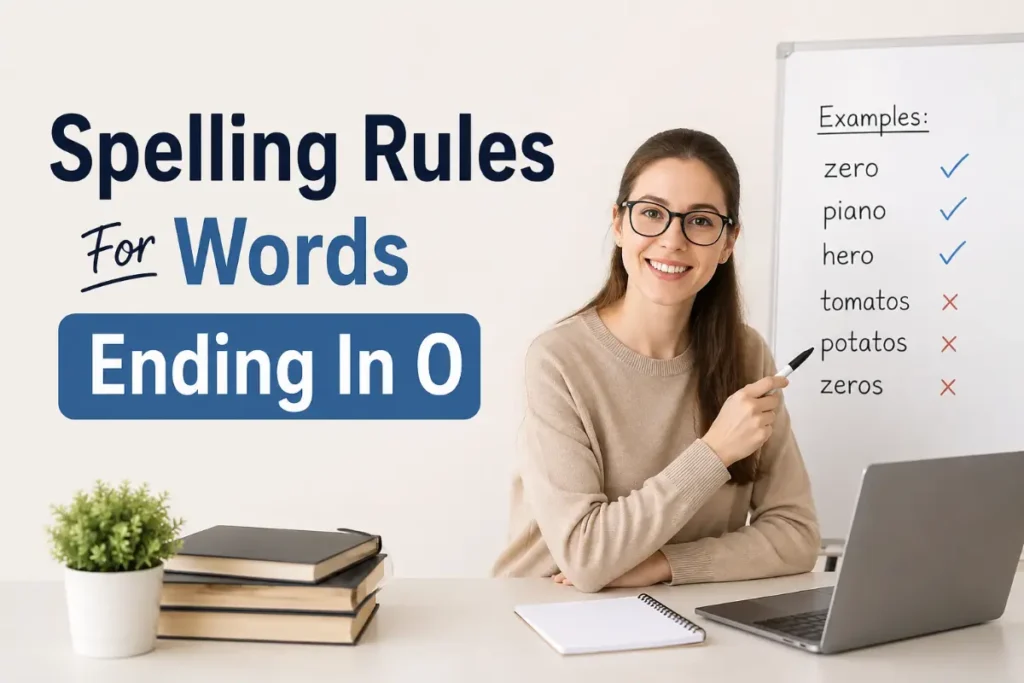
Spelling Rules For Words Ending In O
There is no single rule that predicts every plural of a noun ending in o.
That’s worth remembering.
Some words take es.
- Tomato becomes tomatoes.
- Potato becomes potatoes.
- Hero becomes heroes.
Some commonly used words take s.
- Photo becomes photos.
- Piano becomes pianos.
- Radio becomes radios.
- Video becomes videos.
Then there are words with more than one accepted form.
Zero becomes zeros or zeroes.
This is a good example of why English spelling can’t always be reduced to one simple rule.
Need another quick comparison? Read Comming Vs Coming Which Spelling Is Correct 2026.
Pronunciation Guide
Both zeros and zeroes are normally pronounced the same way.
American English
Zeroes
/ˈzɪroʊz/
Zeros
/ˈzɪroʊz/
The word has two syllables.
ZE roes
The main stress falls on the first syllable.
Common Pronunciation Mistake
Some learners pronounce the final part too strongly because they see es in the spelling zeroes.
You don’t normally add an extra syllable simply because the spelling contains es.
Both forms generally have the same two syllables.
The final s sound is pronounced as a z sound.
Etymology And Word Origin
The history of zero is more interesting than its simple modern meaning suggests.
The English word ultimately traces back through French and Italian to Arabic ṣifr meaning empty or nothing.
The concept traveled through the mathematical traditions of the Middle East and South Asia before becoming established in European mathematics.
The Arabic term developed from a Sanskrit term associated with emptiness or a void.
Over time the concept became essential to mathematics because zero could represent the absence of a quantity and also function as a placeholder in positional number systems.
The English noun zero became established centuries ago.
Its plural forms developed naturally as English speakers applied ordinary plural patterns to the word.
Because English permits both zeros and zeroes modern dictionaries recognize both forms.
British And American English
Regional preference is one of the main reasons people search for zeroes or zeros.
American English
Zeros is the usual choice.
For an American audience this sentence sounds completely natural:
The number contains three zeros.
You may still see zeroes in American writing. It isn’t automatically an error.
British English
Zeroes has a long history of use in British English.
British writers may naturally write:
The number contains three zeroes.
However zeros also appears in British sources.
So the difference isn’t a strict US versus UK rule.
It’s better to think of it as a usage preference.
Canadian English
Canadian English accepts both forms.
Writers may encounter either spelling depending on the publication dictionary or editorial preference.
Australian English
Australian English also recognizes both forms.
As in Canadian English the choice often depends on the writer’s preferred style and the publication’s house rules.
Real Life Examples Of Zeros
Seeing the words in context makes the difference easier to remember.
Daily Conversation
- There are two zeros at the end of the number.
- I accidentally added three zeros to the price.
- The display showed nothing but zeros.
- The code has four zeros in a row.
Workplace Writing
- Please check the report for missing zeros.
- The accounting system added two zeros to the figure.
- Make sure there aren’t any extra zeros in the invoice.
- The calculator returned a series of zeros.
Email Writing
- I noticed three zeros in the account number.
- Could you confirm the number of zeros in the reference code.
Academic Writing
- The student incorrectly placed two zeros after the decimal point.
- The sequence contains several consecutive zeros.
- The graph crosses the axis at two zeros.
- The calculation produces three zeros in the final result.
Journalism
- The company reported losses followed by several zeros.
- The figure contains six zeros after the leading digit.
Social Media
- Add a few zeros to that estimate and you might be closer to the real cost.
- I stared at the screen as the zeros kept appearing.
Technical Writing
- The sensor output should display zeros when no signal is detected.
- Remove the leading zeros before entering the value into the system.
Literature And Creative Writing
- His bank balance had more zeros than he expected.
- The digital clock flickered with rows of zeros.
These examples show how naturally zeros works across American English.
Real Life Examples Of Zeroes
The alternative form works just as well.
- The number contains three zeroes.
- She counted five zeroes in the sequence.
- The display showed a row of zeroes.
- Remove the extra zeroes before submitting the form.
- The calculation produced several zeroes.
- The document contains too many leading zeroes.
- The technician checked the panel for unexpected zeroes.
- The account number has two zeroes in the middle.
There is no change in meaning.
The choice is mainly stylistic and regional.
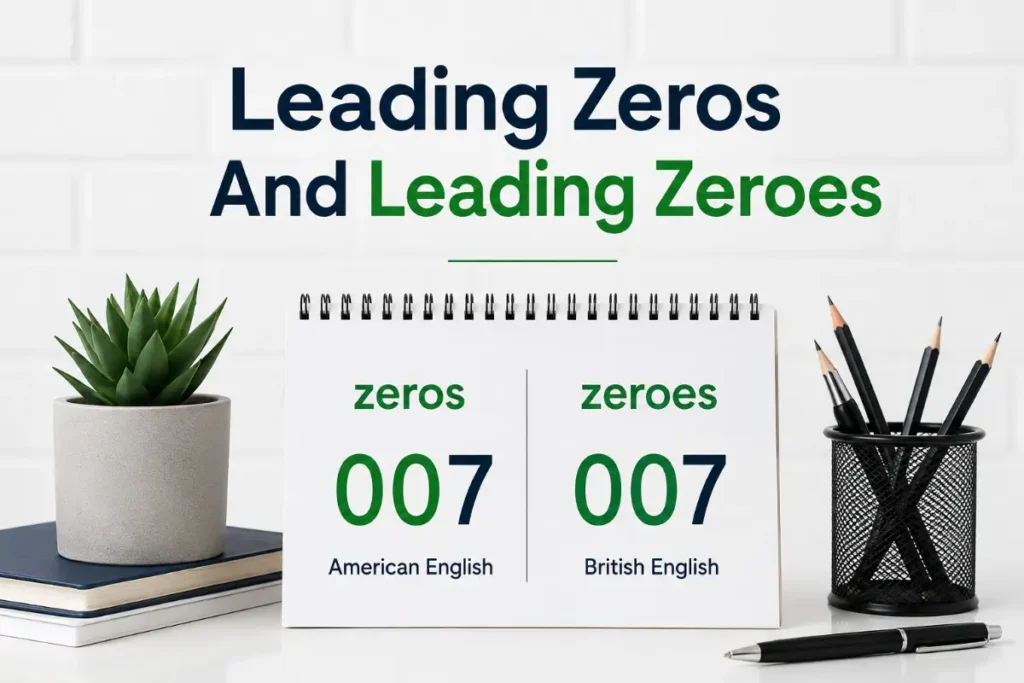
Leading Zeros And Leading Zeroes
One phrase deserves special attention.
Leading zeros means zeros placed before the main digits of a number.
For example:
007
The two zeros before 7 are leading zeros.
You may also see:
007 has two leading zeroes.
Both forms are correct.
In American technical writing leading zeros is usually the more natural choice.
This phrase appears frequently in programming mathematics finance data entry and statistics.
Why Leading Zeros Matter
Leading zeros can change the format of data even when they don’t change the numerical value.
For example:
7
and
007
represent the same numerical quantity in many contexts. However they may have different meanings as identification codes.
A ZIP code employee ID product code or account number may require leading zeros.
That is why writers should not remove them automatically.
Common Mistakes With Zeroes And Zeros
Mistake One Treating Zeroes As Wrong
Some writers assume zeroes is an incorrect spelling.
It isn’t.
It is a legitimate plural form.
Mistake Two Treating Zeros As Wrong
The opposite mistake happens too.
Some writers believe only zeroes is correct because the word ends in o.
That’s also incorrect.
Zeros is standard and especially common in American English.
Mistake Three Assuming All O Words Take Es
English doesn’t work that neatly.
Words such as photo piano and radio normally form plurals with s.
Words such as potato and tomato normally take es.
Zero allows both.
Mistake Four Confusing A Noun With A Verb
Consider these sentences.
The number has three zeroes.
She zeroes the scale.
The first uses zeroes as a plural noun.
The second uses zeroes as a verb.
The spelling alone doesn’t tell you the grammatical role.
Mistake Five Changing Zero To Zeros In Every Situation
Sometimes zero is already the correct form.
For example:
The temperature is zero degrees.
You wouldn’t write zeros degrees.
Use the plural only when referring to multiple zeros or multiple instances of the concept.
Memory Tricks For Remembering The Spelling
You don’t need a complicated rule.
Think American Zeros
If you’re writing for a US audience and you’re unsure choose zeros.
It is short simple and natural.
Remember Both Forms Are Real
Think:
Zero has two accepted plural spellings.
Zeros.
Zeroes.
That removes the false pressure to identify one as wrong.
Use The Meaning Test
If you’re talking about several number symbols use either zeros or zeroes.
If you’re describing an action such as setting something to zero zeroes or zeros may be the verb depending on the sentence.
Related Words
Understanding related vocabulary can prevent other common mistakes.
Zero
The singular noun.
Example:
There is one zero in the number.
Zeros
A plural noun.
Example:
There are three zeros in the number.
Zeroes
A plural noun or a verb form.
Example:
The number contains three zeroes.
She zeroes the scale.
Zeroed
The past tense of the verb zero.
Example:
The technician zeroed the instrument.
Zeroing
The present participle.
Example:
The technician is zeroing the instrument.
Zero Point
A point where a scale begins or reaches zero.
Zero Sum
An expression describing a situation where one person’s gain equals another person’s loss.
Zero Tolerance
A policy allowing no exceptions for a particular behavior.
Expert Editor’s Note
A professional editor would not mark zeroes as an error simply because zeros is more common in American English.
Both spellings have a place in standard English.
For a US focused website or publication I would normally choose zeros. It reads naturally to American readers and appears frequently in everyday technical and mathematical writing.
For British English I would check the publication’s preferred dictionary or house style before making a choice.
The bigger editorial issue is consistency.
Don’t switch between zeros and zeroes randomly within the same article. Pick one form and stay with it unless you’re discussing regional usage.
There’s also a useful distinction between zeroes as a noun and zeroes as a verb. A careful editor checks the sentence structure before deciding what the word means.
The safest practical advice is simple.
Writing for Americans. Choose zeros.
Writing for a British publication. Check the house style and dictionary preference.
Discussing English generally. Recognize both as correct.
Frequently Asked Questions
Is Zeros Or Zeroes Correct.
Both zeros and zeroes are correct plural forms of zero. The difference is mainly a matter of usage preference. American English generally favors zeros, while zeroes has stronger traditional use in British English. Neither spelling is a misspelling when used as the plural noun meaning more than one zero.
Is Zeros More Correct Than Zeroes.
No. Zeros isn’t more grammatically correct than zeroes. It is simply the more common choice in American English. If you’re writing for a US audience, zeros will usually sound more natural. Zeroes remains a valid standard form and may be preferred by some British writers and publications.
Do Americans Say Zeros Or Zeroes.
Americans generally use zeros more often. You’ll see it in mathematics, technology, business writing, data analysis, and everyday conversation. Zeroes is still understood and accepted in American English, so seeing it in a US publication doesn’t automatically indicate an error.
What Is The Plural Of Zero
The plural of zero can be zeros or zeroes. Both forms are standard. For American English, zeros is the best default choice. For British English, zeroes may be more common in some contexts. The meaning remains the same with either spelling.
Is Zeroes A British Spelling
Zeroes is widely used in British English, but it isn’t exclusively British. American English also recognizes the form. The important difference is frequency and editorial preference rather than a strict regional rule. You may encounter zeros in British writing and zeroes in American writing.
Can Zeroes Be A Verb
Yes. Zeroes can be the third person singular present form of the verb zero. For example, She zeroes the scale before every test. In this sentence zeroes means sets or adjusts the scale to zero. The same spelling can also function as the plural noun meaning multiple zeros.
How Do You Spell Leading Zeros
The standard phrase is leading zeros in American English. Leading zeroes is also correct. Both phrases describe zeros placed before the main digits of a number such as the two zeros in 007. In US writing leading zeros is usually the more natural choice.
Which Spelling Should I Use In American English
Use zeros as your default in American English. It is familiar and widely used across general writing, technical documents, mathematics, journalism, and online content. You can still use zeroes because it is correct, but zeros will usually feel more natural to a US reader.
A related grammar guide is Writen or Written Which Is Correct (2026 Guide).
Conclusion
So when you’re choosing between zeroes or zeros you don’t need to worry about picking a wrong word.
Both spellings are correct.
Zeros is the stronger default for American English.
Zeroes is also standard and has especially strong traditional use in British English.
Both forms mean more than one zero. Both can appear in phrases such as leading zeros or leading zeroes.
There’s one extra detail worth remembering. Zeroes can also function as a verb meaning that someone sets something to zero. Context determines the grammatical role.
For everyday American writing the practical choice is easy. Use zeros and keep your spelling consistent throughout the piece.
When two spellings carry the same meaning the best writer isn’t the one who memorizes more rules. It’s the one who knows which form fits the audience and uses it with confidence.

Editorial Reviewer & Proofreader
Grace Mitchell reviews Gramlify’s articles for clarity, consistency, and readability. She is passionate about creating accurate, approachable content that helps English learners build confidence.