
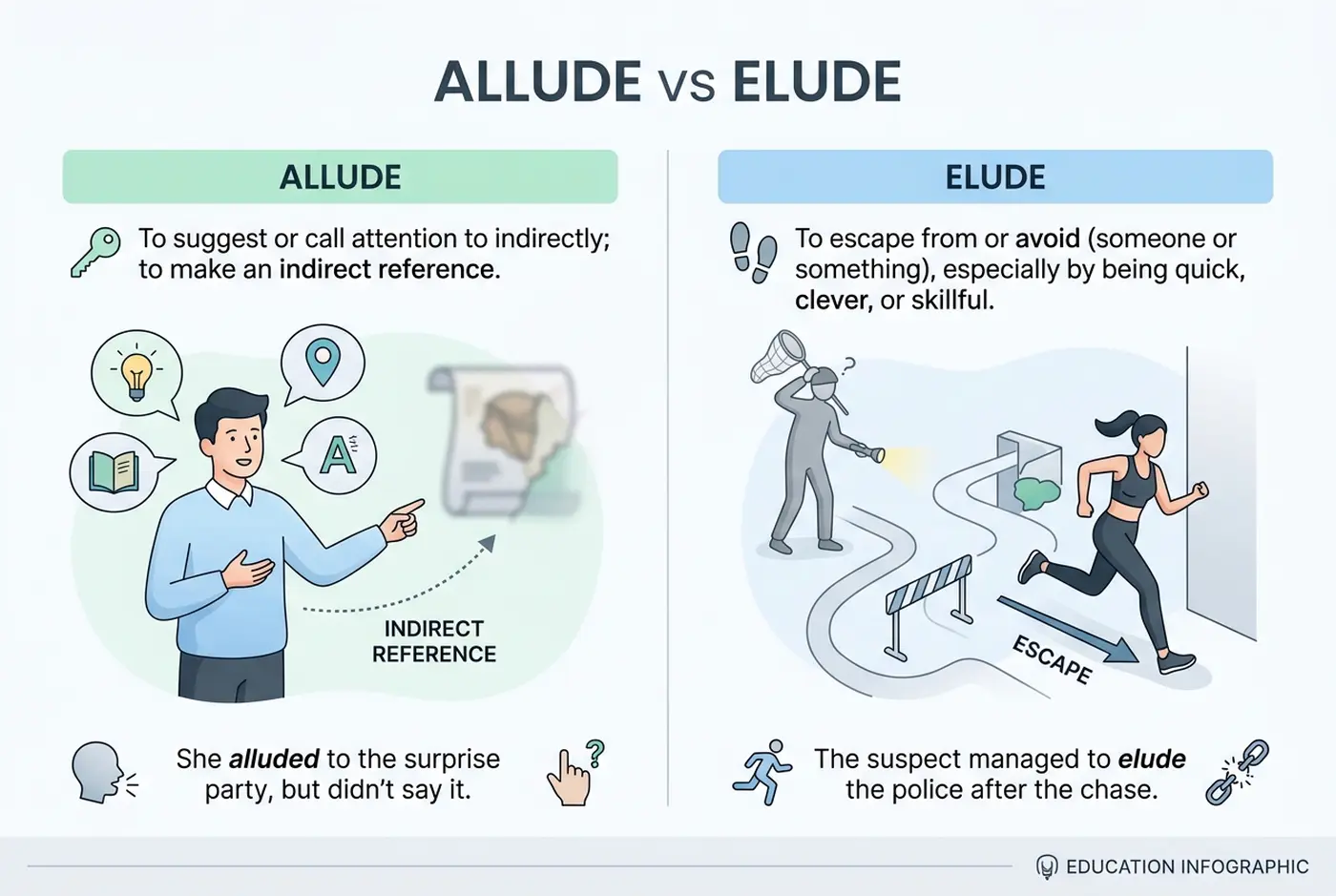
The difference between allude vs elude comes down to two distinct actions. Allude means to refer to something indirectly. Elude means to escape, avoid, or remain difficult to understand or remember. Both words sound similar and share several letters, but they express different ideas.
For example, a writer might allude to a famous novel without naming it directly. A suspect might elude the police by escaping capture. You might also find that a name eludes your memory when you know the person but can’t recall the name.
These words often confuse English learners because their spellings differ by only one letter. Their meanings can also seem abstract, especially when writers use them in figurative expressions. However, once you connect each word to its main action, choosing the right one becomes much easier.
In this guide, you’ll learn the definitions of allude and elude, their pronunciation, grammar, origins, and differences. You’ll also find practical examples for everyday conversations, professional emails, academic writing, and creative work. By the end, you’ll know how to use both words accurately and avoid one of the most common word choice mistakes in English.
Learn the difference in Maintained Vs Maintenanced Which Word Is Correct 2026 Guide.
Quick Answer
Allude means to mention or refer to something indirectly without stating it clearly. Elude means to escape, avoid capture, or remain difficult to understand, find, or remember. For example, a speaker can allude to a secret, while a criminal can elude the police. The words aren’t interchangeable.
Allude vs Elude Comparison Table
Both words are correct English verbs. The right choice depends on the action you want to describe.
| Feature | Allude | Elude |
|---|---|---|
| Meaning | Refer to something indirectly | Escape or avoid something |
| Part of speech | Verb | Verb |
| Pronunciation | uh LOOD | ih LOOD |
| IPA | /əˈluːd/ | /ɪˈluːd/ |
| Main idea | Hinting or referring | Escaping or evading |
| Common object | A topic, event, person, or idea | A pursuer, danger, problem, or memory |
| Formality | Common in formal and informal English | Common in formal and informal English |
| Example | She alluded to their disagreement. | He eluded the guards. |
| Figurative use | He alluded to a hidden meaning. | The answer eluded me. |
| Past tense | Alluded | Eluded |
| Present participle | Alluding | Eluding |
| Noun form | Allusion | Evasion is a related noun |
The easiest distinction to remember is this. Allude is about making an indirect reference. Elude is about escaping something or staying beyond someone’s reach.
What Does Allude Mean
Allude means to mention, suggest, or refer to something indirectly without discussing it fully or naming it outright. Speakers and writers use the word when they want to hint at an idea rather than explain it in detail.
For example, imagine a coworker says, “Some people haven’t been pulling their weight lately.” If the coworker means a particular team member but doesn’t name that person, the coworker may be alluding to that individual.
The reference can be subtle or fairly obvious. The defining feature is that the speaker points toward something instead of stating it directly.
How Allude Works in a Sentence
Allude usually takes the preposition to before the thing being referenced.
Common patterns include:
- Allude to a problem.
- Allude to a past event.
- Allude to someone’s behavior.
- Allude to a book or movie.
- Allude to a possible change.
- Allude to a private conversation.
Here are a few examples.
- The manager alluded to budget cuts during the meeting.
- Her speech alluded to the challenges she faced as a student.
- The novelist alludes to Greek mythology throughout the story.
- He alluded to a disagreement but refused to explain it.
- The advertisement alludes to a popular movie without naming it.
In each sentence, the subject makes an indirect reference. The word doesn’t mean that someone escaped, avoided danger, or failed to remember something.
Allude in Everyday Conversation
You don’t need to be a writer or public speaker to use allude correctly. The word can describe ordinary conversations in which people hint at something.
Consider these situations.
At work. A supervisor says the team needs to improve its communication. A colleague later explains that the supervisor alluded to recent disagreements.
Among friends. Someone mentions that an old friend has changed a lot. Another person notices that the speaker is alluding to a past argument.
In a family conversation. A parent mentions the sacrifices everyone has made without discussing one particular event. The parent may be alluding to a difficult period in the family’s life.
In casual speech, people often use hint at, refer to, or bring up indirectly instead of allude. However, allude is useful when you want a precise word for an indirect reference.
Allude in Literature and Writing
Writers often allude to familiar stories, historical events, myths, or cultural ideas. This technique can add meaning without requiring a long explanation.
For instance, a writer might describe a character’s journey as a long struggle against temptation. Readers familiar with the story of Odysseus may recognize an allusion to ancient Greek literature.
An allusion is the reference itself. To allude is the act of making that reference.
Here are more examples.
- The poem alludes to the biblical story of Noah.
- The film alludes to several classic horror movies.
- The author’s description alludes to a famous historical speech.
- The song alludes to the feeling of starting life over.
- The novel alludes to the legend of King Arthur.
Notice that the writer doesn’t need to explain every reference. Readers may recognize it through familiar names, themes, images, or events.

Allude Does Not Always Mean Hide Something
People sometimes assume that allude always means to hide a secret. That’s too narrow.
An indirect reference can be playful, respectful, literary, political, or simply convenient. A speaker might allude to a famous song because the audience already knows it. A teacher might allude to an earlier lesson to help students remember a concept.
The important point is that the speaker refers to something without spelling it out completely.
What Does Elude Mean
Elude means to escape from someone or something, avoid being caught or detected, or remain difficult to find, understand, achieve, or remember.
The word can describe a physical escape, but it also has several common figurative uses.
For example, a driver might elude the police by taking a route that allows the driver to escape. In another situation, the meaning of a difficult passage might elude a reader. The reader isn’t running away from the passage. Instead, its meaning remains beyond the reader’s understanding.
How Elude Works in a Sentence
Elude commonly takes a direct object. The object is the person, thing, idea, or goal that someone escapes or cannot reach.
Common patterns include:
- Elude the police.
- Elude capture.
- Elude detection.
- Elude understanding.
- Elude someone’s memory.
- Elude an opponent.
- Elude an attempt to solve a problem.
Examples include:
- The suspect eluded the police for several days.
- The answer eluded the researchers.
- Her name eluded me during the introduction.
- The athlete eluded two defenders and scored.
- A clear explanation continued to elude the committee.
The meaning changes slightly with the context, but the central idea stays the same. Something remains out of reach.
Elude in Physical Situations
In its literal sense, elude often describes escaping pursuit or avoiding capture.
For example:
- The fox eluded the hunters.
- The driver eluded the officers by leaving through a side street.
- The thief eluded capture until the following morning.
- The runner eluded his opponent in the final stretch.
- The fugitive managed to elude authorities for weeks.
These examples describe movement, pursuit, or an attempt to catch someone. The person or animal being pursued stays beyond the pursuer’s reach.
However, elude doesn’t always suggest wrongdoing. An athlete can elude a defender during a game, and an animal can elude a predator while trying to survive.
Elude in Figurative Situations
Elude is also common when something is mentally or practically difficult to grasp.
Consider these examples.
- The solution eluded the engineering team.
- The meaning of the poem eluded several readers.
- Financial security continued to elude the family.
- The reason for the sudden change eluded investigators.
- A sense of peace had long eluded him.
In these sentences, the subjects don’t literally run away. Instead, a solution, meaning, goal, reason, or feeling remains difficult to obtain or understand.
This figurative use makes elude a flexible word in professional writing, journalism, literature, and everyday speech.
Elude When Something Slips Your Mind
One of the most useful expressions with elude is elude someone’s memory.
Use it when you know something but can’t recall it at the moment.
For example:
- Her last name eludes me.
- The exact date eludes my memory.
- I know the actor’s face, but his name eludes me.
- The word I need keeps eluding me.
- His reason for leaving has always eluded me.
This usage is natural in both spoken and written English. It can sound slightly more polished than saying “I can’t remember,” although the simpler phrase is often better in casual conversation.
Elude and Achieving a Goal
Elude can also describe something that remains difficult to achieve.
For example:
- A championship continued to elude the team.
- Success eluded the business despite years of hard work.
- A lasting agreement eluded both sides.
- The perfect balance between cost and quality eluded the designers.
The goal isn’t necessarily impossible. It simply hasn’t been reached.
This distinction matters because elude doesn’t automatically mean failure forever. It often describes a temporary or ongoing inability to achieve something.

Allude vs Elude in Simple Words
If the definitions still feel similar, think about the direction of the action.
Allude points toward something. A person refers to an idea, person, event, or subject indirectly.
Elude moves away from something or stays out of reach. A person avoids capture, or a solution remains difficult to find.
Compare these sentences.
- The speaker alluded to a mistake. The speaker hinted at the mistake without explaining it fully.
- The mistake eluded the reviewer. The reviewer failed to notice the mistake.
- The author alluded to an old legend. The author made an indirect reference to the legend.
- The meaning of the legend eluded the reader. The reader couldn’t understand its meaning.
These examples show why the two verbs aren’t interchangeable. In the first sentence of each pair, someone refers to something. In the second, something remains beyond someone’s reach.
Key Differences Between Allude and Elude
The main difference is meaning, but a few grammar and usage details can help you choose the right word with confidence.
Meaning and Function
Allude describes an indirect reference. Elude describes an escape, an avoidance, or something that remains difficult to reach.
| Sentence | What it means |
|---|---|
| She alluded to a past relationship. | She hinted at the relationship. |
| The past continued to elude her. | She struggled to understand or escape something from her past. |
| The speaker alluded to a hidden message. | The speaker indirectly referred to the message. |
| The hidden message eluded the audience. | The audience failed to understand the message. |
A helpful editing question is to ask what the subject is doing. If the subject is hinting at a topic, use allude. If the subject is escaping or remaining out of reach, use elude.
Grammar and Sentence Structure
Both words function as verbs, and both can appear in different tenses.
However, their usual sentence patterns differ.
Allude to something.
- She alludes to the issue.
- She alluded to the issue.
- She is alluding to the issue.
Elude someone or something.
- The answer eludes me.
- The answer eluded me.
- The answer is eluding me.
The preposition to is especially important with allude. In standard usage, you normally allude to a subject rather than allude the subject directly.
By contrast, elude usually takes a direct object. You elude a pursuer, a question, a problem, or someone’s understanding.
Tone and Formality
Both words work in formal and informal contexts, but they don’t sound equally natural in every conversation.
Allude is common in literary analysis, professional discussions, political commentary, and careful writing. In casual conversation, people often say hint at or refer to instead.
Elude appears in news reports, sports commentary, academic discussions, and everyday expressions such as “the name eludes me.”
For example, a friend might say, “I can’t remember her name.” In a more polished account, the same person might write, “Her name continues to elude me.”
Neither choice is inherently better. The goal is to match the word to the meaning and tone of the sentence.
Allude vs Elude Explained With Examples
Pronunciation Guide for Allude vs Elude
Allude and elude have similar pronunciations. Both contain two syllables, and both place the main stress on the second syllable. The main difference appears in the first vowel sound.
| Feature | Allude | Elude |
|---|---|---|
| IPA pronunciation | /əˈluːd/ | /ɪˈluːd/ |
| Syllables | uh LOOD | ih LOOD |
| Syllable count | 2 | 2 |
| Stress | Second syllable | Second syllable |
| Final sound | Long oo followed by d | Long oo followed by d |
How to Pronounce Allude
Pronounce allude as uh LOOD. The first syllable has a relaxed vowel sound, similar to the first sound in about. The second syllable rhymes with food and receives the main stress.
Say it slowly first.
Uh + LOOD = allude.
Then use it in a sentence.
“The speaker alluded to the problem.”
The word alluded is pronounced uh LOO did, with the stress still on the second syllable.
How to Pronounce Elude
Pronounce elude as ih LOOD. The first vowel sounds like the short i in sit. The second syllable rhymes with food and carries the main stress.
Say it slowly.
Ih + LOOD = elude.
Now try this sentence.
“The suspect eluded the police.”
The past tense, eluded, is pronounced ih LOO did.
Common Pronunciation Mistakes
Because these words look and sound alike, speakers sometimes pronounce them almost identically. That’s understandable. In natural speech, unstressed vowels can become less distinct.
Still, learning the standard pronunciations helps you recognize the difference when listening and speaking. Focus on the first vowel, but don’t rely on pronunciation alone to determine the meaning. Context provides the clearest clue.
Word Origins and Etymology
The histories of allude and elude help explain why they look so similar today. Both words came into English through Latin and share a connection to the Latin verb ludere, meaning to play.
However, their meanings developed in different directions.
The Origin of Allude
Allude entered English through Latin alludere, formed from ad, meaning toward, and ludere, meaning to play. The original sense involved playing with or making a reference to something.
Over time, the word developed its modern meaning of referring to something indirectly.
That history fits the way we use allude today. When a speaker alludes to a subject, the speaker points toward it without necessarily stating it outright.
The related noun allusion refers to the indirect reference itself.
For example, a writer might allude to a historical event. The allusion is the reference readers recognize in the writing.
The Origin of Elude
Elude came into English through Latin eludere, formed from e or ex, meaning out of, and ludere, meaning to play. The Latin verb could carry the sense of escaping, avoiding, or evading.
Its modern meaning retains that idea of staying beyond someone’s reach.
For example, a fugitive can elude capture. A difficult answer can also elude a researcher because the researcher cannot find it.
The shared Latin root helps explain the similar spelling. However, the prefixes and later meanings distinguish the words.
Why the Word Origins Matter
You don’t need to memorize Latin to use these words correctly. Their histories simply offer a helpful clue.
- Allude points toward a reference.
- Elude suggests escaping or staying out of reach.
Use the history as a memory aid rather than a strict rule for every English word with a similar spelling.
Grammar Rules for Allude vs Elude
Both allude and elude are regular verbs. They follow standard English patterns when you change them into the past tense, present participle, or third person singular.
The key grammar difference is how each verb connects to the rest of the sentence.
Verb Forms of Allude
| Form | Example |
|---|---|
| Base form | I allude to the incident. |
| Third person singular | She alludes to the incident. |
| Past tense | She alluded to the incident. |
| Present participle | She is alluding to the incident. |
| Past participle | She has alluded to the incident. |
The spelling follows a simple rule. Add d to allude to form alluded, and remove the final e before adding ing to form alluding.
Examples:
- The author alludes to an earlier chapter.
- The author alluded to an earlier chapter.
- The author is alluding to an earlier chapter.
- The author has alluded to an earlier chapter.
The preposition to remains part of the usual construction in all these forms.
Verb Forms of Elude
Elude follows the same regular verb pattern.
| Form | Example |
|---|---|
| Base form | The answer eludes me. |
| Third person singular | The answer eludes her. |
| Past tense | The answer eluded her. |
| Present participle | The answer is eluding her. |
| Past participle | The answer has eluded her. |
Examples:
- The suspect eludes the guards.
- The suspect eluded the guards.
- The suspect is eluding the guards.
- The suspect has eluded the guards.
The verb form doesn’t change its basic meaning. It still describes escaping, avoiding, or remaining out of reach.
Why Allude Usually Takes To
One of the most common grammar mistakes is leaving out to after allude.
Incorrect: The speaker alluded the problem.
Correct: The speaker alluded to the problem.
In standard English, allude to is the normal construction. The verb introduces an indirect reference, and to connects it to the topic.
You can use the same pattern with a person, an event, a book, a problem, or an idea.
- She alluded to her childhood.
- He alluded to a possible mistake.
- The article alludes to a famous speech.
- They alluded to the earlier agreement.
Why Elude Usually Takes a Direct Object
Elude generally connects directly to the person or thing that someone escapes or cannot reach.
Correct: The runner eluded the defender.
Correct: The answer eluded the researcher.
Incorrect: The runner eluded to the defender.
The extra to changes the structure and makes the sentence incorrect in standard usage.
This distinction is a practical editing test. If you’re writing about an indirect reference, use allude to. If you’re writing about an escape or something that remains beyond reach, use elude with its object.
Active and Passive Voice
Both verbs can appear in active and passive constructions, although passive forms are more common with certain uses of elude.
Active: The suspect eluded the police.
Passive: The police were eluded by the suspect.
The active version sounds more natural in most situations because it puts the main action first.
With allude, the active voice is also usually clearer.
Active: The author alluded to the earlier debate.
Less natural: The earlier debate was alluded to by the author.
The second sentence is grammatically possible, but the active version is more direct. Professional editors generally favor the active form when it makes the sentence easier to read.
Many readers also check Aerial Vs Arial Which Word Is Correct.
Allude vs Elude With Real Life Examples
The best way to understand the difference is to see both verbs in realistic situations. The examples below cover conversation, work, education, journalism, literature, and social media.
Examples of Allude in Everyday Conversation
1. Friends: Maya alluded to the surprise party but didn’t reveal the details.
2. Family: My uncle alluded to an old family disagreement during dinner.
3. Dating: He alluded to a previous relationship without explaining what happened.
4. Travel: She alluded to a beautiful place she visited last summer.
5. Daily life: My neighbor alluded to a problem with the new parking rules.
In each example, someone hints at a subject without fully explaining it.
Examples of Elude in Everyday Conversation
6. Memory: Her first name keeps eluding me.
7. Problem solving: The answer eluded us for most of the afternoon.
8. Sports: The quick player eluded two defenders and scored.
9. Goals: A peaceful weekend has eluded me for months.
10. Understanding: The joke eluded my younger brother.
These sentences show that elude can describe physical movement, memory, understanding, and goals.
Examples of Allude in the Workplace
11. Meetings: The director alluded to upcoming changes but didn’t announce a final decision.
12. Performance reviews: My supervisor alluded to an area where I could improve.
13. Business emails: The client alluded to a concern about the delivery schedule.
14. Team discussions: Our colleague alluded to a disagreement between the two departments.
15. Project updates: The report alludes to delays caused by a shortage of staff.
Allude works well in professional writing when the reference is indirect. However, if readers need a clear instruction or decision, direct language is often more useful than a hint.
Examples of Elude in Professional Settings
16. Research: The cause of the error eluded the engineering team.
17. Management: A workable solution eluded the committee despite several meetings.
18. Hiring: The recruiter could recall the candidate’s experience, but the candidate’s name eluded her.
19. Quality control: A small defect eluded the inspectors during the first review.
20. Planning: The company struggled to reach its target because steady growth continued to elude it.
These examples show how elude can describe something difficult to identify, solve, remember, or achieve.
Examples of Allude in Academic Writing
21. Literature: The poem alludes to the myth of Icarus.
22. History: The professor alluded to a major political shift during the lecture.
23. Research papers: The author alludes to earlier findings without discussing them in detail.
24. Film studies: The director alludes to classic cinema through lighting and camera angles.
25. Cultural analysis: The essay alludes to traditions familiar to its intended audience.
In academic writing, allude is useful when identifying indirect references. However, it shouldn’t replace a full citation or explanation when readers need evidence to verify a claim.
Examples of Elude in Academic Writing
26. Scientific research: The precise mechanism continues to elude scientists.
27. Psychology: The reason for the behavior has eluded researchers for decades.
28. Philosophy: The concept may elude readers who are unfamiliar with the terminology.
29. Mathematics: The correct proof eluded the students until they tried a different method.
30. Environmental science: A complete understanding of the ecosystem still eludes researchers.
These examples use elude to describe challenges in understanding, discovery, and problem solving.
Examples in Journalism and Literature
31. Journalism: The suspect eluded authorities for several days.
32. Sports reporting: The striker eluded the opposing defense in the final minutes.
33. Book reviews: The novel alludes to social tensions that shaped the period.
34. Political commentary: The candidate alluded to a possible policy change during the interview.
35. Creative writing: The character’s deepest fear eluded even those closest to him.
Examples in Social Media and Online Writing
36. Caption: She alluded to a big announcement without sharing the news.
37. Comment: That post seems to allude to yesterday’s argument.
38. Discussion thread: The writer alluded to a popular theory but didn’t name it.
39. Personal update: The perfect caption eluded me for an hour.
40. Entertainment post: The film’s ending alludes to the original story.
These examples also show that both verbs can appear in modern digital communication. Allude is useful for hints and indirect references, while elude works when something remains difficult to recall, find, or achieve.
Common Mistakes With Allude vs Elude
Even experienced writers occasionally confuse these words. Most errors come from similar spelling, unfamiliar grammar patterns, or guessing the meaning from context without checking the verb.
Mistake One Using Allude When You Mean Escape
Incorrect: The suspect alluded the police.
Correct: The suspect eluded the police.
The sentence describes avoiding capture, not making an indirect reference. Elude is the right verb.
Mistake Two Using Elude When You Mean Hint
Incorrect: The speaker eluded to a possible budget cut.
Correct: The speaker alluded to a possible budget cut.
The speaker hinted at the change instead of escaping it. Use alluded to.
Mistake Three Leaving Out To After Allude
Incorrect: The author alluded the historical event.
Correct: The author alluded to the historical event.
Remember that allude normally needs to before the topic it references.
Mistake Four Adding To After Elude
Incorrect: The answer eluded to the researcher.
Correct: The answer eluded the researcher.
The answer remained beyond the researcher’s understanding. The verb takes the person directly as its object.
Mistake Five Assuming Elude Only Describes Physical Escape
Incorrect assumption: Elude applies only to criminals or people running away.
Correct understanding: Elude also describes ideas, memories, answers, goals, and solutions that remain out of reach.
For example, “The solution eluded us” is perfectly natural English.
Mistake Six Confusing Allude With Allusion
Allude is a verb. Allusion is a noun.
Correct: The author alludes to a famous speech.
Correct: The author’s allusion adds meaning to the passage.
Incorrect: The author makes an allude to a famous speech.
In that last sentence, use allusion or rewrite it as “The author alludes to a famous speech.”
Mistake Seven Treating the Words as Regional Spellings
Allude and elude aren’t British and American versions of the same word. Both are standard in American English, British English, Canadian English, and Australian English.
The difference is meaning, not region.
Mistake Eight Assuming Similar Sounds Mean Similar Meanings
The words sound alike, but their meanings are different. Don’t select one based only on how it sounds.
Instead, ask yourself what the sentence describes. Is someone making an indirect reference, or is something escaping, avoiding, or remaining out of reach?
That quick check will prevent most mistakes.
British vs American English
There is no meaningful spelling difference between allude and elude in American and British English. Both forms are standard in the United States, the United Kingdom, Canada, and Australia.
| Region | Standard spelling | Meaning |
|---|---|---|
| American English | Allude and elude | Same meanings described above |
| British English | Allude and elude | Same meanings described above |
| Canadian English | Allude and elude | Same meanings described above |
| Australian English | Allude and elude | Same meanings described above |
You don’t need to change either spelling for a regional audience. Instead, focus on choosing the verb that expresses your intended meaning.
Spelling and Word Formation
Allude and elude follow regular spelling patterns.
Their main verb forms are:
- Allude, alludes, alluded, alluding.
- Elude, eludes, eluded, eluding.
Both words end in ude. When you form the past tense, add d. When you add ing, drop the final e.
For example, allude becomes alluded and alluding. Likewise, elude becomes eluded and eluding.
The noun related to allude is allusion. Elude doesn’t have a commonly used direct noun equivalent formed by simply adding a similar ending. Depending on the context, writers use nouns such as evasion, escape, or avoidance.
Allude vs Elude Explained With Examples
Section 3
Memory Tricks to Remember Allude vs Elude
The simplest way to remember allude and elude is to connect each word with its main action. You don’t need to memorize a long definition every time you write a sentence.
Memory Trick for Allude
Think of allude as an indirect clue.
When you allude to something, you point toward it without stating it directly.
For example, if your friend says, “Someone here has an exciting secret,” your friend may be alluding to a surprise.
Remember this pattern.
Allude = Hint at something.
You can also remember the phrase allude to. The word to helps remind you that you’re referring to a topic.
Memory Trick for Elude
Think of elude as escape or evade.
When someone eludes the police, the person avoids capture. When a word eludes your memory, you can’t recall it.
Remember this pattern.
Elude = Escape or stay out of reach.
Imagine trying to catch a slippery fish. It keeps slipping away from your hands. In the same way, an answer can elude you when you can’t find it.
A Quick Comparison to Memorize
| If you mean… | Choose… |
|---|---|
| Hint at a subject | Allude |
| Refer to an event indirectly | Allude |
| Escape from a pursuer | Elude |
| Avoid being caught | Elude |
| Struggle to remember a name | Elude |
| Fail to understand an idea | Elude |
| Struggle to achieve a goal | Elude |
Test Yourself
Choose the correct word in each sentence.
1. The speaker ___ to an earlier disagreement.alludedeluded
2. The runner ___ the defenders and scored.alludedeluded
3. Her last name keeps ___ me.alludingeluding
4. The author ___ to a famous myth.alludedeluded
5. The solution continued to ___ the researchers.alludeelude
0 of 5 answeredTry again
Related Words and Expressions
Understanding related words can help you choose allude or elude more accurately. Some words share a meaning with one of these verbs, while others describe a different action.
Words Related to Allude
Allusion. An indirect reference to a person, event, story, or idea.
Example: The novel contains an allusion to Greek mythology.
Hint. A small clue that helps someone understand something without explaining it completely.
Example: She dropped a hint about her birthday plans.
Imply. To suggest something without stating it directly.
Example: His response implied that he disagreed with the decision.
Refer to. To mention or point toward something.
Example: The report refers to an earlier study.
Suggest. To put forward an idea or indicate something indirectly.
Example: Her expression suggested that she knew more than she admitted.
These words overlap with allude, but they aren’t exact replacements in every sentence. Refer to can describe a direct mention, while allude to usually emphasizes an indirect reference.
Words Related to Elude
Evade. To avoid someone, something, or an obligation.
Example: The driver tried to evade the police.
Escape. To get free from a person, place, or situation.
Example: The prisoner escaped from custody.
Avoid. To keep away from something or prevent contact with it.
Example: She avoided answering the question.
Dodge. To move quickly out of the way or avoid something, often in an informal context.
Example: The player dodged the defender.
Outwit. To defeat or escape someone by using intelligence.
Example: The detective outwitted the criminal.
These words share some meanings with elude, but each carries a slightly different shade of meaning. Escape emphasizes getting free. Evade emphasizes avoidance. Outwit emphasizes using cleverness to gain an advantage.
Opposites of Allude and Elude
The most suitable opposite depends on the context.
| Word | Possible opposite | Example |
|---|---|---|
| Allude | State directly | She stated the problem directly. |
| Allude | Explain explicitly | He explained the reference explicitly. |
| Elude | Confront | She confronted the problem. |
| Elude | Capture | The officers captured the suspect. |
| Elude | Find | Researchers finally found the answer. |
| Elude | Recall | I finally recalled his name. |
There isn’t one perfect opposite for either verb in every situation. Choose a word that contrasts with the exact action in your sentence.
Other Commonly Confused Words
Allude and elude belong to a wider group of English words that look or sound similar but have different meanings.
- Allusion vs illusion. An allusion is an indirect reference. An illusion is something that creates a false or misleading impression.
- Affect vs effect. Affect is usually a verb meaning to influence. Effect is usually a noun meaning a result.
- Imply vs infer. A speaker implies something. A listener infers meaning from the information.
- Elicit vs illicit. Elicit means to draw out a response. Illicit means illegal or forbidden.
- Compliment vs complement. A compliment is praise. A complement is something that completes or enhances something else.
Learning these distinctions helps you avoid word choice errors in emails, essays, reports, and everyday writing.
Expert Editor’s Note
As an editor, I would check the meaning of the sentence before checking its spelling. Both allude and elude are legitimate words, so a spelling checker may accept either one even when the writer has chosen the wrong word.
For example, consider this sentence.
“The speaker eluded to a recent controversy.”
The spelling checker might not flag it because eluded is spelled correctly. However, the intended meaning appears to be an indirect reference. The corrected sentence is:
“The speaker alluded to a recent controversy.”
Now consider this sentence.
“The suspect alluded the police for several hours.”
If the writer means the suspect avoided capture, the correct verb is eluded.
This is why proofreading requires more than looking for red underlines. Editors must check meaning, grammar, context, and sentence structure together.
What Dictionaries Tell Us
Standard English dictionaries distinguish allude as referring to something indirectly and elude as escaping or avoiding something, or remaining difficult to understand, find, or remember.
The distinction is consistent across established English usage. Neither word is a misspelling of the other, and neither is a regional alternative to the other.
For dictionary verification, consult:
- Merriam Webster for definitions, pronunciation, and usage.
- Cambridge Dictionary for meanings, example sentences, and pronunciation.
- Oxford Learner’s Dictionaries for learner friendly definitions and grammar patterns.
These references are useful when you need to confirm a definition or check a word’s use in a formal document.
What Professional Editors Recommend
Choose the word that expresses the intended action, then check the grammar.
Use allude to when someone refers indirectly to a subject. Use elude when someone escapes, avoids capture, or cannot reach or understand something.
Also, don’t confuse an allusion with a complete explanation. If readers need to understand an important point, a direct statement may be clearer than an indirect reference.
The best word is the one that makes your meaning accurate and easy to understand.
Frequently Asked Questions
Is it allude or elude?
Both words are correct, but they have different meanings. Allude means to refer to something indirectly, while elude means to escape, avoid, or remain difficult to find or understand. Use allude when someone hints at a topic. Use elude when something stays out of reach, such as a suspect avoiding capture or a name you can’t remember.
What is the main difference between allude and elude?
The main difference is the action each word describes. Allude means to make an indirect reference to a person, subject, event, or idea. Elude means to escape or avoid something, or to remain beyond someone’s reach. For example, a writer can allude to a famous story, but the story’s meaning can elude a reader.
How do you use allude in a sentence?
Use allude when someone mentions or suggests something indirectly. The standard pattern is allude to something. For example, “The manager alluded to possible changes during the meeting.” This means the manager hinted at changes without explaining them fully. You can use the verb when discussing conversations, books, historical events, workplace issues, or cultural references.
How do you use elude in a sentence?
Use elude when someone escapes, avoids capture, or struggles to find, understand, remember, or achieve something. For example, “The answer eluded the researchers for weeks.” This means they couldn’t find the answer. Another example is “Her name eludes me,” which means the speaker can’t remember her name at that moment.
Is allude followed by to?
Yes. In standard English, allude is normally followed by the preposition to when you identify the subject being referenced. For example, write “She alluded to the earlier discussion.” Avoid writing “She alluded the earlier discussion.” The same pattern works with people, events, books, problems, ideas, and other topics.
Is elude followed by to?
Usually, no. Elude generally takes a direct object without the preposition to. Write “The runner eluded the defender” or “The answer eluded me.” Avoid “The runner eluded to the defender” when you mean the runner escaped the defender. If you intend to describe an indirect reference, use allude to instead.
What is the noun form of allude?
The related noun is allusion, which means an indirect reference to something. For example, “The poem contains an allusion to an ancient myth.” The verb describes the act of making the reference, while the noun describes the reference itself. Don’t use allude as a noun in standard English.
Can elude describe something you can’t remember?
Yes. This is one of the most common figurative uses of elude. When a name, date, word, or memory eludes you, you can’t recall it at that moment. For example, “The actor’s name eludes me.” This doesn’t mean the actor is physically escaping. It means the name remains beyond your immediate memory.
Are allude and elude pronounced the same way?
No. Their pronunciations are similar, but the first vowel differs. Allude is commonly pronounced /əˈluːd/, while elude is pronounced /ɪˈluːd/. Both have two syllables and stress the second syllable. Because the unstressed vowels can sound similar in quick speech, context is often the most reliable clue.
Are allude and elude British or American spellings?
Neither word belongs to just one variety of English. Both allude and elude are standard spellings in American, British, Canadian, and Australian English. Their meanings remain the same across these regions. You don’t need to change the spelling based on your audience. Focus on the intended meaning and the correct sentence pattern.
You may also want to read Reins vs Reigns: Which Word Is Correct (2026 Guide).
Conclusion
The difference between allude vs elude is simple once you focus on meaning. Allude means to refer to something indirectly, while elude means to escape, avoid, or remain difficult to find, understand, remember, or achieve.
Use allude to when someone hints at a topic. Use elude when something stays out of reach. For example, a speaker can allude to a disagreement, while the truth about that disagreement can elude investigators.
The most common mistake is choosing the wrong verb because the two words look alike. Don’t rely on spelling alone. Check what the sentence actually describes, then choose the verb that fits.
Remember this simple rule. Allude points to an idea. Elude keeps something out of reach.

Editorial Reviewer & Proofreader
Grace Mitchell reviews Gramlify’s articles for clarity, consistency, and readability. She is passionate about creating accurate, approachable content that helps English learners build confidence.