
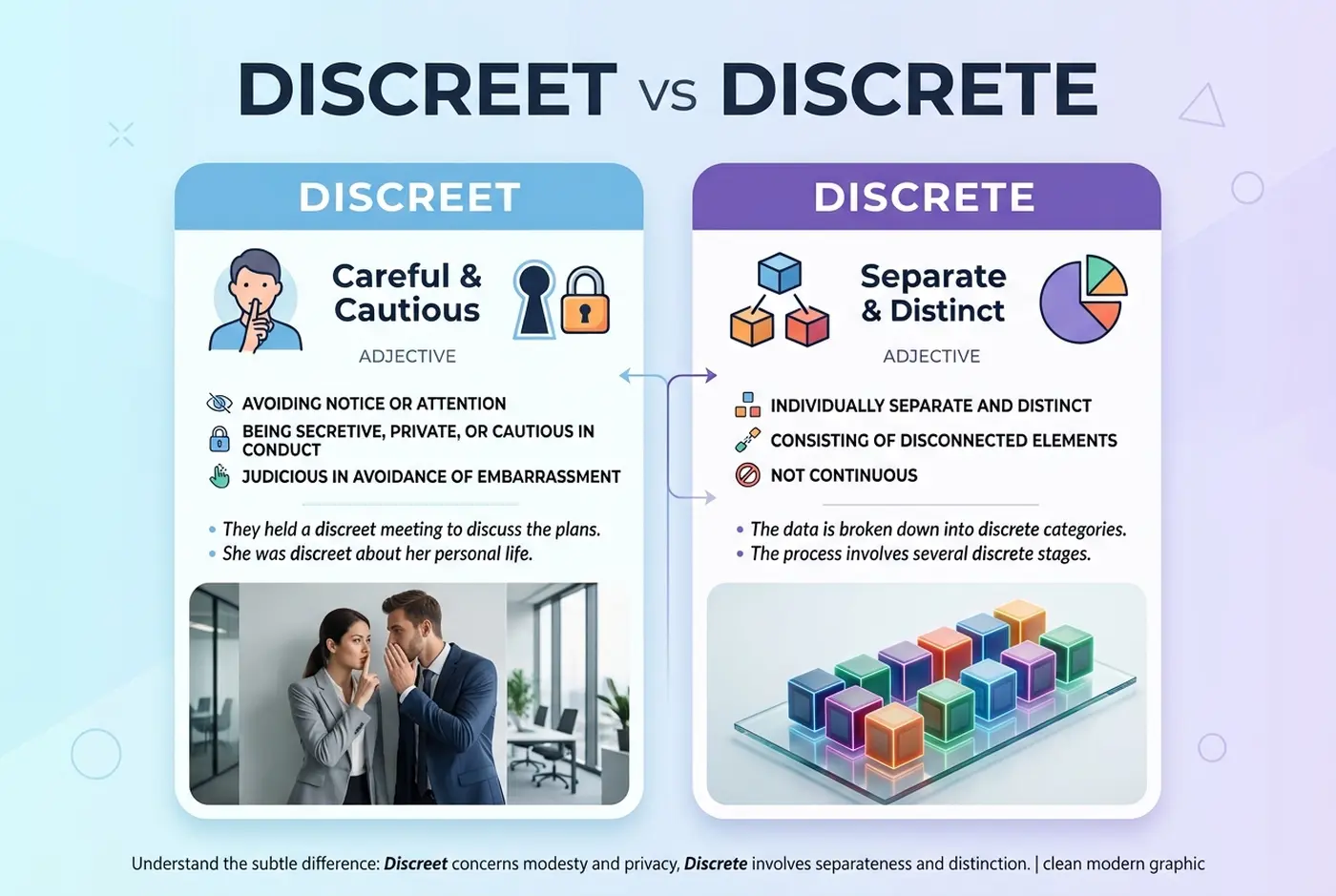
Have you ever paused while writing an email because you couldn’t decide between discreet vs discrete? You’re not alone. These two words look almost identical, sound the same in standard English, and differ by just one letter. However, their meanings are completely different.
Discreet means careful, tactful, or private. You might ask a coworker to be discreet about confidential information or thank a friend for handling an awkward situation discreetly. Discrete, on the other hand, means separate, distinct, or individually identifiable. Scientists study discrete units, mathematicians work with discrete values, and researchers examine discrete categories of data.
Both spellings are correct English words. The challenge is choosing the right one for your sentence. A single letter can change your meaning, especially in professional emails, academic papers, technical reports, and everyday conversations.
This guide explains the difference between discreet and discrete in plain American English. You’ll learn their definitions, pronunciation, spelling patterns, word origins, grammar, and practical uses. You’ll also find more than 20 natural examples, common mistakes, memory tricks, and answers to frequently asked questions.
By the end, you’ll have a simple way to remember the difference and choose the correct word without second guessing yourself.
Internal link opportunity: Add a link here to your article about [commonly confused English words and how to use them correctly].
Many readers also check Prescribe vs Proscribe: The Difference Explained (2026 Guide).
Quick Answer
Discreet means careful, tactful, or private, especially when handling sensitive information. Discrete means separate, distinct, or individually identifiable. Both words are pronounced the same way, but their meanings differ. Use discreet when describing someone’s behavior or confidentiality, and use discrete when describing separate objects, groups, values, or units.
Discreet vs Discrete Comparison Table
| Feature | Discreet | Discrete |
|---|---|---|
| Correct spelling | Discreet | Discrete |
| Main meaning | Careful, tactful, or private | Separate, distinct, or individual |
| Part of speech | Adjective | Adjective |
| Pronunciation | /dɪˈskriːt/ | /dɪˈskriːt/ |
| Syllables | Two | Two |
| Stress | Second syllable | Second syllable |
| Common contexts | Privacy, behavior, sensitive matters | Mathematics, science, data, separate items |
| Example | Please be discreet about the meeting. | The survey contains five discrete categories. |
| Related word | Discretion | Discreteness |
The most important distinction is simple. Discreet describes careful behavior, while discrete describes separate things.
Neither word is a misspelling of the other. They are separate words with different meanings, so the correct choice depends on what you’re trying to say.
What Discreet Means
Discreet is an adjective that describes someone who shows good judgment, protects private information, or avoids drawing unwanted attention.
A discreet person understands that some situations call for care and tact. They know when to speak, when to stay quiet, and how to handle sensitive matters without embarrassing anyone.
For example, imagine that a friend tells you about a personal problem. You agree not to share the information with other people. Your friend might describe you as discreet because you respect their privacy.
Definition of Discreet
Discreet has three closely related meanings.
- Careful with private information. A discreet person doesn’t reveal secrets or confidential details without a good reason.
- Tactful and considerate. Someone discreet handles delicate situations without causing unnecessary embarrassment.
- Unobtrusive or not easily noticed. A discreet action or object doesn’t attract much attention.
These meanings share a common idea. Discretion involves good judgment about what to reveal, how to behave, and how much attention to attract.
How to Use Discreet in a Sentence
Use discreet when describing a person’s behavior, a private conversation, or an action that avoids unwanted attention.
Consider these examples.
- She was discreet about her colleague’s personal problems.
- Please make a discreet inquiry before sharing the news.
- The hotel offers discreet service to guests who value their privacy.
- He gave me a discreet signal to leave the room.
- We need a discreet way to discuss the complaint.
In each sentence, discreet suggests care, privacy, or subtlety.
What Discreet Means in Everyday Conversation
In daily speech, discreet often describes someone you can trust with sensitive information.
For instance, you might say, “She’s very discreet, so you can talk to her privately.” This means she knows how to keep a conversation confidential.
The word can also describe an action that doesn’t attract attention. A discreet glance, a discreet reminder, or a discreet exit happens quietly or subtly.
However, discreet doesn’t always mean secret. Sometimes it simply means showing tact and good judgment.
What Discrete Means
Discrete is an adjective that means separate, distinct, or individually identifiable.
When things are discrete, you can distinguish one item, unit, group, or category from another. The items may belong to the same larger system, but each has a separate identity.
For example, a teacher might divide a class into three discrete groups. Each group has its own members, even though all the students belong to the same class.
Definition of Discrete
Discrete describes things that are separate or distinguishable from one another.
The word commonly appears in mathematics, science, technology, statistics, and general descriptions of separate objects or categories.
Here are three common uses.
- Separate items. The company operates from four discrete locations.
- Distinct categories. Researchers divided the responses into discrete groups.
- Individual values or units. A discrete mathematical variable takes values from a separate set rather than every possible value within a continuous range.
The third meaning is especially important in technical writing. In mathematics and statistics, discrete often describes values that can be counted individually.
How to Use Discrete in a Sentence
Use discrete when you mean separate, distinct, or individually identifiable.
Examples include the following.
- The report identifies three discrete causes of the problem.
- Each department has discrete responsibilities.
- The scientist studied discrete stages of development.
- The application stores information in discrete fields.
- The course consists of six discrete modules.
Each example focuses on separation or distinct identity rather than privacy.
What Discrete Means in Mathematics
In mathematics, discrete describes separate values or objects rather than a continuous range of possibilities.
For example, the number of students in a classroom is discrete. You can have 20 students or 21 students, but you cannot have 20.5 students in the ordinary sense of counting people.
Height is different. It is commonly modeled as a continuous variable because measurements can take many values within a range.
This distinction helps explain phrases such as discrete mathematics, discrete variables, and discrete data.
Discrete mathematics studies structures such as integers, graphs, and logical statements. These structures involve distinct objects or values rather than continuous quantities.
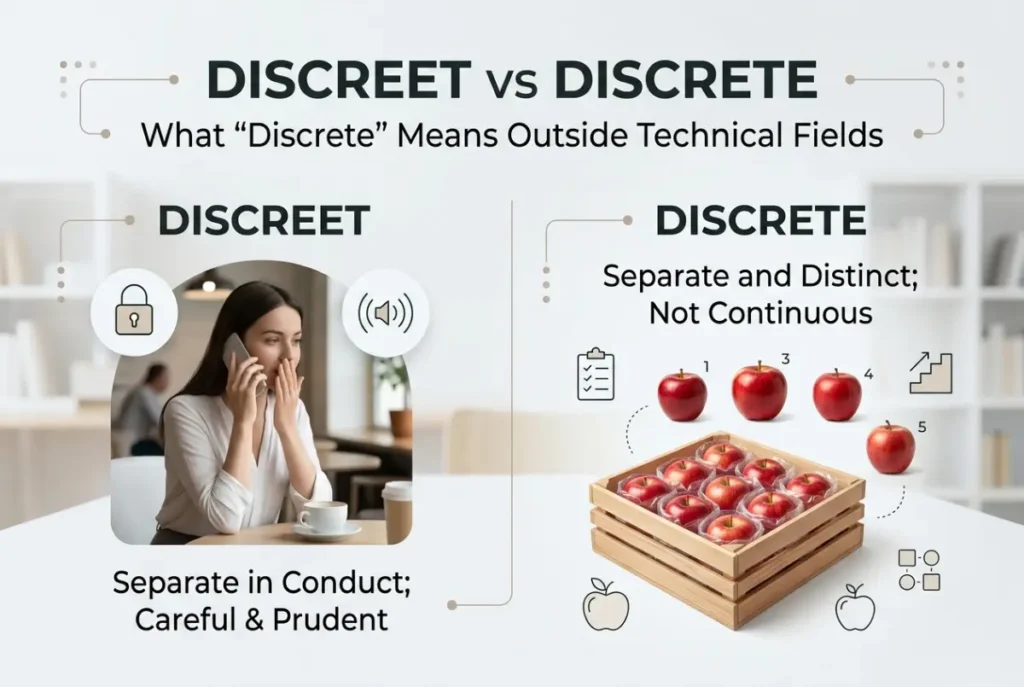
What Discrete Means Outside Technical Fields
You don’t need a scientific background to use discrete correctly.
The word works whenever you want to emphasize that things are separate or distinct.
For example, a writer might describe a novel as having four discrete sections. A manager might divide a project into discrete tasks. A homeowner might notice three discrete cracks in a wall.
In each case, the word highlights the individual identity of each part.
Which One Is Correct
Both discreet and discrete are correct spellings. Neither is more correct than the other in every situation.
The right word depends on the meaning you want to express.
Use discreet when you mean careful, tactful, private, or unobtrusive.
Use discrete when you mean separate, distinct, or individually identifiable.
Compare these two sentences.
- The assistant was discreet about the executive’s travel plans.
- The assistant organized the travel plans into discrete stages.
The first sentence describes the assistant’s careful handling of private information. The second describes separate parts of a plan.
Changing the final two vowels changes the meaning. That’s why proofreading matters, especially when both spellings pass a spellcheck.
Discreet or Discrete in Professional Writing
In professional writing, the distinction can affect clarity and trust.
Suppose you’re writing an email about a confidential workplace matter. You might write, “Please be discreet when discussing the investigation.” The word tells the reader to handle the matter carefully.
Now suppose you’re preparing a technical report. You might write, “The analysis identifies four discrete stages.” Here, the word tells readers that the stages are separate and distinguishable.
Using the wrong word can confuse the reader, even if the surrounding sentence is grammatically correct.
Why People Confuse Discreet and Discrete
Several features make these words easy to mix up. Understanding those features makes the distinction easier to remember.
They Look Almost Identical
Both words contain the same letters in nearly the same order. The only difference is the final vowel sequence.
- Discreet ends in eet.
- Discrete ends in ete.
Because the difference is small, writers can easily type the wrong form while focusing on the meaning of a sentence.
The mistake can slip through proofreading because both words are valid English words.
They Sound Exactly Alike
In standard English pronunciation, discreet and discrete are homophones. They share the same pronunciation but have different meanings and spellings.
Both are pronounced /dɪˈskriːt/, with stress on the second syllable.
As a result, hearing the word usually won’t tell you which spelling the speaker intends. You need to understand the context.
Spellcheck May Not Catch the Error
Traditional spellcheckers usually flag words that aren’t recognized. However, both discreet and discrete appear in standard dictionaries.
If you type “Please be discrete about the complaint,” your software may accept the sentence because discrete is a correctly spelled word. The problem is meaning, not spelling.
For this reason, proofreading should check word choice as well as spelling.
Their Meanings Can Appear in Similar Situations
Some sentences involve both privacy and separation, which can make the choice less obvious.
For example, a company might divide confidential information into discrete categories and ask employees to be discreet when discussing those categories.
The first word describes the structure of the information. The second describes how employees should handle it.
Looking at the role each word plays in the sentence helps you choose correctly.
People Remember the Sound but Forget the Meaning
Many writers learn these words through reading or conversation rather than formal vocabulary study. They may recognize the sound without remembering which spelling matches which definition.
A simple mental association can solve the problem. Think of discreet as discretion and discrete as distinct.
Those related words provide a useful clue whenever you hesitate.
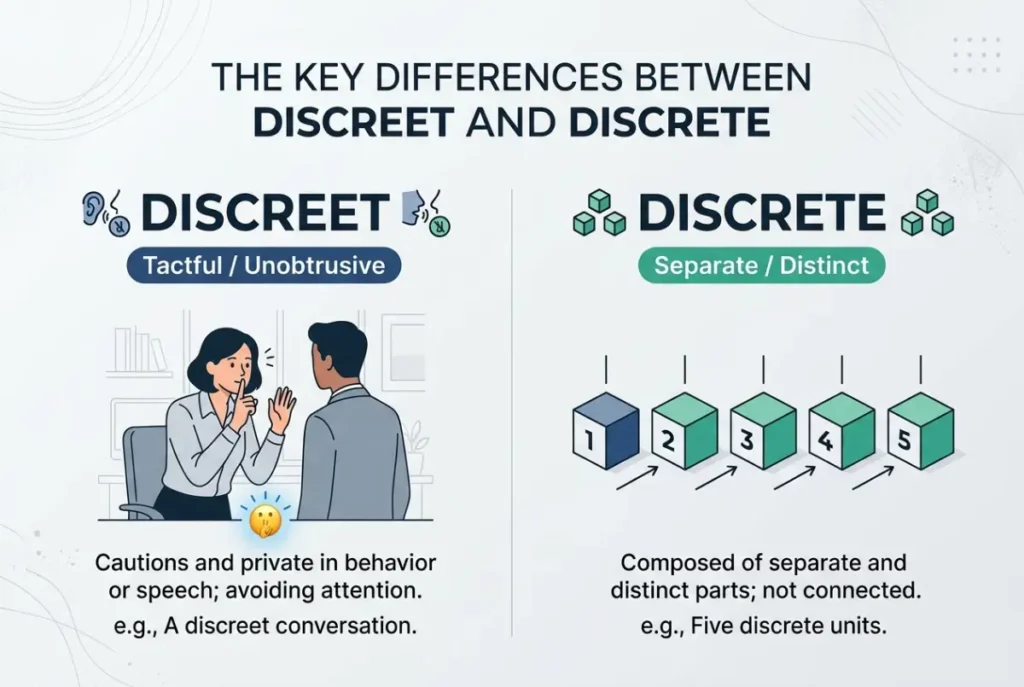
The Key Differences Between Discreet and Discrete
The difference goes beyond one letter. Each word belongs to a different meaning group and works in different contexts.
Meaning and Function
Discreet focuses on how someone behaves or how something is handled. It often suggests tact, confidentiality, or subtlety.
Discrete focuses on the separate identity of things. It suggests that items, units, stages, or categories can be distinguished from one another.
Compare these examples.
- The lawyer was discreet during the meeting.
- The lawyer reviewed three discrete contracts.
In the first sentence, discreet describes behavior. In the second, discrete describes separate documents.
Tone and Context
Discreet often appears in discussions about privacy, relationships, workplace conduct, and sensitive information.
Discrete appears frequently in technical or analytical writing, but it also works in everyday descriptions of separate things.
Neither word is inherently more formal than the other. However, discrete is common in specialist fields such as mathematics and computer science, while discreet is common in discussions of confidentiality and tact.
Grammar and Sentence Structure
Both words are adjectives. They can appear before nouns or after linking verbs.
Examples of adjectives before nouns include:
- A discreet conversation.
- A discreet employee.
- Discrete categories.
- Discrete components.
Examples after linking verbs include:
- Her response was discreet.
- The units remained discrete.
- The discussion seemed discreet.
- The stages are discrete.
The grammatical pattern is similar. The meaning determines which spelling belongs in the sentence.
Pronunciation
There is no standard pronunciation difference between the two words in American English.
Both have two syllables, and both carry stress on the second syllable.
That means pronunciation alone cannot resolve the confusion. Writers must rely on meaning and context.
Synonyms and Related Words
The words become easier to distinguish when you connect them with related vocabulary.
| Discreet | Discrete |
|---|---|
| Tactful | Separate |
| Cautious | Distinct |
| Circumspect | Individual |
| Private | Independent |
| Subtle | Differentiated |
| Unobtrusive | Distinguishable |
These synonyms are not perfect replacements in every sentence. However, they help you identify the central idea behind each word.
For instance, if you can replace discreet with tactful without changing the main idea, discreet is probably the right choice. If you can replace discrete with separate, discrete is likely the word you need.
Spelling Rules for Discreet and Discrete
The spelling difference is small, but a simple pattern can help you remember it.
The EET Pattern in Discreet
Discreet ends with eet, as in the word discreet.
Connect this spelling with discretion, the noun that describes careful judgment, tact, or the ability to keep information private.
For example:
- She handled the matter with discretion.
- She was discreet when discussing the matter.
Both words belong to the same family of meaning. Remembering this connection makes discreet easier to identify.
The ETE Pattern in Discrete
Discrete ends with ete, as in the word discrete.
Connect it with distinct, which means clearly different or recognizable.
For example:
- The study identified two distinct groups.
- The study identified two discrete groups.
The meanings are close in this context because both words emphasize the separation between groups.
Why the Final Letters Matter
English contains many words whose spellings differ by just one or two letters but whose meanings are unrelated or distinct.
Discreet and discrete are especially challenging because their pronunciation doesn’t help you identify the spelling. You must connect the spelling with the intended meaning.
Instead of trying to memorize the letters alone, learn each word alongside its related words and typical uses.
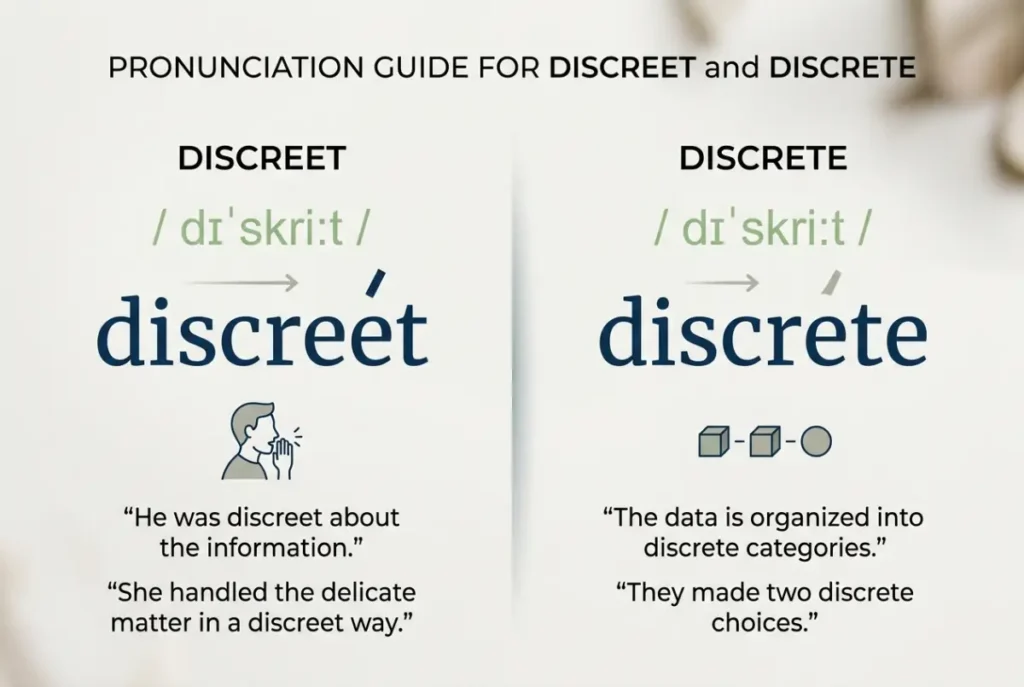
Pronunciation Guide for Discreet and Discrete
Both words have the same standard pronunciation in American English.
Discreet
/dɪˈskriːt/
Syllables: dis · creet.
Stress: Second syllable.
Sound: dih SKREET.
Need another quick comparison? Read Serpent Vs Snake Difference Meaning And Correct 2026.
Discrete
/dɪˈskriːt/
Syllables: dis · crete.
Stress: Second syllable.
Sound: dih SKREET.
The first syllable has a short vowel sound, while the second has the long ee sound. Both words end with the same t sound.
A common mistake is to assume that the different spellings produce different pronunciations. They don’t in standard American English.
If you’re speaking and someone asks which word you mean, the surrounding sentence will usually provide the answer.
The Word Origin of Discreet and Discrete
The history of these words helps explain why they look so similar while carrying different meanings.
Both entered English through French and Latin word forms connected to ideas of discernment and separation. Over time, English developed distinct spellings and meanings for the two forms.
The Origin of Discreet
Discreet comes through Middle French from Latin discretus, the past participle of discernere, meaning to distinguish or separate.
The original idea involved making distinctions or exercising judgment. That connection developed into the modern meaning of showing good judgment, especially when dealing with sensitive matters.
The related noun discretion preserves the idea of sound judgment. Today, discretion often refers to the ability to decide what should be said, shared, or done in a particular situation.
For example, “Use your discretion” means to make a sensible decision based on the circumstances.
The Origin of Discrete
Discrete also comes from Latin discretus, through French forms. Its modern meaning centers on things that are separate or distinct.
That meaning is easy to see in technical expressions such as discrete mathematics and discrete data. Each object or value has an identifiable place within a system.
The words share a historical root, which helps explain their similar appearance and pronunciation. Their modern uses, however, have developed in different directions.
Why Their Shared Origin Matters
Their shared origin offers a useful lesson about English vocabulary. Words can develop from the same historical source yet acquire separate spellings and meanings over time.
That history doesn’t mean the words are interchangeable today. Modern English treats discreet and discrete as different words, and careful writing requires choosing the one that fits the sentence.
British vs American English
Discreet and discrete are standard spellings in both British and American English.
The difference isn’t regional. American writers use discreet for tact and privacy and discrete for separate items. British writers follow the same distinction.
Canadian and Australian English also use both forms with the same meanings.
| English variety | Discreet | Discrete |
|---|---|---|
| American English | Standard | Standard |
| British English | Standard | Standard |
| Canadian English | Standard | Standard |
| Australian English | Standard | Standard |
You don’t need to change either spelling for a different national audience.
This differs from words such as color and colour, where regional spelling conventions matter. With discreet and discrete, the writer must focus on meaning rather than location.
Grammar Explanation and Correct Usage
Because discreet and discrete are both adjectives, their basic grammar is similar. The main challenge is selecting the correct meaning.
Using Discreet Before a Noun
An adjective can come directly before the noun it describes.
Examples include:
- A discreet employee.
- A discreet question.
- A discreet conversation.
- A discreet arrangement.
- A discreet reminder.
These phrases describe people, actions, or situations involving care, privacy, or tact.
Using Discreet After a Linking Verb
You can also place discreet after verbs such as be, seem, remain, and become.
Examples:
- The receptionist was discreet.
- Her response seemed discreet.
- He remained discreet throughout the interview.
- The discussion became more discreet as the meeting continued.
In each example, discreet describes the subject.
Using Discrete Before a Noun
Discrete often describes separate objects, parts, groups, stages, or values.
Examples:
- Discrete categories.
- Discrete units.
- Discrete tasks.
- Discrete components.
- Discrete events.
The word helps readers see that each item has a separate identity.
Using Discrete After a Linking Verb
Discrete can also follow a linking verb.
Examples:
- The categories are discrete.
- The two systems remain discrete.
- These events are discrete.
- The modules appear discrete.
The adjective describes the state of being separate or distinguishable.
Can You Use Discreet as an Adverb?
Yes. The adverb form is discreetly.
It describes an action performed with tact, care, or subtlety.
Examples:
- She discreetly changed the subject.
- The manager discreetly asked for more information.
- He discreetly left the room.
- The receptionist discreetly informed the visitor about the delay.
Don’t write discretely when you mean quietly or tactfully.
Can You Use Discrete as an Adverb?
Yes. Discretely is the adverb form of discrete, although it’s less common in everyday writing than discreetly.
It describes something done in a separate or distinct manner.
For example, a technical description might explain that a system processes several inputs discretely, meaning it treats them as distinct units rather than as one combined whole.
The intended meaning matters because discreetly and discretely are not interchangeable.
What Are the Noun Forms?
The related noun forms are different.
- Discretion means careful judgment or the ability to handle information tactfully.
- Discreteness means the quality of being separate or distinct.
Examples:
- The manager used discretion when handling the complaint.
- The mathematical model depends on the discreteness of its possible values.
Discretion is common in everyday and professional English. Discreteness appears more often in technical or analytical discussions.
Comparative and Superlative Forms
Both adjectives can take comparative and superlative forms.
For discreet, you can write more discreet and most discreet.
For discrete, you can write more discrete and most discrete, although these forms are less common in ordinary conversation.
Examples:
- She was more discreet than her colleague.
- The assistant was the most discreet member of the team.
- The updated model uses more discrete categories.
- This system offers the most discrete set of possible states.
In the last two examples, the technical context makes the intended meaning clear.
Real Life Examples of Discreet vs Discrete
The fastest way to master these words is to see how they work in different situations.
The examples below cover everyday conversation, work, email, school, technology, and formal writing.
Everyday Conversation
- Discreet: Please be discreet about the surprise party.
- Discrete: The recipe separates the process into three discrete steps.
- Discreet: He discreetly told me that I had spinach in my teeth.
- Discrete: The shelf contains five discrete storage compartments.
- Discreet: My friend was discreet about the personal news I shared.
- Discrete: We noticed two discrete stains on the carpet.
Workplace and Business
- Discreet: The manager handled the employee complaint discreetly.
- Discrete: The company operates through four discrete business units.
- Discreet: Please be discreet when discussing the salary review.
- Discrete: Each department has discrete duties and responsibilities.
- Discreet: The assistant made a discreet inquiry about the appointment.
- Discrete: The report identifies three discrete causes of the delay.
Emails and Professional Communication
- Discreet: I’d appreciate it if you could be discreet about this discussion.
- Discrete: Please list the project costs as discrete items.
- Discreet: We should handle the matter discreetly until the review is complete.
- Discrete: The proposal divides the work into discrete phases.
Academic Writing and Research
- Discreet: The interviewer was discreet when asking about the participant’s personal circumstances.
- Discrete: The researchers divided the sample into five discrete groups.
- Discreet: The author discreetly avoids identifying the individual involved.
- Discrete: The study compares discrete and continuous variables.
- Discrete: Discrete mathematics examines structures such as graphs and integers.
- Discrete: The experiment recorded discrete events during each trial.
Technology and Data
- Discreet: The application sends a discreet notification to protect the user’s privacy.
- Discrete: The database stores each response in a discrete field.
- Discrete: The sensor records discrete values at specified intervals.
- Discreet: The system allows users to receive discreet alerts during meetings.
Journalism and Social Media
- Discreet: The journalist was discreet about the identity of the source.
- Discrete: The analysis identified two discrete trends in the survey results.
- Discreet: She discreetly removed the personal information before sharing the screenshot.
- Discrete: The video presents the argument in four discrete sections.
These examples demonstrate the central rule. Discreet describes tact or privacy, while discrete emphasizes separate or distinct things.
Common Mistakes With Discreet and Discrete
Even experienced writers can confuse these words. The best way to avoid mistakes is to check the meaning rather than rely on how the word looks or sounds.
Mistake One Using Discrete to Mean Private
Incorrect: Please be discrete about the confidential meeting.
Correct: Please be discreet about the confidential meeting.
The sentence asks someone to protect private information. Discreet is the correct choice because it describes tact and confidentiality.
Mistake Two Using Discreet to Mean Separate
Incorrect: The researcher divided the data into three discreet groups.
Correct: The researcher divided the data into three discrete groups.
The groups are separate categories. The sentence describes their structure, not anyone’s behavior.
Mistake Three Assuming One Spelling Is Incorrect
Some writers believe discreet is correct and discrete is a misspelling, or the other way around.
Both are standard English words. The mistake occurs when you use a valid word with the wrong meaning.
Always check the intended message before changing the spelling.
Mistake Four Confusing Discreetly and Discretely
These adverbs have different meanings.
- Discreetly means tactfully, carefully, or without attracting attention.
- Discretely means in a separate or distinct manner.
For example, a receptionist might discreetly inform a visitor about a delay. A computer program might process separate categories discretely.
The first example describes careful behavior. The second describes how a process treats distinct units.
Mistake Five Trusting Autocorrect Too Much
Autocorrect can correct a misspelled word, but it may not detect a word used in the wrong context.
If you type “The assistant was discrete about the confidential report,” your software may not flag the error.
Read the sentence again and ask what you mean. If the assistant protected private information, use discreet.
Memory Tricks to Remember the Difference
You don’t need to memorize a long grammar rule. A short association can help you choose the right word quickly.
EET
Discreet means discretion.
Both words contain the letters that help you connect the idea of tact, privacy, and careful judgment.
ETE
Discrete means distinct.
Both words contain an e near the end, and both connect with the idea of separate or distinguishable things.
The Two Question Test
When you’re unsure which spelling to use, ask yourself two questions.
- Am I describing privacy, tact, or careful behavior? Choose discreet.
- Am I describing separate items, categories, or units? Choose discrete.
This test works in most everyday and professional situations.
Try the Substitution Trick
Replace the word with a simpler synonym and see if the sentence still makes sense.
For example:
- Please be tactful about the complaint. The intended word is discreet.
- The report contains three separate sections. The intended word is discrete.
The substitution doesn’t need to preserve every shade of meaning. It only needs to reveal the central idea.
Related Words and Expressions
Understanding related vocabulary helps you expand your word choice and avoid similar mistakes.
Words Related to Discreet
| Word | Meaning | Example |
|---|---|---|
| Discretion | Careful judgment | Use discretion when sharing the information. |
| Discreetly | In a tactful or subtle manner | She discreetly changed the subject. |
| Tactful | Careful not to offend | He gave a tactful response. |
| Circumspect | Cautious and thoughtful | She was circumspect in her comments. |
| Confidential | Intended to remain private | The documents are confidential. |
| Unobtrusive | Not attracting unwanted attention | The device has an unobtrusive design. |
These words overlap with discreet, but they aren’t perfect substitutes in every situation.
For example, confidential usually describes information that should remain private. Discreet usually describes a person or action that handles the information carefully.
Words Related to Discrete
| Word | Meaning | Example |
|---|---|---|
| Discreteness | The quality of being separate | The model depends on the discreteness of the values. |
| Distinct | Clearly different | The report identifies two distinct patterns. |
| Separate | Not joined together | Keep the files in separate folders. |
| Individual | Belonging to one person or thing | Each individual result was recorded. |
| Distinguishable | Able to be recognized as different | The two signals are distinguishable. |
| Discretely | In a separate or distinct manner | The system handles the inputs discretely. |
Distinct and separate are often useful alternatives in general writing. However, discrete has a more specific role in technical fields where the distinction between discrete and continuous values matters.
What Is the Opposite of Discreet?
There isn’t one perfect opposite for every use of discreet.
Depending on the context, possible opposites include indiscreet, tactless, conspicuous, and indiscreetly used behavior.
For example:
- A discreet comment is tactful.
- An indiscreet comment reveals information carelessly.
- A discreet action may be unobtrusive.
- A conspicuous action attracts attention.
Indiscreet is especially useful when you mean someone has revealed private information or acted without enough care.
What Is the Opposite of Discrete?
Discrete can contrast with connected, continuous, or integrated, depending on the subject.
In mathematics, the most important contrast is often discrete vs continuous.
Discrete values are separate and countable in the relevant model. Continuous values can take any value within a specified range under that model.
For example, the number of books on a shelf is discrete, while the measured length of the shelf is commonly treated as continuous.
In other contexts, separate and connected may provide a more natural contrast.
Expert Editor’s Note
As an editor, I’d treat discreet and discrete as a meaning check rather than a spelling check. Both forms are legitimate English words, so a standard spellchecker may accept either one even when the sentence uses it incorrectly.
Major English dictionaries recognize both spellings and distinguish their meanings. Standard American and British usage follows the same basic rule. Discreet relates to tact, privacy, and good judgment, while discrete relates to separation and distinct identity.
When proofreading, I recommend checking the noun or action that the adjective describes.
If the sentence concerns confidential information, a sensitive conversation, or an action intended to avoid attention, discreet will usually fit. If the sentence concerns categories, components, stages, values, or separate objects, discrete will usually be the better choice.
In technical writing, pay particular attention to the established meaning of discrete. In mathematics and statistics, replacing it with discreet can make a sentence inaccurate, even when the sentence remains grammatically sound.
For general readers, choose the simpler synonym if discrete feels unnecessarily technical. Separate or distinct may communicate the idea more clearly in an everyday article.
Frequently Asked Questions
Is discreet or discrete the correct spelling?
Both are correct spellings. Discreet means careful, tactful, or private, while discrete means separate, distinct, or individually identifiable. The right spelling depends on your intended meaning. For example, you should be discreet about a confidential conversation but can divide a report into discrete sections.
What is the easiest way to remember discreet vs discrete?
Connect discreet with discretion, which involves tact and careful judgment. Connect discrete with distinct, which means clearly different or separate. These associations help you remember the spelling and meaning together. When you’re unsure, replace the word with tactful or separate and see which meaning fits your sentence.
Are discreet and discrete pronounced the same?
Yes. In standard American English, both words are pronounced /dɪˈskriːt/. Each has two syllables, with stress on the second syllable. Because they sound alike, listeners rely on context to understand which word a speaker intends. In writing, you must select the spelling that matches the meaning.
What does discreet mean in a relationship?
In a relationship, discreet usually means respecting privacy and handling personal matters carefully. Someone might ask a friend to be discreet about a private conversation or a surprise. The word doesn’t automatically mean dishonest or secretive. It often suggests tact, respect, and good judgment when dealing with sensitive information.
What does discrete mean in simple terms?
Discrete means separate or distinct. For example, a box containing red, blue, and green buttons has discrete items because you can identify each button individually. The word also appears in mathematics and science, where it describes separate values, categories, or units rather than a continuous range.
Is discreet the same as secretive?
No. Discreet and secretive have related meanings, but they aren’t identical. Discreet usually suggests sensible privacy and good judgment. Secretive often suggests a desire to conceal information. A discreet employee can protect confidential information while acting openly and honestly in other parts of their work.
Can I use discretely instead of discreetly?
Only when you mean something happens in a separate or distinct manner. Discretely is the adverb form of discrete, while discreetly is the adverb form of discreet. For example, a person might discreetly leave a meeting, while a technical system might process separate categories discretely.
What is the difference between discrete and continuous?
Discrete refers to separate values or units. Continuous refers to values that can vary throughout a range. For example, the number of customers entering a store is discrete because you count individual people. Their waiting time can be modeled as continuous because it can take many values within a range.
Are discreet and discrete different in British and American English?
No. Both spellings are standard in American and British English. Canadian and Australian English follow the same distinction. You don’t need to change the spelling for a regional audience. Focus on the meaning of the sentence instead.
Can discreet and discrete describe the same thing?
Sometimes the same situation involves both concepts, but the words still describe different features. A company might organize information into discrete categories and require employees to be discreet when discussing it. The categories are separate, while the employees handle the information carefully.
Still confused? Compare Drier Vs Dryer Which Word Is Correct 2026 Guide.
Conclusion
The difference between discreet vs discrete comes down to meaning, not pronunciation. Both words are correct, and both sound the same in standard American English.
Use discreet when describing tact, privacy, or careful behavior. Use discrete when describing separate objects, distinct categories, or individual units.
Remember the simple connections. Discreet goes with discretion. Discrete goes with distinct.
Before choosing a spelling, pause for a moment and ask what you’re trying to describe. That small habit can prevent a common mistake and make your writing clearer.
One letter can change the message, but the right meaning makes the choice clear.

Editorial Reviewer & Proofreader
Grace Mitchell reviews Gramlify’s articles for clarity, consistency, and readability. She is passionate about creating accurate, approachable content that helps English learners build confidence.