
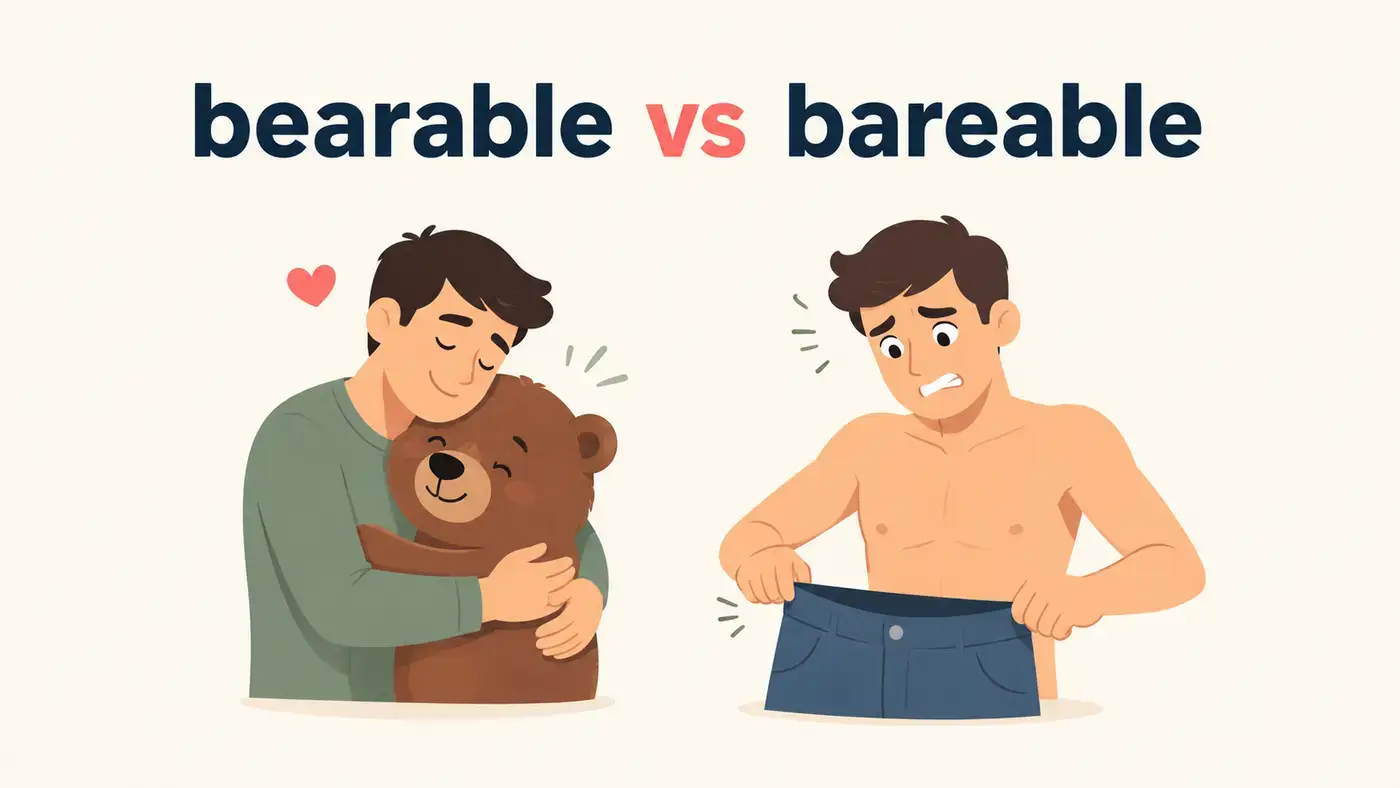
Have you ever paused while writing bearable vs bareable and wondered which spelling is right? You’re not alone. These two words look almost identical, and spell check does not always help when you’re typing quickly. Many English learners and even native speakers accidentally write bareable because it seems to match the word bare. Still, only one spelling is accepted in standard English.
The correct spelling is bearable. It means something is tolerable, manageable, or not too difficult to endure. Bareable is almost always a misspelling and does not appear as a standard word in modern English dictionaries.
The confusion comes from the verbs bear and bare. They sound exactly alike, but they have different meanings. Since they are homophones, it is easy to choose the wrong spelling if you rely only on pronunciation.
This guide explains the difference in plain English. You’ll learn the correct spelling, the meanings behind each word, grammar rules, memory tricks, common mistakes, and plenty of real life examples. By the end, you’ll know exactly when to use bearable and why bareable should almost always be avoided.
Need another quick comparison? Read Journies or Journeys Which Is Correct 2026 Guide.
Quick Answer
Bearable is the correct spelling. It means something is tolerable or can be endured without too much difficulty. Bareable is not recognized as a standard English word and is considered a misspelling in almost every context. If you mean something is manageable or tolerable, always use bearable.
Bearable Vs Bareable Comparison Table
| Feature | Bearable | Bareable |
|---|---|---|
| Correct spelling | Yes | No |
| Meaning | Able to be endured or tolerated | Not a standard English word |
| Part of speech | Adjective | Misspelling |
| Pronunciation | Same as bareable | Same as bearable |
| Used in dictionaries | Yes | No |
| Formal writing | Yes | No |
| Everyday English | Very common | Should be avoided |
| Example | The weather was bearable today. | The weather was bareable. ✘ |
What Does Bearable Mean
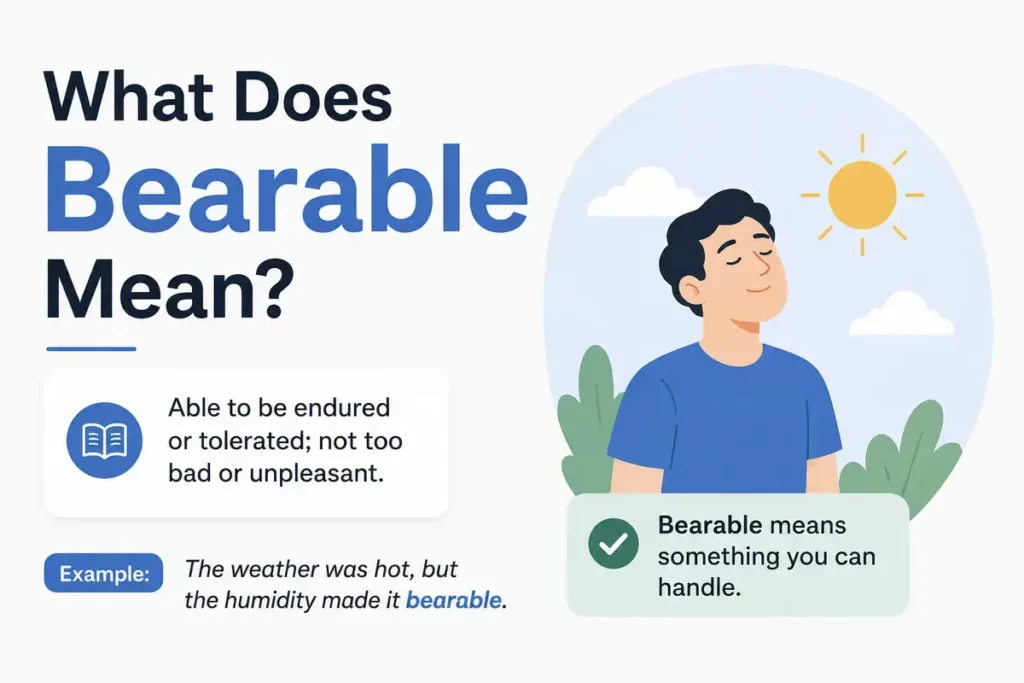
Bearable is an adjective that describes something you can tolerate, endure, or put up with.
It usually refers to situations that are unpleasant but not impossible to handle.
Simple Definition
Bearable means able to be endured without too much pain, discomfort, or difficulty.
Common Uses Of Bearable
People use bearable to describe many everyday situations.
- Physical pain.
- Hot or cold weather.
- Loud noise.
- Stress.
- Waiting times.
- Difficult situations.
- Emotional hardship.
Real Life Examples
- The headache became bearable after I took some medicine.
- The weather was finally bearable once the sun went down.
- The long meeting was bearable because everyone stayed focused.
- Her kindness made the difficult day more bearable.
- The traffic was frustrating but still bearable.
- The apartment is small, but the rent makes it bearable.
- The workload became bearable after we hired another employee.
- His jokes made the long drive bearable.
Common Expressions With Bearable
English speakers often use bearable in expressions like these.
- Barely bearable.
- More bearable.
- Perfectly bearable.
- Almost bearable.
- Hardly bearable.
- Just bearable.
These combinations sound natural in both spoken and written English.
What Does Bareable Mean
In standard English, bareable is not a recognized word.
Most dictionaries do not include it because it is simply a spelling mistake people make when they intend to write bearable.
The confusion happens because the verb bare means to uncover or reveal.
Examples include.
- Bare your feet.
- Bare your shoulders.
- The trees stood bare during winter.
Since bare is a real English word, some writers incorrectly assume bareable must also be correct.
It isn’t.
Why Bareable Looks Correct
Many English words are formed by adding able to a verb.
Examples include.
- Read becomes readable.
- Wash becomes washable.
- Comfort becomes comfortable.
Because of this pattern, some people expect bare to become bareable.
English simply does not form the word that way.
If you want to describe something that can be tolerated, the correct adjective is bearable.
Which One Is Correct
The answer is straightforward.
✅ Bearable is correct.
❌ Bareable is incorrect in standard English.
Use bearable every time you mean something can be endured, tolerated, or managed.
Correct examples.
- The heat became bearable after the rain.
- The pain is now bearable.
- Her support made the experience bearable.
Incorrect examples.
- The heat became bareable.
- The pain is bareable now.
- The meeting was bareable.
Replacing bareable with bearable fixes every one of those sentences.
Why People Confuse Bearable And Bareable
This spelling mistake is extremely common for several reasons.
They Sound Exactly The Same
Bear and bare are perfect homophones.
Both are pronounced the same, so pronunciation cannot help you choose the correct spelling.
They Look Very Similar
Only one letter changes between the two words.
When typing quickly, many writers accidentally choose the wrong version.
Both Root Words Exist
Unlike many spelling mistakes, bear and bare are both real English words.
That makes the error harder to notice.
Compare these meanings.
Bear
To carry, support, tolerate, or endure.
Bare
To uncover, expose, or reveal.
Only the first meaning leads to the adjective bearable.
Autocorrect Does Not Always Help
Some writing tools overlook bareable because it resembles valid word patterns.
Others suggest corrections only after the sentence is complete.
For that reason, proofreading remains important.
Social Media And Informal Writing
Online posts often contain spelling mistakes. As people repeatedly see bareable, they may assume it is another accepted spelling.
It is not.
Professional editors, teachers, dictionaries, and style guides consistently recommend bearable as the only correct spelling.
Key Differences Between Bearable And Bareable
The easiest way to remember the difference is to focus on the root word.
Bearable comes from the verb bear, which means to carry, tolerate, or endure.
Bareable would come from bare, which means to uncover or expose. English does not use this spelling as a standard adjective.
| Feature | Bearable | Bareable |
|---|---|---|
| Status | Correct English | Incorrect spelling |
| Root word | Bear | Bare |
| Root meaning | Endure or tolerate | Uncover or expose |
| Dictionary entry | Yes | No |
| Formal writing | Accepted | Not accepted |
| Everyday use | Common | Should be avoided |
If your sentence talks about pain, weather, stress, noise, emotions, or anything that can be tolerated, bearable is always the correct choice.
Grammar Explanation
Understanding the grammar behind bearable makes it much easier to remember.
Bearable Is An Adjective
Bearable describes a noun. It tells you that something can be endured or tolerated.
Examples.
- The pain was bearable.
- The weather became bearable.
- The workload seemed bearable.
In each sentence, bearable describes the noun.
Where Bearable Appears In A Sentence
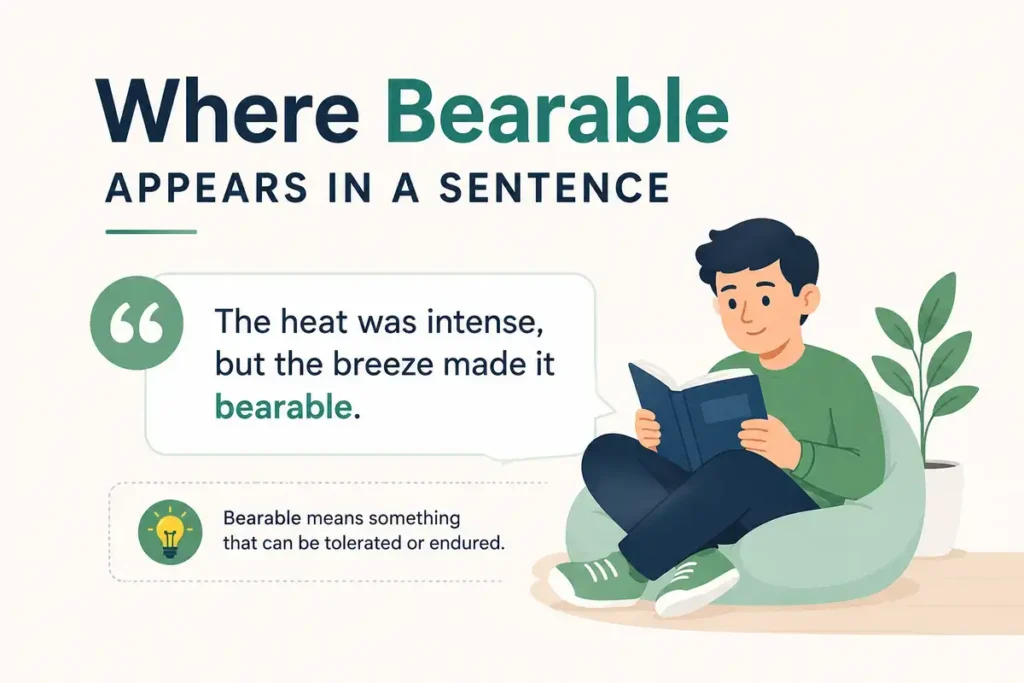
It usually comes after a linking verb.
Examples.
- The noise is bearable.
- The delay was bearable.
- The temperature feels bearable.
It can also appear before a noun.
Examples.
- We had a bearable workload.
- She faced a bearable level of stress.
- It was a bearable amount of heat.
Why Bareable Is Grammatically Incorrect
Although bare is a verb and an adjective, English does not create the adjective bareable.
Instead, the language already has bearable for the idea of enduring something.
Because of this, dictionaries and style guides treat bareable as a spelling mistake rather than a separate word.
Spelling Rule Behind Bearable
The spelling becomes easier once you know where the word comes from.
The adjective bearable comes from the verb bear.
Examples of the verb.
- I can’t bear the noise.
- She bore the responsibility with courage.
- We must bear the cost.
When you add the suffix able, the meaning becomes able to be endured.
Bear.
Bearable.
This pattern appears in many English words.
- Read becomes readable.
- Depend becomes dependable.
- Respect becomes respectable.
The important point is that the original verb is bear, not bare.
Learn the difference in Feel Or Feal Which Spelling Is Correct 2026 Guide.
Pronunciation Guide
Bearable
IPA
American English.
/ˈberəbəl/
Syllables
Bear a ble.
Stress
The first syllable receives the primary stress.
Bareable
People usually pronounce it exactly the same as bearable, even though the spelling is incorrect.
This identical pronunciation explains why so many people confuse the two spellings.
Word Origin And History
The history of bearable goes back hundreds of years.
The verb bear comes from Old English beran, meaning to carry, support, endure, or tolerate.
Over time, English added the suffix able to create bearable, meaning something that can be endured.
The word has appeared in English writing for centuries and remains the accepted spelling today.
The word bare has a completely different history.
It comes from Old English bær, meaning uncovered or exposed.
Although bare is an important English word, it never developed the adjective bareable in standard usage.
That is why dictionaries include bearable but not bareable.
British American Canadian And Australian English
There is no spelling difference across the major English speaking countries.
American English uses bearable.
British English uses bearable.
Canadian English uses bearable.
Australian English uses bearable.
No major dictionary in any of these regions accepts bareable as a standard spelling.
This makes the answer easy. No matter where you write English, choose bearable.
Real Life Examples
Seeing the word in context helps it stick.
Daily Conversation
- The weather became bearable after sunset.
- The movie was slow, but still bearable.
- My shoulder feels much more bearable today.
- The line moved quickly enough to stay bearable.
Workplace
- The deadline looked impossible at first, but it became bearable after the team shared the work.
- The office temperature is finally bearable.
- The new software makes the task more bearable.
- Even during the busiest season, the workload stayed bearable.
Emails
- Thank you for adjusting the schedule. The workload is much more bearable now.
- The revised timeline seems bearable for our team.
Academic Writing
- Researchers found the treatment produced bearable side effects.
- The author describes the difficult conditions as surprisingly bearable.
Journalism
- Cooler temperatures made the heatwave more bearable.
- Residents said the power outage was bearable because it lasted only a few hours.
Social Media
- Coffee makes Monday mornings bearable.
- Good friends make tough days bearable.
- The waiting is bearable when you know something exciting is coming.
- Winter is bearable with a warm fireplace.
Literature
- Her smile made every hardship bearable.
- Hope turned an unbearable journey into something almost bearable.
Common Mistakes
Even experienced writers occasionally misspell bearable because the pronunciation matches bare. These are the mistakes editors see most often.
Writing Bareable Instead Of Bearable
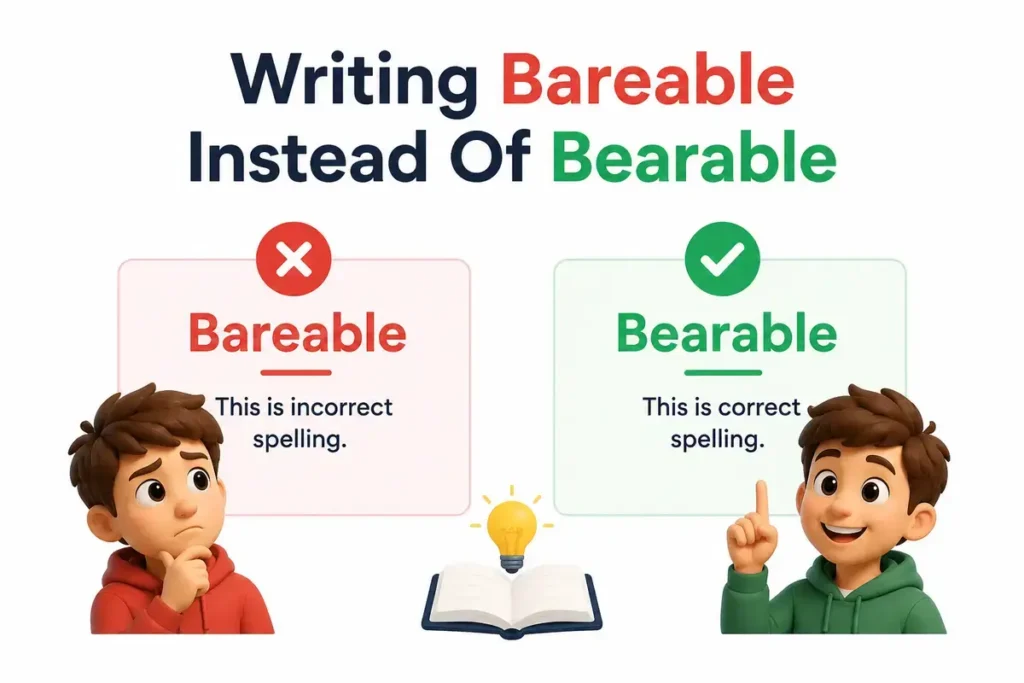
Incorrect.
The pain is bareable now.
Correct.
The pain is bearable now.
Confusing Bear With Bare
Remember the meanings.
Bear means to endure, tolerate, or carry.
Bare means to uncover or expose.
Examples.
- I can’t bear the noise.
- Please bare your feet before entering.
The first sentence talks about tolerating something. The second talks about uncovering something.
Assuming Bareable Is An Alternative Spelling
Some people believe bareable is a British spelling or an older form.
It is not.
Modern dictionaries and style guides recognize only bearable.
Using Unbearable Incorrectly
The opposite of bearable is unbearable.
Examples.
- The pain became unbearable.
- The summer heat was unbearable.
Never write unbareable.
Easy Memory Tricks
A simple memory trick can prevent this mistake forever.
Think Of Bear As Endure
The verb bear means to tolerate or endure.
If something can be endured, it is bearable.
Remember The Bear
Imagine a strong bear carrying a heavy backpack.
The bear can bear the weight.
If you can bear something, it is bearable.
Connect The Meaning
Ask yourself one question.
Can I endure this?
If the answer is yes, use bearable.
If you are talking about exposing something, use bare instead.
Related Words
Learning related words strengthens your vocabulary.
Synonyms For Bearable
- Tolerable.
- Manageable.
- Acceptable.
- Endurable.
- Reasonable.
- Moderate.
Opposites
- Unbearable.
- Intolerable.
- Impossible.
- Agonizing.
- Miserable.
Related Words
- Bear.
- Bearing.
- Endure.
- Tolerate.
- Sustain.
- Withstand.
Frequently Confused Words
- Bear and bare.
- Bare and barren.
- Barefoot and bear foot.
- Bore and born.
- Accept and except.
These pairs often confuse English learners because they sound similar but have different meanings.
Expert Editor’s Note
Professional editors consistently recommend bearable because it is the only accepted spelling in standard English.
Major dictionaries define bearable as something that can be endured or tolerated. You will find it in newspapers, academic writing, novels, business communication, and everyday conversation.
The spelling bareable does not appear as a standard dictionary entry. If it appears in a document, editors almost always correct it to bearable.
When proofreading, pay close attention to words built from homophones. They often pass unnoticed because they sound correct when read aloud.
Frequently Asked Questions
Is Bearable Or Bareable Correct?
Bearable is correct. It means something can be tolerated or endured. Bareable is a misspelling and should not be used in standard English.
Is Bareable A Real Word?
No. Modern English dictionaries do not recognize bareable as a standard word. The correct spelling is bearable.
Why Do People Spell Bearable As Bareable?
The mistake happens because bear and bare sound exactly alike. Since both are real English words, many writers choose the wrong spelling without realizing it.
What Does Bearable Mean?
Bearable describes something that is unpleasant but still manageable. It often refers to pain, weather, stress, noise, or difficult situations that can be endured.
Is Bearable Used In Formal Writing?
Yes. Bearable is appropriate in academic writing, business communication, journalism, and professional documents.
What Is The Opposite Of Bearable?
The opposite is unbearable, which describes something too painful, difficult, or unpleasant to tolerate.
How Can I Remember The Correct Spelling?
Remember that bear means to endure. If you can bear something, it is bearable. This simple connection makes the correct spelling easy to remember.
You may also want to read Dysregulated Vs Disregulated Which Spelling Is Correct 2026.
Conclusion
The answer to bearable vs bareable is clear.
Bearable is the correct spelling and the only standard English word. It means something can be tolerated, managed, or endured.
Bareable is a common misspelling that comes from confusing the verbs bear and bare. Although the words sound identical, they have completely different meanings.
A quick memory trick can save you from making this mistake. If you can bear it, then it is bearable.
Use that simple rule every time, and you’ll choose the correct spelling with confidence.

Editorial Reviewer & Proofreader
Grace Mitchell reviews Gramlify’s articles for clarity, consistency, and readability. She is passionate about creating accurate, approachable content that helps English learners build confidence.
1 thought on “Bearable Vs Bareable Which Spelling Is Correct 2026”