
If you’ve ever paused while writing an email or workplace notice and wondered about breakroom or break room you’re not alone. Both forms appear in American English and both are easy to understand. The real question is which spelling fits standard usage and which form you should choose in your own writing.
The short answer is simple. Break room is the safest and most widely accepted spelling for a room where employees take breaks. Breakroom is also used especially in American workplace English and appears frequently as a closed compound. So this isn’t a case of one spelling being correct and the other being wrong.
The confusion comes from English compound words. Some combinations remain open as two words while others eventually become closed compounds. Workplace vocabulary has also helped breakroom gain traction in American English.
This guide explains the difference between breakroom or break room including meaning grammar spelling usage pronunciation regional preferences and examples. You’ll also learn which form works best in formal writing and why break room remains a dependable editorial choice.
Still confused? Compare Ninth Vs Nineth Which Spelling Is Correct 2026 Guide.
Quick Answer
Break room and breakroom can both refer to a room where employees relax and eat during work breaks. Break room is the more traditional open form and a safe choice for formal writing. Breakroom is a common American English closed compound. Choose one spelling and use it consistently.
Breakroom Or Break Room Comparison
| Feature | Break room | Breakroom |
|---|---|---|
| Meaning | A room where people take breaks | A room where people take breaks |
| Spelling | Two words | One word |
| Part of speech | Compound noun | Compound noun |
| American English | Common | Common |
| British English | More likely to use a different expression | Less common |
| Formal writing | Safe choice | Acceptable in many contexts |
| Workplace use | Very common | Very common |
| Pronunciation | Usually the same | Usually the same |
| Plural | Break rooms | Breakrooms |
| Example | The break room is on the second floor. | The breakroom is on the second floor. |
What Does Break Room Mean
A break room is a room provided for employees or workers to relax during breaks. It may contain tables chairs a refrigerator microwave coffee maker vending machines or other basic facilities.
The room can serve several purposes. Employees might eat lunch drink coffee talk with coworkers or simply step away from their work for a few minutes.
For example:
The employees ate lunch in the break room.
Here break room functions as a compound noun.
The two words work together to identify one place. Break tells us the purpose of the room while room identifies the physical space.
What Does Breakroom Mean
Breakroom has the same basic meaning as break room.
It refers to a designated space where employees can take breaks from work.
For example:
The new breakroom has comfortable chairs and a coffee machine.
There is no meaningful difference in the physical place described by the two forms.
The main difference is simply how the compound is written.
This distinction matters because English has many compound nouns that can appear in open or closed forms depending on usage.
Examples include:
- Coffee shop.
- Bedroom.
- Workplace.
- Break room.
- Breakroom.
Some compounds have settled into one standard spelling. Others continue to appear in more than one form.
Which One Is Correct
Break room is correct.
Breakroom is also correct and widely used.
If you’re writing something formal and want the safest conventional choice then break room is an excellent option.
For example:
Please leave your belongings in the break room.
This spelling is immediately clear and follows the traditional open compound pattern.
At the same time you shouldn’t assume that breakroom is a spelling error. Major American usage recognizes closed compounds in many areas of workplace vocabulary and breakroom is well established in practical American usage.
The important point is consistency.
If a company uses breakroom throughout its employee handbook then changing individual references to break room may create an unnecessary style inconsistency. A professional editor normally follows the organization’s established house style unless there is a strong reason to change it.
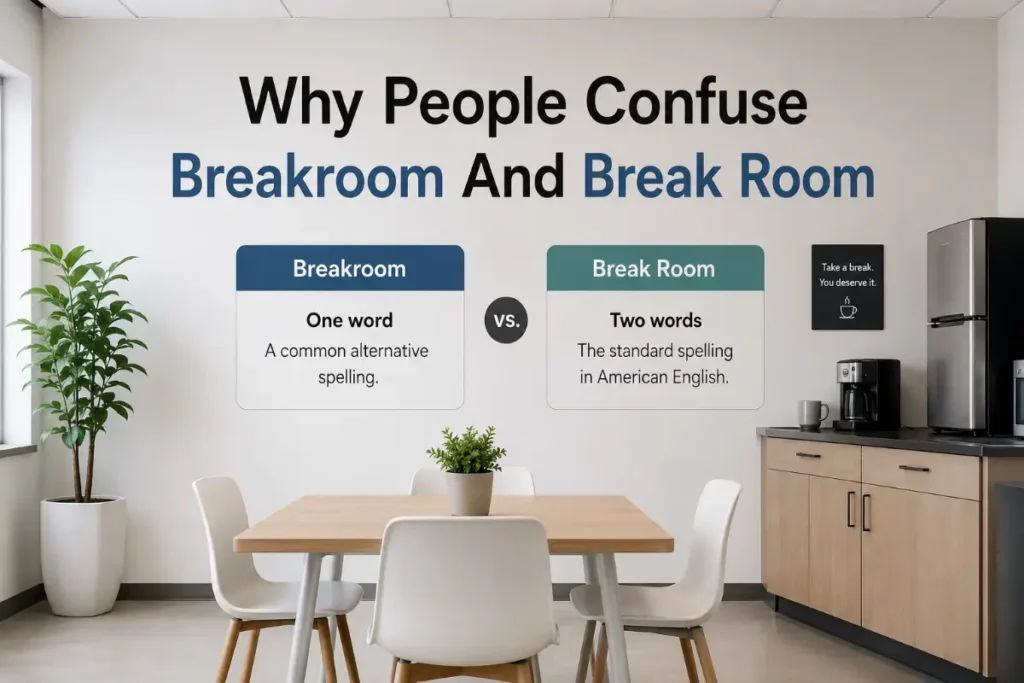
Why People Confuse Breakroom And Break Room
The confusion comes from a normal feature of English rather than a grammar problem.
Compound Words Cause Confusion
English creates new words by combining existing words.
Consider these examples.
work + place = workplace
bed + room = bedroom
class + room = classroom
break + room = break room or breakroom
English doesn’t always follow one predictable rule for deciding when a compound should become one word.
That makes compound nouns especially tricky for learners.
Workplace Usage Influences Spelling
Words connected with offices factories schools hospitals and other workplaces often develop their own common forms.
Breakroom has become familiar in American workplace language because people use the term frequently in employee manuals signs company websites and everyday conversation.
Fast Typing Can Encourage Closed Forms
When people type quickly they sometimes combine familiar word pairs into one word. Repeated exposure can then make the closed spelling feel natural.
Over time common usage can reinforce the pattern.
Dictionaries And Style Guides Can Differ
English dictionaries don’t always treat compound words in exactly the same way. Some may list one form as the main entry while noting another form. Style guides can also make different recommendations based on audience and publication style.
So a spelling difference doesn’t automatically mean one version is an error.
Key Differences Between Breakroom And Break Room
There is no major difference in meaning.
The important differences involve spelling style and usage.
Meaning
Both forms describe a room where people take breaks.
Grammar
Both forms function as compound nouns.
Pronunciation
Most speakers pronounce them the same way.
Register
Both can appear in everyday and workplace writing.
Region
Breakroom is particularly familiar in American workplace English. Break room is also widely used in the United States.
Function
Both identify a physical room rather than the break itself.
The spelling changes but the underlying meaning stays the same.
Grammar Explanation
Understanding the grammar helps explain why both forms work.
Break Room Is A Compound Noun
A compound noun combines two or more words to create a single concept.
In break room the word break modifies room.
It tells us what kind of room it is.
Compare these expressions.
- Break room.
- Meeting room.
- Waiting room.
- Dining room.
- Locker room.
Many common English compound nouns remain open.
Breakroom Is A Closed Compound Noun
When the same concept is written as breakroom the two parts form a closed compound.
The grammatical function doesn’t change.
Compare:
The break room is clean.
The breakroom is clean.
In both sentences the compound noun acts as the subject.
Singular Form
The singular forms are:
break room
breakroom
Example:
The break room is closed for cleaning.
Plural Form
The plural of the open form is:
break rooms
The plural of the closed form is:
breakrooms
Examples:
The company has three break rooms.
The company has three breakrooms.
Don’t write break roomes or breakroomes.
The word follows the regular plural pattern.
Possessive Form
You can also make the compound possessive.
Singular:
The break room’s refrigerator needs repair.
Closed form:
The breakroom’s refrigerator needs repair.
Plural:
The break rooms’ refrigerators were replaced.
The apostrophe follows the normal possessive rules.
Using Articles
Because break room and breakroom are countable nouns you can use articles such as a and the.
Examples:
We need a break room for the new office.
The break room is upstairs.
An employee asked for a larger breakroom.
Using Break Room As A Modifier
The phrase can also appear before another noun.
Examples:
break room furniture
break room supplies
In careful writing the open form is especially easy to read in these combinations.

Spelling Rules For Breakroom And Break Room
There isn’t a special spelling rule that forces breakroom into one word.
The issue comes from compound noun formation.
Open Compounds
An open compound contains separate words that work together as one idea.
Examples include:
- Post office.
- High school.
- Living room.
- Dining room.
- Break room.
Closed Compounds
A closed compound joins the words together.
Examples include:
- Bedroom.
- Classroom.
- Workplace.
- Notebook.
- Breakroom.
The important lesson is that English compounds develop through common usage. You can’t always predict the final spelling simply by looking at the two original words.
Don’t Add A Hyphen
For standard use don’t normally write:
break room
or
breakroom
The hyphenated form break-room isn’t the normal spelling for the noun.
That distinction matters because writers sometimes assume a hyphen is needed when two words work together.
It isn’t.
Pronunciation Guide
The pronunciation of break room and breakroom is essentially the same.
IPA
A common American English pronunciation is approximately:
/ˈbreɪk ˌruːm/
The first part sounds like brake.
The second part sounds like room.
Syllables
You can think of the phrase as:
break room
It has two main syllables.
Stress Pattern
The strongest stress usually falls on break while room receives secondary stress.
Common Pronunciation Mistake
Some learners may pronounce break like brick because of spelling differences between languages.
In American English the vowel in break is the same general vowel sound heard in day and great.
Learn the difference in Comming Vs Coming Which Spelling Is Correct 2026.
Break Room In American English
American English commonly uses break room for an employee area.
You might see the term in:
- Office buildings.
- Retail stores.
- Warehouses.
- Schools.
- Hospitals.
- Factories.
- Restaurants.
- Corporate offices.
- Call centers.
- Government workplaces.
Both break room and breakroom occur in American usage.
For signs and internal documents the choice often depends on the organization’s preferred style.
A sign might say:
EMPLOYEE BREAK ROOM
Another workplace might use:
EMPLOYEE BREAKROOM
Neither sign creates a meaningful difference for the reader.
British English And Other Varieties
The term break room is understood in British English but isn’t always the preferred everyday expression.
British speakers may use terms such as staff room depending on the workplace and situation.
For example:
The teachers are in the staff room.
In a British workplace staff room can sound more natural than break room.
Canadian English can use break room and staff room depending on the setting. Australian English also uses workplace terms such as staff room and tearoom in some contexts.
Regional vocabulary matters here because English speakers don’t always choose the same label for the same physical space.
Still the spelling difference between break room and breakroom is primarily an American usage issue.
Real Life Examples
Seeing both forms in natural sentences makes the distinction easier to understand.
Daily Conversation
- I’ll meet you in the break room after lunch.
- The breakroom has a new coffee machine.
- Is anyone using the break room?
- I left my lunch in the breakroom.
- The break room gets crowded around noon.
Workplace Writing
- Please keep the break room clean.
- Employees can use the breakroom during scheduled breaks.
- The break room will be closed on Friday.
- New chairs were delivered to the breakroom.
- Please report any break room maintenance problems to the office manager.
Workplace Signs
- Please clean the break room after use.
- Breakroom supplies are stored in the cabinet.
- Employees only beyond this point.
- Please label food kept in the break room refrigerator.
Emails
- The break room will be unavailable from 2 p.m. to 4 p.m.
- We’ve added a microwave to the breakroom.
- Please remove personal items from the break room before leaving today.
Employee Handbooks
- Employees may use the break room during their scheduled breaks.
- Food should be stored in the breakroom refrigerator.
- Personal belongings shouldn’t be left unattended in the break room.
Academic Writing
- The study examined how employees used the break room during scheduled rest periods.
- Researchers observed social interaction in the workplace breakroom.
Academic writers may prefer more specific terms such as employee lounge or staff area when the exact setting matters.
Journalism
- Workers gathered in the break room after the meeting.
- The company renovated its breakroom as part of an office redesign.
Social Media
- Our breakroom coffee machine finally works again.
- Someone left birthday cake in the break room.
The social media examples show why breakroom feels perfectly natural to many American readers.
Break Room Or Employee Lounge
These terms can overlap but they aren’t always identical.
A break room usually refers specifically to a workplace room where employees take scheduled breaks.
An employee lounge can suggest a more comfortable shared space designed for relaxing.
For example:
The employees ate lunch in the break room.
The employee lounge has sofas and a television.
A company can use both terms for different spaces.
Break Room Or Staff Room
The difference is partly regional and partly contextual.
Break room focuses on taking breaks.
Staff room focuses on the employees who use the room.
In a school you are more likely to hear staff room than break room.
Example:
The teachers met in the staff room.
In an American office you might hear:
I’ll leave the documents in the break room.
Choosing the most natural term depends on the workplace and audience.
Common Mistakes
Writing Break-Room
Avoid the unnecessary hyphen in ordinary usage.
Use:
break room
or
breakroom
Treating Breakroom As Wrong
This is one of the most common misconceptions.
Breakroom isn’t simply a careless spelling of break room. It is an established closed compound used in American English.
Treating Break Room As Old Fashioned
The open form remains completely natural.
You don’t need to change break room to breakroom to sound modern.
Mixing Forms In One Document
Consistency matters in professional writing.
If an employee handbook uses breakroom throughout then suddenly switches to break room the change may look accidental.
Choose one style and stick with it.
Confusing Break Room With Breakroom Rules
The spelling doesn’t change the meaning of related phrases.
You can write:
break room rules
or
breakroom rules
The key is consistency.
Memory Trick
Use this simple idea.
A break needs a room.
Think of break room as two clear pieces.
break + room
If you’re unsure while writing formal content then use the open form. It is easy to recognize and difficult to misunderstand.
For the closed form remember that breakroom behaves like other familiar workplace compounds.
bedroom
classroom
workplace
breakroom
This isn’t a perfect rule for all English compounds but it can help you remember the spelling.
Related Words And Expressions
The word break appears in many workplace expressions.
Break Related Words
- Coffee break.
- Lunch break.
- Rest break.
- Meal break.
- Work break.
- Break time.
- Rest period.
- Employee lounge.
- Staff room.
- Common room.
Related Compound Nouns
- Workplace.
- Workroom.
- Classroom.
- Bedroom.
- Locker room.
- Lunchroom.
- Dining room.
- Meeting room.
- Waiting room.
- Conference room.
These examples show why compound nouns can create spelling questions. English uses open compounds closed compounds and occasionally hyphenated compounds.
Expert Editor’s Note
If I were editing a formal American workplace document and had no house style to follow I’d choose break room.
Why?
It is transparent. Readers immediately see the relationship between break and room. It also avoids any argument about the closed form.
That doesn’t mean I’d automatically change breakroom during an edit.
If the organization’s established documents use breakroom consistently then I would normally preserve it. Good editing isn’t about changing words simply because another form exists. It is about clarity consistency correctness and audience expectations.
For general American English writing the practical recommendation is simple.
Use break room when you want the safest conventional choice.
Use breakroom when it matches your organization’s established style or the publication’s preferred dictionary and style guide.
Don’t treat one as a spelling mistake without checking the intended style.
Frequently Asked Questions
Is Breakroom One Word Or Two Words?
Both breakroom and break room are used in American English. Break room is the traditional open form and remains a safe choice for formal writing. Breakroom is also established as a closed compound. The two forms have the same meaning and usually differ only in spelling style.
Is Break Room Grammatically Correct?
Yes. Break room is a grammatically correct compound noun. It refers to a room where employees or workers take breaks. You can use it as a singular noun or pluralize it as break rooms. The phrase works naturally in conversation workplace documents signs and general writing.
Is Breakroom Better Than Break Room?
Not necessarily. Breakroom isn’t inherently better. It is simply a closed spelling of the same compound noun. For general formal American writing break room is a dependable choice because readers recognize the structure immediately. If a company already uses breakroom in its style then consistency may be more important.
How Do You Pluralize Break Room?
The open form becomes break rooms. The closed form becomes breakrooms. For example you can write The company has two break rooms or The company has two breakrooms. Don’t add an apostrophe to make the ordinary plural.
Is Break Room Hyphenated?
Normally no. Standard usage uses either break room as two words or breakroom as one word. The form break-room isn’t normally needed when you’re using the expression as a noun for an employee area.
What Do British People Call A Break Room?
British speakers often use staff room for a workplace area where employees can relax. The exact term depends on the setting. Break room is understood but may sound more American in some contexts. Schools and workplaces can have their own preferred terminology.
Should A Workplace Sign Say Break Room Or Breakroom?
Either can work. For a general American audience BREAK ROOM is a clear and familiar choice. If your company uses BREAKROOM throughout its signs employee handbook and internal communications then keeping that spelling consistent is perfectly reasonable.
Many readers also check Traveled Or Travelled Which Spelling Is Correct 2026.
Conclusion
The answer to breakroom or break room isn’t as complicated as it first appears.
Break room is the traditional open form and a strong choice for formal American writing. Breakroom is also a legitimate and widely used closed compound in American workplace English.
Both forms describe the same thing. Both function as compound nouns. The main difference is simply how the compound is written.
If you’re unsure which form to use in a document choose break room. It’s clear familiar and broadly accepted.
If your workplace already uses breakroom consistently there’s no need to change it simply because another spelling exists.
The smartest rule is simple: choose a clear form and use it consistently.

Editorial Reviewer & Proofreader
Grace Mitchell reviews Gramlify’s articles for clarity, consistency, and readability. She is passionate about creating accurate, approachable content that helps English learners build confidence.