
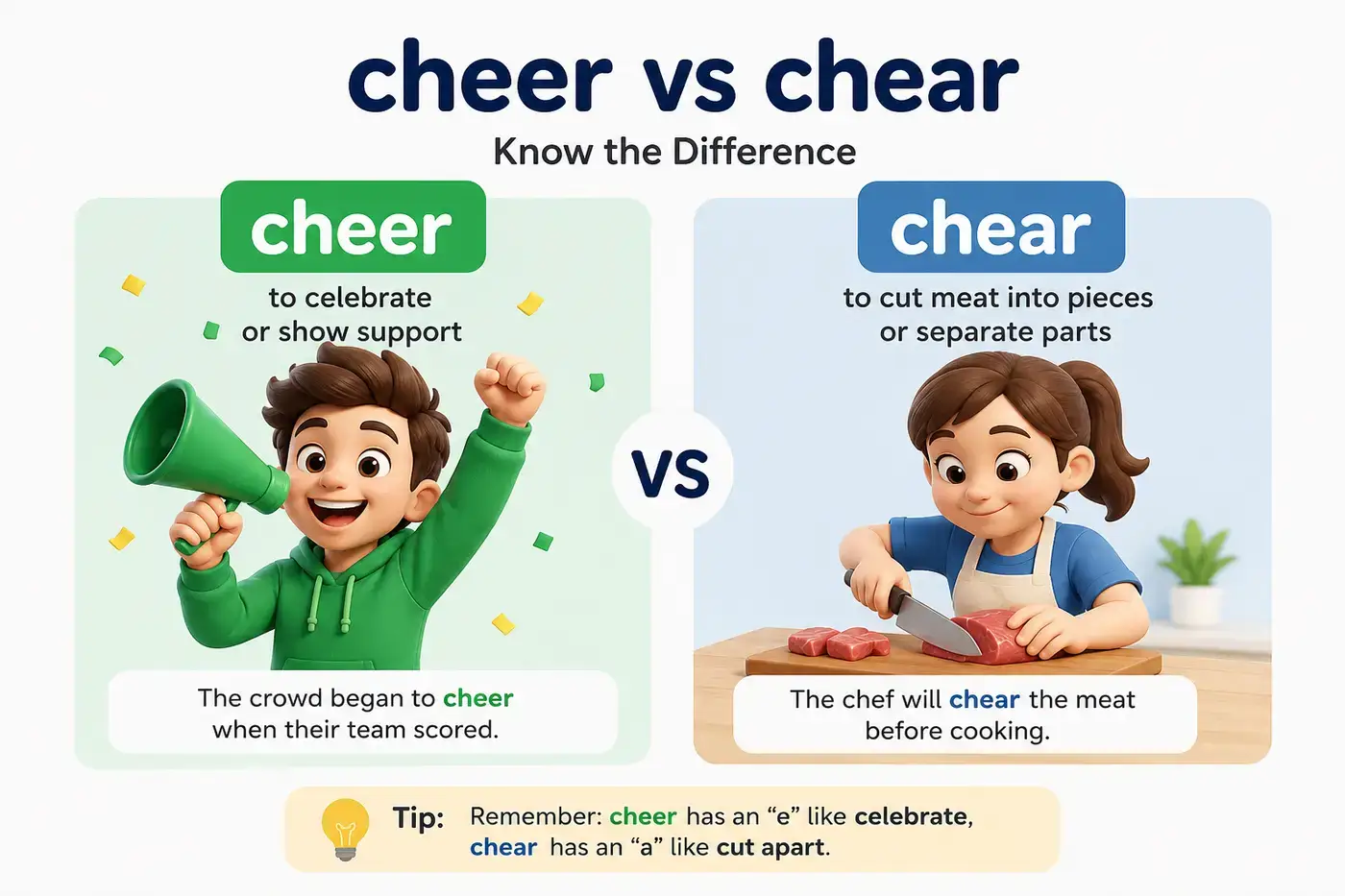
English spelling can be tricky because some incorrect words look almost identical to correct ones. The confusion around cheer vs chear is a perfect example. Many learners wonder if both spellings are acceptable or if one is simply a typing mistake.
The correct spelling is cheer. The word chear is not a standard English word in modern usage. It is usually a spelling mistake caused by the similar sound of the two words.
The word cheer has several meanings. It can describe happiness, encouragement, support, or the loud sounds people make to show excitement. You can cheer for a sports team, cheer up a friend, or describe someone as cheerful.
In this guide, you’ll learn the difference between cheer and chear, why people confuse these spellings, how to use the correct word in sentences, the grammar rules behind it, common mistakes to avoid, and simple memory tricks that help you remember the right spelling.
You may also want to read Kinesthesiology Vs Kinesiology Which Word Is Correct 2026.
Quick Answer
Cheer is the correct spelling. It means happiness, encouragement, support, or a shout of excitement. Chear is an incorrect spelling in modern English and should not be used. If you are writing an email, essay, article, or message, always choose cheer.
Cheer Vs Chear Comparison Table
| Feature | Cheer | Chear |
|---|---|---|
| Correct spelling | Yes | No |
| Meaning | Happiness, encouragement, support, or a joyful shout | No modern English meaning |
| Part of speech | Noun and verb | Incorrect spelling |
| Pronunciation | /tʃɪr/ | Usually intended as cheer |
| Usage | Common in everyday English | Not used in standard English |
| Formal writing | Accepted | Should be avoided |
| Example | The fans cheer for their team. | The fans chear for their team. |
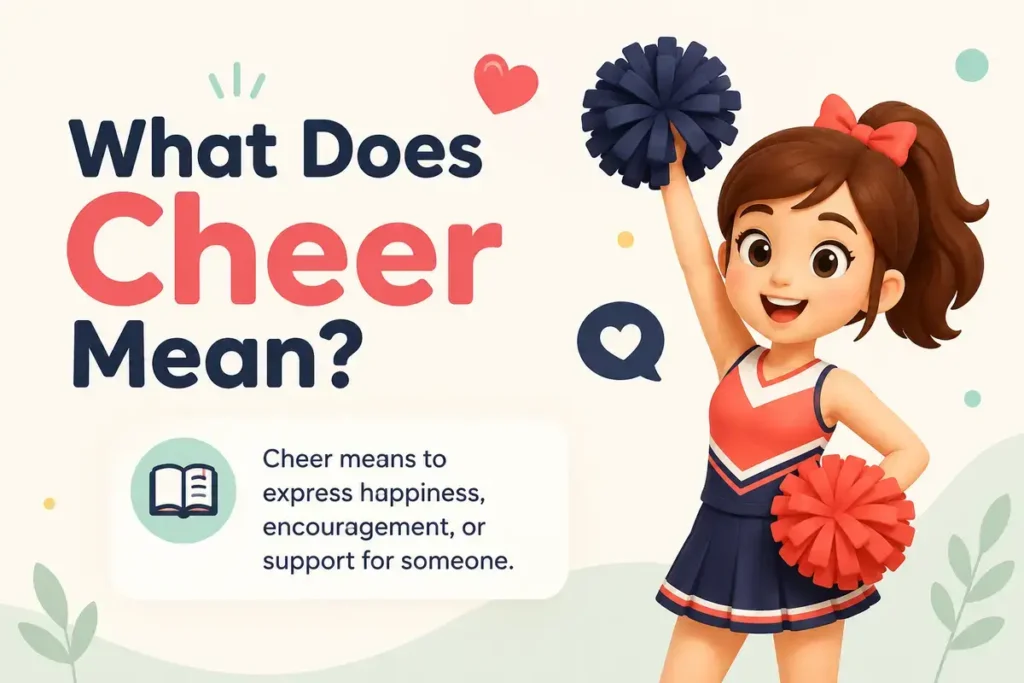
What Does Cheer Mean
Cheer is a common English word with several related meanings. It can be used as a noun or a verb.
Cheer As A Noun
As a noun, cheer refers to happiness, positive feelings, encouragement, or a loud expression of support.
Examples.
- The crowd gave a loud cheer when the team scored.
- Her kind words brought cheer to everyone in the room.
- The holiday decorations filled the house with cheer.
- The children shouted with cheer during the celebration.
In these examples, cheer represents a feeling or a joyful sound.
Cheer As A Verb
As a verb, cheer means to encourage someone, make someone happier, or show support.
Examples.
- The fans cheer for their favorite player.
- I called my friend to cheer her up.
- The coach cheered the team before the final match.
- The music helped cheer everyone after a difficult day.
The verb form often appears in phrases like:
- Cheer up.
- Cheer for someone.
- Cheer someone on.
What Does Chear Mean
Chear is not a correct spelling in modern English.
If you see chear in writing, it is usually:
- A spelling mistake.
- A typing error.
- A misunderstanding of the word cheer.
Modern English dictionaries do not recognize chear as the standard spelling for happiness, support, or encouragement.
For correct writing, replace chear with cheer.
Incorrect.
The crowd began to chear loudly.
Correct.
The crowd began to cheer loudly.
Which One Is Correct Cheer Or Chear
The correct word is cheer.
English spelling follows patterns, but some words cannot be predicted only by sound. Cheer is one of those words where the letters ee create the long e sound.
Similar examples include:
- See.
- Feel.
- Green.
- Cheer.
The spelling chear may look logical because English has words like hear and near. However, chear is not the accepted spelling for this meaning.
Professional writers, editors, teachers, and dictionaries all use cheer.
Why People Confuse Cheer And Chear
The confusion between cheer and chear happens for several reasons.
Similar Pronunciation
Both spellings appear like they could create the same sound.
When people hear the word spoken, they only hear the sound. They do not see the spelling. This can lead to mistakes when writing.
For example, someone may think:
The word sounds like hear.
Maybe it should be spelled chear.
However, English spelling does not always follow simple sound patterns.
Similar Looking Words
Many English words use ear to create sounds.
Examples.
- Hear.
- Near.
- Clear.
- Fear.
Because of this pattern, some people guess that chear might be correct.
The correct spelling developed differently. The word uses cheer.
Keyboard Mistakes
People often type quickly and choose a spelling that feels familiar. Since chear looks close to cheer, it can happen as a typing mistake.
Autocorrect usually fixes this error, but it may not always catch it depending on the sentence.
Internet Influence
Online conversations sometimes spread incorrect spellings. When people repeatedly see a misspelled word, it can start to look normal.
Seeing a word often does not always mean it is correct.
Historical Spelling Confusion
English has changed over hundreds of years. Some older spellings no longer appear in modern writing.
Today, cheer is the accepted form.
Key Differences Between Cheer And Chear
The main difference is simple.
Cheer is a real English word.
Chear is a spelling error.
Meaning Difference
Cheer has several meanings:
- A feeling of happiness.
- A shout of support.
- An act of encouragement.
Chear has no standard modern meaning.
Grammar Difference
Cheer can function as:
- A noun.
- A verb.
Chear does not function as any accepted part of speech in modern English.
Usage Difference
Cheer appears in everyday conversations, literature, journalism, education, and professional writing.
Chear should not appear in formal or informal writing.
Context Difference
You may use cheer in situations involving:
- Sports.
- Celebrations.
- Emotional support.
- Positive feelings.
Examples.
The audience erupted in cheer.
She tried to cheer him up.
The students cheer for their school.
Grammar Explanation Of Cheer
Understanding how cheer works in a sentence makes correct usage easier.
Cheer As A Noun
A noun names a person, place, thing, or idea.
As a noun, cheer can describe a feeling or sound.
Examples.
- A loud cheer came from the stadium.
- The room was full of holiday cheer.
- Her smile brought cheer to the office.
Common noun forms include:
- A cheer.
- The cheer.
- Loud cheers.
Singular And Plural Form
The singular form is:
Cheer.
The plural form is:
Cheers.
Examples.
- The player heard one cheer from the crowd.
- The team received many cheers from supporters.
Cheer As A Verb
As a verb, cheer describes an action.
Common verb forms include:
Present tense.
Cheer.
Past tense.
Cheered.
Past participle.
Cheered.
Present participle.
Cheering.
Examples.
- Fans cheer during the game.
- Fans cheered after the victory.
- The crowd is cheering loudly.
Common Phrases With Cheer
English speakers often use cheer in fixed expressions.
Cheer Up
Meaning: Become happier or make someone happier.
Example.
I bought flowers to cheer my sister up.
Cheer For
Meaning: Support someone or something.
Example.
Millions of fans cheer for their favorite teams.
Cheer On
Meaning: Encourage someone during an activity.
Example.
Her family came to cheer her on during the race.
Three Cheers For
Meaning: A phrase used to show strong approval.
Example.
Three cheers for the volunteers who helped the community.
Spelling Rules For Cheer
The spelling of cheer follows a common English pattern where the letters ee create a long e sound.
Examples of the same spelling pattern include:
- See.
- Tree.
- Green.
- Sleep.
- Cheer.
The ee combination often appears in words where the vowel sound is stretched.
Why Cheer Uses Double E
English spelling developed from many languages, so spelling does not always match pronunciation perfectly. The spelling cheer became the accepted form because of historical language changes and common usage.
The word follows the same pattern as many other English words with ee.
Incorrect.
I want to chear for my team.
Correct.
I want to cheer for my team.
Pronunciation Guide For Cheer
The pronunciation of cheer is simple.
IPA
/tʃɪr/
Syllables
Cheer has one syllable.
Sound Breakdown
The word begins with the sound:
/tʃ/
This is the same sound found in:
- Chair.
- Child.
- Cheese.
The ending creates the long e sound.
Examples.
- Cheer.
- Clear.
- Fear.
Common Pronunciation Mistakes
Some learners pronounce cheer like:
- Chair.
- Chare.
- Care.
These pronunciations change the word and may confuse listeners.
A good way to practice is to say:
Cheer.
Then compare it with:
Chair.
The vowel sound is different.
British American Canadian And Australian English
The spelling cheer is the same across major English varieties.
There is no regional spelling difference between American English and British English.
Speakers in:
- The United States.
- The United Kingdom.
- Canada.
- Australia.
All use cheer.
The pronunciation may have small differences because accents vary, but the spelling remains unchanged.
Examples.
American English.
The fans cheer loudly.
British English.
The crowd gave a huge cheer.
Canadian English.
The students cheer for their school.
Australian English.
The supporters cheer during the match.

Real Life Examples Of Cheer
Seeing the word in different situations helps you understand how native speakers use it naturally.
Daily Conversation Examples
- I need something to cheer me up after a long day.
- Everyone started to cheer when the surprise was announced.
- Her message brought cheer to my morning.
- We went outside to cheer for the runners.
- A little kindness can bring cheer to someone’s life.
Workplace Examples
- The team gathered to cheer their coworker after the successful presentation.
- The manager shared good news to bring cheer to the office.
- Employees cheered when the company reached its goal.
- A positive workplace can create a sense of cheer among workers.
- The audience gave a cheer after the speaker finished.
Need another quick comparison? Read Copys Or Copies Which Is Correct 2026.
Email Examples
- Thank you for your support. Your message brought a lot of cheer.
- We are excited to share this news and celebrate with everyone.
- The team continues to cheer each other on during the project.
Academic Writing Examples
- The study examines how public celebrations create social cheer.
- The author describes moments of cheer during difficult periods.
- Researchers observed that group support can increase feelings of happiness and encouragement.
Journalism Examples
- Fans erupted into cheer after the final score was announced.
- The event brought cheer to the local community.
- The celebration was filled with music, laughter, and cheer.
Social Media Examples
- Sending you some positive cheer today.
- Three cheers for everyone who helped make this happen.
- Your support is the real reason we can keep going. Cheer to the amazing team.
Literature Examples
- The character searched for moments of cheer during difficult times.
- The village welcomed the travelers with songs and cheers.
Common Mistakes With Cheer And Chear
Even though the difference is simple, several mistakes appear frequently.
Mistake One Writing Chear Instead Of Cheer
Incorrect.
The children began to chear when the show started.
Correct.
The children began to cheer when the show started.
The correct spelling always uses ee.
Mistake Two Using Cheer When You Mean Cheerful
These words are connected but different.
Cheer is a noun or verb.
Cheerful is an adjective.
Incorrect.
She is very cheer.
Correct.
She is very cheerful.
Mistake Three Confusing Cheer And Chair
These words look and sound similar for some learners.
A chair is a piece of furniture.
A cheer is happiness, support, or encouragement.
Examples.
I sat on the chair.
The fans gave a cheer.
Mistake Four Forgetting The Double E
Some learners write:
Cher.
Chear.
Chere.
Only cheer is correct for this meaning.
Mistake Five Using Incorrect Verb Forms
The verb forms of cheer follow regular English patterns.
Correct forms:
Present.
I cheer.
Past.
I cheered.
Past participle.
I have cheered.
Present participle.
I am cheering.
Incorrect forms:
I chear.
I am cheer.

Memory Tricks To Remember Cheer
A good memory trick can prevent spelling mistakes.
Think Of Two E For Extra Energy
Remember:
Cheer has two E letters because cheering shows extra energy and excitement.
Cheer = Energy + Encouragement.
Connect Cheer With Team Support
Picture a stadium.
Fans are shouting:
Go team.
They are not chearing.
They are cheering.
This mental image connects the correct spelling with the meaning.
Remember The Double E Family
The word cheer belongs with other double e words.
Examples.
- Green.
- Feel.
- Sleep.
- Need.
- Cheer.
When you remember this group, the spelling becomes easier.
Related Words And Expressions
Understanding related words builds stronger vocabulary.
Words Related To Cheer
Cheerful
Meaning: Happy and positive.
Example.
She has a cheerful personality.
Cheerfully
Meaning: In a happy way.
Example.
He cheerfully helped his neighbors.
Cheerless
Meaning: Without happiness or excitement.
Example.
The empty room felt cheerless.
Cheerleader
Meaning: A person who encourages others or performs organized support routines.
Example.
The cheerleader encouraged the team.
Cheers
Meaning: More than one joyful shout or a friendly expression used for celebration.
Example.
The crowd gave three cheers.
Synonyms For Cheer
Depending on the meaning, synonyms include:
- Happiness.
- Joy.
- Delight.
- Encouragement.
- Support.
- Applause.
- Celebration.
- Confidence.
Opposites Of Cheer
Opposite words include:
- Sadness.
- Discouragement.
- Gloom.
- Unhappiness.
- Disappointment.
Commonly Confused Words With Cheer
Cheer And Cheers
Cheer can be singular.
Cheers can be plural.
Examples.
One cheer came from the crowd.
The crowd gave many cheers.
Cheer And Cheerful
Cheer describes a feeling or action.
Cheerful describes someone’s personality.
Examples.
The room was filled with cheer.
She is cheerful.
Cheer And Encourage
These words are connected but not identical.
To encourage means to give support.
To cheer can mean to encourage through words, actions, or excitement.
Example.
The coach encouraged the players.
The fans cheered for the players.
Cheer Vs Chear Expert Editor Note FAQs And Final Guide
Expert Editor’s Note
From an editor’s perspective, the choice between cheer and chear is straightforward. Only cheer belongs in modern English writing.
Professional editors, teachers, and dictionary writers follow accepted spelling standards. They do not rely only on pronunciation because English contains many words where the sound and spelling do not match perfectly.
The word cheer has a long history in English and appears in dictionaries as a noun and verb. It works in both casual conversations and formal writing.
Examples.
- The crowd erupted in cheer.
- The students cheered for the speaker.
- Her kindness brought cheer to the community.
The spelling chear may look reasonable, but it does not follow modern English usage. Using it in an article, email, school assignment, or professional document would be considered a spelling error.
A useful editing habit is to check the word family.
Cheer.
Cheerful.
Cheerfully.
Cheering.
Cheered.
All these words keep the same cheer spelling pattern.
When you recognize the word family, the correct spelling becomes much easier to remember.
Why Dictionaries Prefer Cheer
Modern dictionaries list cheer as the accepted spelling because it has a clear meaning and established usage.
The word appears in:
- Everyday conversations.
- Newspapers.
- Books.
- Academic writing.
- Professional communication.
Dictionaries record how English speakers use words over time. Since chear does not have standard modern usage for this meaning, it is not considered the correct spelling.
Frequently Asked Questions
Is Cheer Or Chear The Correct Spelling?
Cheer is the correct spelling. It can mean happiness, encouragement, support, or a joyful shout. Chear is a misspelling and should not be used in modern English writing.
Why Is Chear Wrong?
Chear is wrong because English dictionaries and standard writing rules recognize cheer as the correct form. Although chear looks possible because of words like hear and near, it is not the accepted spelling for this meaning.
How Do You Spell Cheer Correctly?
The correct spelling is C H E E R. Remember the double E in the middle. The same pattern appears in words like green, sleep, and feel.
What Does Cheer Mean In English?
Cheer means happiness, encouragement, support, or a loud expression of excitement. As a verb, it means to encourage someone or show support. As a noun, it describes a joyful feeling or sound.
Is Cheer A Noun Or A Verb?
Cheer can be both a noun and a verb. As a noun, it describes a joyful feeling or sound. As a verb, it describes the action of encouraging someone or showing support.
Can Cheer Be Used In Formal Writing?
Yes. Cheer is appropriate in both formal and informal writing. It appears in professional documents, academic writing, journalism, and everyday communication.
What Is The Difference Between Cheer And Cheers?
Cheer is usually singular and refers to one feeling or one shout. Cheers is the plural form and can also be used as a friendly expression when making a toast or showing approval.
Example.
The team heard one loud cheer.
The audience gave three cheers.
How Do You Remember The Spelling Of Cheer?
Remember that cheer has two E letters. Think of a crowd cheering with extra energy and excitement. The double E can remind you of the positive feeling connected with the word.
A related grammar guide is Potatoes Or Potatos Which Spelling Is Correct 2026.
Conclusion
The correct answer to cheer vs chear is simple. Cheer is the correct English spelling, while chear is a spelling mistake.
Use cheer when you want to talk about happiness, encouragement, support, or a joyful expression. It works as both a noun and a verb.
The biggest mistake is trusting pronunciation alone. English spelling often follows history and common usage rather than simple sound patterns.
A quick memory tip can help. Cheer has two E letters because cheering brings extra energy.
When you write the word correctly, your message sounds clearer and more natural. A small spelling choice can make a big difference in confident communication.

Editorial Reviewer & Proofreader
Grace Mitchell reviews Gramlify’s articles for clarity, consistency, and readability. She is passionate about creating accurate, approachable content that helps English learners build confidence.
1 thought on “Cheer Vs Chear Which Spelling Is Correct 2026 Guide”