
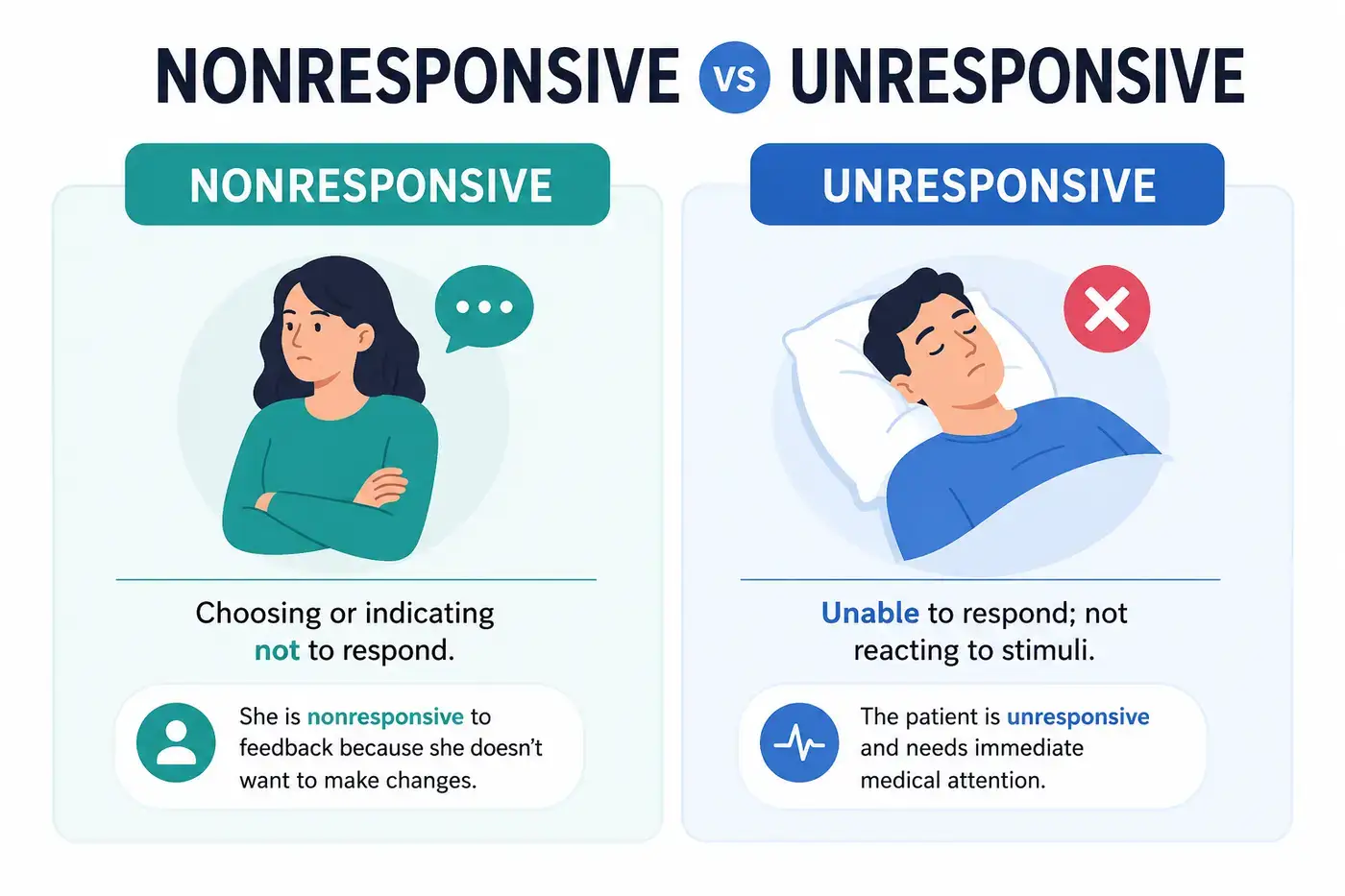
When something stops working or someone fails to react, many people wonder if they should use nonresponsive vs unresponsive. Both words look almost identical, and both can describe a lack of response. However, they are not always used in the same situations.
The main difference is focus. Unresponsive usually describes a person, device, or system that does not respond when a response is expected. It often suggests a failure to react after an attempt has been made. Nonresponsive is a broader term that means something does not provide a response or does not show a response at all.
These words appear in medical reports, technology discussions, customer service messages, workplace communication, and everyday conversations. Choosing the right one depends on the context and the level of formality you need.
This guide explains the difference between nonresponsive vs unresponsive, including their meanings, grammar, pronunciation, usage, examples, common mistakes, and expert writing tips. You’ll learn how native speakers use these words and how to choose the correct word confidently in professional and casual writing.
For another common grammar confusion, see Serpent Vs Snake Difference Meaning And Correct 2026.
Quick Answer
Nonresponsive means not giving a response or reaction. It is common in formal, technical, and professional contexts. Unresponsive means not reacting or failing to respond, often describing people, machines, or systems that should normally react. Both words are correct, but context determines the better choice.
Nonresponsive Vs Unresponsive Comparison Table
| Feature | Nonresponsive | Unresponsive |
|---|---|---|
| Correct spelling | Yes | Yes |
| Part of speech | Adjective | Adjective |
| Main meaning | Not providing a response | Not reacting or failing to respond |
| Common use | Reports, surveys, technology, customer service | People, devices, medical situations, systems |
| Tone | More neutral and formal | More direct and sometimes serious |
| Prefix | Non means not | Un means opposite or lack of |
| Example | The company received many nonresponsive applications. | The patient became unresponsive. |

What Does Nonresponsive Mean
Nonresponsive is an adjective that describes something or someone that does not respond, answer, react, or provide feedback.
The prefix non means not or absence of something. When added to responsive, it creates the meaning of lacking a response.
Simple Definition
Nonresponsive means not giving an answer, reaction, reply, or expected response.
Common Contexts For Nonresponsive
The word nonresponsive often appears in formal or analytical situations.
Examples include:
- A survey participant who does not answer questions.
- A customer who does not reply to messages.
- A website feature that does not provide feedback.
- A company that ignores repeated requests.
- A system that does not return information.
Examples Of Nonresponsive In Sentences
- The client remained nonresponsive after several follow up emails.
- The survey included several nonresponsive participants.
- The application became nonresponsive after the update.
- The department marked the request as nonresponsive because no information was provided.
- The website showed a nonresponsive page error.
Nonresponsive In Professional Writing
Writers often choose nonresponsive in business, research, and technical communication because it sounds neutral and descriptive.
For example:
A customer support report may say:
The user was nonresponsive to multiple contact attempts.
This sounds more objective than saying the person ignored messages.
What Does Unresponsive Mean
Unresponsive means not reacting, not answering, or not responding when a response is expected.
The prefix un often creates the opposite meaning of a word.
Examples:
- Happy becomes unhappy.
- Clear becomes unclear.
- Responsive becomes unresponsive.
Simple Definition
Unresponsive means unable or unwilling to respond.
Common Contexts For Unresponsive
The word appears frequently when describing:
- People who do not react.
- Phones or computers that freeze.
- Organizations that fail to answer.
- Emergency situations.
- Devices that stop working.
Examples Of Unresponsive In Sentences
- The patient was unresponsive when emergency workers arrived.
- My laptop became unresponsive during the presentation.
- The employee remained unresponsive to repeated requests.
- The phone screen became unresponsive after the fall.
- The customer service team was unresponsive for several days.
Which One Is Correct Nonresponsive Or Unresponsive
Both nonresponsive and unresponsive are correct English words.
The right choice depends on what you want to describe.
Use nonresponsive when you want to emphasize the absence of a response.
Example:
The survey results included many nonresponsive entries.
Use unresponsive when you want to emphasize a failure to react.
Example:
The computer became unresponsive after opening too many programs.
A helpful rule:
Use nonresponsive for missing answers, feedback, or participation.
Use unresponsive for people, machines, and situations where a reaction was expected.
Why People Confuse Nonresponsive And Unresponsive
The confusion happens because both words share the same base word: responsive.
They also use prefixes that can both mean a lack of something.
Similar Appearance
The words differ by only two letters.
Nonresponsive.
Unresponsive.
When people read quickly, the difference can disappear.
Similar Meaning
Both words suggest a lack of response, so speakers often use them interchangeably.
In many everyday situations, people understand both versions. However, professional writing benefits from choosing the more precise word.
Prefix Confusion
English uses many prefixes to create opposite meanings.
The prefix non usually means absence or lack.
Examples:
- Nonfiction means writing that is not fiction.
- Nonprofit means an organization that does not operate for profit.
- Nonverbal means without words.
The prefix un often means the opposite state.
Examples:
- Unclear means not clear.
- Unfair means not fair.
- Unresponsive means not responding.
Understanding these patterns helps explain why both words exist.
Key Differences Between Nonresponsive And Unresponsive
The biggest difference is the type of response being discussed.
Nonresponsive Focuses On Lack Of Response
Nonresponsive often describes a missing answer or reaction.
Examples:
The applicant was nonresponsive during the interview process.
The report had several nonresponsive sections.
The survey contained nonresponsive answers.
Unresponsive Focuses On Failure To React
Unresponsive often suggests that something should respond but does not.
Examples:
The patient was unresponsive.
The phone became unresponsive.
The computer is unresponsive.
Tone Difference
Nonresponsive often sounds more neutral and professional.
Unresponsive can sound stronger because it may suggest a problem or concern.
Compare:
The department was nonresponsive to the request.
The department was unresponsive to the request.
The second sentence sounds more critical.
Grammar Explanation Of Nonresponsive And Unresponsive
Both words function as adjectives.
An adjective describes a noun.
Examples:
- A nonresponsive customer.
- An unresponsive device.
- A nonresponsive system.
- An unresponsive patient.
Sentence Structure
Both words usually appear before a noun or after linking verbs.
Before a noun:
The team contacted the nonresponsive client.
The technician fixed the unresponsive computer.
After a linking verb:
The customer was nonresponsive.
The screen became unresponsive.
Comparative And Superlative Forms
Because these words describe a condition, writers usually avoid forms like:
More nonresponsive.
Most nonresponsive.
More unresponsive.
Most unresponsive.
Instead, writers often use clearer phrases.
Examples:
The second system was less responsive.
The device showed a higher level of unresponsiveness.
The patient became completely unresponsive.
Spelling Rules For Nonresponsive And Unresponsive
Both words follow common English prefix rules.
Nonresponsive
The prefix non attaches directly to the word.
Correct:
Nonresponsive.
Incorrect:
Non responsive.
In modern English, many words with non are written without a space.
Examples:
- Nonfiction.
- Nonpayment.
- Nonessential.
Unresponsive
The prefix un also joins directly with the base word.
Correct:
Unresponsive.
Incorrect:
Un responsive.
Examples:
- Unhappy.
- Uncertain.
- Unavailable.
Both spellings are simple once you recognize the prefix pattern.
Pronunciation Guide
Nonresponsive
Pronunciation:
/ˌnɑn rɪˈspɑn sɪv/
Syllables:
Non re spon sive.
Stress:
The strongest stress usually falls on spon.
Unresponsive
Pronunciation:
/ˌʌn rɪˈspɑn sɪv/
Syllables:
Un re spon sive.
Stress:
The main stress also falls on spon.
Common Pronunciation Mistake
Some speakers shorten the middle sound and say the words too quickly. Clear pronunciation keeps the prefix separate from the main word.
Say:
Non responsive.
Un responsive.
This makes the meaning easier to understand.
Nonresponsive Vs Unresponsive In Real Life Usage
Understanding the difference becomes easier when you see how native speakers use these words in different situations. Both words describe a lack of response, but the situation decides which one sounds more natural.
Nonresponsive Vs Unresponsive In Medical Contexts
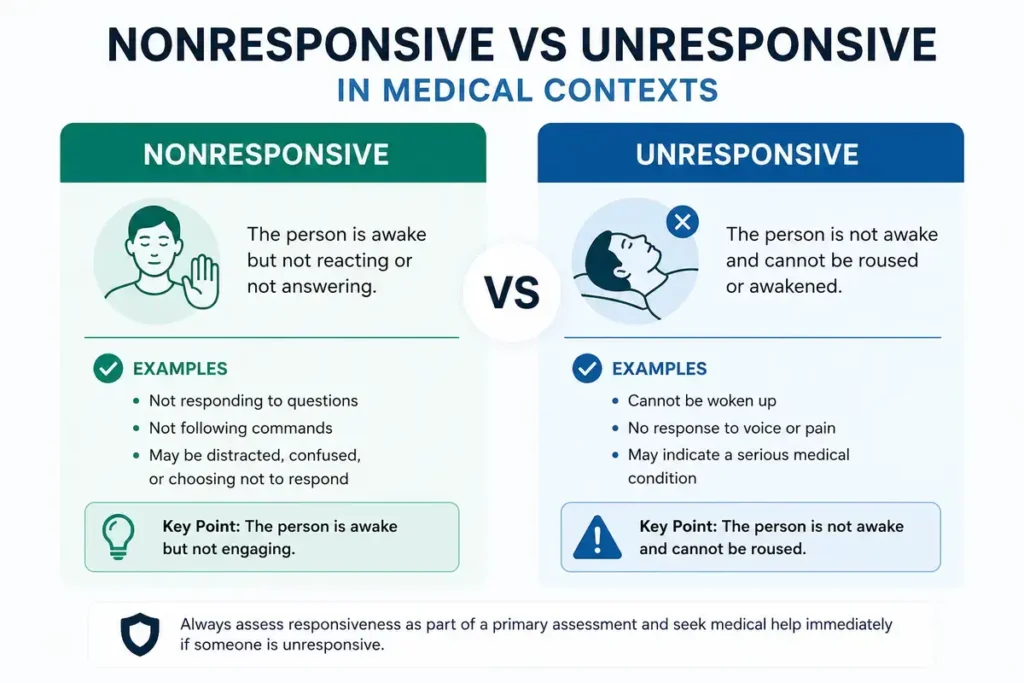
In healthcare, unresponsive is usually the preferred word when describing a person who does not react.
Doctors and emergency workers often use unresponsive because it describes a serious condition where a person does not respond to voice, touch, or other attempts to get a reaction.
Examples:
- The patient was found unresponsive in the room.
- Emergency workers treated the unresponsive patient immediately.
- The doctor checked if the person was responsive.
Using nonresponsive in this context is possible, but it sounds less common.
Example:
The patient was nonresponsive during the examination.
This sentence is grammatically correct, but medical professionals usually choose unresponsive because it clearly describes a lack of reaction.
Many readers also check Gradual Vs Insidious The Real Difference Explained.
Nonresponsive Vs Unresponsive In Technology
Technology is one area where both words appear often.
When To Use Unresponsive
Use unresponsive when a device or program stops reacting to commands.
Examples:
- My computer became unresponsive during the update.
- The app is unresponsive when I click the button.
- The touchscreen became unresponsive after the accident.
This wording suggests the device normally responds but has stopped working.
When To Use Nonresponsive
Use nonresponsive when describing a system feature that does not return information or a process that lacks a response.
Examples:
- The server sent a nonresponsive message.
- The form contains nonresponsive fields.
- The software detected a nonresponsive connection.
In technical writing, engineers may choose nonresponsive because it sounds more neutral and descriptive.
Nonresponsive Vs Unresponsive In Customer Service
Customer communication creates another area where the difference matters.
Nonresponsive Customer
A nonresponsive customer usually means someone who has not replied.
Example:
The customer was nonresponsive after three email attempts.
This sounds professional and neutral.
Unresponsive Customer
An unresponsive customer can mean the same thing, but it may sound more negative.
Example:
The customer was unresponsive throughout the complaint process.
The sentence suggests frustration because the customer failed to react.
For business reports, nonresponsive often sounds more objective.
Nonresponsive Vs Unresponsive In Workplace Writing
Professional communication requires careful word choice.
Compare these examples.
Neutral Workplace Style
The applicant was nonresponsive after receiving the interview invitation.
This focuses on the missing reply.
Stronger Workplace Style
The applicant was unresponsive after several attempts to contact them.
This highlights the failure to respond.
Both sentences work, but the second one carries more criticism.
Examples From Different Writing Situations
Daily Conversation
- My old phone is unresponsive.
- She has been nonresponsive to my messages.
- The remote control became unresponsive.
- He seemed unresponsive during the conversation.
Workplace Emails
- The client has been nonresponsive since Monday.
- The system is currently unresponsive.
- We contacted the nonresponsive users again.
- The software issue caused an unresponsive screen.
Academic Writing
- Researchers excluded nonresponsive participants from the final results.
- The study examined factors behind unresponsive behavior.
- The author presents an unresponsive character who avoids communication.
Journalism
- Officials reported that the suspect was unresponsive when found.
- The company remained nonresponsive to media questions.
- The agency received criticism for being unresponsive to public concerns.
Social Media
- My phone became completely unresponsive during the live stream.
- Some brands appear nonresponsive when customers ask questions.
- The app is unresponsive after the latest update.
- A nonresponsive audience can make online campaigns difficult.
Etymology And Word Origin
Understanding the history of these words helps explain their meanings.
Both words come from the base word responsive.
Origin Of Responsive
The word responsive comes from Latin roots connected with answering and replying.
It entered English through French and developed the meaning of reacting, answering, or responding.
Over time, English added prefixes to create words with opposite meanings.
Origin Of Nonresponsive
The prefix non comes from Latin and means not.
English uses it to show the absence of something.
Examples:
- Nonfiction means writing that is not fiction.
- Nonverbal means without words.
- Nonresponsive means without a response.
Origin Of Unresponsive
The prefix un comes from Old English and commonly creates opposite meanings.
Examples:
- Unknown means not known.
- Unfair means not fair.
- Unresponsive means not responding.
Both prefixes create negative meanings, but English speakers often choose between them based on context and tone.
British American Canadian And Australian English Usage
The difference between nonresponsive and unresponsive is not mainly regional.
English speakers in the United States, United Kingdom, Canada, and Australia understand both words.
The preference depends more on situation.
American English
American speakers commonly use:
- Unresponsive patient.
- Unresponsive computer.
- Nonresponsive survey participant.
British English
British writers use both words in similar ways.
Examples:
The patient was unresponsive.
The company was nonresponsive to complaints.
Canadian And Australian English
These varieties follow the same general pattern.
Professional writers often choose nonresponsive for reports and unresponsive for people or devices that fail to react.
Common Mistakes With Nonresponsive And Unresponsive
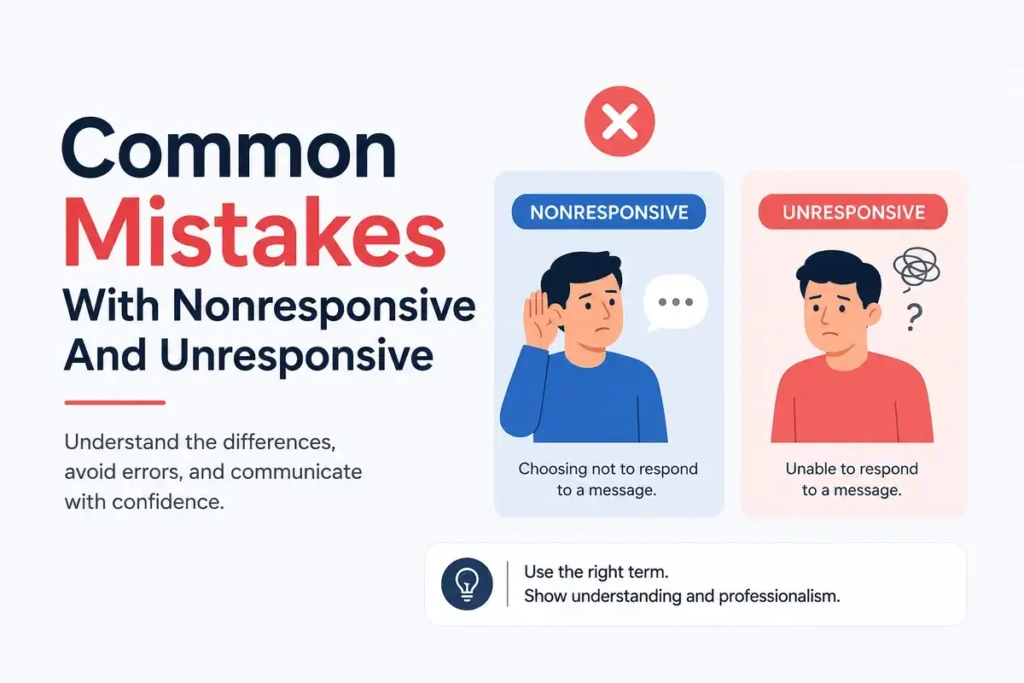
Even fluent speakers sometimes choose the wrong word because the meanings overlap.
Mistake One
Using nonresponsive for every situation.
Incorrect:
My laptop is nonresponsive.
Better:
My laptop is unresponsive.
Why?
The laptop should react to commands but does not.
Mistake Two
Using unresponsive when describing survey data.
Less natural:
The research included many unresponsive participants.
Better:
The research included many nonresponsive participants.
Why?
The participants failed to provide answers rather than physically failing to react.
Mistake Three
Thinking Nonresponsive Is Incorrect
Some writers believe nonresponsive is not a real word.
That is false.
It is a standard English adjective used in professional and technical writing.
Mistake Four
Writing The Words Separately
Incorrect:
Non responsive.
Un responsive.
Correct:
Nonresponsive.
Unresponsive.
Both words are written as one word.
Memory Tricks To Remember The Difference
A simple memory method can make the difference easy.
Think About The Prefix
Non means no response exists.
Example:
Nonresponsive survey.
No answer was provided.
Un means unable to respond.
Example:
Unresponsive computer.
The computer cannot react.
Use The Human Test
Ask:
Is this a person or device that should react?
Choose unresponsive.
Is this a missing answer, reply, or participation?
Choose nonresponsive.
Remember This Short Rule
Nonresponsive means no response given.
Unresponsive means no reaction happening.
This small difference covers most everyday situations.
Related Words And Similar Expressions
Understanding related words can help you use nonresponsive vs unresponsive more accurately. Many English words describe a lack of reaction, but each one carries a slightly different meaning.
Responsive
Responsive is the opposite of both words.
It means reacting quickly or providing a useful response.
Examples:
- The customer service team was very responsive.
- The website is responsive on mobile devices.
- She is responsive to feedback.
Irresponsive
Irresponsive is a rare word and is not common in modern English.
Most native speakers use unresponsive or nonresponsive instead.
Unavailable
Unavailable means something or someone cannot be reached or accessed.
Example:
The manager was unavailable during the meeting.
This does not always mean the person refused to respond.
Silent
Silent means making no sound or giving no verbal response.
Example:
The room became silent after the announcement.
A silent person may still be responsive through actions or gestures.
Ignoring
Ignoring suggests a person chooses not to respond.
Example:
He ignored my messages.
This carries a stronger suggestion of intention than nonresponsive.
Opposites Of Nonresponsive And Unresponsive
The main opposite word is responsive.
Examples:
- The employee was responsive to feedback.
- The application is responsive again.
- The patient became responsive after treatment.
Other related opposites include:
- Available.
- Engaged.
- Active.
- Communicative.
- Cooperative.
Expert Editor’s Note
Professional editors pay close attention to the difference between describing a lack of response and describing a failure to react.
In formal writing, nonresponsive often works best when the writer wants a neutral tone.
Examples:
The organization received several nonresponsive applications.
The survey included nonresponsive participants.
This wording focuses on the result without suggesting blame.
Editors often choose unresponsive when the situation involves a clear expectation of reaction.
Examples:
The device became unresponsive.
The patient was unresponsive.
The employee remained unresponsive to repeated requests.
Many dictionaries list both words as correct. Style guides generally recommend choosing the word that matches the context instead of treating them as exact synonyms.
A good writer does not only ask if a word is correct. A good writer asks if the word creates the right meaning.
Frequently Asked Questions
Is Nonresponsive Or Unresponsive More Correct?
Both words are correct English adjectives. Nonresponsive usually describes a lack of reply, participation, or feedback. Unresponsive usually describes something or someone that fails to react when a response is expected. The better choice depends on the situation.
Can Nonresponsive And Unresponsive Be Used Interchangeably?
Sometimes they can, especially in casual conversation. However, they are not perfect substitutes. A computer that freezes is usually called unresponsive, while a person who does not complete a survey is usually called nonresponsive.
Is Nonresponsive A Real Word?
Yes. Nonresponsive is a standard English word. It appears often in professional reports, research studies, customer service records, and technical documents. The spelling follows the common English pattern of adding the prefix non to a word.
Is Unresponsive Only Used For People?
No. Although unresponsive is common in medical situations, it can also describe machines, software, devices, and organizations. For example, a phone can become unresponsive, and a company can be unresponsive to customer concerns.
What Is The Difference Between Nonresponsive And Unresponsive In Medical Language?
Medical professionals usually prefer unresponsive when describing a person who does not react to voice, touch, or other attempts to get a response. Nonresponsive can be understood, but unresponsive is more common in emergency and clinical settings.
How Do You Spell Nonresponsive Correctly?
The correct spelling is nonresponsive as one word. Do not write it as two separate words. The same rule applies to unresponsive, which is also written as one word.
Which Word Sounds More Natural In American English?
American English speakers use both words naturally. Unresponsive sounds more common for people and technology, while nonresponsive appears more often in formal reports, surveys, and professional communication.
What Is The Opposite Of Nonresponsive And Unresponsive?
The opposite of both words is responsive. A responsive person, system, or device reacts, answers, or provides feedback when needed.
Internal Linking Opportunities
- Add an internal link after the introduction using anchor text: Responsive Vs Responsible Difference Explained.
- Add an internal link before the conclusion using anchor text: Commonly Confused English Words And Their Meanings.
Learn the difference in How The Turntables Meaning Origin And Correct Usage.
Conclusion
The difference between nonresponsive vs unresponsive comes down to the type of response being discussed.Nonresponsive focuses on the absence of a reply, answer, or participation. It is common in surveys, reports, customer communication, and professional writing.Unresponsive focuses on something or someone failing to react. It is often used for people, devices, software, and situations where a response should happen.The most common mistake is using these words as exact replacements. They overlap, but they create slightly different impressions.A simple rule can help you choose correctly:Use nonresponsive when a response is missing.
Use unresponsive when something stops reacting.
The right word does more than sound correct. It helps your reader understand exactly what happened.

Vocabulary & Language Research Writer
Ethan Parker researches English vocabulary, word meanings, slang, idioms, and commonly confused words. His goal is to help readers understand how English is actually used in everyday conversations and writing.
1 thought on “Nonresponsive Vs Unresponsive Which Word Is Correct 2026”