
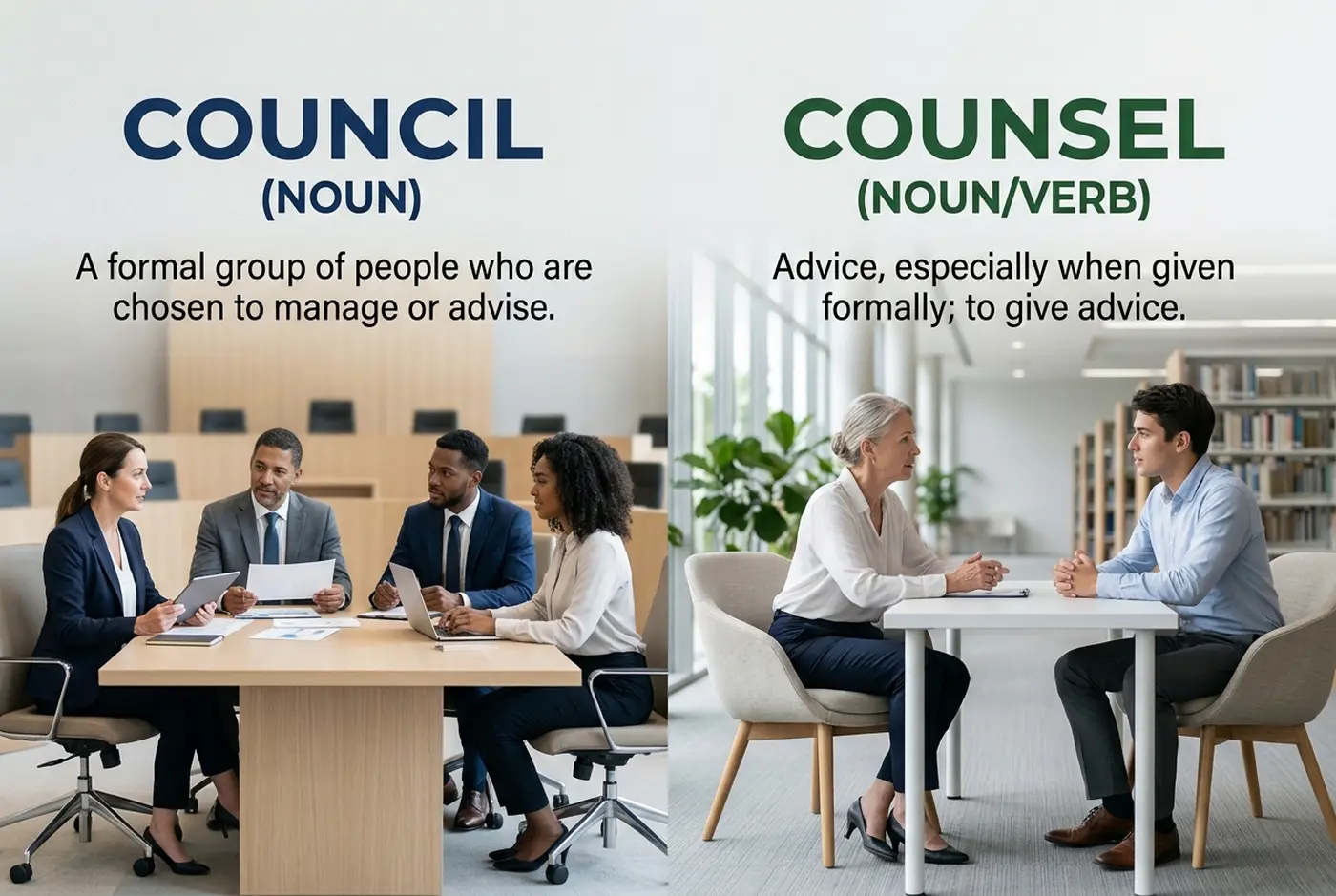
The difference between council vs counsel comes down to one important question. Are you talking about a group of people who make decisions, or advice that helps someone make a decision? These two words look and sound almost identical, so even experienced writers sometimes mix them up. However, their meanings and uses are quite different.
Council is a group of people chosen or appointed to discuss issues, make decisions, or manage an organization. A city council, for example, helps govern a local community. Counsel usually means advice or guidance. It can also refer to a lawyer or serve as a verb meaning to advise someone.
The confusion often appears in professional emails, legal documents, school assignments, news reports, and everyday conversations. You might write that someone sought legal counsel when you mean legal advice, or refer to a city council when discussing local government. Using the wrong word can change the meaning of your sentence.
In this guide, you’ll learn how to distinguish council from counsel, understand their definitions and grammatical roles, recognize common mistakes, and choose the right word with confidence. You’ll also find practical examples, pronunciation tips, memory tricks, and answers to common questions.
Learn the difference in Indulgent vs Sober Understanding the Difference (2026 Guide).
Quick Answer
Council means a group of people who meet to discuss issues or make decisions. Counsel means advice or guidance, can refer to a lawyer, and can function as a verb meaning to advise. For example, a city council manages local affairs, while a lawyer provides legal counsel. Both words are correct, but they serve different purposes.
Related reading idea: Add an internal link here to your article about [commonly confused English words and their meanings].
Council vs Counsel at a Glance
The easiest way to understand these words is to compare their meanings, grammatical roles, and common uses.
| Feature | Council | Counsel |
|---|---|---|
| Main meaning | A group of people who make decisions | Advice or guidance |
| Part of speech | Noun | Noun and verb |
| Refers to a group | Yes | No |
| Refers to advice | No | Yes |
| Refers to a lawyer | No | Yes |
| Can describe advising someone | No | Yes |
| Example | The city council approved the plan. | She sought legal counsel. |
| Verb example | Not used as a standard verb | The therapist will counsel the family. |
Both words are standard English. Neither spelling is inherently wrong, and neither is simply the American or British version of the other. The correct choice depends on what you want to express.
What Does Council Mean
Council is a noun that refers to a group of people who meet to discuss matters, make decisions, provide guidance, or manage an organization.
These people often have a shared responsibility. They might represent a community, oversee a school, advise a leader, or help run a professional organization.
Definition of Council
Council means an organized group of people appointed or elected to discuss issues and make decisions within a particular area of responsibility.
Common examples include a city council, student council, school council, and advisory council.
For example.
- The city council approved funding for a new public park.
- Our student council organized a charity event.
- The school council discussed changes to the lunch program.
- An advisory council helped the company improve its policies.
In each sentence, council refers to a group of people rather than advice itself.
How Council Is Used in Everyday English
You’ll often see council in government, education, business, and community settings.
Local government. A city council or town council helps manage local matters such as public services, planning, budgets, and community facilities.
Example. The city council voted to repair the damaged roads.
Education. A student council represents students and may organize activities or raise concerns with school leaders.
Example. The student council asked the principal for more study spaces.
Professional organizations. A professional council may establish standards, provide oversight, or represent people working in a particular field.
Example. The council published new guidelines for professional conduct.
Advisory groups. An advisory council offers recommendations to a person, organization, or institution.
Example. The president consulted an advisory council before announcing the policy.
Notice that an advisory council may give counsel. However, the council is the group, while counsel is the advice or guidance it provides.
That distinction is useful in both everyday writing and professional communication.
What Is a City Council
A city council is a governing body responsible for making decisions about local affairs. Its exact powers depend on the laws and structure of the local government.
For example.
The city council approved a budget for road repairs and public transportation.
Here, council refers to the people who voted on the budget. It doesn’t refer to the budget itself or the advice they received.
You may also encounter these expressions.
- Town council.
- County council.
- Municipal council.
- Regional council.
- Local council.
These terms describe different types of governing bodies. Their responsibilities vary by location.
What Is a Student Council
A student council is a group of students who represent their classmates and help improve school life.
For example.
The student council planned a school festival and collected suggestions from students.
The word council works because a group of representatives is involved in planning and decision making.
You wouldn’t use counsel in this sentence unless you meant advice or the act of advising someone.
Is Council Singular or Plural
Council is a singular countable noun when it refers to one organized group.
Examples.
- The council meets every month.
- The council has approved the proposal.
- The council is reviewing its budget.
In American English, a council is generally treated as a singular unit when it acts as one body.
The members of the council, however, are individuals.
Example. The council members are discussing their options.
Here, members is plural, so the sentence uses are rather than is.
What Is the Plural of Council
The plural form is councils.
Examples.
- Several city councils supported the regional initiative.
- The two councils signed an agreement.
- School councils from different districts attended the meeting.
Don’t confuse councils with counsels. Both are possible plural forms, but their meanings differ.
Councils means multiple groups. Counsels can mean different pieces of advice or several instances of advice, although this plural use is less common. In legal contexts, counsels can also refer to lawyers, depending on the sentence.
What Does Counsel Mean
Counsel has several related meanings. It can refer to advice, professional guidance, or a lawyer. It can also function as a verb meaning to advise or guide someone.
Unlike council, counsel isn’t the name of a governing group.
Definition of Counsel as a Noun
As a noun, counsel commonly means advice or guidance intended to help someone make a decision or deal with a problem.
For example.
- She sought counsel from an experienced mentor.
- His parents offered wise counsel.
- The employee received counsel about handling workplace conflict.
- The manager asked for counsel before making a difficult decision.
In these examples, counsel means advice or guidance.
The word often sounds more formal than advice. You’ll find it in legal writing, professional communication, literature, religious contexts, and discussions about important personal decisions.
What Does Legal Counsel Mean
Legal counsel refers to legal advice or the lawyer who provides it.
The exact meaning depends on the context.
Counsel as legal advice.
The company sought legal counsel before signing the contract.
Here, legal counsel means legal advice from a qualified professional.
Counsel as a lawyer.
The defendant spoke with counsel before the hearing.
Here, counsel refers to the defendant’s lawyer or legal representative.
This second meaning is especially common in legal documents and courtroom discussions.
You may also see the phrase legal counsel used for an in house lawyer or a lawyer working for a company.
Example. The business hired legal counsel to review its employment policies.
What Does Counsel Mean as a Verb
Counsel can also be a verb. It means to advise, guide, or help someone consider a decision or deal with a difficulty.
Examples.
- The therapist counseled the family during a difficult period.
- The lawyer counseled her client before the hearing.
- Teachers counsel students about their academic choices.
- The manager counseled the employee about improving performance.
In these sentences, counsel describes an action. It doesn’t refer to a group of people.
The verb often appears in education, law, mental health services, career guidance, and professional development.
Counsel in Professional and Personal Settings
Counsel can describe guidance in several areas of life.
Legal guidance. A lawyer provides counsel about contracts, legal rights, and court proceedings.
Example. The business owner requested counsel before responding to the claim.
Personal guidance. A trusted person may offer counsel during a difficult situation.
Example. She followed her grandmother’s counsel and took time to think.
Academic guidance. A school counselor or academic adviser may counsel students about education and career plans.
Example. The adviser counseled the student about choosing a suitable major.
Workplace guidance. A manager may counsel an employee about conduct, performance, or career development.
Example. Human resources counseled the employee about the company’s attendance policy.
The central idea remains advice or guidance, even though the setting changes.
Is Counsel Singular or Plural
Counsel has more than one grammatical use, so the answer depends on its meaning.
When counsel means advice, it’s usually an uncountable noun. You generally wouldn’t say a counsel to mean one piece of advice in ordinary modern English.
Instead, write:
- She gave me helpful counsel.
- He asked for professional counsel.
- Their counsel proved valuable.
You can use expressions such as a piece of advice or a word of advice when you need to count individual recommendations.
When counsel refers to a lawyer or legal representation, its grammatical behavior depends on the sentence and the legal context. The word can also appear in the plural form counsels when referring to multiple lawyers or distinct bodies of advice.
As a verb, counsel changes form according to tense.
- Present: counsel.
- Third person singular: counsels.
- Past tense: counseled in American English and counselled in British English.
- Present participle: counseling in American English and counselling in British English.
These spelling differences relate to the verb’s endings, not to the distinction between council and counsel.
Council vs Counsel Pronunciation
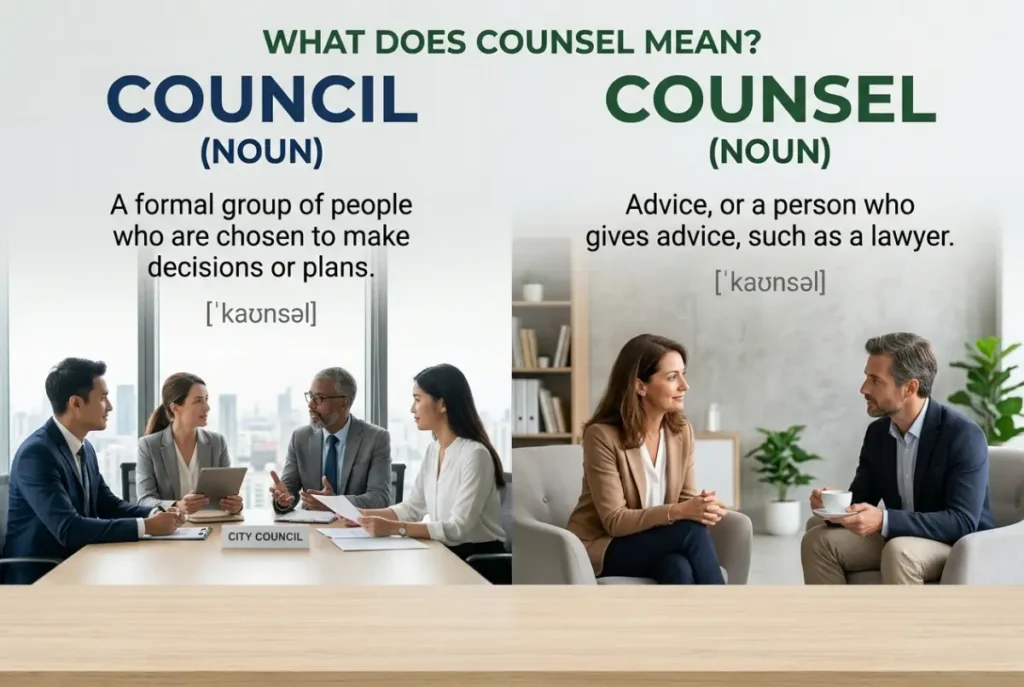
Council and counsel are homophones for most English speakers. That means they have the same pronunciation even though they have different spellings and meanings.
Both words are commonly pronounced /ˈkaʊn.səl/.
The first syllable sounds like the word cow. The second syllable has a relaxed sound similar to suhl.
Syllables and Word Stress
Both words have two syllables.
- Council: coun cil.
- Counsel: coun sel.
The stress falls on the first syllable in both words.
You don’t need to pronounce the second syllable differently to distinguish them. Instead, rely on the meaning and context.
For example, when someone says, The council offered counsel, the first word identifies the group and the second identifies the guidance it provided.
This is why spelling errors can slip into writing unnoticed. A spell checker may recognize both forms as valid English words, even when the writer has chosen the wrong one.
Council vs Counsel and Their Key Differences
The main difference between council and counsel is their meaning and grammatical function. Council names a group, while counsel refers to advice or the act of advising someone. Counsel can also mean a lawyer.
Both words appear in formal writing, but they aren’t interchangeable. Understanding their roles will help you avoid errors in emails, reports, legal documents, and everyday conversations.
Difference in Meaning
Council refers to an organized group of people who meet to discuss matters or make decisions.
Example. The council approved the new community center.
Counsel refers to advice, guidance, or a lawyer.
Example. The business owner sought counsel before signing the agreement.
The first sentence describes a decision made by a group. The second describes professional guidance.
Difference in Grammar
Council is a noun. In standard modern English, it’s not used as a verb to mean advising someone.
Counsel can function as both a noun and a verb.
Examples.
- Noun. Her counsel helped me make a difficult decision.
- Noun. The defendant spoke with legal counsel.
- Verb. The therapist will counsel the family.
- Verb. The manager counseled the employee about workplace conduct.
This grammatical difference is one of the most reliable ways to identify the correct word.
Difference in Context
Council usually appears in discussions about organizations, government, education, and administration.
Common expressions include:
- City council.
- Student council.
- School council.
- Advisory council.
- County council.
Counsel commonly appears in legal, professional, educational, and personal guidance contexts.
Common expressions include:
- Legal counsel.
- Wise counsel.
- Seek counsel.
- Offer counsel.
- Counsel someone.
- Counsel a client.
Context gives you a strong clue, but always check the meaning of the full sentence.
Difference in Tone and Formality
Council is a neutral noun. It can appear in casual conversation, news reports, government documents, and academic writing.
Counsel often sounds more formal than advice, especially when it refers to guidance. It’s also a standard legal term for a lawyer or legal representative.
Compare these sentences.
- My friend gave me some advice.
- My friend offered me some counsel.
Both sentences can be correct, but the second sounds more formal.
In a legal document, however, counsel may be the expected term because it has a specific professional meaning.
Council vs Counsel in Grammar
Grammar makes the distinction easier because each word follows different patterns.
How to Use Council Correctly
Use council when your sentence refers to a group of people.
Correct examples.
- The council meets on the first Monday of each month.
- The city council has announced a new housing plan.
- Our student council is planning a fundraiser.
- Several councils joined the regional meeting.
Because council is a countable noun, you can use an article or a number before it.
Examples.
- A council reviewed the proposal.
- The council approved the budget.
- Three councils signed the agreement.
You can also use possessive forms.
- The council’s decision surprised residents.
- The council’s members attended the event.
- The councils’ agreement covered several shared services.
The first two examples use council’s because one council owns or is associated with the decision or members. The final example uses councils’ because multiple councils are involved.
How to Use Counsel Correctly
Use counsel when you mean advice, professional legal representation, or the act of advising someone.
As a noun meaning advice, counsel generally doesn’t need an article.
Correct examples.
- She sought counsel from a trusted adviser.
- His counsel was helpful.
- The company requested legal counsel.
Avoid writing a counsel when you simply mean one piece of advice. Use advice or a piece of advice instead.
As a verb, counsel takes a direct object when you identify the person receiving advice.
Examples.
- The lawyer counseled her client.
- The school counselor counsels students.
- The therapist is counseling the couple.
You can also use counsel with a preposition to describe the topic or purpose of the advice.
Example. The adviser counseled the student on career options.
Council’s vs Counsel’s
Both council’s and counsel’s are grammatically possible, but they have different meanings.
Council’s is the possessive form of council.
Example. The council’s proposal received public support.
This means the proposal belongs to, comes from, or is associated with the council.
Counsel’s is the possessive form of counsel.
Example. The lawyer followed counsel’s recommendation.
Here, counsel refers to a lawyer or adviser whose recommendation is being discussed.
When counsel means advice, a phrase such as the counsel’s advice can sound awkward or unclear. In most cases, write the advice or identify the adviser directly.
Council vs Counsel in Past Tense
Council doesn’t have a standard verb tense because it’s a noun.
Counsel can be a verb, so it changes form according to tense.
| Tense | Example |
|---|---|
| Present | The lawyer counsels her client. |
| Past | The lawyer counseled her client. |
| Present continuous | The lawyer is counseling her client. |
| Present perfect | The lawyer has counseled her client. |
| Future | The lawyer will counsel her client. |
American English usually uses counseled and counseling. British English commonly uses counselled and counselling.
These are regional spelling differences in the verb forms. The noun counsel keeps the same spelling in both varieties.
Council vs Counsel in Sentence Structure
The role each word plays in a sentence can help you spot mistakes.
Consider these examples.
Council as the subject.
The council approved the proposal.
Council is the subject performing the action.
Council as the object.
Residents contacted the council.
Council receives the action.
Counsel as the object.
The client requested counsel.
Counsel refers to advice or legal representation.
Counsel as the verb.
The adviser will counsel the student.
Counsel describes the action performed by the adviser.
If you’re unsure which word to use, identify the job it performs in the sentence before choosing the spelling.
Council vs Counsel Spelling Rules
Council and counsel differ by just one letter near the end.
The difference is small enough to escape notice during proofreading. However, each spelling represents a different word, so changing one letter can change the meaning of a sentence.
Why Council Ends in Cil
The word council follows a spelling pattern that you need to learn as a whole. There isn’t a simple modern rule that lets you derive its spelling from its meaning.
The safest approach is to connect council with familiar expressions such as city council and student council.
Examples.
- The city council met on Tuesday.
- The council reviewed the school’s request.
- Our student council organized a debate.
Why Counsel Ends in Sel
Counsel shares its spelling with related words such as counselor, counseling, and counseled.
Examples.
- The counselor offered helpful advice.
- The lawyer counseled her client.
- The employee received counseling.
These related forms can help you remember the spelling of counsel. They also reinforce its connection with advising and guidance.
Council and Counsel Are Not Regional Spellings
Some English words have different spellings in American and British English. Examples include color and colour, and center and centre.
Council and counsel don’t follow that pattern. Both spellings are standard in American, British, Canadian, and Australian English.
You shouldn’t use council simply because you’re writing for an American audience, or counsel because you’re writing for a British audience. Choose the word that matches your intended meaning.
Council vs Counsel Word Origin
The histories of council and counsel help explain why the words look so similar today.
Both entered English through French and have roots connected with Latin. Their historical relationship helps explain their resemblance, but their modern meanings remain distinct.
Origin of Council
Council comes through Anglo French and Old French forms related to the Latin word concilium, which referred to a gathering, assembly, or meeting.
Over time, council developed its modern meaning as a group assembled to discuss matters or make decisions.
That history connects naturally with the word’s current use in local government, education, and organized groups.
For example, a city council is a body of representatives who meet to consider issues affecting the community.
Origin of Counsel
Counsel came through Anglo French and Old French forms related to the Latin verb consulere, meaning to consult, deliberate, or seek advice.
Its meaning developed around advice, guidance, and consultation. It later became established as a legal term for a lawyer or legal adviser.
The verb counsel also grew from this sense of giving advice or guidance.
For example, a lawyer may counsel a client about legal rights, while a trusted friend may offer counsel during a difficult decision.
Why the Words Look So Similar
Council and counsel share a historical connection through French and Latin. Their similar sounds and spellings have helped keep them closely associated in English.
However, their meanings developed in different directions.
- Council focuses on an assembly or organized group.
- Counsel focuses on advice, consultation, and legal representation.
Their shared history explains the resemblance. Their present day meanings determine which spelling belongs in your sentence.
A related grammar guide is Apposed Vs Opposed Which Word Is Correct 2026.
Council vs Counsel in American and British English
The distinction between council and counsel remains the same across major varieties of English.
| English variety | Council | Counsel |
|---|---|---|
| American English | A governing or advisory group | Advice, a lawyer, or to advise |
| British English | A governing or advisory group | Advice, a lawyer, or to advise |
| Canadian English | A governing or advisory group | Advice, a lawyer, or to advise |
| Australian English | A governing or advisory group | Advice, a lawyer, or to advise |
There is no standard regional spelling rule that reverses their meanings.
American English Examples
In the United States, city council and student council are common expressions.
Examples.
- The city council approved the development plan.
- She sought legal counsel before signing the agreement.
- The therapist counseled the family.
American English generally spells the past tense and continuous forms of the verb as counseled and counseling.
British English Examples
British English also uses council for an organized group and counsel for advice or legal representation.
Examples.
- The local council discussed the transport plan.
- The defendant consulted legal counsel.
- The adviser counselled the student.
British English commonly uses counselled and counselling for the verb forms.
Canadian and Australian English
Canadian and Australian English follow the same core distinction.
In both varieties, council refers to a group, while counsel refers to advice, a lawyer, or the act of advising.
Local government terminology can vary. For instance, the names and responsibilities of municipal bodies differ between countries and regions. That variation doesn’t change the spelling distinction.

Real Life Examples of Council vs Counsel
The best way to remember these words is to see how they work in different situations. The following examples show the correct usage in everyday conversation, workplaces, education, legal settings, journalism, and online communication.
Daily Conversation Examples
1. Council. The town council is planning a new playground for local children.
2. Counsel. My grandfather gave me wise counsel when I was choosing a career.
3. Council. Our student council wants to organize a school talent show.
4. Counsel. She asked a trusted friend for counsel before making her decision.
5. Council. The local council will collect residents’ feedback next week.
Workplace Examples
6. Council. The advisory council met to discuss the company’s long term goals.
7. Counsel. The manager sought legal counsel before responding to the complaint.
8. Council. The council approved a revised budget for the upcoming year.
9. Counsel. Human resources counseled the employee about repeated attendance problems.
10. Counsel. The company hired experienced counsel to review its contracts.
Email Examples
11. Council. Please send your suggestions to the student council before Friday.
12. Counsel. We recommend seeking legal counsel before accepting the proposed settlement.
13. Council. The council’s meeting minutes are attached to this email.
14. Counsel. Thank you for your counsel during the negotiation process.
These examples also show how the words fit naturally into formal written communication.
Academic Writing Examples
15. Council. The research examined how student councils influence school policy.
16. Counsel. The paper discusses the role of professional counsel in ethical decision making.
17. Council. Several regional councils participated in the environmental initiative.
18. Counsel. Participants received guidance from trained advisers who counseled them throughout the program.
In academic writing, precision matters. Choose council when you mean an organized body, and counsel when you mean advice or advising.
Legal Examples
19. Counsel. The defendant consulted legal counsel before entering a plea.
20. Council. The city council voted to revise its public safety policy.
21. Counsel. The attorney counseled the client about the risks of signing the contract.
22. Counsel. The judge asked counsel to clarify the legal argument.
The final example uses counsel to refer to a lawyer or legal representative participating in a legal proceeding.
Journalism Examples
23. Council. The city council approved funding for affordable housing.
24. Counsel. Legal counsel advised the organization against making an immediate public statement.
25. Council. The county council announced a new plan to improve public transportation.
26. Counsel. The report recommends that employees seek independent counsel when facing complex legal questions.
News reports often use council when covering local government and counsel when discussing legal advice or representation.
Social Media Examples
27. Council. Our student council just announced the date for the spring festival.
28. Counsel. Sometimes the best counsel comes from someone who listens without judging.
29. Council. The city council finally approved the new bike lanes.
30. Counsel. I asked a lawyer for counsel before signing the paperwork.
These examples demonstrate that both words work in informal settings, too. Their meanings don’t change just because the writing is casual.
How to Remember Council vs Counsel
You don’t need to memorize a long spelling rule. A simple memory trick can help you choose the right word quickly.
The Group and Guidance Trick
Remember these two associations.
Council equals a group.
Think of a city council, school council, or student council. Each example involves a group of people.
Counsel equals guidance.
Think of legal counsel, wise counsel, or a counselor giving advice. Each example relates to guidance or professional support.
When you’re writing, ask yourself one simple question.
Am I talking about a group of people or advice from someone?
If you’re referring to a group, choose council. If you’re referring to advice, a lawyer, or the act of advising, choose counsel.
Use Related Words to Remember Counsel
Counsel shares its spelling with several related forms.
- Counselor.
- Counseling.
- Counseled.
- Counselled.
These words all relate to advising or guidance.
For example, a counselor may counsel a student about career choices.
By contrast, a student council is a group of students who represent their classmates.
Connecting the words through meaning is more reliable than trying to remember the spelling by appearance alone.
Test Yourself With Three Sentences
Choose the correct word for each blank.
- The city _____ approved the new parking rules.
- The company requested legal _____ before signing the contract.
- The therapist will _____ the family during the transition.
1. The city _____ approved the new parking rules.councilcounsel
Check answers
2. The company requested legal _____ before signing the contract.councilcounsel
Check answers
3. The therapist will _____ the family during the transition.councilcounsel
Check answers
Common Mistakes With Council and Counsel
Even strong writers can confuse council and counsel because both words sound alike. The best way to avoid errors is to focus on meaning rather than pronunciation.
Using Council When You Mean Advice
One common mistake is using council when you mean advice or guidance.
Incorrect. She asked her mentor for council before accepting the job.
Correct. She asked her mentor for counsel before accepting the job.
The sentence refers to guidance from a mentor, not a group of people. Therefore, counsel is the correct word.
In casual writing, advice may sound more natural.
She asked her mentor for advice before accepting the job.
Using Counsel When You Mean a Group
Another mistake is writing counsel when referring to an organized group.
Incorrect. The city counsel approved the new road project.
Correct. The city council approved the new road project.
The sentence describes a governing body that makes decisions about local affairs. Council is the correct noun.
This error often appears in emails, social media posts, and informal reports because spell checkers may accept both words.
Confusing Legal Counsel With a Legal Council
Legal counsel generally means a lawyer, legal representative, or legal advice. A legal council would mean a group with a legal or advisory function, if an organization uses that name.
Compare these examples.
- The company hired legal counsel to review the contract.
- The legal council met to discuss proposed regulations.
The first sentence refers to legal representation. The second describes a group of people meeting to discuss an issue.
Don’t assume that legal automatically requires counsel. The noun that follows it still depends on the intended meaning.
Assuming Counsel Always Means a Lawyer
Counsel doesn’t always refer to a lawyer. It can also mean advice or guidance.
Example. My father’s counsel helped me reconsider my decision.
Here, counsel means advice. No lawyer is involved.
However, in a sentence such as The defendant spoke with counsel, the word usually refers to a lawyer or legal representative.
Read the surrounding sentence to identify the intended meaning.
Treating Council and Counsel as Regional Spellings
Some writers assume that council is British English and counsel is American English, or the other way around.
That assumption is incorrect.
Both words are used in American and British English. Their meanings stay the same across these varieties.
The spelling difference reflects two separate words, not a regional preference.
Assuming Spell Checkers Will Catch Every Error
A spell checker may not flag council when you’ve accidentally used it instead of counsel.
For example.
The defendant asked the court to appoint a council.
If the intended meaning is a lawyer, the correct sentence is:
The defendant asked the court to appoint counsel.
The original sentence may look correct to a spell checker because council is a valid English word. This is a context error rather than a simple spelling error.
For important documents, read the sentence carefully and check its meaning. Grammar tools can help, but they don’t always understand the exact message you intend to convey.
Related Words and Expressions
Learning related words helps you understand how council and counsel fit into the wider English vocabulary.
Words Related to Council
These words describe groups, governing bodies, or organized meetings.
| Word | Meaning | Example |
|---|---|---|
| Committee | A group assigned a specific task | The committee reviewed the proposal. |
| Board | A group that oversees an organization | The board approved the budget. |
| Assembly | A group gathered for a purpose | The assembly discussed the new rules. |
| Panel | A group of people selected for a task | The panel evaluated the applications. |
| Advisory body | A group that offers recommendations | The advisory body reviewed the policy. |
| Municipality | A local government area or governing entity | The municipality improved its public services. |
These words aren’t exact synonyms in every context. A committee may have a narrower role than a council, while a board may have different legal powers.
Choose the word that accurately describes the organization.
Words Related to Counsel
These words relate to advice, guidance, or professional support.
| Word | Meaning | Example |
|---|---|---|
| Advice | An opinion or suggestion about what to do | She gave me useful advice. |
| Guidance | Help that directs someone’s choices | The teacher offered guidance. |
| Recommendation | A suggested action or choice | His recommendation was practical. |
| Consultation | A discussion with an expert or adviser | The client arranged a consultation. |
| Adviser | A person who gives advice | The financial adviser explained the options. |
| Counselor | A person who provides guidance or support | The counselor helped the student plan ahead. |
Advice is the most common everyday alternative to counsel when you mean guidance.
However, counsel is often more suitable in legal and formal professional contexts.
Council vs Counsel vs Counselor
These three words are related in appearance but have different meanings.
Council is a group of people.
Example. The student council organized a fundraiser.
Counsel means advice, a lawyer, or the act of advising.
Example. The lawyer counseled the client.
Counselor usually means a person who provides guidance, support, or advice.
Example. The school counselor helped the student explore career options.
A counselor may provide counsel, and a council may receive counsel from an adviser. Each word has its own grammatical role.
Council vs Counsel vs Consul
Another word that can cause confusion is consul.
A consul is a government official who represents a country in certain foreign affairs and provides services to citizens abroad.
Example. The consul helped the traveler understand the required documents.
A council is a group of people, while counsel refers to advice or legal representation.
These words look similar, but their meanings are distinct.
Synonyms and Opposites
Council and counsel don’t have perfect opposites, but related words can help clarify their meanings.
Synonyms for Council
Depending on the context, possible alternatives include:
- Committee.
- Board.
- Assembly.
- Governing body.
- Advisory group.
- Panel.
For example, you might replace advisory council with advisory committee if the organization and its role support that description.
However, don’t replace council with committee automatically. The two terms may refer to bodies with different responsibilities.
Synonyms for Counsel
When counsel means advice, suitable alternatives include:
- Advice.
- Guidance.
- Recommendation.
- Direction.
- Consultation.
When counsel means a lawyer, possible alternatives include:
- Attorney.
- Lawyer.
- Legal representative.
- Legal adviser.
The best choice depends on the sentence. Legal counsel may refer to a lawyer or legal advice, so replacing it without checking the context can change the meaning.
Are There Antonyms for Council and Counsel
Neither word has one universal opposite.
For council, you might contrast a group with an individual, but individual isn’t a direct antonym in every context.
For counsel, possible contrasts depend on the intended meaning. Advice may be contrasted with a lack of guidance, while a recommendation may be contrasted with a warning against an action.
Don’t force an opposite where English doesn’t have a natural one.
Expert Editor’s Note
As an editor, I’d treat council and counsel as a meaning distinction first and a spelling issue second.
Both words are correctly spelled. The challenge is choosing the one that expresses the intended idea.
What Dictionaries Tell Us
Standard English dictionaries distinguish council as a group that meets to discuss or decide matters. Counsel is defined in terms of advice, guidance, legal representation, or the act of advising.
This distinction remains consistent across major English varieties.
For a formal article, legal document, or academic assignment, check a trusted dictionary if the word’s meaning isn’t clear from context.
What Professional Editors Recommend
A professional editor doesn’t rely on how a word sounds when two words are homophones. Instead, the editor checks the role the word plays in the sentence.
For example.
The council provided counsel to the new director.
This sentence is correct because council identifies the group and counsel identifies the guidance it provided.
The sentence may sound repetitive because the words are so similar. However, the repetition isn’t grammatically wrong.
For smoother writing, you could say:
The advisory group offered guidance to the new director.
The revised version is easier to read because it avoids the similar sounding words.
Which Word Sounds More Natural to Native Speakers
Neither word is more natural in every situation. Native speakers choose council when referring to an organized body and counsel when referring to advice, a lawyer, or the act of advising someone.
In everyday conversation, advice is often more common than counsel when discussing ordinary personal suggestions.
For instance, My friend gave me some advice sounds more conversational than My friend offered me counsel.
However, in legal writing, legal counsel is a standard expression and often the most precise choice.
The goal isn’t to choose the fancier word. It’s to choose the word that communicates your meaning clearly.
My Practical Proofreading Rule
When editing a sentence containing council or counsel, I ask three questions.
- Does the sentence refer to a group of people?
- Does it refer to advice, legal representation, or the act of advising?
- Does the word’s grammatical role match the sentence?
If the sentence refers to a group, council is usually correct. If it refers to advice, a lawyer, or advising, counsel is usually correct.
This quick check catches most errors without requiring a lengthy grammar review.
Frequently Asked Questions
1. What Is the Difference Between Council and Counsel
Council refers to a group of people who meet to discuss issues or make decisions. Counsel refers to advice or guidance, a lawyer, or the act of advising someone. For example, a city council manages local affairs, while a lawyer provides legal counsel. Both words are correct, but they cannot replace each other in most sentences.
2. Is It City Council or City Counsel
The correct expression is city council when referring to the local governing body. A city council may make decisions about budgets, public services, and community development. City counsel could refer to a lawyer or legal adviser associated with a city, depending on the context, but it isn’t the standard name for the governing body.
3. Is Legal Council or Legal Counsel Correct
Legal counsel is the standard expression when referring to legal advice or a lawyer. For example, a company may seek legal counsel before signing a contract. Legal council would refer to a group with a legal or advisory function if that group were described by that name. It doesn’t normally mean a lawyer.
4. Can Counsel Be Used as a Verb
Yes. Counsel can function as a verb meaning to advise, guide, or support someone. For example, a therapist may counsel a family, or a lawyer may counsel a client before a hearing. The past tense is counseled in American English and commonly counselled in British English. Council doesn’t normally function as a verb.
5. Are Council and Counsel Homophones
Yes. Council and counsel are pronounced alike in most varieties of English, commonly as /ˈkaʊn.səl/. They have different spellings and meanings, so they are homophones. Because they sound the same, writers need to use context to choose the correct form. Spell checkers may not catch an error if the incorrect word is still spelled correctly.
6. What Is the Plural of Council
The plural of council is councils. For example, several city councils attended the regional meeting. The word counsel can also have a plural form, counsels, but its use depends on the meaning and context. When counsel means advice, it’s usually uncountable, so writers normally use advice or pieces of advice when counting recommendations.
7. Is Counsel More Formal Than Advice
Counsel often sounds more formal than advice, especially in legal, professional, or serious personal contexts. However, both words can be correct. Advice is usually more natural in everyday conversation, while counsel is common in expressions such as legal counsel and wise counsel. Choose the word that best fits your audience and the situation.
8. How Do You Remember Council vs Counsel
Remember that council means a group, as in city council or student council. Counsel relates to guidance, as in legal counsel or a counselor who advises people. When you write the sentence, ask yourself if you’re describing a group or referring to advice. That simple distinction helps you select the right spelling.
9. Is Council or Counsel Used in British English
British English uses both words with the same core meanings found in American English. Council refers to a group, while counsel refers to advice, legal representation, or advising. The difference isn’t regional. British English does commonly use spellings such as counselled and counselling for the verb forms, while American English usually uses counseled and counseling.
10. What Does Counsel Mean in Court
In court, counsel usually refers to a lawyer or legal representative involved in a case. For example, a judge may ask counsel to clarify a legal argument. The phrase legal counsel can also refer to legal advice or the professional who provides it. The exact meaning depends on the sentence and legal context.
11. Can a Council Give Counsel
Yes. A council can give or receive counsel because the two words refer to different things. Council identifies a group of people, while counsel refers to advice or guidance. For example, an advisory council may offer counsel to a school principal. The sentence is correct, although a writer may choose a simpler phrase to avoid repetition.
12. Is Council Ever a Verb
In standard modern English, council is not normally used as a verb meaning to advise someone. Use counsel for that meaning. For example, write The therapist will counsel the family, not The therapist will council the family. Council is primarily a noun that identifies a group of people organized for discussion, oversight, or decision making.
For another common grammar confusion, see Preform Vs Perform Which Word Is Correct 2026 Guide.
Conclusion
The difference between council vs counsel is simple once you focus on meaning. Council refers to an organized group of people, while counsel means advice, guidance, a lawyer, or the act of advising someone.
Both words are correct English, and both appear in American and British writing. The main mistake is choosing the wrong word because it sounds right rather than checking what the sentence means.
For everyday writing, remember this rule. A council is a group, and counsel is guidance. Keep that distinction in mind, and you’ll be able to use both words accurately in emails, academic work, professional documents, and daily conversation.

Editorial Reviewer & Proofreader
Grace Mitchell reviews Gramlify’s articles for clarity, consistency, and readability. She is passionate about creating accurate, approachable content that helps English learners build confidence.