
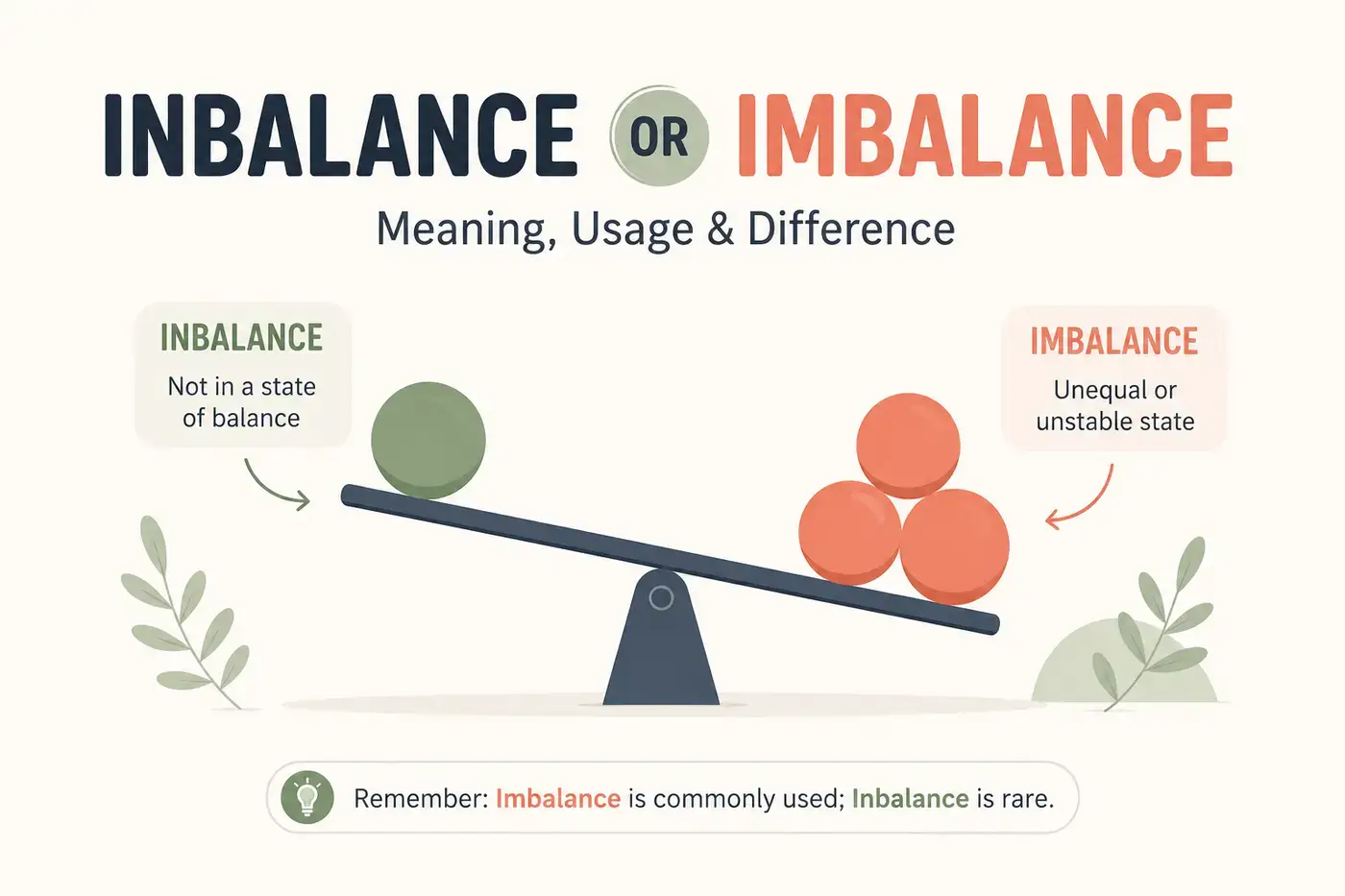
Many English learners search for inbalance or imbalance because both words look like they should be correct. They share the same root word, and the prefixes in and im can both mean not or opposite. This makes the spelling choice confusing.
The correct and widely accepted word in modern English is imbalance. It means a lack of balance, an uneven condition, or a situation where different parts are not equal or properly matched.
The word inbalance is rare and usually considered incorrect in standard English. While you may find it in some older texts or occasional usage, dictionaries and professional writing guides prefer imbalance.
This confusion happens because English has many words that use the prefix in such as inaccurate, incomplete, and inactive. However, English spelling changes prefixes depending on the sound that follows. Before words beginning with b, the prefix often changes from in to im.
In this guide, you’ll learn the difference between inbalance or imbalance, why one spelling is preferred, how the word developed, common mistakes, grammar rules, examples, and simple ways to remember the correct form.
You may also want to read Bony Vs Boney Which Spelling Is Correct 2026 Guide.
Quick Answer
Imbalance is the correct spelling in standard English. It means a lack of balance or an uneven condition. Inbalance is rarely used and is generally considered a nonstandard form. Use imbalance in everyday writing, professional communication, academic work, and formal documents.
Inbalance Or Imbalance Comparison Table
| Feature | Imbalance | Inbalance |
|---|---|---|
| Correct spelling | Yes | Usually no |
| Meaning | Lack of balance or an uneven state | Same intended meaning but uncommon |
| Part of speech | Noun | Rare noun form |
| Standard English | Accepted | Not preferred |
| Formal writing | Recommended | Avoid |
| Common usage | Very common | Extremely rare |
| Example | The diet caused an imbalance. | The diet caused an inbalance. |
What Does Imbalance Mean
Imbalance is a noun that describes a situation where things are not balanced, equal, or properly arranged.
It can describe physical conditions, emotional states, social issues, financial situations, or systems that are not working properly.
Simple Definition
An imbalance is a state where one part is greater, weaker, stronger, or different compared with another part.
Common Contexts For Imbalance
The word appears in many areas of life.
Physical Balance
A person may experience an imbalance in their body or movement.
Example.
The injury caused an imbalance while walking.
Health And Nutrition
Doctors and health experts often use this word to describe problems caused by too much or too little of something.
Example.
A vitamin imbalance can affect overall health.
Economy
Economists use imbalance when discussing unequal systems.
Example.
The country is trying to reduce the trade imbalance.
Relationships
People also use imbalance when talking about unfair situations.
Example.
There was an imbalance of responsibility in the relationship.
Work And Organizations
Businesses may experience an imbalance between resources and demands.
Example.
The team faced an imbalance between workload and available staff.
What Does Inbalance Mean
Inbalance is an uncommon form that attempts to create the opposite meaning of balance by adding the prefix in.
Although it may seem logical, English does not use it as the standard spelling.
Most dictionaries and style guides recognize imbalance as the correct form.
Why Inbalance Looks Correct
The confusion comes from common English patterns.
Many negative words use in.
Examples.
- Incorrect.
- Incomplete.
- Inactive.
- Inaccurate.
Because of this pattern, some writers assume inbalance follows the same rule.
However, English prefixes often change based on pronunciation and spelling tradition.
Which One Is Correct
The correct spelling is imbalance.
Use imbalance when you mean a lack of balance, an uneven situation, or a condition where parts do not match properly.
Examples.
- The doctor noticed a chemical imbalance.
- The company has an imbalance between supply and demand.
- The athlete worked to correct a muscle imbalance.
Avoid using inbalance in professional or academic writing because most readers will see it as a spelling mistake.
Why People Confuse Inbalance And Imbalance
The confusion between these words comes from several common English patterns.
Prefix Confusion
The biggest reason is the negative prefix rule.
English uses several prefixes to create opposite meanings.
Examples.
- Unhappy.
- Disagree.
- Incorrect.
- Impossible.
The prefix changes depending on the word.
For words beginning with b, m, or p, the prefix in often becomes im.
Examples.
- Balance becomes imbalance.
- Possible becomes impossible.
- Mature becomes immature.
- Patient becomes impatient.
This spelling change makes pronunciation smoother.
Visual Similarity
The two spellings look almost identical.
The difference is only one letter.
Inbalance.
Imbalance.
When people type quickly or rely on memory, they may choose the wrong version.
Autocorrect And Typing Habits
Autocorrect can create confusion because some uncommon words are not recognized properly.
A person may type inbalance because it feels natural and not notice that professional dictionaries prefer imbalance.
Internet Influence
Online content sometimes contains incorrect spellings. When people repeatedly see a word used incorrectly, it can start to feel normal.
Search results, forums, and informal posts can spread spelling mistakes.
Historical Usage
English has changed over centuries, and some older or less common forms still appear in written records.
However, modern English has settled on imbalance as the accepted spelling.
Key Differences Between Inbalance And Imbalance
The main difference is not meaning. Both words are intended to express the idea of lacking balance.
The real difference is acceptance and usage.
Spelling
Imbalance follows standard English spelling rules.
Inbalance does not follow the commonly accepted form.
Grammar
Both forms would function as nouns if used.
Example.
The imbalance affected performance.
However, only imbalance is considered standard.
Usage
Imbalance appears frequently in health, science, business, education, and everyday writing.
Inbalance is rarely used and may distract readers.
Formality
Professional writers, editors, teachers, and publishers recommend imbalance.
Using the standard spelling helps your writing appear accurate and polished.
Grammar Explanation
Imbalance is a noun.
It names a condition or situation.
Singular Form
The singular form is imbalance.
Examples.
- The imbalance created problems.
- A financial imbalance can affect growth.
Plural Form
The plural form is imbalances.
Examples.
- Several economic imbalances affected the market.
- Doctors studied different chemical imbalances.
Sentence Structure
Imbalance often appears after articles like an or the.
Examples.
- The imbalance was difficult to fix.
- Scientists found an imbalance in the system.
Because the word begins with a vowel sound, we use an, not a.
Correct.
An imbalance.
Incorrect.
A imbalance.
Spelling Rule Behind Imbalance
The spelling of imbalance follows an important English prefix rule.
The negative prefix in changes to im before certain letters.
This happens because the sounds are easier to pronounce together.
Examples Of The Im Prefix
- Imbalance.
- Impossible.
- Immoral.
- Impatient.
- Imperfect.
The change does not alter the meaning. It simply creates a smoother spelling and pronunciation pattern.
Pronunciation Guide For Imbalance
Knowing the pronunciation of imbalance can help you recognize the correct word when speaking and writing.
Imbalance Pronunciation
IPA
American English: /ɪmˈbæl.əns/
Syllables
Im bal ance.
Stress Pattern
The main stress falls on the second syllable.
im BAL ance.
The first syllable is softer, while the middle syllable receives the strongest emphasis.
Common Pronunciation Mistakes
Some learners pronounce the word as if it starts with in because they spell it incorrectly as inbalance.
Correct pronunciation.
Im balance.
Incorrect pronunciation pattern.
In balance.
The beginning sound changes because the prefix becomes im before the letter b.

Etymology And Word Origin Of Imbalance
Understanding the history of imbalance explains why the spelling developed this way.
The word comes from the combination of:
Im meaning not or opposite of.
Balance meaning a state where things are equal, stable, or properly arranged.
The word balance entered English through Old French from the Latin word bilanx, which referred to a two pan scale used for measuring weight.
Over time, balance expanded beyond physical weight. English speakers began using it for ideas like fairness, stability, harmony, and proportion.
The word imbalance developed to describe the opposite condition where something becomes uneven or unstable.
Examples.
- An imbalance between work and rest.
- An imbalance in financial resources.
- An imbalance in body movement.
Today, imbalance is widely used in science, medicine, economics, psychology, education, and everyday communication.
British And American English Difference
There is no spelling difference between American English and British English for imbalance.
Both regions use the same form.
American English.
The company reported an imbalance in supply and demand.
British English.
The company reported an imbalance in supply and demand.
Canadian English and Australian English also use imbalance.
The word is universal across major English varieties.
The difference appears only in pronunciation style and accent, not spelling.
Real Life Examples Of Imbalance
Seeing the word in different situations helps you understand natural usage.
Daily Conversation
- I feel an imbalance between my work life and personal life.
- The room feels uncomfortable because there is an imbalance in the furniture arrangement.
- Too much screen time can create an imbalance in your daily routine.
- There is an imbalance between what people expect and what actually happens.
- The coach noticed an imbalance in the team’s performance.
Workplace Examples
- The manager wanted to fix the imbalance between workload and available employees.
- The company is studying the imbalance between expenses and income.
- An imbalance of responsibilities can reduce team motivation.
- The department experienced an imbalance after several employees left.
- Leaders should watch for an imbalance between goals and resources.
Email Examples
- I noticed an imbalance in the current project timeline and suggest reviewing the schedule.
- We need to address the imbalance between customer demand and available inventory.
- The report highlights an imbalance that requires immediate attention.
- Please review the data and check for any imbalance in the figures.
Learn the difference in Passtime Or Pastime Which Spelling Is Correct 2026.
Academic Writing Examples
- Researchers studied the imbalance between economic growth and environmental protection.
- The paper explores the social imbalance created by unequal opportunities.
- Scientists identified an imbalance in the chemical process.
- The study examines gender imbalance in leadership positions.
Journalism Examples
- Experts warned about an imbalance in the housing market.
- The article discussed the growing imbalance between rural and urban development.
- Analysts believe the trade imbalance may affect future policies.
- The report revealed an imbalance in access to education.
Social Media Examples
- There needs to be a better work life balance because the imbalance is exhausting.
- This conversation shows the imbalance in how people share responsibilities.
- A small lifestyle change can help fix an unhealthy imbalance.
Literature And Creative Writing Examples
- The story explores the imbalance between ambition and happiness.
- The character struggles with an emotional imbalance after the loss.
- The author describes a world where power imbalance controls society.
Common Mistakes With Imbalance
Even experienced writers sometimes make errors with this word.
Writing Inbalance Instead Of Imbalance
Incorrect.
The economy has an inbalance between imports and exports.
Correct.
The economy has an imbalance between imports and exports.
The correct prefix form changes before the letter b.
Using A Instead Of An
Incorrect.
A imbalance affected the system.
Correct.
An imbalance affected the system.
Because imbalance starts with a vowel sound, it requires an.
Confusing Imbalance With Unbalance
These words are related but not always identical.
Imbalance usually refers to a condition where parts are unequal.
Example.
The study found an imbalance in income distribution.
Unbalance is often used as a verb meaning to make something unstable.
Example.
The sudden movement could unbalance the machine.
However, in some situations, people use them similarly.
Confusing Imbalance With Disbalance
Some writers use disbalance, but it is uncommon in standard English.
Imbalance is the natural and widely accepted choice.
Professional writers almost always choose imbalance.
Using Imbalance When You Mean Lack Of Balance In Movement
The word can describe physical stability, but context matters.
Example.
The athlete suffered from an imbalance in muscle strength.
This sounds natural.
The athlete suffered from a balance problem.
This may sound simpler in everyday speech.

Memory Tricks To Remember Imbalance
Simple memory methods make spelling easier.
Remember The B Rule
The word starts with im because balance begins with b.
Think:
I M Before B
Examples.
- Imbalance.
- Impossible.
- Immature.
- Impatient.
The prefix changes to make pronunciation smoother.
Think About A Scale
Imagine a balanced scale.
When the scale becomes uneven, it creates an imbalance.
The word starts with im because the balance is no longer correct.
Use The Opposite Test
Ask yourself:
What is the opposite of balance?
The answer is imbalance.
Not inbalance.
Related Words And Expressions
Understanding related vocabulary improves word choice.
Words Related To Imbalance
- Balance.
- Balanced.
- Imbalanced.
- Equality.
- Inequality.
- Stability.
- Instability.
- Unevenness.
- Disproportion.
- Disruption.
Synonyms For Imbalance
Depending on the context, you can use:
- Unevenness.
- Inequality.
- Disproportion.
- Instability.
- Difference.
- Mismatch.
- Disturbance.
- Lack of balance.
Opposites Of Imbalance
- Balance.
- Equality.
- Stability.
- Harmony.
- Symmetry.
- Fairness.
Related Expressions
English speakers use many phrases connected with imbalance.
- Work life imbalance.
- Power imbalance.
- Economic imbalance.
- Chemical imbalance.
- Emotional imbalance.
- Gender imbalance.
- Financial imbalance.
- Natural imbalance.
Suggested Internal Link
Difference Between Affect And Effect In English.
Expert Editor’s Note On Imbalance
Professional editors, dictionary writers, and language teachers all recommend imbalance as the correct spelling in modern English.
When reviewing articles, reports, academic papers, or business documents, editors usually correct inbalance to imbalance because the standard spelling follows English prefix rules.
Major dictionaries recognize imbalance as the accepted noun form. The word appears regularly in formal writing, including medicine, economics, science, education, and journalism.
A useful editing tip is to avoid choosing words only because they look logical. English has many spelling patterns that developed through history and pronunciation. A word may seem like it should follow one rule while standard usage follows another.
For professional writing, use:
✔ Imbalance.
Avoid:
✘ Inbalance.
Using the accepted spelling helps readers focus on your message instead of noticing a spelling issue.
Frequently Asked Questions About Inbalance Or Imbalance
Is Inbalance A Correct Word?
Inbalance is rarely used and is not considered the standard spelling in modern English. Most dictionaries and style guides recommend imbalance. If you are writing an email, article, essay, report, or professional document, choose imbalance.
Why Is Imbalance Spelled With Im Instead Of In?
The prefix changes from in to im before words beginning with certain letters, including b. This change makes pronunciation smoother. Since balance starts with b, the correct form becomes imbalance.
What Is The Difference Between Inbalance And Imbalance?
The intended meaning is similar, but the usage is different. Imbalance is the accepted English word meaning a lack of balance. Inbalance is a rare nonstandard form that most writers should avoid.
Is Imbalance A Noun Or An Adjective?
Imbalance is a noun. It names a condition or situation where balance is missing. The adjective form is imbalanced.
Examples.
The system has an imbalance.
The patient showed imbalanced movement.
What Is The Plural Of Imbalance?
The plural form is imbalances.
Examples.
- Scientists studied several chemical imbalances.
- The report identified economic imbalances across regions.
Can Imbalance Be Used In Formal Writing?
Yes. Imbalance is widely accepted in formal writing. It appears in academic research, medical reports, business documents, and professional communication.
What Is The Opposite Of Imbalance?
The opposite of imbalance is balance. Depending on the context, related opposites include equality, stability, harmony, and fairness.
How Do You Remember The Correct Spelling Of Imbalance?
Remember the phrase I M Before B. Since balance begins with b, the prefix becomes im.
Think:
Balance becomes imbalance.
Not inbalance.
Learn the difference in Seing Vs Seeing Which Spelling Is Correct 2026 Guide.
Conclusion
The correct choice between inbalance or imbalance is clear. The standard English spelling is imbalance.
The word describes a lack of balance, an uneven condition, or a situation where parts do not match properly. It is commonly used in health, business, science, relationships, and everyday communication.
The main reason people write inbalance is because English often uses the prefix in to create opposites. However, prefixes can change form based on the sound that follows. Before b, the spelling usually changes to im.
The easiest rule to remember is simple.
Use imbalance when you mean a lack of balance.
Avoid inbalance because it is not the accepted modern spelling.
Good writing is not only about sharing ideas. It is also about choosing words that readers instantly recognize and trust.

Editorial Reviewer & Proofreader
Grace Mitchell reviews Gramlify’s articles for clarity, consistency, and readability. She is passionate about creating accurate, approachable content that helps English learners build confidence.
1 thought on “Inbalance Or Imbalance Which Word Is Correct 2026 Guide”