

If you’ve ever paused while writing about clothes, hotel rooms, business software, or playing cards, suit vs suite can be a surprisingly tricky comparison. The two words look almost identical, and they share the same historical roots. Yet they have different meanings, different grammatical roles, and different uses in modern English.
The good news is simple. Suit usually refers to clothing, a group of playing cards, a legal case, or something that fits or works well. Suite usually refers to a group of connected rooms, matching furniture, a related group of musical pieces, or a collection of software programs. The two words are not interchangeable.
Pronunciation causes another layer of confusion. Suit is pronounced /suːt/ and suite is pronounced /swiːt/ in standard American and British English. The extra letters in suite do not make it a longer version of suit. They represent a different spelling with a different sound.
You may also want to read Investor Vs Investee Which Word Is Correct 2026 Guide.
Quick Answer
This guide explains the difference between suit and suite in plain English. You’ll learn their meanings, grammar, pronunciation, spelling, history, common mistakes, and natural examples so you can choose the right word with confidence.
Suit and suite are different words. Suit can mean a set of clothes, a group of playing cards, a lawsuit, or something that fits someone or works well. Suite means a set of connected rooms, matching furniture, related music, or related software. They also have different pronunciations.
Suit vs Suite At a Glance
| Feature | Suit | Suite |
|---|---|---|
| Correct spelling | suit | suite |
| Main part of speech | Noun and verb | Noun |
| Common meaning | Clothes or something that fits | A set of rooms or related things |
| Pronunciation | /suːt/ | /swiːt/ |
| Syllables | One | One |
| Common context | Clothing, cards, law, preferences | Hotels, furniture, music, software |
| Example | She bought a new suit. | We booked a hotel suite. |
| Related phrase | suit someone | suite of rooms |
| American English | suit | suite |
| British English | suit | suite |
The biggest difference is meaning. Suit often describes an item, action, or relationship between something and a person. Suite usually describes a collection of related things.
What Does Suit Mean
Suit has several common meanings in English. It can function as both a noun and a verb.
As a noun, suit often means a set of clothes made from matching material. In American English, this commonly means a jacket with matching pants or a jacket with a matching skirt. Oxford gives examples such as a business suit and a pinstripe suit.
For example:
She wore a navy suit to the interview.
Here, suit refers to clothing.
The word also has an important meaning in card games. A suit is one of the four groups in a standard deck of cards: hearts, diamonds, clubs, and spades.
For example:
Hearts is my favorite suit in cards.
Suit can also refer to a legal case.
For example:
The company filed a suit against the contractor.
In this context, suit is short for a lawsuit or legal proceeding.
As a verb, suit means to be convenient, appropriate, attractive, or useful for someone or something. Oxford lists meanings such as being convenient or useful and gives examples like a meeting time that suits someone.
For example:
Does Friday afternoon suit you?
Here, suit does not refer to clothing. It means that Friday afternoon is convenient for the person.
You can also use suit when something looks good on someone.
That color suits you.
You can use it when something matches a person’s needs or preferences.
This schedule suits my routine.
So, suit has a much wider range of meanings than many learners first expect.
Suit As A Noun
The most common noun meanings include:
- A matching set of clothes.
- One of the four groups in a deck of cards.
- A legal case.
- A person in a business context when used informally as suits.
The business meaning is informal. For example:
The suits approved the new budget.
Here, suits refers to business executives or managers. It often carries a slightly negative or humorous tone.
Suit As A Verb
As a verb, suit commonly means:
- To be convenient.
- To be appropriate.
- To look good on someone.
- To meet someone’s needs.
- To fit a particular situation.
Consider these examples:
That time suits me.
The blue jacket suits her.
This plan suits our budget.
A quieter room would suit him better.
Notice that the verb does not describe an object that comes as a set. Instead, it describes a good match between a person, thing, need, or situation.
What Does Suite Mean
Suite is a noun. It usually describes a group of connected or related things.
The most familiar meaning in American English is a group of connected rooms in a hotel or another building. Cambridge defines a suite as a set of connected rooms, especially in a hotel.
For example:
We reserved a luxury suite for the weekend.
A hotel suite might contain a bedroom, living area, bathroom, and other connected spaces. The exact layout depends on the property.
Suite can also refer to a group of offices.
The company’s executive suite occupies the top floor.
The word has several other established meanings.
In British English, suite can describe a matching set of furniture for a room. Cambridge gives examples such as a three piece furniture suite and a bathroom suite.
For example:
They bought a new living room suite.
In music, a suite is a group of related musical pieces performed together. Oxford describes it as a piece of music made up of several related parts.
For example:
The orchestra performed a suite from the ballet.
In computing, a suite is a collection of related software programs.
For example:
The company uses a design software suite.
This meaning is common in professional and technical writing. Cambridge also lists a suite as a set of related software products.
So, the central idea behind suite is a group or collection. That idea connects its meanings across hotels, furniture, music, and software.
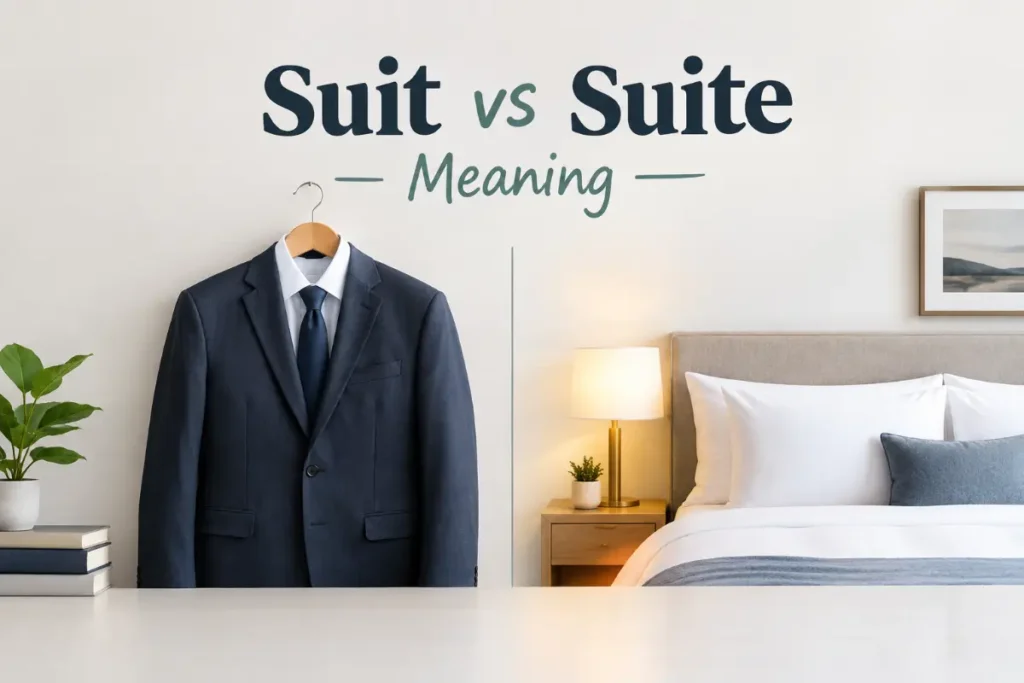
Suit vs Suite Meaning
The easiest way to understand the difference is to focus on the type of thing each word describes.
Suit often points to something that fits or matches.
Suite usually points to a group of connected or related things.
Compare these sentences:
He bought a new suit.
He booked a hotel suite.
The first sentence is about clothing. The second is about connected rooms.
Now compare these:
This schedule suits me.
The company purchased a software suite.
The first uses suit as a verb meaning to be convenient. The second uses suite as a noun meaning a collection of related programs.
That distinction makes the words much easier to separate.
| Word | Core idea | Example |
|---|---|---|
| suit | Fit, match, clothing, cards, or legal case | This time suits me. |
| suite | A connected or related set | We stayed in a hotel suite. |
A useful memory shortcut is this:
Suit fits. Suite groups.
That isn’t a complete definition of either word, but it gives you a quick way to choose the right spelling in many everyday situations.
Which One Is Correct
Both suit and suite are correct English words. Neither is a misspelling of the other.
The correct choice depends on the meaning of your sentence.
Use suit when you mean clothing.
She wore a black suit.
Use suit when you mean one group in a deck of cards.
He played a card from the same suit.
Use suit when you mean a legal case.
The company faced a civil suit.
Use suit as a verb when something is convenient or appropriate.
Monday suits me better.
Use suite when you mean connected hotel rooms.
They upgraded us to a larger suite.
Use suite when you mean a collection of related software.
The company offers a complete security suite.
Use suite when you mean a group of related musical pieces.
The pianist performed a short suite.
Use suite for a matching collection of furniture in contexts where that meaning is established.
They ordered a new bedroom suite.
The important point is that you cannot choose between these words based on spelling alone. You need to look at the meaning of the sentence.
Why People Confuse Suit And Suite
The confusion makes sense because the words have a close visual relationship. They also have a shared history and similar sounds.
The Spelling Looks Almost Identical
At first glance, suit and suite look like variations of the same word.
The only visible difference is the extra e in suite.
That can lead learners to assume that one spelling represents a special form of the other. It doesn’t.
The words developed into separate modern uses even though they are historically related. Etymological sources trace suit through Anglo French and Old French forms connected with following or accompanying someone. Suite developed from a related French form and kept the idea of a group or sequence.
They Sound Similar But Not Identically
The pronunciation creates another trap.
Suit is pronounced /suːt/.
Suite is pronounced /swiːt/.
The first sound of suite is /sw/. The first sound of suit is /s/.
This difference is small but important.
Say them slowly:
suit → soot
suite → sweet
The vowel sound in both words is long. The key difference comes at the beginning. Suite starts with the consonant combination /sw/.
Oxford lists suit as /suːt/ and suite as /swiːt/. Cambridge also gives suite as /swiːt/ in its English dictionary.
The Words Have Related Histories
Historical connections can make these words especially confusing for learners who notice that the spelling seems too similar to be accidental.
Etymology Online traces suit to Anglo French and Old French forms associated with following, pursuing, or accompanying. Over time, the word developed meanings involving groups, matching garments, legal proceedings, and cards.
Oxford traces suite to French through Anglo Norman French and ultimately to a Latin root associated with following. The modern English meanings preserve the broader idea of things that belong together or form a sequence.
So, the connection is real. The modern meanings are still different.
Autocorrect Can Make The Problem Worse
Spelling software can sometimes reinforce confusion because both words are legitimate English words.
If you type suite when you mean clothing, a basic spell checker may not flag the mistake. The word is spelled correctly. The problem is semantic rather than mechanical.
That is an important lesson for English learners.
A spell checker can often tell you that suitt is wrong.
It may not tell you that suite is wrong in the sentence:
He wore a gray suite to work.
The correct sentence is:
He wore a gray suit to work.
This is why proofreading requires more than checking spelling. Good editing also checks meaning, grammar, context, and word choice.
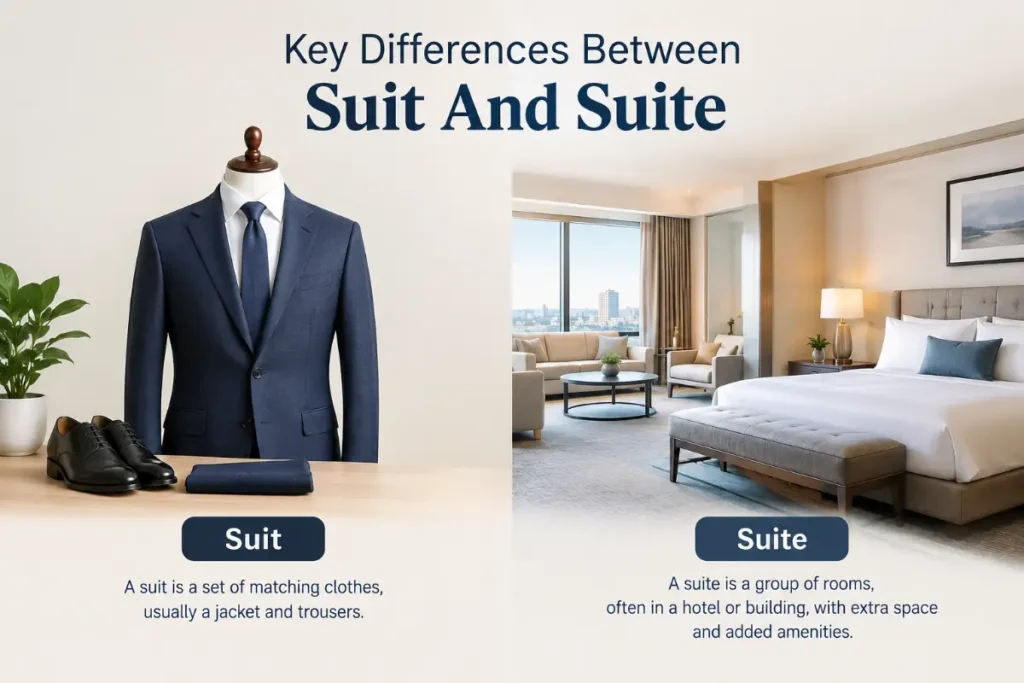
Key Differences Between Suit And Suite
The clearest differences involve meaning, grammar, pronunciation, and context.
Meaning
Suit can mean clothing, a card group, a legal case, or something that fits or works well.
Suite usually means a group of connected rooms or a related collection of things.
Grammar
Suit can be both a noun and a verb.
That suit is expensive.
That color suits you.
Suite is normally a noun.
The suite has two bedrooms.
You don’t normally use suite as a verb in standard modern English.
Pronunciation
Suit is /suːt/.
Suite is /swiːt/.
The pronunciation difference is small but consistent.
Context
You will commonly find suit in conversations about:
Clothing.
Cards.
Law.
Personal preferences.
Convenience.
Appearance.
You will commonly find suite in contexts involving:
Hotels.
Offices.
Furniture.
Music.
Software.
Collections of related things.
Function
A useful test is to ask what the word is doing in the sentence.
If the word means fits, matches, or is convenient, you probably need suit.
If it describes a group of connected or related things, you probably need suite.
That simple distinction solves most everyday cases.
Suit And Suite Pronunciation
Pronunciation deserves special attention because spelling can mislead learners.
How To Pronounce Suit
Suit is pronounced /suːt/.
It has one syllable.
It sounds similar to soot.
For example:
I need to buy a new suit.
The word begins with the /s/ sound and then uses the long /uː/ vowel.
How To Pronounce Suite
Suite is pronounced /swiːt/.
It also has one syllable.
It sounds similar to sweet.
For example:
Our hotel suite has a balcony.
The word begins with /sw/ and ends with the long /iː/ sound.
A Simple Pronunciation Trick
Think of these pairs:
suit sounds like soot.
suite sounds like sweet.
That distinction can help you remember both spelling and pronunciation at the same time.
Do not pronounce suite by trying to pronounce every written letter. The spelling comes from the word’s history rather than from a simple letter by letter English pattern.
Suit Grammar And Word Forms
Because suit can work as both a noun and a verb, learners need to pay attention to sentence structure.
As a noun, it can take an article.
He bought a suit.
She wore the suit yesterday.
As a verb, it takes a subject and can take an object.
This jacket suits you.
The new schedule suits everyone.
The verb has regular forms:
suit
suits
suited
suiting
Oxford lists suited as the past form and suiting as the ing form. It also notes that the verb is not normally used in progressive forms.
For example:
The schedule suits me.
The schedule suited me last year.
The schedule has suited our needs.
A common learner error is using suite when the sentence needs the verb suit.
Incorrect:
This time suite me.
Correct:
This time suits me.
The subject is this time, which is singular. Therefore, the verb needs the third person singular form suits.
That small grammar point matters in everyday English because the phrase Does that suit you? is extremely common.
Suit vs Suite Spelling Rules
The spelling difference between suit and suite isn’t based on a modern English spelling rule such as adding a suffix or doubling a consonant. Instead, the two forms come from related historical words that developed into separate English words.
That history explains why suite contains an extra e that you don’t pronounce in the same way you might expect from ordinary English spelling.
How To Spell Suit
Suit contains four letters:
S U I T
It has no final e.
Use suit when you mean clothing, a card group, a lawsuit, or something that fits or works well.
Examples include:
He wore a dark suit to the ceremony.
Diamonds is a suit in a standard deck of cards.
That time doesn’t suit me.
The lawyer filed a suit.
How To Spell Suite
Suite contains five letters:
S U I T E
The final e is part of the established spelling.
Use suite for a group of connected rooms or a related collection such as software or musical pieces.
Examples include:
We booked a hotel suite.
The company installed a security software suite.
The orchestra performed a suite.
The extra e isn’t a grammatical ending. It doesn’t turn suit into a plural or another form. Suite is a separate noun with its own meaning.
A Useful Spelling Reminder
Think of the two words as separate vocabulary items.
Suit = clothing, cards, law, or fit.
Suite = rooms or a related set.
Trying to remember suite as a special spelling of suit can make the distinction harder. It works better to connect each spelling directly to its meaning.
Suit vs Suite Word Origin
The history of these words explains some of their unusual spelling and meaning.
Both words are connected to French and ultimately to a Latin root associated with following. Suit entered English through Anglo French and Old French forms. Over time, it developed several meanings connected with things that belong together or follow one another.
The clothing sense developed from the idea of a set of garments that go together. The card sense also developed around the idea of a group of cards sharing a common mark or symbol.
Suite came into English through French as well. Its meaning developed around a group or sequence of related things. That idea remains visible in several modern uses.
A hotel suite contains rooms that belong together.
A musical suite contains pieces that belong together.
A software suite contains programs that belong together.
This shared idea gives you a helpful semantic clue. When you see suite in modern English, you can often expect some kind of collection or connected group.
Learn the difference in Deep Seated Vs Deep Seeded: Which One Is Correct (2026 Guide).
Suit vs Suite In American English
American English uses both suit and suite in the same basic ways as standard British English. The main difference isn’t the spelling. It’s the frequency and context of certain meanings.
In the United States, suit is very common for clothing.
He wore a blue suit to the wedding.
It’s also common in legal language.
The company is facing a lawsuit.
The word suit remains common in card games too.
Hearts is a suit.
For suite, American English commonly uses the word for hotel rooms.
The hotel has several executive suites.
American businesses also commonly use suite for groups of related software.
The company uses an accounting software suite.
The furniture meaning can vary in familiarity across English speaking regions. American speakers are more likely to use specific terms such as living room set, bedroom set, or furniture set in everyday conversation. The word suite still appears in American English for particular furniture collections and in product descriptions.
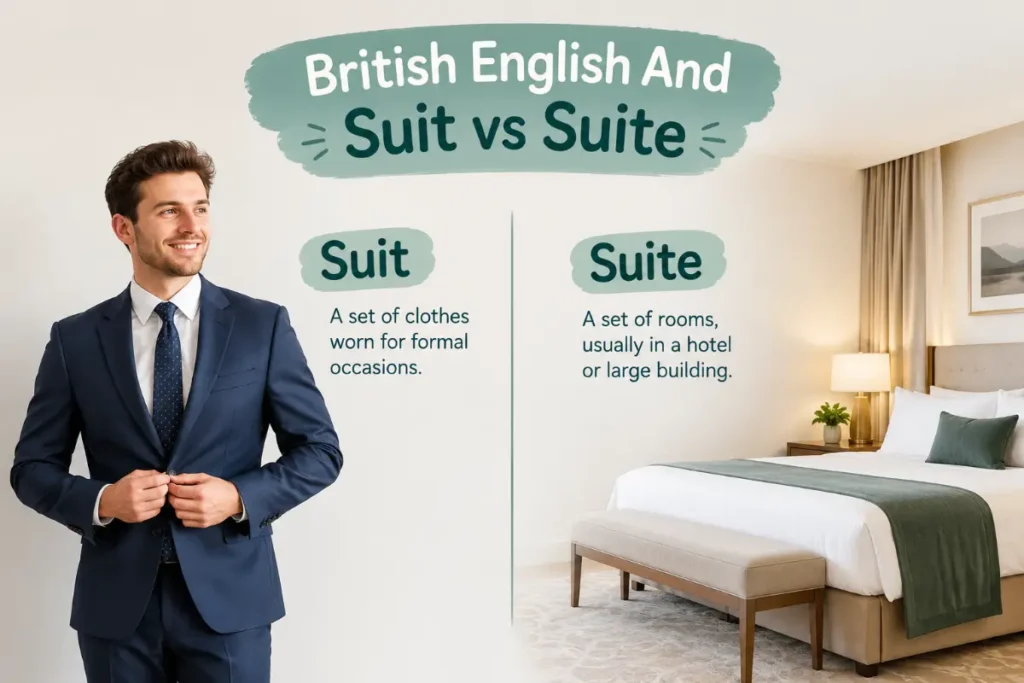
British English And Suit vs Suite
British English uses suit and suite with the same core distinctions.
A suit can mean matching clothing.
He bought a new business suit.
A suite can mean connected rooms.
The hotel has a presidential suite.
British English also commonly uses suite for a matching set of furniture.
They ordered a new three piece suite.
This meaning can sound less familiar to some American readers. In the United States, three piece suite isn’t usually the first phrase people choose for a matching living room furniture set.
Regional vocabulary can therefore affect how natural a sentence sounds even when the spelling is identical.
The important point is that suite doesn’t become suit simply because the meaning changes across countries. The spelling stays suite for the furniture sense.
Canadian And Australian English
Canadian English generally follows the same distinction between suit and suite.
For example:
She wore a formal suit.
They booked a hotel suite.
Canadian speakers also use suite for software collections and other related groups.
Australian English follows the same basic pattern.
He bought a new suit for work.
The guests stayed in a hotel suite.
The spelling difference is therefore stable across the major varieties of English. You don’t need a different spelling for American, British, Canadian, or Australian English.
The main variation comes from specific meanings and preferred expressions rather than from the spelling itself.
Real Life Examples Of Suit And Suite
Seeing the words in different contexts is one of the best ways to make the distinction automatic.
Daily Conversation Examples
- I need a new suit for the wedding.
- That jacket really suits you.
- Does Saturday suit you?
- We stayed in a beautiful hotel suite.
- The suite had a separate living room.
- Blue is a color that suits her.
- Which suit did you play?
- The hotel gave us a larger suite.
These examples show how quickly the meaning changes.
In that jacket really suits you, the word is a verb.
In I need a new suit, it is a noun.
In hotel suite, it refers to connected rooms.
Workplace Examples
- He wore a gray suit to the meeting.
- The new schedule suits our team.
- The company purchased a software suite for its employees.
- The executive suite is on the top floor.
- This reporting system suits our needs.
- She ordered a new suit for the conference.
Professional writing often uses both words in the same document.
For example:
The executive team met in a private suite after the conference. Several members wore formal suits for the event.
The words look similar but refer to completely different things.
Email Examples
- Does Tuesday afternoon suit you?
- Please let me know if this time suits your schedule.
- We have reserved a suite for the visiting speaker.
- The hotel suite will be available after 3 p.m.
The verb suit is especially useful in polite workplace emails.
Would 2 p.m. suit you?
This sounds natural and professional without being overly formal.
Academic Writing Examples
- The theory suits the evidence presented in the study.
- The researchers analyzed a suite of related variables.
- The article discusses the historical development of the card suits.
- The musical suite reflects several themes from the original composition.
Academic writing often uses suite in the sense of a collection.
For example:
The researchers used a suite of statistical methods to analyze the data.
Here, suite means a related group of methods.
Literature And Journalism Examples
- The character arrived wearing a dark suit.
- The hotel offered the celebrity a private suite.
- The composer created a suite based on the original score.
- The company filed a legal suit after negotiations failed.
In journalism, suit often appears in legal reporting.
However, professional writers should take care with legal terminology. In many contexts, lawsuit or a more specific legal term provides greater clarity than simply suit.
Social Media Examples
- This suit looks amazing.
- That color really suits you.
- Hotel suite with a view? Yes please.
- Nothing suits a Friday night like a good card game.
Social media often relies on short sentences and context. That can make confusing words harder to distinguish.
A sentence like This suite looks amazing could refer to a hotel room. If the writer means clothing, This suit looks amazing is the correct choice.
Common Mistakes With Suit And Suite
The most common mistakes happen when writers know both words but don’t connect each spelling with its meaning.
Mistake 1
She bought a new suite for the interview.
Correct:
She bought a new suit for the interview.
A person wears a suit. A person doesn’t normally wear a suite.
Mistake 2
Does this time suite you?
Correct:
Does this time suit you?
The verb is suit.
Mistake 3
We booked a hotel suit.
Correct:
We booked a hotel suite.
A group of connected hotel rooms is a suite.
Mistake 4
The company purchased a new software suit.
Correct:
The company purchased a new software suite.
A collection of related software programs is a suite.
Mistake 5
That color suite you.
Correct:
That color suits you.
The verb must agree with the singular subject color.
Mistake 6
He played a card from the same suite.
Correct:
He played a card from the same suit.
In card games, the group is called a suit.
These mistakes aren’t usually grammar problems. They’re word choice problems. The writer has selected a real English word but attached it to the wrong meaning.
Suit vs Suite In Common Expressions
Learning common phrases can make the distinction much easier.
Expressions With Suit
Suit someone
This schedule suits me.
Suit your needs
The plan should suit your needs.
Suit yourself
This expression means to do what you want.
If you don’t want to come with us, suit yourself.
Suit the occasion
She chose an outfit that suited the occasion.
Follow suit
This means to do the same thing as someone else.
Several other companies followed suit.
A suit and tie
The invitation says guests should wear a suit and tie.
A suit of cards
Hearts is a suit of cards.
Expressions With Suite
Hotel suite
They stayed in a luxury hotel suite.
Executive suite
The meeting took place in the executive suite.
Bridal suite
The bride waited in the bridal suite.
Software suite
The company uses a complete software suite.
Suite of tools
The platform provides a suite of editing tools.
Musical suite
The orchestra performed a musical suite.
These expressions reinforce the central difference. Suit often relates to fitting or matching. Suite often refers to a connected group.
Suit And Suite In Formal Writing
Both words are perfectly acceptable in formal writing. The important issue is precision.
For professional writing, choose suit when the meaning involves fit, convenience, clothing, cards, or law.
Choose suite when the meaning involves a group of connected or related things.
Consider this sentence:
The software suit is designed for accountants.
A reader might assume that suit means a legal case or clothing. The intended meaning is probably a collection of software programs.
The better version is:
The software suite is designed for accountants.
Likewise:
The meeting time suites our needs.
should be:
The meeting time suits our needs.
Professional editing isn’t only about catching misspelled words. It’s also about making sure the selected word communicates the intended meaning.
A Simple Test For Choosing Suit Or Suite
When you’re unsure, ask one question:
Am I talking about something that fits or a group of related things?
If you’re talking about fit, convenience, clothing, cards, or a legal case, choose suit.
If you’re talking about connected rooms or a collection of related items, choose suite.
For example:
This appointment time ___ me.
The answer is suits because the meaning is convenience.
We booked a hotel ___.
The answer is suite because the meaning is a group of connected rooms.
He bought a formal ___.
The answer is suit because the meaning is clothing.
The company bought a software ___.
The answer is suite because the meaning is a collection of programs.
This simple test handles most everyday situations.
Memory Tricks For Suit And Suite
A good memory trick should connect the spelling with the meaning. It shouldn’t force you to memorize a complicated rule.
Remember Suit With Fit
Think:
Suit = fit.
If something suits you, it fits your needs or looks good on you.
That jacket suits you.
Friday suits me.
The clothing meaning also gives you a strong visual connection.
Suit = something you can wear.
Remember Suite With Sweet
Suite sounds like sweet.
Think:
A hotel suite can be sweet.
This isn’t a formal language rule. It’s simply a memorable sound connection.
You can also connect suite with the idea of a set.
Suite = set.
A hotel suite is a set of connected rooms.
A software suite is a set of related programs.
A musical suite is a set of related pieces.
The Fastest Memory Rule
If you need one shortcut for everyday writing, use this:
Suit fits. Suite groups.
It won’t cover every dictionary definition. Still, it’s an excellent first check when you’re writing quickly.
Related Words And Frequently Confused Terms
English has several words that can cause the same kind of confusion because they look or sound similar.
Suit And Fit
Fit and suit overlap in meaning but aren’t always interchangeable.
The shoes fit me.
This usually means the size is right.
The shoes suit me.
This usually means they look good on me or match my style.
So, fit often concerns physical size while suit can concern appearance, preference, convenience, or appropriateness.
Suit And Match
Match often means that two things look good together.
The shoes match the suit.
Suit can describe something that looks good on a person.
The color suits her.
Suit And Set
Set is broader than suit.
A set is a group of things that belong together.
We bought a set of dishes.
A suit can also be a set of matching clothes.
He wore a suit to work.
However, you can’t replace suite with set in every context. A hotel suite is an established term.
Suite And Series
A series is a group of related things arranged in an order or connected by a theme.
A suite is also a group of related things but has specific established meanings in areas such as hotels, music, furniture, and software.
For example:
a suite of software tools.
You wouldn’t normally replace that with a series of software tools if you mean one integrated collection of programs.
Expert Editor’s Note
From an editing perspective, suit and suite are classic examples of words that require semantic proofreading.
Both spellings are legitimate. A spell checker alone cannot reliably catch an incorrect choice because the problem isn’t the spelling of the individual word. The problem is the relationship between the word and the sentence.
Major learner dictionaries distinguish the words clearly. Oxford lists suit as a noun and verb with meanings connected to clothing, cards, legal action, and suitability. It separately defines suite as a noun for groups of connected rooms and related collections.
Cambridge makes the same fundamental distinction. It defines suit as a word connected with clothing, cards, and suitability while suite refers to connected rooms and groups of related things.
As an editor, I wouldn’t recommend memorizing dozens of isolated examples. Instead, learn the core semantic contrast.
Suit often carries the idea of fitting or matching.
Suite often carries the idea of a connected set.
That distinction gives writers a reliable mental framework. It also explains why phrases such as this suits me, a business suit, a hotel suite, and a software suite feel natural to native speakers.
One more editorial point matters in formal writing. If the reader could misunderstand the noun suit in a legal context, consider using lawsuit when clarity matters. The longer word removes ambiguity and tells the reader immediately that you’re discussing legal action.
Good editing isn’t about choosing the most complicated word. It’s about choosing the clearest word for the intended meaning.
Common Questions About Suit And Suite
Is suit or suite correct for clothing?
Suit is correct for clothing. A suit is a matching set of garments such as a jacket and pants or a jacket and skirt. For example, you can write She wore a black suit to the interview. Suite is not correct when you mean clothing.
Is it hotel suit or hotel suite?
The correct expression is hotel suite. A suite is a group of connected rooms or a larger private accommodation area within a hotel. For example, We booked a hotel suite for three nights. Hotel suit is an incorrect spelling when you mean a group of rooms.
Is suite pronounced like sweet?
Yes. Suite is commonly pronounced /swiːt/ in standard American and British English. It sounds like sweet. Suit is pronounced /suːt/ and sounds like soot. The words therefore have similar but different pronunciations.
Does suit mean fit?
Yes. As a verb, suit can mean to be suitable, convenient, or appropriate. For example, Does Friday suit you? means Is Friday convenient for you? The verb can also describe appearance. That color suits you means the color looks good on you.
What is a software suite?
A software suite is a collection of related software programs that are designed to work together. For example, a business might use a suite containing programs for documents, spreadsheets, presentations, and other tasks. The word suite is appropriate because the programs form a related collection.
What is a suit in cards?
A suit is one of the four categories in a standard deck of playing cards. The four suits are hearts, diamonds, clubs, and spades. Each suit contains cards with the same symbol. In this context, suite is incorrect.
Can suite be a verb?
In standard modern English, suite is primarily a noun. It isn’t normally used as the verb meaning to fit or be convenient. Use suit for that meaning. For example, write This time suits me rather than This time suites me.
Why does suite have an extra e?
The spelling suite comes through French and reflects the historical development of the word. The final e isn’t a modern English grammatical ending. It is part of the established spelling of the noun. The word developed meanings involving groups or sequences that remain visible in modern uses such as hotel suite and software suite.
Is suit a homophone of suite?
No. In standard English pronunciation, suit and suite aren’t exact homophones. Suit is /suːt/ while suite is /swiːt/. They differ in their initial consonant sound. However, their similar spelling and pronunciation can still make them easy to confuse.
Should I use suit or suite in a formal email?
Use the word that matches your intended meaning. Write Does this time suit you? when asking if a time is convenient. Write The guest will stay in a suite when referring to connected hotel rooms. Formal writing doesn’t change the basic distinction between the two words.
Many readers also check Ballot Or Bullet Which Word Is Correct 2026 Guide.
Final Takeaway
Suit vs suite are both correct words. The choice depends entirely on meaning.
Use suit for clothing, card groups, legal cases, and the verb meaning to fit, suit, or be convenient.
Use suite for connected rooms and related collections such as software, music, or certain furniture sets.
The easiest memory trick is simple:
Suit fits. Suite groups.
Once you connect each spelling with its core meaning, the confusion becomes much easier to avoid. When proofreading, don’t rely only on spell check. Read the sentence for meaning too. A correctly spelled word can still be the wrong word.
When the meaning fits, choose suit. When the things belong together as a set, choose suite.

Vocabulary & Language Research Writer
Ethan Parker researches English vocabulary, word meanings, slang, idioms, and commonly confused words. His goal is to help readers understand how English is actually used in everyday conversations and writing.