
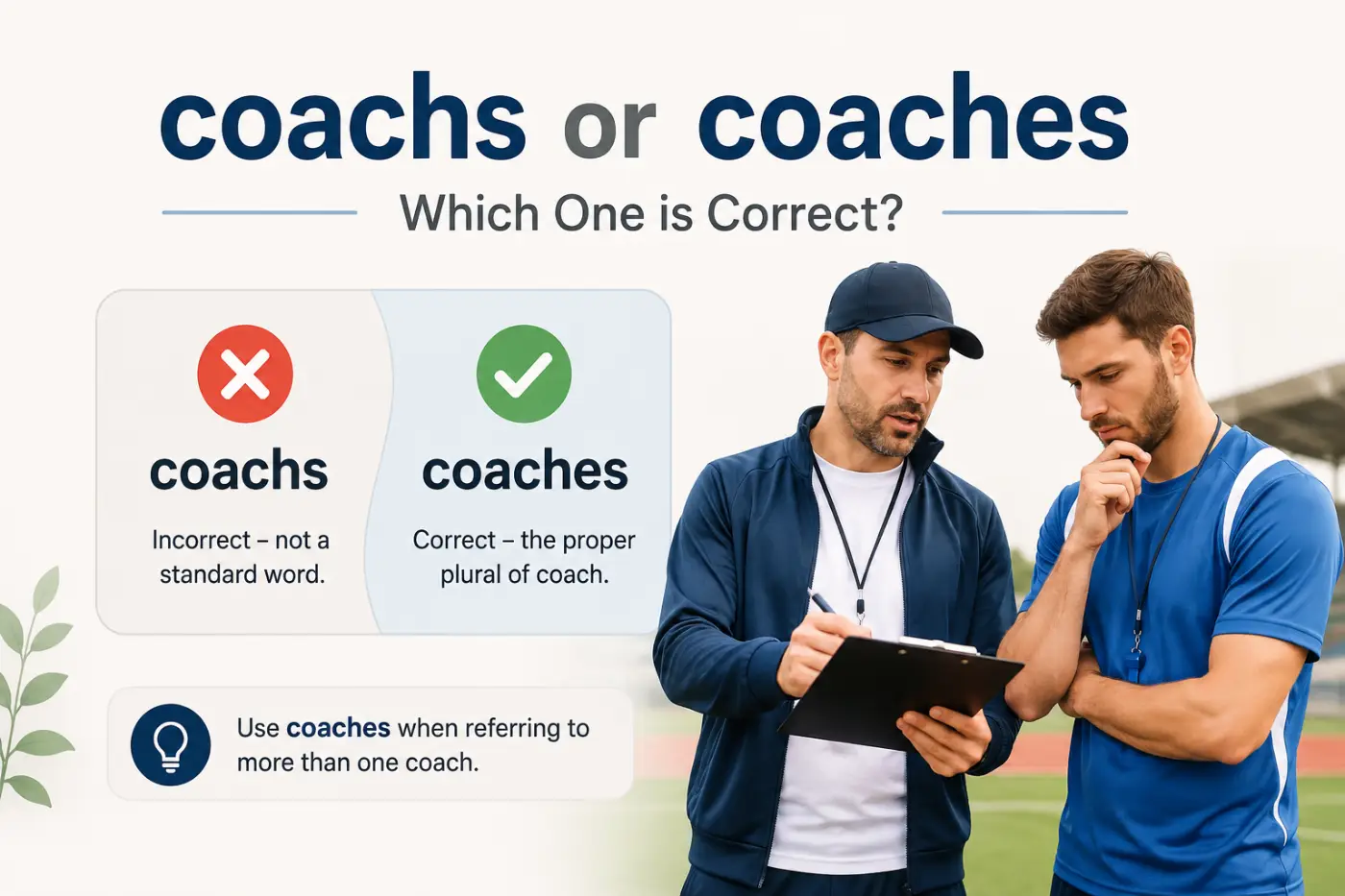
If you’ve ever paused over coachs or coaches while writing about sports, teaching, business, or personal training, you’re not alone. The correct spelling is coaches. Coachs is not the standard plural form of coach in English.
The confusion comes from a spelling rule that looks simple but can be easy to miss. The singular word is coach, and you might expect its plural to follow the usual pattern by adding s. That would produce coachs. English doesn’t work that way here because the word already ends in a sound that requires an extra syllable in the plural.
The correct form is coaches. It can refer to two or more sports coaches, teachers, trainers, mentors, or people who guide others. The same spelling also works for the third person singular present tense of the verb coach. For example, The trainer coaches young athletes.
This guide explains the difference between coachs and coaches, the spelling rule behind the correct form, pronunciation, grammar, real life examples, common mistakes, and the fastest way to remember the correct spelling.
You may also want to read Placque Vs Plaque Which Spelling Is Correct 2026.
Quick Answer.
Coaches is the correct spelling. Coachs is incorrect in standard English. Coaches is the plural of the noun coach and also the third person singular form of the verb coach. The spelling changes from coach to coaches because English adds es after words ending in certain sounds.
Coachs Or Coaches Comparison.
| Feature | Coachs | Coaches |
|---|---|---|
| Correct spelling | No | Yes |
| Standard English | No | Yes |
| Singular form | Coach | Coach |
| Plural form | Incorrect | Coaches |
| Part of speech | Not standard | Noun or verb |
| Meaning as a noun | Not applicable | Two or more coaches |
| Meaning as a verb | Not standard | Guides or trains |
| Pronunciation | Not standard | /ˈkoʊtʃɪz/ |
| Example | Coachs are meeting today. | Coaches are meeting today. |
The key point is simple. Coach becomes coaches in the plural.

What Does Coach Mean
Before understanding coaches, it helps to understand the singular word coach.
A coach is a person who trains guides or teaches someone to improve a skill. The word is strongly associated with sports but its modern meaning is much broader.
A coach can help people improve in areas such as athletics, business, education, communication, leadership, or personal development.
Coach As A Noun.
When coach is a noun, it names a person who provides training or guidance.
Examples.
- The coach helped the team prepare for the championship.
- Our basketball coach organized practice for Saturday.
- She hired a career coach to help with her job search.
- The tennis coach noticed a problem with his technique.
- My coach encouraged me to keep practicing.
The plural of coach is coaches.
Examples.
- The coaches met after practice.
- Several coaches attended the tournament.
- The coaches discussed the players’ progress.
Coach As A Verb.
Coach can also function as a verb. It means to train guide or instruct someone.
Examples.
- I coach a youth soccer team.
- She coaches new employees.
- They coach athletes throughout the season.
When the subject is he, she, or it, the verb becomes coaches.
Examples.
- She coaches the varsity team.
- He coaches young swimmers.
- Our manager coaches new employees.
This gives coaches two important grammatical uses.
It can mean more than one coach.
It can also mean trains or guides when the subject is singular in the present tense.
What Does Coaches Mean.
Coaches has two standard meanings depending on its grammatical role.
Coaches As A Plural Noun.
When coaches is a noun, it means more than one coach.
Example.
The coaches are preparing the players for the final game.
Here coaches refers to multiple people.
You can test the sentence by replacing coaches with trainers.
The trainers are preparing the players for the final game.
The meaning still works.
Coaches As A Verb.
When coaches is a verb, it means trains guides or instructs.
Example.
Maria coaches the school volleyball team.
Here coaches does not mean multiple coaches. It describes what Maria does.
Another example is.
Our instructor coaches students through difficult interviews.
The subject is instructor. The verb coaches tells us what the instructor does.
This distinction matters because coaches can look like a simple plural but grammar determines its role.
Which One Is Correct.
Coaches is correct.
Coachs is incorrect in standard English.
Use coaches when you mean more than one coach.
Correct.
The coaches arrived early.
Incorrect.
The coachs arrived early.
Use coaches when the subject is singular and the verb coach needs its third person singular form.
Correct.
She coaches the team every afternoon.
Incorrect.
She coachs the team every afternoon.
The spelling coachs doesn’t follow the standard English spelling pattern for this word.
Why People Confuse Coachs And Coaches.
The mistake is understandable because many English plurals simply take s.
For example.
- Book becomes books.
- Player becomes players.
- Teacher becomes teachers.
- Car becomes cars.
Someone who knows this basic rule may naturally try to write coachs. The problem is that English has several spelling patterns for plural nouns.
Words ending in a sound similar to the ending in coach often use es.
The same pattern appears in words such as.
- Box becomes boxes.
- Bus becomes buses.
- Dish becomes dishes.
- Watch becomes watches.
- Match becomes matches.
- Church becomes churches.
- Class becomes classes.
The word coach belongs to this larger spelling pattern.
The Spelling Rule Behind Coaches.
The important part of coach is its final sound.
The word ends with the sound /tʃ/. This is the sound you hear at the end of words such as watch, match, and church.
When English forms the plural of many words ending in this sound, it adds es.
So.
Coach + es = coaches.
Not.
Coach + s = coachs.
The spelling change also affects pronunciation.
Coach has one syllable.
Coaches has two syllables.
You can hear the difference clearly.
Coach.
Coaches.
The plural ending creates an extra syllable.
When To Add Es To A Word.
Several common English spelling patterns use es for plural forms.
Words ending in s often take es.
Bus becomes buses.
Words ending in sh often take es.
Brush becomes brushes.
Words ending in ch often take es.
Watch becomes watches.
Words ending in x often take es.
Box becomes boxes.
Words ending in z often take es.
Quiz becomes quizzes.
The word coach ends in the ch spelling pattern and therefore becomes coaches.
Coaches Pronunciation Guide.
The correct pronunciation of coaches is different from simply saying coach with an added written letter.
IPA.
In American English, coaches is commonly pronounced:
/ˈkoʊtʃɪz/
The first syllable carries the main stress.
Syllables.
Coach es
The word has two syllables.
The first part sounds like coach.
The second part sounds like iz.
Say it naturally.
COACH iz.
The plural ending is pronounced as a separate syllable because of the sound at the end of the singular word.
Common Pronunciation Mistake.
Some learners try to pronounce coaches as if it were simply coach plus an s sound.
That produces an unnatural pronunciation.
The standard pronunciation has an extra syllable.
Coach has one syllable.
Coaches has two syllables.
Coachs Or Coaches In American English.
American English uses coaches as the standard plural spelling.
You will see it in sports journalism, school communication, workplace training, professional development, and everyday conversation.
Examples include.
- The coaches announced the new practice schedule.
- Several coaches attended the conference.
- The school hired two new coaches.
- Our coaches gave us useful feedback.
The incorrect form coachs isn’t a regional American spelling. It isn’t an accepted alternative in standard American English.
British English And Other Varieties.
The spelling coaches is also standard in British English.
Canadian English uses coaches as well.
Australian English also uses coaches.
So this isn’t a case where American and British English use different spellings.
The same standard form works across major varieties of English.
That makes the rule especially easy to apply. If you’re writing for an American audience or an international English speaking audience, choose coaches.
Real Life Examples Of Coaches.
Seeing the word in different settings makes its usage easier to recognize.
Daily Conversation.
- The coaches are waiting outside.
- Our coaches gave us extra practice this week.
- Two coaches helped organize the event.
- The coaches want everyone to arrive early.
Sports.
- The coaches reviewed the game footage.
- Several coaches watched the players during practice.
- The coaches changed the lineup before the final match.
- The team’s coaches worked together on the training plan.
School.
- The coaches met with students after class.
- The school hired two new coaches this year.
- The coaches helped students prepare for the competition.
- Parents spoke with the coaches after the game.
Workplace.
- Executive coaches often help managers develop leadership skills.
- The coaches worked with employees on communication.
- Our company brought in professional coaches for the training program.
- The coaches provided feedback after each session.
Verb Usage.
- She coaches the local basketball team.
- He coaches young athletes every weekend.
- Our instructor coaches employees through difficult presentations.
- Maria coaches students before major interviews.
These examples show why coaches cannot simply be treated as a plural noun. Its meaning depends on the sentence.
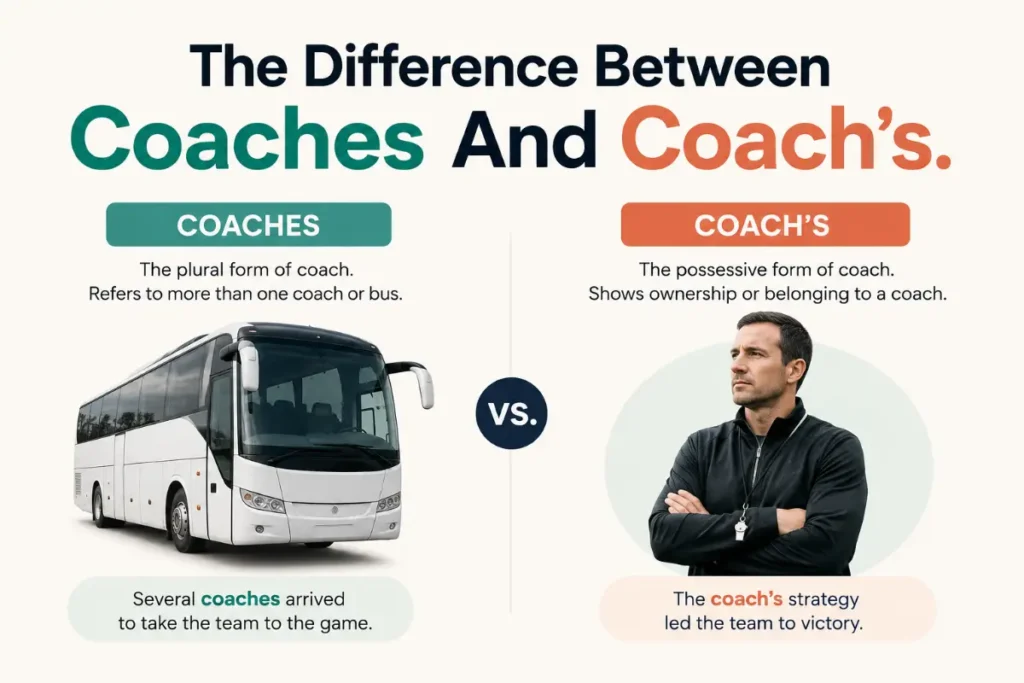
The Difference Between Coaches And Coach’s
Another spelling can create confusion here.
Coaches and coach’s don’t mean the same thing.
Coaches can be a plural noun or a verb.
Coach’s is usually a possessive form.
Example.
The coach’s office is upstairs.
Here coach’s means the office belongs to the coach.
Compare these sentences.
The coaches are in the office.
The coach’s office is upstairs.
The first sentence refers to several coaches.
The second sentence refers to one coach and something belonging to that coach.
This distinction is important in formal writing because apostrophes can completely change meaning.
The Difference Between Coaches And Coaches’.
There is also a plural possessive form.
Coaches’ means something belongs to multiple coaches.
Example.
The coaches’ meeting begins at noon.
The meeting belongs to or is associated with several coaches.
Compare the three forms.
Coach means one coach.
Coaches means more than one coach or trains someone.
Coach’s usually means belonging to one coach.
Coaches’ usually means belonging to multiple coaches.
Learning these forms gives you much more control over your writing.
A Simple Grammar Test.
When you see coaches in a sentence, ask what job it is doing.
If it refers to several people, it’s a plural noun.
Example.
The coaches arrived early.
If it describes what one person does, it’s a verb.
Example.
She coaches the team.
If you see an apostrophe, you’re dealing with possession.
Example.
The coach’s whistle was loud.
Or.
The coaches’ meeting lasted an hour.
This small test can prevent several common grammar errors.
Coaches In Different Grammar Contexts.
The spelling coaches becomes easier to understand once you see how it behaves in different sentence structures. It can function as a plural noun or as a present tense verb. The surrounding words tell you which meaning applies.
Coaches As A Plural Noun.
When coaches refers to two or more people it acts as a plural noun.
Examples.
- The coaches are planning tomorrow’s practice.
- Three coaches attended the meeting.
- The coaches discussed the players’ performance.
- Our coaches expect everyone to arrive on time.
Because coaches is plural here it normally takes a plural verb.
Correct.
The coaches are ready.
Incorrect.
The coaches is ready.
This is a common agreement mistake. The plural noun coaches needs the plural form are.
Coaches As A Verb.
When coaches describes an action it acts as a verb.
Examples.
- She coaches the school team.
- He coaches new employees.
- My sister coaches young swimmers.
- The instructor coaches students through difficult presentations.
Here the subject is singular. That is why the verb takes the es ending.
Compare these forms.
I coach the team.
You coach the team.
We coach the team.
They coach the team.
He coaches the team.
She coaches the team.
The pattern is simple. The base verb is coach. With he, she, or it, the present tense becomes coaches.
Coach Coaches And Coached.
Understanding the main verb forms can prevent spelling and grammar mistakes.
Present Tense.
The base form is coach.
Examples.
I coach soccer.
They coach students.
The third person singular form is coaches.
Examples.
She coaches soccer.
He coaches students.
Past Tense.
The past tense is coached.
Examples.
- She coached the team last year.
- He coached several athletes during college.
- They coached the players throughout the season.
Notice that the spelling changes again.
Coach.
Coaches.
Coached.
Coaching.
These forms serve different grammatical purposes.
Present Participle.
The ing form is coaching.
Examples.
- She is coaching the team today.
- He enjoys coaching young athletes.
- They are coaching employees on communication skills.
The word coaching can function as part of a verb phrase or as a noun depending on the sentence.
Coaches In Possessive Forms.
Possessives often cause trouble because they introduce apostrophes.
The correct form depends on the number of coaches and what belongs to them.
One Coach.
Use coach’s for something belonging to one coach.
Example.
The coach’s office is locked.
The coach’s decision surprised everyone.
Multiple Coaches.
Use coaches’ when something belongs to multiple coaches.
Example.
The coaches’ meeting starts at six.
The coaches’ opinions differed on the issue.
Multiple Coaches Without Possession.
Use coaches when you simply mean more than one coach.
Example.
The coaches arrived early.
Don’t add an apostrophe unless you’re showing possession.
Incorrect.
The coaches’ arrived early.
Correct.
The coaches arrived early.
This distinction is especially important in professional writing and school assignments.
You may also want to read Using or Useing Which Spelling Is Correct.
Coaches In Formal Writing.
Coaches is completely acceptable in formal English.
You can use it in academic writing, journalism, reports, workplace documents, school communication, and professional publications.
Examples.
- The coaches evaluated each participant using the same criteria.
- Several coaches participated in the research project.
- The coaches reported improvements in athlete performance.
- Professional coaches often use structured feedback to support development.
When the word appears in a formal sentence, focus on its grammatical role rather than avoiding it because it sounds conversational.
Coaches In Informal Writing.
The word is equally common in casual English.
Examples include.
- Our coaches are awesome.
- The coaches really helped us this season.
- Those coaches know their stuff.
- The coaches gave us some great advice.
The spelling doesn’t change between formal and informal English. Only the surrounding language and tone change.
Common Mistakes With Coaches.
A few errors appear repeatedly in student writing, workplace documents, and online posts.
Writing Coachs.
Incorrect.
The coachs met after the game.
Correct.
The coaches met after the game.
The problem comes from adding s directly to coach. The standard plural requires es.
Writing Coachs As A Verb.
Incorrect.
She coachs the team.
Correct.
She coaches the team.
The third person singular form of coach is coaches.
Using Coaches With A Singular Verb.
Incorrect.
The coaches is ready.
Correct.
The coaches are ready.
A plural subject requires a plural verb.
Confusing Coaches And Coach’s.
Incorrect.
The coaches office is upstairs.
Correct.
The coach’s office is upstairs.
The apostrophe shows possession.
Confusing Coaches And Coaches’.
Incorrect.
The coaches meeting starts at noon.
Correct.
The coaches’ meeting starts at noon.
The apostrophe comes after the s because several coaches are involved.
Why Coach Becomes Coaches.
English spelling can seem inconsistent until you notice the sound patterns underneath it.
The word coach ends in the letters ch. In this word the letters represent the /tʃ/ sound.
English commonly uses es to form plurals after words ending in sounds such as /tʃ/.
Compare these examples.
- Coach becomes coaches.
- Watch becomes watches.
- Match becomes matches.
- Church becomes churches.
- Beach becomes beaches.
- Branch becomes branches.
The same general spelling pattern explains all of them.
This doesn’t mean every English plural follows one universal rule. English has many historical spelling patterns. Still, learning common groups makes spelling much easier.
Does Coach Always Take Es.
For the plural noun coach, yes. The standard plural is coaches.
For the verb coach, the third person singular present form is also coaches.
Examples.
The coaches are here.
She coaches the team.
So you don’t need to decide between coachs and coaches based on the meaning. Coaches is the correct spelling in both cases.
The meaning comes from grammar and context.
Coaches In Different Fields.
The word coach has expanded far beyond sports. That broader meaning explains why coaches appears in many types of writing.
Sports Coaches.
Sports coaches train athletes and teams.
Examples include basketball coaches, football coaches, soccer coaches, tennis coaches, swimming coaches, and track coaches.
Example.
The coaches created a detailed training plan.
Career Coaches.
Career coaches help people make decisions about jobs, skills, interviews, and professional goals.
Example.
Career coaches often help clients prepare for interviews.
Life Coaches.
Life coaches typically help clients work toward personal goals and changes.
Example.
Some life coaches focus on habits and goal setting.
Business Coaches.
Business coaches work with business owners, managers, or teams.
Example.
The business coaches helped the company improve its leadership process.
Academic Coaches.
Academic coaches may help students develop study habits, organization skills, and learning strategies.
Example.
The academic coaches met with students before exams.
The spelling stays exactly the same in every field.
Real Life Examples Of Coaches In Professional Writing.
Here are additional examples showing how the word works in different settings.
Workplace Communication.
- The coaches will meet with department leaders on Friday.
- Our executive coaches provided detailed feedback.
- The coaches created a development plan for new managers.
Academic Writing.
- Researchers interviewed coaches about athlete motivation.
- The study examined how coaches influence team communication.
- Several coaches participated in the training program.
Journalism.
- Coaches praised the team’s defensive effort after the game.
- Several coaches questioned the decision during the press conference.
- The coaches agreed that the players had improved.
Email Writing.
- The coaches will send the updated schedule this afternoon.
- Please contact the coaches if you have questions about practice.
- The coaches’ meeting has been moved to Thursday.
Social Media.
- Our coaches believed in us from day one.
- Great coaches don’t just teach skills. They build confidence.
- The coaches deserve credit for the team’s progress.
Everyday Speech.
- The coaches are waiting outside.
- Two coaches helped us today.
- Our coaches gave us some useful advice.
- Those coaches work incredibly hard.
- The coaches want everyone back by five.
Coachs Or Coaches In Digital Writing.
Typing mistakes become more common online because people often write quickly and rely on memory.
A person may type coachs because the basic plural rule feels automatic. Spell check can catch some instances but shouldn’t be your only line of defense.
If you’re writing a website, email, article, school assignment, or professional document, coaches is the form to use.
Search engines may still return pages containing coachs because web pages can contain spelling mistakes, user generated content, or poorly edited text. Seeing an incorrect spelling online doesn’t make it an accepted English form.
This is an important lesson for English learners. Frequency on the internet isn’t proof of grammatical correctness.
Is Coachs Ever Correct.
In standard English, coachs isn’t the correct spelling of the plural noun coach or the third person singular verb coach.
You might encounter the string coachs in usernames, file names, brand names, product labels, search queries, or unedited online content. Those uses don’t change the standard spelling.
For normal English writing, use coaches.
Memory Tricks For Coaches.
A good memory trick should be quick enough to use while writing.
Remember The Ch Ending.
Think of coach as belonging to the same spelling family as watch and match.
Watch becomes watches.
Match becomes matches.
Coach becomes coaches.
Remember The Extra Syllable.
Say the two forms aloud.
Coach.
Coaches.
The plural has an extra syllable.
That sound can remind you that the spelling also needs the extra es.
Use The Formula.
Coach + es = coaches.
That’s the easiest formula to memorize.
Don’t use.
Coach + s = coachs.
The first formula is the standard English form.
Related Words.
Understanding related vocabulary can help reinforce the spelling.
Words Related To Coach.
- Coaching.
- Coached.
- Coachable.
- Coachwork.
- Trainer.
- Mentor.
- Instructor.
- Adviser.
- Guide.
- Manager.
These words aren’t exact synonyms in every context. A sports coach may train athletes directly while a mentor may provide broader advice and support.
Coaches And Similar Plurals.
The spelling pattern becomes clearer when you compare it with other words.
| Singular | Plural |
|---|---|
| Coach | Coaches |
| Watch | Watches |
| Match | Matches |
| Church | Churches |
| Branch | Branches |
| Dish | Dishes |
| Box | Boxes |
| Bus | Buses |
| Class | Classes |
These examples show why adding s isn’t always enough to make a plural noun.
English spelling reflects both letters and sounds. Learning common patterns is more useful than memorizing every word separately.
Expert Editor’s Note.
A professional editor would mark coachs as an error in standard English and replace it with coaches.
The reason is straightforward. Coach forms its plural with es, and its third person singular present tense also uses es.
The most important editorial point is consistency. Once you’ve chosen the correct form, check related forms in the same document.
For example, a sports article might contain all of these forms.
The coach spoke to the team.
The coaches spoke to the players.
The coach’s office was closed.
The coaches’ meeting lasted two hours.
She coaches the junior team.
Each form has a different grammatical function.
A good editor doesn’t just correct spelling. They check the role the word plays in the sentence. That’s especially important with words such as coaches because the same spelling can function as both a noun and a verb.
A Quick Editing Test.
When proofreading, search for coachs.
If you find it, replace it with coaches unless you’re dealing with a special name or identifier that intentionally uses nonstandard spelling.
Then check for apostrophes.
Ask.
Is this one coach owning something?
Use coach’s.
Are several coaches associated with something?
Use coaches’.
Are you simply talking about several coaches?
Use coaches.
Is the word describing what one person does?
Use coaches.
That four part check catches nearly every common error involving this word.
The Most Important Difference To Remember.
There isn’t a genuine spelling choice between coachs and coaches in standard English.
Coaches is the correct form.
The real grammar question is what coaches means in your sentence.
It can mean several coaches.
The coaches arrived.
Or it can describe an action.
She coaches the team.
That makes coaches a useful word with two grammatical roles rather than a confusing spelling variation.
Coaches Or Coachs Final Guide.
Common Questions About Coaches.
Is Coachs A Correct Spelling.
No. Coachs isn’t the standard English spelling. The correct form is coaches. Use coaches when you mean more than one coach and also when coach is used as a third person singular present tense verb. For example, The coaches arrived early and She coaches the team are both correct.
Why Is Coaches Spelled With Es.
The word coach ends with the ch spelling pattern. English commonly forms plurals of words ending in this sound by adding es. That’s why coach becomes coaches. The same pattern appears in words such as watch and match. You can remember the pattern as coach plus es equals coaches.
What Is The Plural Of Coach.
The plural of coach is coaches. Never use coachs in standard English. For example, The coaches met before the game is correct. The extra es also creates an additional syllable in pronunciation, so coach has one syllable while coaches has two.
Is Coaches A Noun Or A Verb.
Coaches can be either a plural noun or a verb. As a noun, it refers to two or more coaches. As a verb, it is the third person singular present form of coach. For example, The coaches arrived uses a noun, while She coaches athletes uses a verb.
What Is The Difference Between Coaches And Coach’s.
Coaches means more than one coach or describes what one person does. Coach’s is normally the possessive form of the singular noun coach. For example, The coaches arrived refers to several coaches, while The coach’s office is closed means the office belongs to one coach.
What Is The Difference Between Coaches And Coaches’.
Coaches refers to several coaches without showing possession. Coaches’ shows that something belongs to or is associated with several coaches. For example, The coaches arrived uses the plural noun, while The coaches’ meeting starts at noon uses the plural possessive form.
How Do You Pronounce Coaches.
In American English, coaches is commonly pronounced /ˈkoʊtʃɪz/. It has two syllables and the main stress falls on the first syllable. The second syllable sounds similar to iz. Say it as COACH iz rather than treating the final letters as a single /s/ sound.
For another common grammar confusion, see Spicey Vs Spicy Which Spelling Is Correct 2026 Guide.
Conclusion.
The answer to coachs or coaches is clear. Coaches is the correct spelling in standard English. Coachs is an incorrect plural and an incorrect third person singular verb form.
The reason is a simple English spelling pattern. Words ending in the ch sound often take es when forming their plural or third person singular present form. So you write coach, coaches, coached, and coaching.
Remember the most useful rule.
Coach plus es equals coaches.
Also pay attention to the apostrophe. Coaches means several coaches or the verb coaches. Coach’s normally shows possession by one coach. Coaches’ shows possession or association involving several coaches.
If you’re proofreading an article, email, school assignment, sports report, or business document, replace coachs with coaches.
Once you remember the ch plus es pattern, this spelling becomes one less English trap to worry about.
Correct spelling brings clarity. Coaches is the form that keeps your writing on the right track.

Editorial Reviewer & Proofreader
Grace Mitchell reviews Gramlify’s articles for clarity, consistency, and readability. She is passionate about creating accurate, approachable content that helps English learners build confidence.