
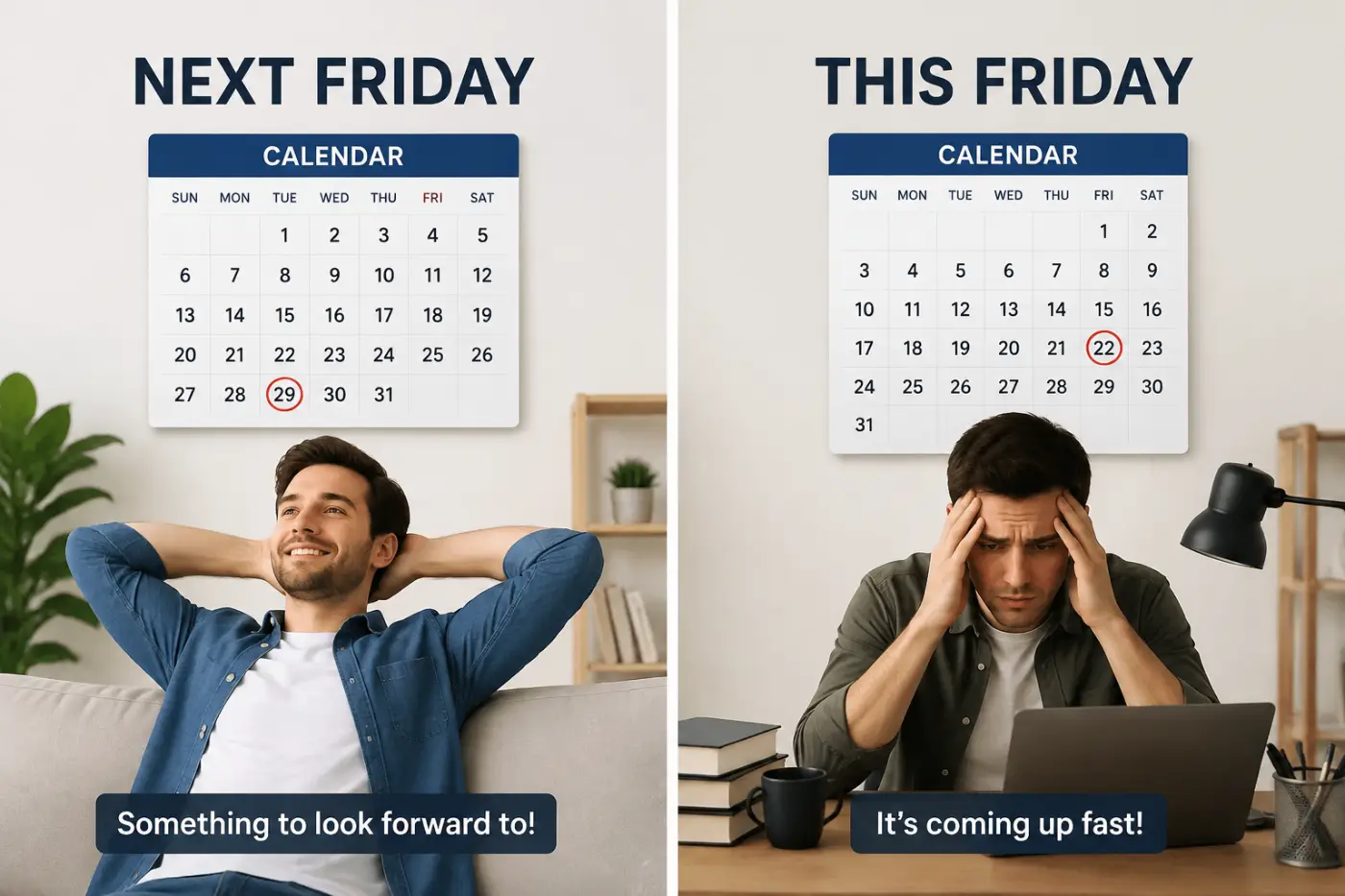
If you’ve ever said next Friday vs this Friday and then wondered if the other person understood the same date you meant you’re not alone. These two expressions look simple but they can create real confusion in everyday English. The problem isn’t grammar alone. The bigger issue is that people use these phrases from different points of view.
This Friday usually refers to the Friday that is closest to the present moment. Next Friday often refers to the Friday after the upcoming Friday. However people also use next Friday to mean the upcoming Friday. That difference can turn a simple meeting plan into a scheduling mistake.
English doesn’t provide one universal rule that forces every speaker to use next Friday in exactly the same way. Context matters. The safest approach is to understand the common meanings and use the actual date when precision matters.
This guide explains the difference between this Friday and next Friday in everyday American English. You’ll learn how native speakers use them how calendars affect the meaning why people disagree about the phrases and how to avoid confusion in texts emails meetings and plans.
You may also want to read Implicit Vs Complicit Differences Meanings And Correct 2026.
Quick Answer
This Friday usually means the Friday coming up within the current week. Next Friday can mean the Friday after this coming Friday. However many American English speakers also use next Friday for the upcoming Friday. If the date matters use the exact date to remove all doubt.
Next Friday Vs This Friday Comparison
| Expression | Common meaning | Typical use | Example |
|---|---|---|---|
| This Friday | The upcoming Friday in the current week | Casual plans and conversations | Let’s meet this Friday. |
| Next Friday | Often the Friday after the upcoming Friday | Future plans | Let’s meet next Friday. |
| Next Friday | Sometimes the upcoming Friday | Informal American English | I’ll call you next Friday. |
| Friday | A Friday without a relative time word | General reference | The event is on Friday. |
| This coming Friday | The upcoming Friday | Clearer scheduling | I’ll see you this coming Friday. |
| The Friday after next | The second Friday from now | Very specific future reference | The appointment is the Friday after next. |
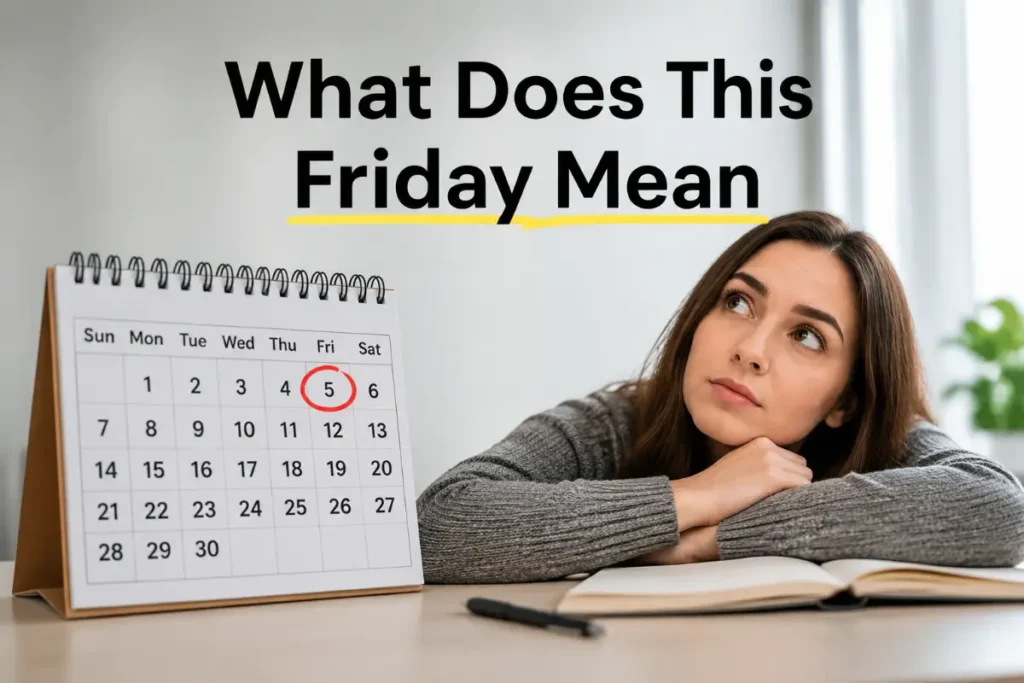
What Does This Friday Mean
This Friday normally points to the Friday that belongs to the current week or the Friday immediately ahead.
For example if today is Monday and you say:
I’ll see you this Friday.
Most listeners will understand that you mean the Friday only a few days away.
The expression contains two important ideas. This connects the day to the current time period and Friday identifies the specific day of the week.
Examples Of This Friday
- We have a meeting this Friday.
- I’m flying home this Friday.
- The movie comes out this Friday.
- Can you finish the report this Friday.
- We’re having dinner this Friday.
- I’ll send the documents this Friday.
In each example the speaker normally means the nearest Friday within the current week.
What Does Next Friday Mean
Next Friday refers to a Friday in the future. The difficulty comes from the fact that English speakers don’t always use it in the same way.
One common interpretation is the Friday after the upcoming Friday.
For example if today is Monday and the upcoming Friday is August 28 then next Friday may mean September 4.
Another common interpretation treats next Friday as the upcoming Friday itself. Under this interpretation someone speaking on Monday could use next Friday to mean August 28.
Both patterns appear in natural English.
That’s why the phrase can cause confusion even among native speakers.
Which One Is Correct
Both this Friday and next Friday are grammatically correct.
The issue isn’t correct spelling or incorrect grammar. The issue is reference.
If you want to refer to the Friday coming up during the current week this Friday is usually the clearest choice.
If you mean the Friday after that next Friday is often understood correctly.
The trouble begins when the speaker uses next Friday for the upcoming Friday and the listener understands it as the following Friday.
For important plans don’t depend on the listener guessing your intention.
Instead of saying:
Let’s meet next Friday.
Say:
Let’s meet Friday August 28.
That small change removes the ambiguity completely.
Why People Confuse Next Friday And This Friday
The confusion comes from the way English handles relative time expressions.
The Word Next Has Flexible Meaning
The word next can mean the first item after the current one.
For example:
Next week can mean the week immediately after the current week.
But in everyday conversation people sometimes use next Friday to mean the next Friday they will encounter on the calendar.
This creates two competing interpretations.
This Focuses On The Current Period
The word this often connects something to the current period.
Consider these examples.
This week means the week we are currently in.
This month means the current month.
This Friday normally connects Friday to that current week.
That makes this Friday more predictable than next Friday.
Next Can Point Beyond The Current Period
The word next usually points forward.
Next week means the week after the current week.
Next month means the month after the current month.
Because of this pattern many speakers naturally interpret next Friday as the Friday belonging to the following week.
At the same time casual speech doesn’t always follow that strict calendar logic.
The Calendar Changes The Meaning
The day you say the phrase can affect how people understand it.
Imagine today is Monday.
The upcoming Friday is only four days away.
If you say:
I’ll call you this Friday.
The meaning is clear. You’re almost certainly referring to the Friday later that week.
Now consider:
I’ll call you next Friday.
Some people hear the upcoming Friday. Others hear the Friday one week later.
Now imagine today is Saturday.
The phrase this Friday can become less natural because the Friday in the current calendar week has already passed.
In that situation next Friday will usually point to the upcoming Friday.
This is one reason context matters so much.
Next Friday or This Friday In American English
American English doesn’t have a strict rule that guarantees everyone will interpret these expressions identically.
In ordinary conversation this Friday is generally a strong choice for the upcoming Friday.
Next Friday has two common interpretations.
- The Friday after the upcoming Friday.
- The upcoming Friday.
The first interpretation follows the idea that next means the period after the current one.
The second interpretation treats next as meaning the next occurrence of Friday.
Neither interpretation should be treated as a simple spelling or grammar error.
From an editor’s perspective the important question isn’t only Is this sentence grammatical. The better question is Will the reader know exactly which date I mean.
That’s the standard that matters in practical communication.
Is This Friday More Clear Than Next Friday
Usually yes.
If you’re talking about the Friday that is coming up during the current week this Friday is often less ambiguous.
Compare these examples.
Let’s have lunch this Friday.
This normally sounds like the coming Friday.
Let’s have lunch next Friday.
The listener may ask which Friday you mean.
For casual plans that difference may not matter. For appointments travel work deadlines and medical or financial matters it can matter a lot.
A good communication habit is to use this Friday for the immediate Friday and provide the date whenever the plan has real consequences.
This Friday In Everyday Conversation
People commonly use this Friday when talking about plans that are already close.
Social Plans
We’re going to the concert this Friday.
Family Plans
My parents are visiting this Friday.
School
The assignment is due this Friday.
Work
The team meeting is this Friday.
Travel
My flight leaves this Friday morning.
The phrase works naturally because the listener can usually connect Friday with the current week.
Next Friday In Everyday Conversation
People use next Friday when talking about a future Friday that isn’t necessarily part of the current week.
Examples include:
- The interview is next Friday.
- I’ll finish the project next Friday.
- We’re moving next Friday.
- Can we talk next Friday.
- The new class starts next Friday.
These sentences are grammatically natural.
The only problem is that the exact date may remain unclear.
This Friday or Next Friday In Workplace Communication
Workplace communication deserves extra care because unclear dates can create missed deadlines and scheduling problems.
Suppose a manager writes:
Please send the report next Friday.
One employee may schedule the deadline for the upcoming Friday. Another may schedule it for the Friday after that.
A clearer version is:
Please send the report by Friday August 28.
Another useful option is:
Please send the report by this Friday August 28.
The date provides the real anchor. The relative phrase simply makes the sentence sound natural.
For formal communication this is one of the best editorial habits you can develop.
This Friday Vs Next Friday In Text Messages
Text messages are more flexible because people often share context.
For example:
Are we still meeting this Friday.
The other person may already know the date from an earlier conversation.
But if you haven’t discussed the plan before it’s safer to write:
Are we still meeting Friday August 28.
You don’t need a long explanation. A date does the job in seconds.
A Simple Rule To Remember
Use this practical rule.
This Friday usually means the Friday coming up in the current week.
Next Friday may mean the Friday after that or the upcoming Friday depending on the speaker.
When precision matters use the date.
That rule is more useful than trying to memorize a rigid grammar formula that native speakers don’t consistently follow.
Next Friday or This Friday Across Different Days
The meaning becomes easier to understand when you place the expressions on an actual calendar. The same phrase can feel clearer or less clear depending on the day you say it.
If Today Is Monday
Suppose today is Monday August 24.
The upcoming Friday is August 28.
This Friday normally means August 28.
Next Friday could mean August 28 or September 4 depending on the speaker.
For clear communication you could say:
Let’s meet this Friday August 28.
If Today Is Wednesday
Suppose today is Wednesday August 26.
This Friday strongly suggests August 28.
Next Friday may still create two possible interpretations.
If you mean September 4 then say:
Let’s meet Friday September 4.
If Today Is Friday
This situation gets more interesting.
If today is Friday August 28 and someone says:
I’ll see you next Friday.
Most listeners will probably understand September 4 because today’s Friday has already arrived.
However if someone says:
I’ll see you this Friday.
The meaning could be August 28 if the plan is happening later that same day.
Context and the time of the conversation can matter.
If Today Is Saturday
Suppose today is Saturday August 29.
The Friday that just passed was August 28.
The upcoming Friday is September 4.
In this situation next Friday will usually mean September 4.
The phrase this Friday can also refer to September 4 in casual conversation because it is the next Friday within the current conversational period. This shows why the expressions aren’t governed by one perfectly rigid rule.
The Difference Between This Friday And The Next Friday
There is an important distinction between this Friday and the next Friday.
This Friday connects Friday to the current week or current time frame.
The next Friday usually identifies the first Friday that occurs after a particular reference point.
Consider this sentence:
Today is Tuesday. The next Friday is August 28.
Here the next Friday clearly means the first Friday after Tuesday.
But next Friday in ordinary conversation can behave differently because speakers use it as a relative time phrase.
This small difference in wording can help explain why dictionaries and grammar guides may describe the expressions differently from how people actually use them.
This Friday And Next Friday In Formal Writing
Formal writing needs more precision than casual conversation.
If you’re writing an academic paper a contract business email appointment notice or official document avoid relying on next Friday when the exact date matters.
Instead use the full date.
For example:
The application deadline is Friday August 28 2026.
This sentence leaves no room for interpretation.
You can also write:
The application deadline is August 28 2026.
For formal documents the date itself should carry the meaning.
Is Next Friday Ambiguous
Yes. Next Friday can be ambiguous.
This doesn’t mean the phrase is wrong.
It means two reasonable listeners can interpret it differently.
Imagine one person says:
Can you come next Friday.
The listener might think of the upcoming Friday.
The speaker might mean the Friday after it.
Both people can understand the sentence perfectly while still choosing different dates.
That’s the heart of the problem.
The grammar is fine. The reference is unclear.
How To Make Next Friday Clear
If you want to use next Friday but want to avoid confusion add the date.
For example:
I’ll call you next Friday September 4.
Or simply:
I’ll call you September 4.
You can also add a phrase that identifies the week.
I’ll call you next Friday which is September 4.
In a casual text that’s usually more explanation than you need. A simple date works better.
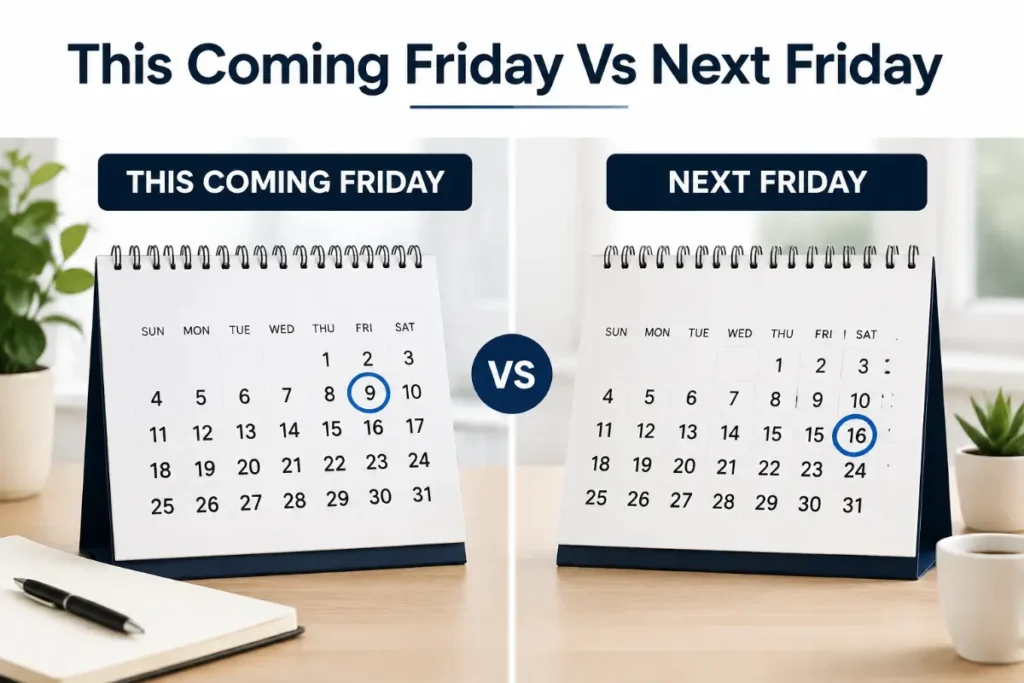
This Coming Friday or Next Friday
This coming Friday is often useful when you mean the upcoming Friday and want to make your intention clear.
For example:
I’ll send the report this coming Friday.
If today is Monday Wednesday or Thursday the phrase strongly points toward the Friday immediately ahead.
Still the clearest option for an important deadline is the actual date.
Compare:
Please submit the form this coming Friday.
with:
Please submit the form by Friday August 28.
The second sentence is more precise.
Is This Coming Friday Better
For casual speech this coming Friday can be clearer than next Friday.
It tells the listener you’re looking ahead to the Friday that is coming.
However it doesn’t solve every possible calendar issue. If the message involves travel appointments payments deadlines or legal matters use the date.
The Friday After Next
English also has the phrase the Friday after next.
This usually refers to the Friday after the upcoming Friday.
Suppose today is Monday August 24.
Upcoming Friday is August 28.
The Friday after next is September 4.
This expression can be useful in conversation but it still depends on the speaker’s reference point.
For maximum clarity say:
Friday September 4.
That is shorter and more precise.
Next Friday Vs Friday Next Week
The phrases next Friday and Friday next week often point toward the same date but they aren’t equally natural in every sentence.
Consider:
I’ll see you next Friday.
This sounds completely natural.
I’ll see you Friday next week.
This is understandable but can sound less natural in American English.
A more natural version is:
I’ll see you next Friday.
Or if clarity matters:
I’ll see you Friday next week on September 4.
In everyday American English speakers usually prefer simple time expressions.
Next Friday Vs This Friday In American English
American speakers commonly use both expressions. The important difference is that this Friday tends to be easier to interpret.
When Americans say:
Let’s meet this Friday.
They usually mean the upcoming Friday connected to the current week.
When they say:
Let’s meet next Friday.
The meaning can depend on personal speaking habits.
Some speakers mean the upcoming Friday.
Others mean the Friday after the upcoming Friday.
That variation is normal enough that careful writers should not assume everyone shares the same interpretation.
For another common grammar confusion, see Fair Vs Good Which Word Should You Use 2026.
What Dictionaries And Editors Focus On
Dictionaries generally describe relative time words according to established meanings. Actual conversation can still be more flexible.
Professional editors care about something slightly different.
They ask if the reader can understand the intended date without guessing.
That’s why experienced writers often replace ambiguous time phrases with exact dates.
This principle applies beyond Friday.
Consider:
I’ll finish it next week.
That can be perfectly clear in a casual conversation.
But if a contract says:
Payment must arrive next week.
the lack of a specific date could create a problem.
Relative expressions work best when the context is obvious.
Real Life Examples You Can Copy
These examples show how the phrases work naturally.
Daily Conversation
- Are you free this Friday.
- We’re going to the beach this Friday.
- I’ll see you this Friday after work.
- Can we move dinner to next Friday.
- I’m visiting my parents next Friday.
Workplace
- The meeting is this Friday at 10 a.m.
- I’ll have the report ready this Friday.
- Can we schedule the interview for next Friday.
- The manager will review the proposal next Friday.
- Please send me the final version by Friday August 28.
Text Messages
- Are we still on for this Friday.
- Want to grab coffee this Friday.
- I can’t make it this Friday. Can we do next Friday instead.
- I’ll send you the details next Friday.
- I’m writing to confirm our meeting this Friday.
- Please let me know if next Friday works for you.
- The deadline has been moved to Friday September 4.
Academic And Professional Writing
- The final presentation will take place on Friday August 28.
- Students must submit their projects by Friday September 4.
- The committee will meet next Friday to discuss the proposal.
Notice how formal examples often use the exact date. That isn’t because next Friday is grammatically wrong. It’s because precision matters more in formal communication.
Common Mistakes With Next Friday And This Friday
Mistake One
I’ll see you next Friday.
The speaker means the upcoming Friday but the listener thinks they mean the following Friday.
Better:
I’ll see you this Friday.
Or give the date.
Mistake Two
The deadline is next Friday.
The reader doesn’t know which Friday the writer means.
Better:
The deadline is Friday August 28.
Mistake Three
Assuming next Friday always means the Friday after this Friday.
That interpretation is common but not universal.
Mistake Four
Assuming next Friday always means the upcoming Friday.
Some speakers use it that way but others don’t.
Mistake Five
Correcting someone by saying their use of next Friday is grammatically wrong.
Usually the problem isn’t grammar. It’s ambiguity.
An editor should distinguish between an actual language error and a phrase that can have more than one interpretation.
A Useful Scheduling Rule
When you’re arranging something important use three levels of clarity.
Casual.
Let’s meet this Friday.
Clearer.
Let’s meet this Friday August 28.
Most precise.
Let’s meet Friday August 28 at 2 p.m. Eastern Time.
The more important the appointment the more information you should include.
Memory Trick For This Friday And Next Friday
Use this simple mental picture.
This points to the current calendar box.
Next points forward.
If you’re talking about the Friday sitting inside the current week use this Friday.
If you’re talking about a later Friday use next Friday but consider adding the date because people interpret the phrase differently.
An even easier rule is:
If a missed date would cause a problem use the date.
That one rule works at work at school while traveling and when making appointments.
Related Time Expressions
Understanding these phrases can help you handle similar expressions.
This Week
Usually means the current calendar week.
Next Week
Usually means the week after the current week.
This Month
Usually means the current month.
Next Month
Usually means the following month.
This Weekend
Usually means the upcoming weekend.
Next Weekend
Can mean the upcoming weekend or the weekend after it depending on context and speaker habits.
The same ambiguity that appears with next Friday can appear with other relative time expressions.
Expert Editor’s Note
If I were editing a message for a client or workplace I’d keep this Friday when it clearly means the upcoming Friday.
I’d be more careful with next Friday.
The phrase is grammatically correct and completely normal in English. The concern is clarity rather than correctness.
For casual conversation a little ambiguity may not matter. For appointments deadlines travel arrangements legal documents school schedules and financial matters it does.
The strongest professional habit is simple.
Use relative time expressions when the context is obvious. Use exact dates when the date matters.
That approach respects how people actually speak while protecting the reader from unnecessary confusion.
Common Questions About Next Friday And This Friday
Does Next Friday Mean The Friday After This Friday
Not always. Many speakers use next Friday to mean the Friday after the upcoming Friday. Others use it to mean the upcoming Friday itself. This difference is common in everyday English. If you need to make the date completely clear then use the calendar date instead.
Is This Friday The Same As This Coming Friday
Usually yes. This Friday and this coming Friday commonly refer to the Friday that is approaching within the current week. The longer expression can add clarity in casual conversation. For important plans you can still include the exact date so nobody has to guess.
Which Is Better For The Upcoming Friday
This Friday is usually the safer choice when you mean the upcoming Friday during the current week. It creates less confusion than next Friday because speakers don’t always agree on what next means in this context.
Can Next Friday Mean This Friday
Yes. In everyday American English some people use next Friday to mean the upcoming Friday. Others use it for the Friday after the upcoming Friday. This variation explains why the phrase can cause scheduling confusion.
What Does The Friday After Next Mean
The Friday after next generally refers to the Friday after the next upcoming Friday. For example if today is Monday and the upcoming Friday is August 28 then the Friday after next would normally be September 4. Still an exact date is clearer for important plans.
Should I Use A Date Instead Of Next Friday
Use an exact date when missing the appointment or deadline could cause a problem. A sentence such as Please send the report by Friday August 28 is clearer than Please send the report by next Friday because everyone sees the same date.
Is Next Friday Grammatically Correct
Yes. Next Friday is grammatically correct English. The issue is not grammar. The problem comes from its possible interpretation. Different speakers can attach the phrase to different Fridays so adding the date can make your meaning precise.
Does This Friday Always Mean The Upcoming Friday
Usually it does when the current week still contains Friday. However context can affect how people interpret relative time expressions. If today is already Saturday or Sunday then this Friday may become less clear because the Friday in the current week has passed.
Next Friday Vs This Friday In Different Situations
The best choice depends on the situation.
| Situation | Best choice | Reason |
|---|---|---|
| Casual plan for the upcoming Friday | This Friday | Usually clear |
| Important work deadline | Exact date | Removes ambiguity |
| Appointment | Exact date and time | Prevents scheduling mistakes |
| Casual future plan | Next Friday | Natural but can be unclear |
| Formal email | Exact date | Professional and precise |
| Text with shared context | This Friday | Usually easy to understand |
| Travel booking | Exact date | Essential for accuracy |
| Academic deadline | Exact date | Leaves no room for confusion |
How Native Speakers Actually Use These Expressions
Language doesn’t always behave like a math equation.
English speakers learn patterns from real conversations. Because of that they sometimes use next Friday based on the next Friday they have in mind rather than a strict calendar calculation.
Imagine a person says:
Are you free next Friday.
They may be thinking about September 4 because that’s the Friday they want to discuss.
Another person hears the same sentence and thinks about August 28 because that’s the next Friday on the calendar.
Neither person is necessarily making a grammar mistake.
They’re using different reference points.
That distinction is important for English learners because grammar books often present rules while real communication depends heavily on context.
How To Avoid Confusion In Conversation
You don’t need to stop using next Friday.
Instead develop the habit of checking the date when plans matter.
If someone says:
Can you meet next Friday.
You can respond:
Do you mean August 28 or September 4.
That question is short natural and completely normal.
You can also confirm the date yourself.
Sure. Friday August 28 works for me.
This method works better than silently assuming what the other person meant.
How To Avoid Confusion In Writing
Writers have an advantage because they can include the exact date.
Instead of:
The meeting will happen next Friday.
Write:
The meeting will happen Friday August 28.
Instead of:
Your payment is due this Friday.
Write:
Your payment is due Friday August 28.
You can still use the relative expression if you want the sentence to sound conversational.
Your payment is due this Friday August 28.
That combination gives the reader both natural language and exact information.
Punctuation With Friday Expressions
There is no special punctuation rule for this Friday or next Friday.
Both phrases normally appear without commas.
Examples:
I’ll see you this Friday.
We’re meeting next Friday.
When you add the date you still don’t need a comma in ordinary American date style.
The meeting is Friday August 28.
In some formal styles you may see a comma after the weekday.
The meeting is Friday August 28 2026.
Style guides differ on date punctuation. The important point is consistency within the document.
Is Friday A Proper Noun
Yes. Friday is a proper noun because it names a specific day of the week.
It should always begin with a capital letter.
Correct:
I’ll call you this Friday.
Incorrect:
I’ll call you this friday.
The same capitalization rule applies to Monday Tuesday Wednesday Thursday Saturday and Sunday.
Words such as this and next remain lowercase unless they begin the sentence.
Does Next Friday Need A Preposition
Usually no.
You can say:
I’ll see you next Friday.
You don’t need on before next Friday.
The same pattern works with many relative time expressions.
I’ll see you next week.
I’ll call you tomorrow.
We’ll meet this Friday.
Compare that with a specific day.
I’ll see you on Friday.
Both forms are correct but the structure changes.
On Friday Vs This Friday
On Friday simply identifies the day.
This Friday adds a reference to the current time period.
Compare:
I’ll call you on Friday.
This can sound slightly less specific because the listener may need context to know which Friday you mean.
I’ll call you this Friday.
This usually points to the upcoming Friday within the current week.
If the conversation already establishes the date then on Friday may be perfectly clear.
Next Friday Vs The Next Friday
These expressions can sound similar but their grammar differs slightly.
Next Friday works as a fixed relative time phrase.
The next Friday can describe the first Friday after a particular reference point.
For example:
We arrived on Monday and left the next Friday.
Here the next Friday clearly connects to the earlier time reference.
But in casual scheduling:
Let’s meet next Friday.
the phrase functions as a normal future time expression.
The small article the can change how the phrase behaves.
Historical Development Of Relative Time Expressions
Words such as this and next have served as basic time markers in English for centuries.
The underlying idea is simple.
This connects something to the speaker’s current frame of reference.
Next points to something following the current item or period.
English inherited much of this flexible time language from earlier forms of Germanic speech. As English developed speakers continued using short relative expressions because they are efficient in conversation.
The ambiguity around next Friday isn’t a modern internet invention.
Social media may make disagreements more visible but people have long relied on context when using relative time expressions.
British English And Other Varieties
The basic expressions this Friday and next Friday are used across major varieties of English.
British speakers use both.
American speakers use both.
Canadian and Australian speakers use both as well.
The main issue is not regional spelling. It is individual interpretation and context.
You may find different preferences from one person to another even within the same city or country.
That is why telling an English learner that one interpretation is always correct can create more confusion than it solves.
Common Internet Myths
Myth One
Next Friday always means the Friday after this Friday.
Not universally. Many people use it that way but others use it for the upcoming Friday.
Myth Two
Next Friday always means the upcoming Friday.
Again not universally. Many speakers interpret it as the Friday after the upcoming one.
Myth Three
Using Next Friday Is Bad Grammar.
False. The phrase is grammatically correct.
Myth Four
This Friday Is Always Completely Unambiguous.
Usually clearer but not guaranteed in every context. The meaning still depends on when the sentence is spoken and what the conversation already established.
Myth Five
Native Speakers Always Agree About These Phrases.
They don’t. Native speakers can interpret relative time expressions differently.
The Best Choice For English Learners
If you’re learning American English focus on clarity instead of trying to win an argument about which interpretation is correct.
Use:
This Friday for the upcoming Friday when the current week makes the meaning clear.
Use:
Next Friday for a future Friday when context makes the intended date clear.
Use:
Friday plus the exact date when you need certainty.
This approach will serve you well in conversations emails school work travel and professional communication.
Final Practical Rule
Remember these three lines.
This Friday usually points to the upcoming Friday.
Next Friday can point to the upcoming Friday or the Friday after it.
The exact date removes the confusion completely.
That’s the most useful answer to next Friday vs this Friday.
Don’t worry about sounding unnatural because you choose the date. Native speakers use exact dates all the time when schedules matter.
Clear communication beats clever wording every time.
For another common grammar confusion, see Fair vs Good: What’s the Real Difference? (2026).
Conclusion
The difference between next Friday and this Friday isn’t as simple as saying one is correct and the other is wrong.
Both expressions are correct English.
This Friday generally refers to the upcoming Friday in the current week. It is usually the safer choice when you’re talking about the immediate Friday ahead.
Next Friday is more flexible. Some speakers use it for the upcoming Friday while others use it for the Friday after the upcoming Friday. That difference can lead to misunderstandings even between fluent native speakers.
The biggest mistake is assuming everyone uses next Friday according to the same calendar rule.
When the plan is casual and the context is obvious either expression can work. When the date matters use the exact date.
Instead of asking someone to guess what you mean say Friday August 28.
One clear date can save a whole conversation from going sideways.

Senior Grammar Editor
Olivia Reynolds is a grammar editor and language writer who enjoys making complex English rules easy to understand. She specializes in grammar, punctuation, sentence structure, and everyday writing tips, helping readers write with greater confidence and clarity.