

If you’ve searched for steam vs steem because you’re unsure which spelling belongs in a sentence you’re not alone. The two words look almost identical and sound very similar. However the difference is important because steam is a standard English word while steem is not normally used as a modern English word in everyday writing.
Steam can refer to the hot vapor produced by heated water. It can also describe strong energy or anger and it works as both a noun and a verb. Steem is mainly seen as a proper name or in specialized contexts rather than as the standard spelling of the common English word.
The confusion often comes from pronunciation. In most common English accents both forms would sound almost the same. Fast typing can make the problem worse because the letters are next to each other and the incorrect spelling can look convincing.
This guide explains the difference between steam and steem including their meanings pronunciation grammar spelling history real life examples and common mistakes. By the end you’ll know exactly which word to use and why.
A related grammar guide is Dieing Vs Dying Which Spelling Is Correct 2026.
Quick Answer
Steam is the correct spelling for the hot vapor produced by heated water and for related meanings such as energy or momentum. Steem is not the standard spelling of this common English word. If you mean hot water vapor or the related verb use steam.
Steam Vs Steem Comparison
| Feature | Steam | Steem |
|---|---|---|
| Standard English word | Yes | No for the common meaning |
| Main meaning | Water vapor produced by heat | Not the standard spelling of steam |
| Part of speech | Noun and verb | Usually a proper name or specialized term |
| Pronunciation | Usually pronounced like steem | Often pronounced like steam |
| Common use | Everyday English | Specialized or branded contexts |
| Formal writing | Correct | Avoid as a replacement for steam |
| Example | Steam rose from the kettle. | Do not use steem for water vapor. |
The key point is simple. Steam is the ordinary English spelling. Steem should not replace it in normal sentences.
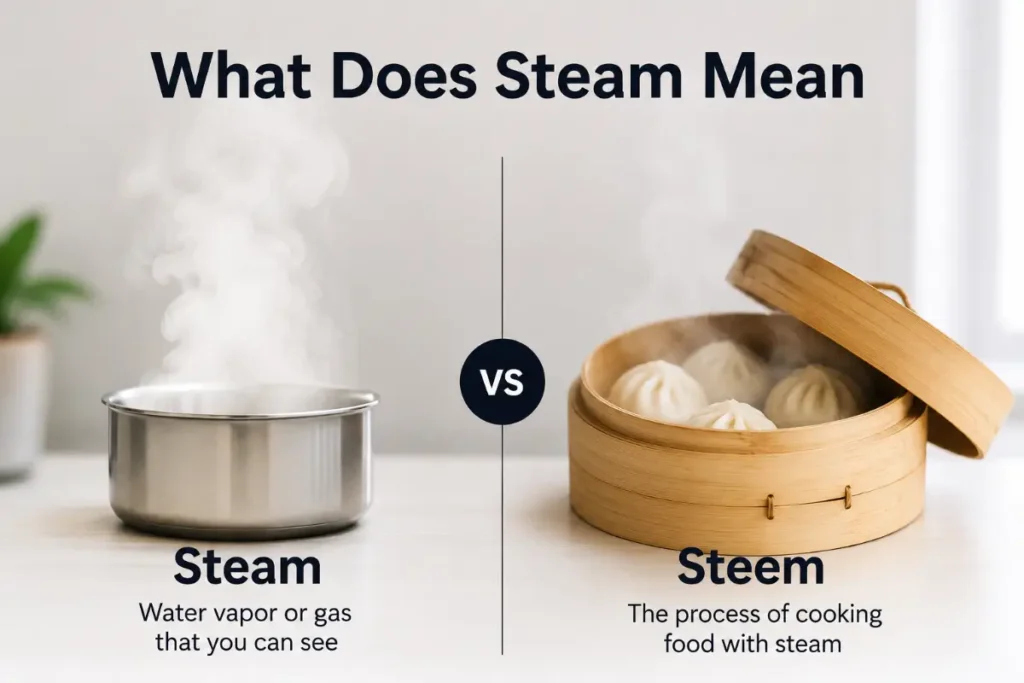
What Does Steam Mean
Steam has several related meanings. The most basic one describes water in a gaseous state that forms when water is heated.
For example:
The steam from the shower filled the bathroom.
The kettle released steam when the water began to boil.
The word also has figurative meanings. Someone can lose steam when they lose energy or motivation. A person can also steam with anger.
Steam As A Noun
As a noun steam refers to vapor produced by heated water. It can also refer to energy momentum or emotional force in figurative expressions.
Examples include:
- Steam covered the kitchen window.
- The train disappeared into a cloud of steam.
- We need more steam to finish the project.
- The team lost steam near the end of the season.
- She was running out of steam after working all afternoon.
Steam As A Verb
Steam can also function as a verb.
It can mean to cook food using hot vapor.
For example:
We steamed the vegetables for five minutes.
It can also mean to produce or release steam.
The pot was steaming on the stove.
In informal English steam can describe moving forcefully or quickly.
The train steamed toward the station.
It can also describe intense anger.
He was steaming after hearing the news.
What Does Steem Mean
Steem is not the standard spelling of the everyday English word for water vapor.
If you’re writing a sentence such as steam rose from the pot then steam is the correct choice.
You may still encounter Steem online because it has been used as a proper name for a blockchain and cryptocurrency related platform and token. In that context the spelling is intentional and should not be changed to steam.
This distinction matters.
A proper name can have a spelling that differs from an ordinary English word. You should preserve the official spelling when referring to a specific organization platform product or brand.
So these two uses are different:
Steam from a kettle.
Steem as a proper name.
If you’re simply talking about hot water vapor then use steam.
Which One Is Correct
For ordinary English writing steam is the correct word.
Use steam when you mean:
- Hot water vapor.
- Cooking with hot vapor.
- Energy or momentum.
- Anger in informal expressions.
- Movement related to steam power.
- A loss of energy or motivation in expressions such as lose steam.
Use Steem only when you’re referring to a specific proper name or specialized term that intentionally uses that spelling.
For example:
Correct: Steam rose from the cup.
Correct: We steamed the vegetables.
Correct: I’m starting to lose steam.
Incorrect: Steem rose from the cup.
The last sentence uses the nonstandard spelling for a common English meaning.
Why People Confuse Steam And Steem
The confusion is easy to understand because English spelling and pronunciation don’t always line up neatly.
They Sound Similar
In common English pronunciation steam sounds like the word steem would naturally sound if someone treated it as a regular English word.
That creates a classic spelling problem. Someone may know the word perfectly when speaking but hesitate when writing it.
The Vowel Pattern Looks Plausible
English contains many words with ee.
Examples include:
- Green.
- Street.
- Sleep.
- Feel.
- Keep.
Because steem follows a familiar spelling pattern it can look reasonable even though it isn’t the standard spelling of the common word.
Fast Typing Causes Errors
When people type quickly they often spell a familiar word according to how it sounds.
Someone might think:
steam → steem.
The mistake is especially easy to make in informal messages where people rarely stop to check spelling.
Social Media Can Reinforce Errors
Online writing spreads unusual spellings quickly. A misspelling can appear in posts comments usernames or captions and then get repeated by other people.
Seeing a word often doesn’t make the spelling correct.
This is one reason experienced editors check unfamiliar spellings against reliable dictionaries rather than trusting search results alone.
Proper Names Add More Confusion
The existence of Steem as a proper name can make the spelling look even more legitimate.
If you’ve encountered Steem online you may naturally wonder if you’ve been spelling steam incorrectly. You haven’t. The ordinary English word remains steam.

Key Differences Between Steam And Steem
The biggest difference is not pronunciation. It’s standard usage.
Meaning
Steam has established English meanings.
Steem does not normally function as the standard spelling of those meanings.
Grammar
Steam can act as both a noun and a verb.
Examples:
The steam is rising.
The vegetables will steam.
Steem does not replace those grammatical forms.
Context
Use steam in everyday English.
Use Steem only when a specific name or specialized reference requires that spelling.
Formality
Steam works in casual conversation academic writing journalism technical writing and professional communication.
Steem should not appear as a substitute for steam in those settings.
Grammar Explanation
Understanding how steam behaves in a sentence helps prevent spelling mistakes.
Steam As A Countable Or Uncountable Noun
In its ordinary physical meaning steam is usually an uncountable noun.
We normally say:
There was steam in the bathroom.
Not:
There were three steams in the bathroom.
When discussing separate clouds or emissions you can use phrases such as clouds of steam or jets of steam.
For example:
Several clouds of steam rose from the machine.
Steam As A Verb
The verb follows normal English verb patterns.
Present:
I steam vegetables.
Past:
I steamed vegetables.
Present participle:
I am steaming vegetables.
Third person singular:
She steams vegetables.
These forms all keep the spelling steam.
Steam In Expressions
English uses steam in several familiar expressions.
Lose steam means to lose energy enthusiasm or momentum.
The campaign started strongly but lost steam.
Run out of steam means to become too tired to continue.
I ran out of steam after three hours of studying.
Full steam ahead means to move forward with great energy or determination.
The team is moving full steam ahead with the new plan.
Blow off steam means to release anger frustration or tension.
I went for a walk to blow off steam.
These expressions use steam not steem.
Spelling Rules For Steam
The spelling steam follows a common English vowel pattern.
It contains the long e sound represented by ea.
You can see a similar pattern in words such as:
- Dream.
- Clean.
- Cream.
- Team.
- Speak.
- Treat.
The pronunciation alone doesn’t tell you the spelling. English has several ways to represent the same vowel sound. That’s why learning the spelling as part of the whole word is more useful than trying to spell only from sound.
Steam And Its Word Forms
The spelling stays consistent across common forms.
Steam.
Steams.
Steamed.
Steaming.
The final e remains part of the base word when appropriate and normal spelling rules apply when endings are added.
Examples:
The engine steamed toward the station.
The chef is steaming the dumplings.
The pipes steamed after the pressure increased.
Many readers also check Transferred Or Transfered Which Spelling Is Correct 2026 Guide.
Pronunciation Guide
Steam
IPA
/stiːm/
Syllables
Steam has one syllable.
Stress Pattern
Because it has only one syllable there is no separate word stress pattern to learn.
The vowel sound is the long ee sound found in words such as team and dream.
Common Pronunciation Mistake
The most common problem isn’t really pronunciation. It’s spelling the sound incorrectly.
A learner may hear /stiːm/ and write steem because the ee spelling appears in many English words.
The safest approach is to remember the whole word:
steam = /stiːm/.
Steam Word Origin
The history of steam goes back a long way.
The modern English word developed from older Germanic forms connected with vapor or mist. English has used related forms for centuries.
The word became especially important during the Industrial Revolution. Steam power transformed transportation manufacturing mining and other industries.
This history also helped create many modern expressions.
For example steam engine became a familiar term during the rise of industrial technology.
The figurative meaning of steam as energy or force developed naturally from the physical idea. A machine powered by steam could move with great force. English speakers eventually began using steam to describe human energy and momentum too.
That gives us expressions such as:
The team is gaining steam.
The project lost steam.
We’re running out of steam.
The language moved from physical power to figurative power.
British And American English
There is no meaningful British American spelling difference between steam and steem.
American English uses steam.
British English uses steam.
Canadian English uses steam.
Australian English uses steam.
The word does not change spelling based on region.
This is useful because some English words do have major regional differences. For example color and colour differ between American and British English. Steam isn’t one of them.
If you see steem used for ordinary water vapor you aren’t looking at an American versus British spelling difference.
You’re looking at a nonstandard spelling or a specific proper name.
Real Life Examples
Seeing the words in context makes the distinction much easier to remember.
Daily Conversation
- Steam rose from my coffee.
- The bathroom was full of steam after my shower.
- Let the soup steam for another minute.
- I need a short break before I completely run out of steam.
- She went for a walk to blow off steam.
- The team started strong but lost steam later.
Workplace Examples
- The machine produces steam under high pressure.
- We need to release the steam before opening the valve.
- The project had plenty of momentum but eventually lost steam.
- The factory uses steam to heat part of the production system.
Email Examples
- Please check the steam pressure before starting the equipment.
- The kitchen became unusually warm because of the steam.
- We may need to pause the project if the team starts losing steam.
Academic Writing
- The experiment measured changes in steam pressure.
- Steam power played an important role in industrial development.
- The researcher examined the effect of temperature on steam production.
Journalism
- The historic locomotive released a cloud of steam as it left the station.
- The campaign gained steam after the announcement.
Literature
- A cloud of steam drifted across the window.
- The character was still steaming with anger after the argument.
Social Media
- I finally finished the project and now I have zero steam left.
- Time to blow off some steam.
- The new idea is gaining steam fast.
Notice that every ordinary English example uses steam.
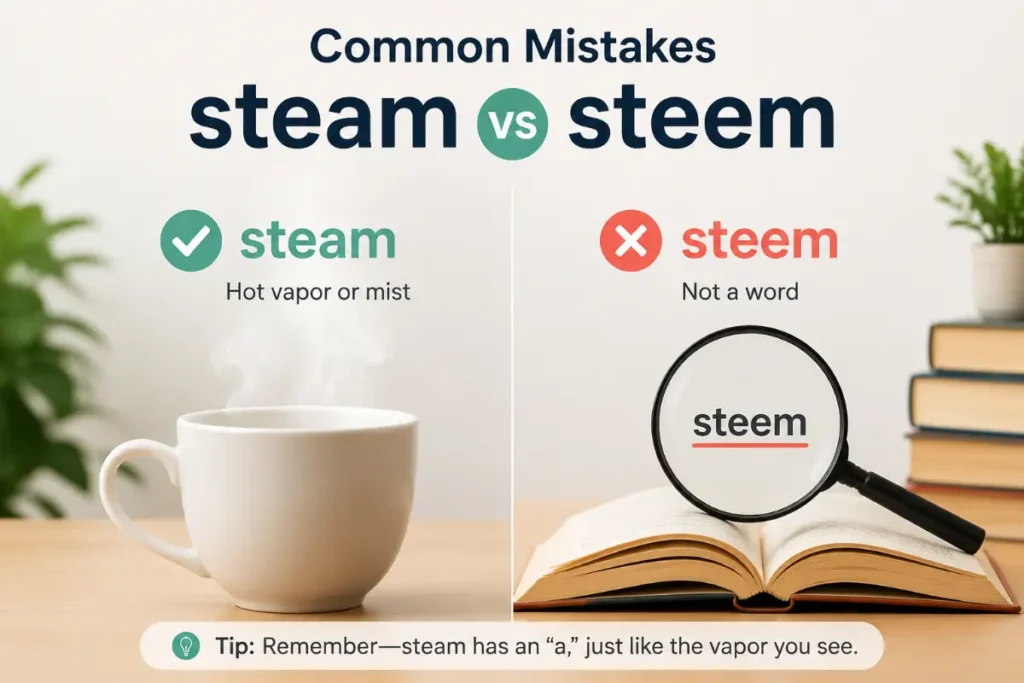
Common Mistakes steam vs steem
Writing Steem For Steam
This is the most direct spelling error.
Incorrect:
The kettle is producing steem.
Correct:
The kettle is producing steam.
Assuming Steem Is A British Spelling
It isn’t.
English speakers in Britain use steam.
Treating Steem As A Standard Variant
For the ordinary meaning of water vapor steem isn’t a standard spelling variant.
Don’t treat the two spellings like color and colour.
Using Steem In Expressions
Incorrect:
The project has lost steem.
Correct:
The project has lost steam.
Incorrect:
I need to blow off some steem.
Correct:
I need to blow off some steam.
Confusing Spelling With Pronunciation
The sound /stiːm/ doesn’t automatically tell you to use ee in writing.
English spelling doesn’t work that neatly.
Memory Tricks For Steam
A good memory trick should be quick enough to use when you’re writing.
Think Of Team
Steam rhymes with team.
You can remember:
steam has the same long e sound as team but uses ea.
Another useful connection is:
steam → steam engine → steam train.
Those familiar phrases reinforce the spelling.
Remember The Phrase Full Steam Ahead
If you remember full steam ahead you have a ready made spelling anchor.
Think:
Steam moves forward. Steem doesn’t belong in ordinary English.
Connect Steam With Heat
Think of:
steam → heat → water → vapor.
That mental chain helps separate the ordinary English word from the proper name Steem.
Related Words And Expressions
Learning related vocabulary gives you a stronger understanding of the word.
Words Related To Steam
- Vapor.
- Water vapor.
- Mist.
- Condensation.
- Boil.
- Evaporate.
- Heat.
- Pressure.
- Humidity.
- Vaporize.
Steam Synonyms
The best synonym depends on the context.
For physical steam you might use water vapor.
For figurative energy you might use energy.
For momentum you might use momentum.
For anger in certain expressions you might use anger or frustration.
These aren’t perfect replacements in every sentence because steam has several meanings.
Related Expressions
Common expressions include:
- Full steam ahead.
- Lose steam.
- Run out of steam.
- Blow off steam.
- Pick up steam.
- Gain steam.
These expressions are useful in both everyday speech and informal writing.
Expert Editor’s Note
From an editing standpoint the choice is straightforward.
If your sentence refers to hot vapor or a figurative idea connected with energy momentum or anger use steam.
Don’t change the spelling to steem simply because you hear the long e sound.
Editors also pay close attention to proper names. If a source uses Steem as the official name of a platform organization or other entity then preserve its capitalization and spelling. A proper name follows its own naming convention.
This is an important writing lesson. Correct spelling depends on meaning and context. A word can look unusual and still be correct as a proper name. At the same time a familiar looking spelling can be wrong for an ordinary English word.
For standard English writing the safest rule is simple:
If you mean hot water vapor or the familiar expressions built around it write steam.
A related grammar guide is Dought Vs Doubt Which Word Is Correct 2026 Guide.
Conclusion
The difference between steam vs steem is much easier than it first appears.
Steam is the standard English word. It can refer to water vapor and can also describe energy momentum or anger in certain expressions.
Steem isn’t the normal spelling of that English word. You may encounter it as a proper name or in a specialized context but it shouldn’t replace steam in ordinary writing.
The biggest mistake is spelling the word according to its sound. English has many words where the long e sound can be written in different ways. In this case the correct spelling is steam.
So when the kettle boils the steam rises. When your project loses momentum it loses steam. When you’re frustrated you can blow off steam.
Remember one simple rule and you’ll rarely miss it.
If you mean the vapor or the familiar English expressions use steam and keep steem for names or specialized references.

Editorial Reviewer & Proofreader
Grace Mitchell reviews Gramlify’s articles for clarity, consistency, and readability. She is passionate about creating accurate, approachable content that helps English learners build confidence.