
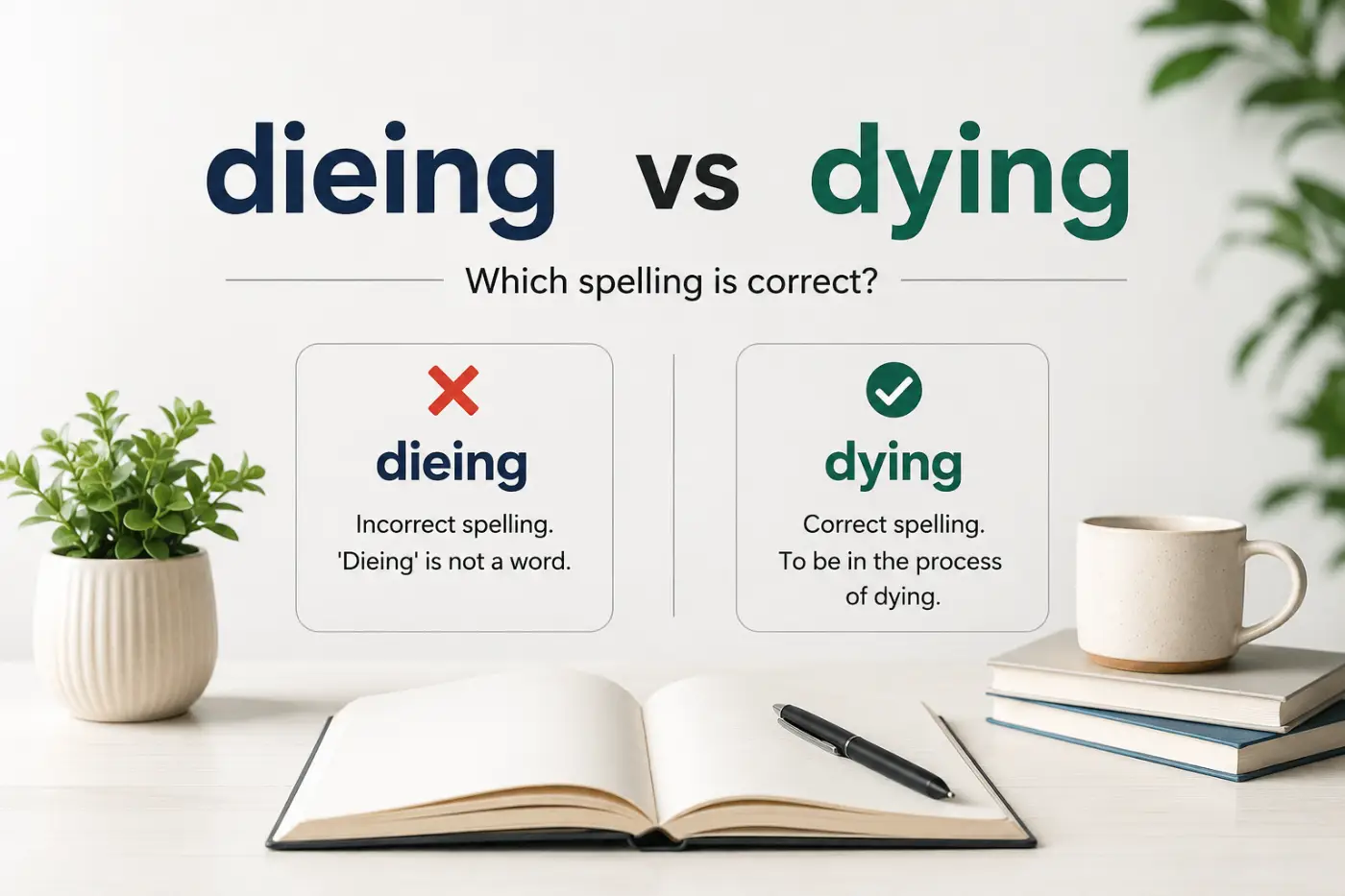
If you’ve searched for dieing vs dying, you’re probably trying to figure out which spelling is correct. The short answer is simple. Dying is the correct spelling in almost every situation when talking about death or something coming to an end. Dieing is a real word too, but it has a very different meaning and appears only in specialized manufacturing and textile contexts.
The confusion happens because English usually changes verbs ending in ie by replacing ie with y before adding ing. That rule turns die into dying, not dieing. Since this spelling breaks what many learners expect, people often assume dieing is correct.
You may also see dieing in technical documents about shaping metal or drawing wire through a die. Outside those industries, using dieing instead of dying is considered a spelling mistake.
In this guide, you’ll learn the difference between dieing and dying, the grammar rule behind the spelling, why people confuse them, and how to use each word correctly with plenty of natural examples.
Need another quick comparison? Read Leary Or Leery Which Word Is Correct 2026 Guide.
Quick Answer
Dying is the correct spelling when referring to death, something ending, or gradually disappearing. Dieing is a correct but uncommon technical word that refers to using a die, a tool that cuts, shapes, or stamps materials. For everyday English, use dying.
Dieing Vs Dying Comparison Table
| Feature | Dying | Dieing |
|---|---|---|
| Correct everyday spelling | Yes | No |
| Correct technical spelling | No | Yes |
| Meaning | Passing away or coming to an end | Working with a die or die cutting process |
| Part of speech | Present participle and adjective | Present participle |
| Common usage | Daily conversation writing journalism literature | Manufacturing engineering printing textiles |
| Formal writing | Very common | Only in technical fields |
| Frequency | Extremely common | Very rare |
| Example | The flowers are dying. | The factory is dieing metal sheets. |

What Does Dying Mean
Dying is the present participle of the verb die. It describes someone or something that is losing life, coming to an end, fading away, or disappearing.
It can refer to people, animals, plants, ideas, traditions, businesses, languages, or anything that is gradually ending.
Simple Definition
Dying means passing from life, stopping existing, or slowly coming to an end.
Common Uses Of Dying
People use dying in many different situations.
- A person who is near death.
- A plant that no longer receives enough water.
- A business losing customers.
- A tradition that fewer people continue.
- A battery running out of power.
Examples Of Dying
- The old tree is dying because of the long drought.
- Many ancient languages are slowly dying.
- Her phone is dying after a full day of travel.
- The patient is dying peacefully with family nearby.
- Some family traditions are dying as lifestyles change.
- The fire is dying after several hours.
- His interest in the project is slowly dying.
- The local bookstore is dying because of online competition.
What Does Dieing Mean
Dieing is much less common. It has nothing to do with death.
Instead, it comes from the noun die, which means a specialized tool used to cut, stamp, press, shape, or mold materials.
Manufacturing industries use dieing to describe the process of working with a die.
Simple Definition
Dieing means shaping, stamping, cutting, or forming material with a die.
Common Technical Uses
You may find dieing in industries such as these.
- Metal fabrication.
- Tool making.
- Wire production.
- Plastic molding.
- Industrial manufacturing.
Examples Of Dieing
- The company is dieing aluminum parts for aircraft.
- Workers are dieing steel sheets before assembly.
- Modern dieing equipment improves production speed.
- Engineers inspected the dieing process for quality control.
- The factory invested in automated dieing machines.
These examples are correct only because they refer to manufacturing processes.
Which One Is Correct
For almost every English learner and writer, dying is the correct spelling.
Use dying when talking about death, fading away, disappearing, ending, or losing strength.
Use dieing only when discussing industrial processes that involve a die.
Here are a few examples.
✔ Several traditions are slowly dying.
✔ The factory is dieing metal components.
✘ My grandfather is dieing.
✘ The grass is dieing because of the heat.
Those last two sentences are incorrect because they describe death or decline. The correct spelling is dying.
Why People Confuse Dieing And Dying
The confusion comes from English spelling rules.
Most verbs simply add ing.
Examples include.
- Walk becomes walking.
- Jump becomes jumping.
- Paint becomes painting.
People naturally expect die to become dieing.
English follows a different rule for verbs ending in ie.
The ie changes to y before adding ing.
Examples include.
- Die becomes dying.
- Lie becomes lying.
- Tie becomes tying.
Since this rule is unusual, many writers spell dying incorrectly on their first attempt.
Autocorrect, fast typing, and unfamiliarity with the rule also contribute to the mistake.
Key Differences Between Dieing And Dying
Although the words differ by only one letter, they have completely different meanings and uses.
| Feature | Dying | Dieing |
|---|---|---|
| Meaning | Passing away or coming to an end | Shaping or cutting material with a die |
| Grammar | Present participle of die | Present participle of die meaning to use a die |
| Common use | Everyday English | Technical industries |
| Frequency | Extremely common | Very rare |
| Used by most writers | Yes | No |
| Appropriate in daily conversation | Yes | Almost never |
The easiest way to remember the difference is this.
If your sentence talks about life, death, fading, ending, or losing strength, the correct word is dying.
If your sentence discusses factory equipment, metalworking, stamping, or industrial tools, dieing may be correct.
Grammar Rule Behind Dying
The spelling of dying follows a special English rule.
Most verbs simply add ing.
Examples.
- Read becomes reading.
- Help becomes helping.
- Wash becomes washing.
The verb die is different because it ends with ie.
When a verb ends in ie, replace ie with y before adding ing.
Examples.
- Die becomes dying.
- Lie becomes lying.
- Tie becomes tying.
This spelling rule prevents awkward letter combinations and makes words easier to read.
Many learners expect dieing because it seems logical. English simply follows a different spelling pattern in this case.
Spelling Rule Explained
A quick rule can save you from making this mistake.
Verbs Ending In Ie
Change ie to y before adding ing.
Examples.
- Die becomes dying.
- Lie becomes lying.
- Tie becomes tying.
Verbs Ending In E
Most verbs ending in e simply drop the final e.
Examples.
- Make becomes making.
- Write becomes writing.
- Smile becomes smiling.
Because die ends in ie, it follows the first rule instead of the second.
You may also want to read Provider Vs Providor Which Word Is Correct 2026 Guide.
Pronunciation Guide
Even though the spellings differ, pronunciation helps reinforce the correct form.
Dying
IPA
American English.
/ˈdaɪɪŋ/
Syllables
Dy ing.
Stress
The first syllable receives the main stress.
Dieing
IPA
American English.
/ˈdaɪɪŋ/
In technical fields, it is generally pronounced the same as dying.
Common Pronunciation Mistake
People rarely mispronounce these words. The mistake almost always happens in writing rather than speech.
Native speakers understand the meaning from the surrounding sentence.
Word Origin And History
Understanding the history makes the spelling easier to remember.
Origin Of Die
The verb die entered English centuries ago from Old Norse and related Germanic languages. It has long referred to the end of life.
Over time English developed the spelling dying by replacing ie with y before adding ing.
Origin Of Die
The noun die, meaning a tool used to shape materials, has a different history. It comes from an older word referring to molds and shaping tools.
Because this is a different meaning of die, the participle dieing appears in technical writing.
Although both words share the same spelling, they developed different meanings over time.
British American Canadian And Australian English
There is no regional spelling difference.
Writers in the United States, the United Kingdom, Canada, Australia, and New Zealand all use dying for death or something coming to an end.
Likewise, technical industries in these countries use dieing when referring to processes involving a die.
This is not a case of British versus American spelling.
The distinction depends entirely on meaning.
Real Life Examples
Seeing both words in natural sentences makes the difference much easier to remember.
Daily Conversation
- My phone is dying again.
- The flowers are dying because nobody watered them.
- Several old traditions are slowly dying.
- The campfire is dying after the rain.
Workplace
- Sales are dying because customers have moved online.
- The factory is dieing steel parts for heavy equipment.
- Engineers reviewed the dieing process before production began.
- The machine stopped during the dieing operation.
Emails
- My laptop battery is dying much faster than usual.
- Production paused while technicians adjusted the dieing equipment.
Academic Writing
- Researchers studied dying coral reefs along the coast.
- The report examined modern dieing techniques used in manufacturing.
Journalism
- Local newspapers reported that the historic theater is slowly dying.
- The company expanded its dieing department to improve efficiency.
Literature
- The novel describes a dying kingdom struggling to survive.
- The poet compares a dying flame to fading hope.
Social Media
- My charger broke and my phone is dying.
- This trend is finally dying.
- I cannot believe my favorite show is ending. It feels like part of my childhood is dying.
- The factory shared a video explaining its new dieing technology.

Common Mistakes With Dieing And Dying
Most mistakes happen because people apply the wrong spelling rule or do not know that dieing has a technical meaning.
Here are the errors editors see most often.
Using Dieing For Death
Incorrect.
He is dieing from his illness.
Correct.
He is dying from his illness.
This is by far the most common mistake in everyday writing.
Thinking Dieing Is Always Wrong
Many grammar guides simply say dieing is incorrect.
That is only partly true.
Dieing is a legitimate word in manufacturing, engineering, and metalworking. Outside those fields, it is almost never the right choice.

Confusing Dying With Dyeing
Another common mistake involves dyeing.
Remember the difference.
Dying relates to death or something ending.
Dyeing means adding color to fabric, hair, paper, or other materials.
Examples.
- She is dyeing her hair blue.
- The flowers are dying because they need water.
Although they sound alike, they have completely different meanings.
Easy Memory Tricks
These simple tricks make the correct spelling easy to remember.
Remember The Rule
When a verb ends in ie, change ie to y before adding ing.
Think of these examples.
- Die becomes dying.
- Lie becomes lying.
- Tie becomes tying.
The pattern stays the same every time.
Think About The Letter Y
The Y in dying reminds many learners of life reaching its final stage.
That small change from ie to y follows the grammar rule and gives you the correct spelling.
Remember The Tool
The uncommon word dieing contains the word die, meaning a metal tool used for shaping materials.
If your sentence has nothing to do with machinery or manufacturing, you almost certainly need dying.
Related Words
Learning related vocabulary strengthens your understanding.
Related To Dying
- Death.
- Dead.
- Passing away.
- Fading.
- Declining.
- Ending.
- Disappearing.
- Perishing.
Related To Dieing
- Die.
- Die cutting.
- Stamping.
- Metal forming.
- Tooling.
- Manufacturing.
- Pressing.
- Fabrication.
Frequently Confused Words
- Dying and dyeing.
- Lying and lieing.
- Tieing and tying.
- Die and dye.
- Fading and ending.
Expert Editor’s Note
Professional editors almost always replace dieing with dying unless the document discusses manufacturing or industrial production.
Major dictionaries recognize dying as the standard present participle of the verb die. They also recognize dieing as a specialized technical term related to using a die.
If you are writing an email, school assignment, article, business report, or social media post about death or something coming to an end, dying is the correct choice.
When proofreading, pay extra attention to this word because spell checkers may not always flag dieing as an error. Since it is a legitimate technical term, some programs accept both spellings.
Frequently Asked Questions
Is Dying Or Dieing Correct?
Dying is correct for almost every everyday situation. Use dieing only when referring to manufacturing processes that involve a die.
Why Is It Dying Instead Of Dieing?
English changes ie to y before adding ing to verbs ending in ie. That is why die becomes dying.
Is Dieing A Real Word?
Yes. It is a real but uncommon technical word used in manufacturing, engineering, and metalworking.
Is Dieing A Spelling Mistake?
In everyday English, yes. If you are talking about death, illness, fading, or something ending, dieing is a spelling mistake.
Is Dying Used Only For Death?
No. It can also describe something gradually ending or losing strength.
Examples include a dying battery, a dying business, or a dying tradition.
What Is The Difference Between Dying And Dyeing?
Dying relates to death or something ending.
Dyeing means adding color to hair, fabric, paper, or other materials.
The words sound alike but have different meanings and spellings.
Is There A British And American Difference?
No. American English, British English, Canadian English, and Australian English all use dying with the same spelling and meaning.
You may also want to read Seal Vs Seel Which Spelling Is Correct 2026 Guide.
Conclusion
The difference between dieing vs dying comes down to meaning and a simple spelling rule.
Dying is the correct spelling when talking about death, something fading away, or coming to an end. It follows the English rule that changes ie to y before adding ing.
Dieing is also a real word, but it belongs almost entirely to manufacturing and engineering. Unless your sentence involves shaping material with a die, it is not the word you want.
A quick rule can save you every time.
If your sentence is about life, death, decline, or something ending, choose dying. If it is about industrial equipment and metal forming, dieing may be correct.

Editorial Reviewer & Proofreader
Grace Mitchell reviews Gramlify’s articles for clarity, consistency, and readability. She is passionate about creating accurate, approachable content that helps English learners build confidence.