
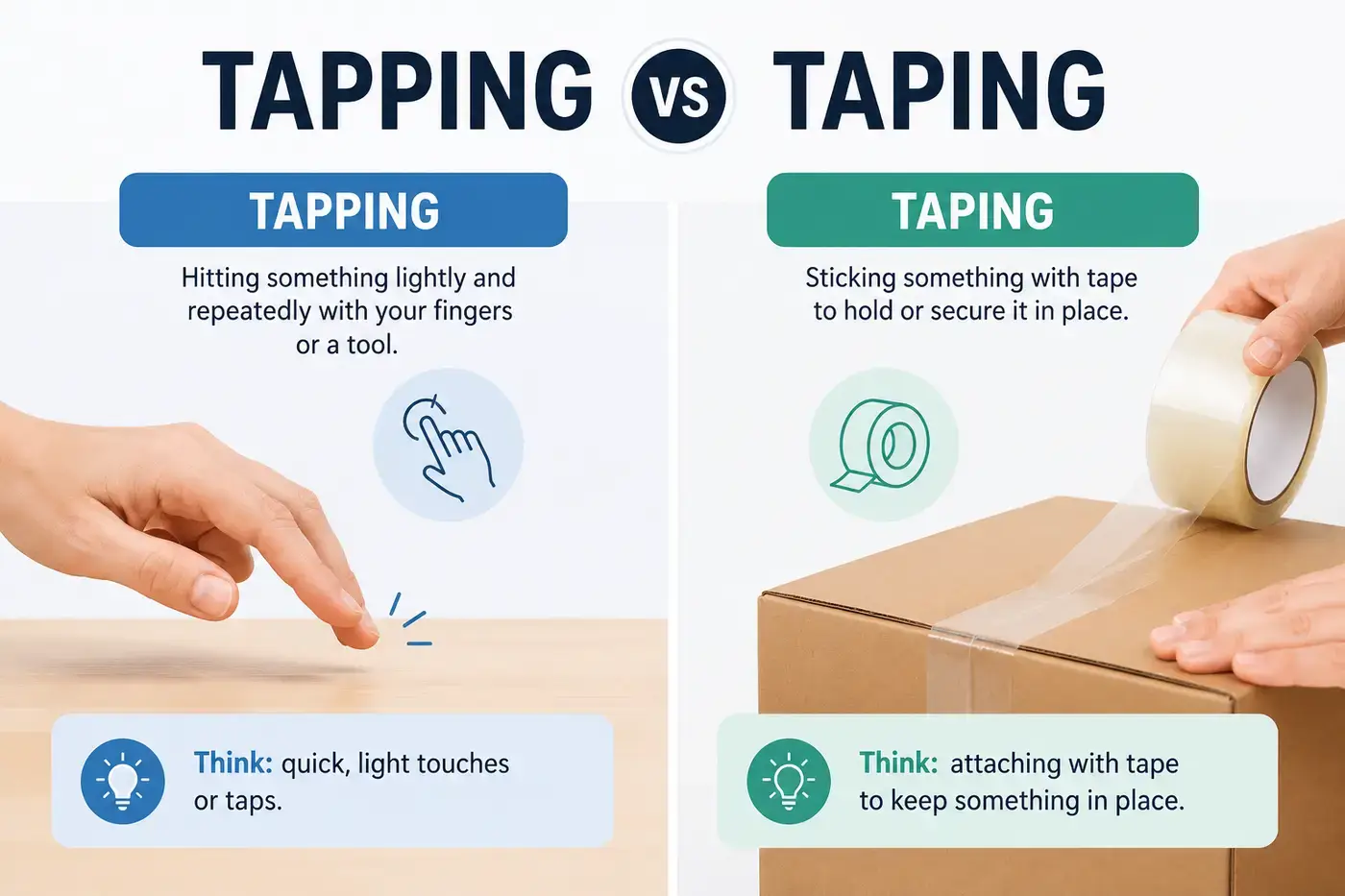
Have you ever stopped while writing and wondered if the correct word is tapping vs taping? You’re not alone. These two words look similar, sound almost alike, and are easy to confuse. Still, they have completely different meanings.
The confusion often happens because both words come from short verbs that differ by just one letter. On top of that, the pronunciation is very close in everyday speech. Many people accidentally choose the wrong word in emails, school assignments, text messages, and even professional writing.
The good news is that the difference is simple once you understand how each word works. Tapping comes from the verb tap, which means to touch something lightly or repeatedly. Taping comes from the verb tape, which means to attach, secure, or record something using tape.
In this guide, you’ll learn the meaning of each word, how to use them correctly, why people mix them up, common grammar rules, and plenty of real life examples. By the end, you’ll know exactly which word fits your sentence every time.
A related grammar guide is Bearer vs Barer Which One Is Correct (2026 Guide).
Quick Answer
Tapping and taping are both correct English words, but they have different meanings. Tapping means lightly touching or striking something repeatedly. Taping means attaching something with tape or recording audio or video. They cannot replace each other because they come from different verbs and describe different actions.
Tapping Vs Taping Comparison Table
| Feature | Tapping | Taping |
|---|---|---|
| Base verb | Tap | Tape |
| Part of speech | Present participle and gerund | Present participle and gerund |
| Meaning | Touching or striking lightly | Using tape or making a recording |
| Correct English | Yes | Yes |
| Common contexts | Phones, doors, keyboards, music | Packaging, sports, repairs, recording |
| Formal writing | Yes | Yes |
| Everyday use | Very common | Very common |
| Example | She kept tapping on the desk. | He is taping the package. |
What Does Tapping Mean
Tapping is the present participle and gerund form of the verb tap.
It means to touch, strike, or hit something lightly, usually several times.
The action is usually gentle rather than forceful.
Simple Definition
Tapping means lightly touching or knocking on something with your hand, finger, foot, or another object.
Common Uses Of Tapping
People use tapping in many everyday situations.
- Knocking gently on a door.
- Touching a phone or tablet screen.
- Drumming your fingers on a table.
- Entering numbers on a keypad.
- Keeping rhythm in music.
- Lightly hitting someone’s shoulder to get attention.
Real Life Examples
- She was tapping her pencil during the lesson.
- Someone kept tapping on the front door.
- He spent the afternoon tapping on his keyboard.
- My son enjoys tapping on the piano keys.
- The doctor started tapping my knee during the examination.
- I heard rain tapping against the window.
Tapping In Different Contexts
Daily conversation.
Stop tapping your foot. You’re making everyone nervous.
Workplace.
She kept tapping her keyboard while waiting for the report to load.
Technology.
Try tapping the screen once to open the app.
Healthcare.
The physician used gentle tapping to check the patient’s reflexes.
Music.
The drummer practiced tapping different rhythms.
What Does Taping Mean
Taping is the present participle and gerund form of the verb tape.
It has two common meanings.
The first means attaching or securing something with adhesive tape.
The second means recording sound or video.
Simple Definition
Taping means using tape to hold something together or making an audio or video recording.
Common Uses Of Taping
You will often see taping used in these situations.
- Wrapping boxes for shipping.
- Securing wires.
- Athletic taping before sports.
- Repairing torn paper.
- Recording television shows.
- Filming interviews or presentations.
Real Life Examples
- She is taping the gift before the party.
- They’re taping today’s podcast episode.
- The coach finished taping the player’s ankle.
- Dad spent the morning taping loose cables.
- We are taping the meeting for people who cannot attend.
- The technician is taping the damaged wire.
Taping In Different Contexts
Daily conversation.
I’m taping the birthday present now.
Workplace.
The team is taping the training session for future employees.
Healthcare.
The therapist is taping the athlete’s shoulder for extra support.
Education.
The teacher is taping the science experiment for the online class.
Television.
The audience arrived early because the show was taping live.
Which One Is Correct
Both tapping and taping are correct.
The right choice depends entirely on what you want to say.
Choose tapping if you mean lightly touching or striking something.
Choose taping if you mean attaching something with tape or recording audio or video.
Here are a few quick comparisons.
✔ She kept tapping her fingers on the table.
He is taping the broken box.
✔ They’re tapping the phone screen.
✔ We’re taping the interview this afternoon.
Each sentence uses the correct verb based on the action being described.
Tapping Vs Taping Key Differences
Although only one letter separates these words, their meanings are completely different.
| Difference | Tapping | Taping |
|---|---|---|
| Action | Light touch or gentle strike | Use tape or record something |
| Comes from | Tap | Tape |
| Typical objects | Door, screen, keyboard, shoulder | Box, package, ankle, camera |
| Purpose | Create light contact | Secure or record |
| Example | He was tapping the desk. | She was taping the package. |
The easiest way to remember the difference is to think about the object.
If your sentence involves a gentle touch, use tapping.
If your sentence involves adhesive tape or recording equipment, use taping.
Why People Confuse Tapping And Taping
It’s easy to see why these words cause confusion. They differ by only one letter, and their pronunciation is very similar in everyday speech. Still, they come from different verbs and describe completely different actions.
Several factors contribute to the mix up.
Similar Spelling
The words tapping and taping share the same first three letters. When people type quickly, they often miss the extra e in tape or accidentally add one where it doesn’t belong.
Similar Pronunciation
In fast conversation, both words can sound alike, especially for English learners. The surrounding sentence usually tells native speakers which word is intended.
Autocorrect And Typing Errors
Phones and computers sometimes replace one word with the other, especially if the sentence is incomplete.
Shared Grammar Pattern
Both words are present participles ending in ing. Since they have the same grammatical form, writers sometimes focus on the ending instead of the base verb.
Grammar Explanation
Understanding the grammar makes choosing the correct word much easier.
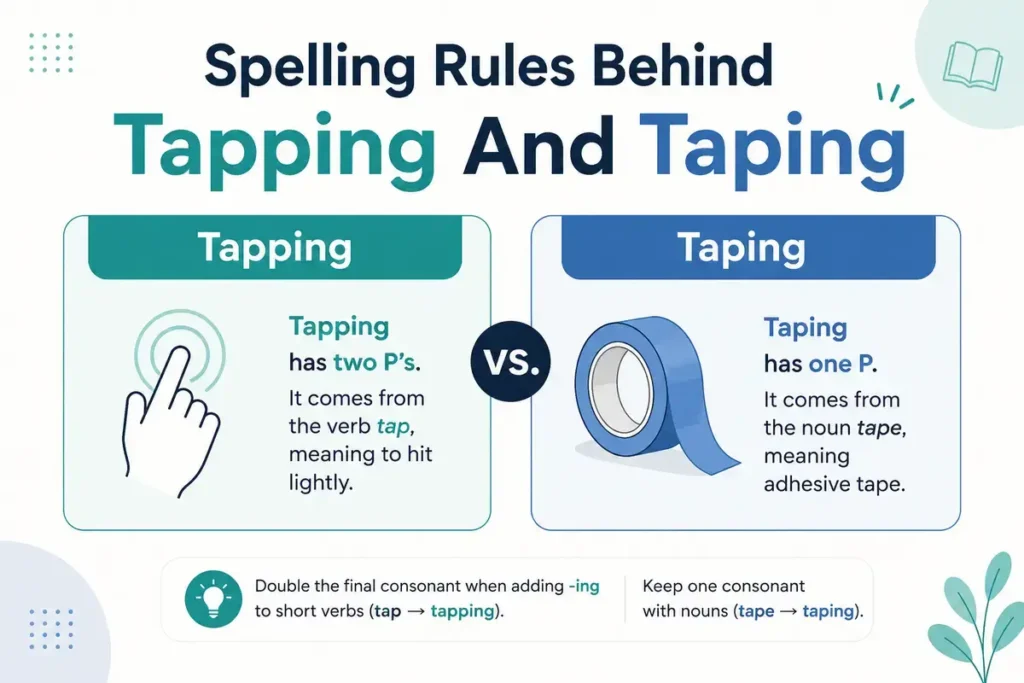
Tapping Comes From Tap
The base verb is tap.
When adding ing, English doubles the final consonant because tap ends with one vowel followed by one consonant.
Tap.
Tapping.
The same spelling rule appears in words like.
- Run becomes running.
- Sit becomes sitting.
- Stop becomes stopping.
Taping Comes From Tape
The base verb is tape.
Since tape already ends with a silent e, English removes the e before adding ing.
Tape.
Taping.
This follows the same spelling pattern as.
- Bake becomes baking.
- Dance becomes dancing.
- Smile becomes smiling.
These spelling rules explain why the two words look different even though they sound similar.
Spelling Rules Behind Tapping And Taping
English follows predictable spelling patterns.
Rule One
Double the final consonant after a short vowel before adding ing.
Examples.
- Tap becomes tapping.
- Hop becomes hopping.
- Clap becomes clapping.
Rule Two
Drop the silent e before adding ing.
Examples.
- Tape becomes taping.
- Bake becomes baking.
- Share becomes sharing.
Remembering these two rules helps with many other English words as well.
Learn the difference in Afterward Vs Afterword Which Word Is Correct 2026.
Pronunciation Guide
Although the meanings differ, the pronunciation is close enough to confuse many learners.
Tapping
IPA
American English.
/ˈtæpɪŋ/
Syllables
Tap ping.
Stress
The first syllable receives the stress.
Taping
IPA
American English.
/ˈteɪpɪŋ/
Syllables
Ta ping.
Stress
The first syllable also receives the stress.
Common Pronunciation Mistake
Some learners pronounce taping like tapping because they overlook the long vowel sound created by the silent e.
Compare the first vowel.
Tap.
Tape.
That single vowel sound changes the entire meaning.
Word Origin
Both words come from different English verbs with different histories.
Tap
The verb tap has existed in English for hundreds of years. It originally referred to striking something lightly or making a gentle knocking sound.
Over time, the meaning expanded to include touching screens, keyboards, and other electronic devices.
Tape
The word tape originally referred to a narrow strip of fabric used for binding or fastening objects.
Later, adhesive tape became common, and the verb tape developed to mean fastening with tape.
As recording technology evolved, tape also became associated with audio and video recording.
Although digital technology has replaced cassette tapes in many situations, people still say they are taping a television show or interview.
British American Canadian And Australian English
There is no spelling difference between these varieties of English.
People in the United States, the United Kingdom, Canada, Australia, and New Zealand all use tapping and taping with the same meanings.
The only noticeable difference is usage.
In modern American English, people often say recording instead of taping because digital recording is now more common.
Still, taping remains widely understood and continues to appear in everyday conversation.
Real Life Examples
Seeing both words in natural sentences makes the difference easier to remember.
Daily Conversation
- She kept tapping her phone while waiting for a reply.
- My neighbor was tapping on the wall again.
- I’m taping the birthday card inside the gift box.
- Dad is taping the family vacation tonight.
Workplace
- The assistant kept tapping the keyboard during the presentation.
- We’re taping the training session for new employees.
- The engineer was tapping the pipe to check for damage.
- Please finish taping the shipping boxes before lunch.
Emails
- Thanks for tapping the link I sent yesterday.
- We’re taping today’s webinar for everyone who cannot attend live.
Education
- The student was tapping his pencil during the test.
- The teacher is taping the science demonstration for the online class.
Healthcare
- The doctor started tapping my knee with a reflex hammer.
- The therapist is taping the athlete’s wrist before practice.
Journalism
- Reporters were tapping their keyboards as the news conference began.
- The television crew is taping tonight’s interview.
Social Media
- Stop tapping the screen so many times.
- They’re taping a behind the scenes video today.
Everyday Activities
- Someone kept tapping at the window during the storm.
- She finished taping the package before the delivery driver arrived.
Common Mistakes With Tapping And Taping
Even experienced writers occasionally choose the wrong word because the spellings are so similar.
These are the mistakes editors see most often.
Using Tapping Instead Of Taping
Incorrect.
We’re tapping the interview for tomorrow’s broadcast.
Correct.
We’re taping the interview for tomorrow’s broadcast.
The sentence refers to recording a program, so taping is the correct choice.
Using Taping Instead Of Tapping
Incorrect.
She kept taping on the door.
Correct.
She kept tapping on the door.
The action is a light knock, so tapping is correct.
Forgetting The Base Verb
Many people focus only on the ing ending.
Instead, identify the original verb first.
Tap becomes tapping.
Tape becomes taping.
That simple step prevents most mistakes.
Assuming Taping Only Means Recording
Many people think taping only refers to making a video or audio recording.
It also means fastening or securing something with adhesive tape.
Examples.
- The nurse is taping the bandage.
- He’s taping the moving boxes.
Both sentences are correct.
Easy Memory Tricks
These simple tricks make the difference easy to remember.
Think About The Letter E
The word tape has an e.
Anything involving adhesive tape or recording keeps the idea of tape.
Tape.
Taping.
Think About A Gentle Tap
A tap is a light touch.
If someone is knocking, touching, pressing, or drumming lightly, choose tapping.
Ask Yourself One Question
What is the person doing?
If they are touching lightly, write tapping.
If they are using tape or recording something, write taping.
That single question solves almost every situation.
Related Words
Learning related vocabulary helps you understand both words more naturally.
Related To Tapping
- Tap.
- Knock.
- Touch.
- Drum.
- Strike.
- Press.
- Pat.
Related To Taping
- Tape.
- Record.
- Film.
- Wrap.
- Secure.
- Attach.
- Fasten.
Frequently Confused Words
These word pairs also cause confusion.
- Tap and tape.
- Typing and tapping.
- Recording and filming.
- Wrapping and taping.
- Knocking and tapping.
Understanding these related words strengthens your vocabulary and improves your writing.
Expert Editor’s Note
Professional editors recommend choosing the word based on the action, not the spelling.
If someone is making gentle contact with a surface, tapping is always the correct choice.
If someone is using adhesive tape or creating an audio or video recording, taping is correct.
Modern dictionaries recognize both words as standard English. The only mistake is using one in place of the other.
Many editors also suggest replacing taping with recording in formal writing when discussing digital media because it reflects today’s technology more accurately. Still, taping remains widely accepted and understood.
Frequently Asked Questions
Is Tapping Or Taping Correct?
Both are correct English words. Tapping refers to lightly touching or knocking on something. Taping means attaching something with tape or recording audio or video.
What Is The Difference Between Tapping And Taping?
The difference is the action. Tapping involves gentle contact, while taping involves adhesive tape or recording equipment.
Is Taping Still Correct If Nothing Uses Video Tape?
Yes. Even though digital recording is common today, native speakers still use taping to describe recording television shows, podcasts, interviews, and live events.
Why Is Tapping Spelled With Two Ps?
The verb tap ends with one vowel followed by one consonant. English doubles the final consonant before adding ing, creating tapping.
Why Does Taping Lose The Letter E?
The verb tape ends with a silent e. Standard English spelling drops the final e before adding ing, resulting in taping.
Can Taping Mean Wrapping Something?
Yes. Taping often means attaching or securing objects with adhesive tape. It is commonly used for packages, sports injuries, electrical wires, and repairs.
Which Word Is More Common?
Both words are common because they describe different actions. Tapping appears frequently in conversations about phones, computers, music, and knocking. Taping is common in packaging, healthcare, sports, and media.
How Can I Remember The Difference?
Remember that tap means a light touch, while tape refers to adhesive tape or recording. Think about the action before choosing the word.
A related grammar guide is It Is Must vs It Is a Must: Which One Is Correct in 2026?.
Conclusion
The difference between tapping vs taping is simple once you know the base verb.Use tapping when someone lightly touches, knocks, presses, or strikes a surface.Use taping when someone secures something with tape or records audio or video.The biggest mistake is treating these words as interchangeable. They describe different actions and cannot replace each other.When you’re unsure, ask yourself one question.Is the action a gentle touch or does it involve tape or recording?The answer will point you to the correct word every time.

Vocabulary & Language Research Writer
Ethan Parker researches English vocabulary, word meanings, slang, idioms, and commonly confused words. His goal is to help readers understand how English is actually used in everyday conversations and writing.
1 thought on “Tapping Vs Taping Which Word Should You Use”