
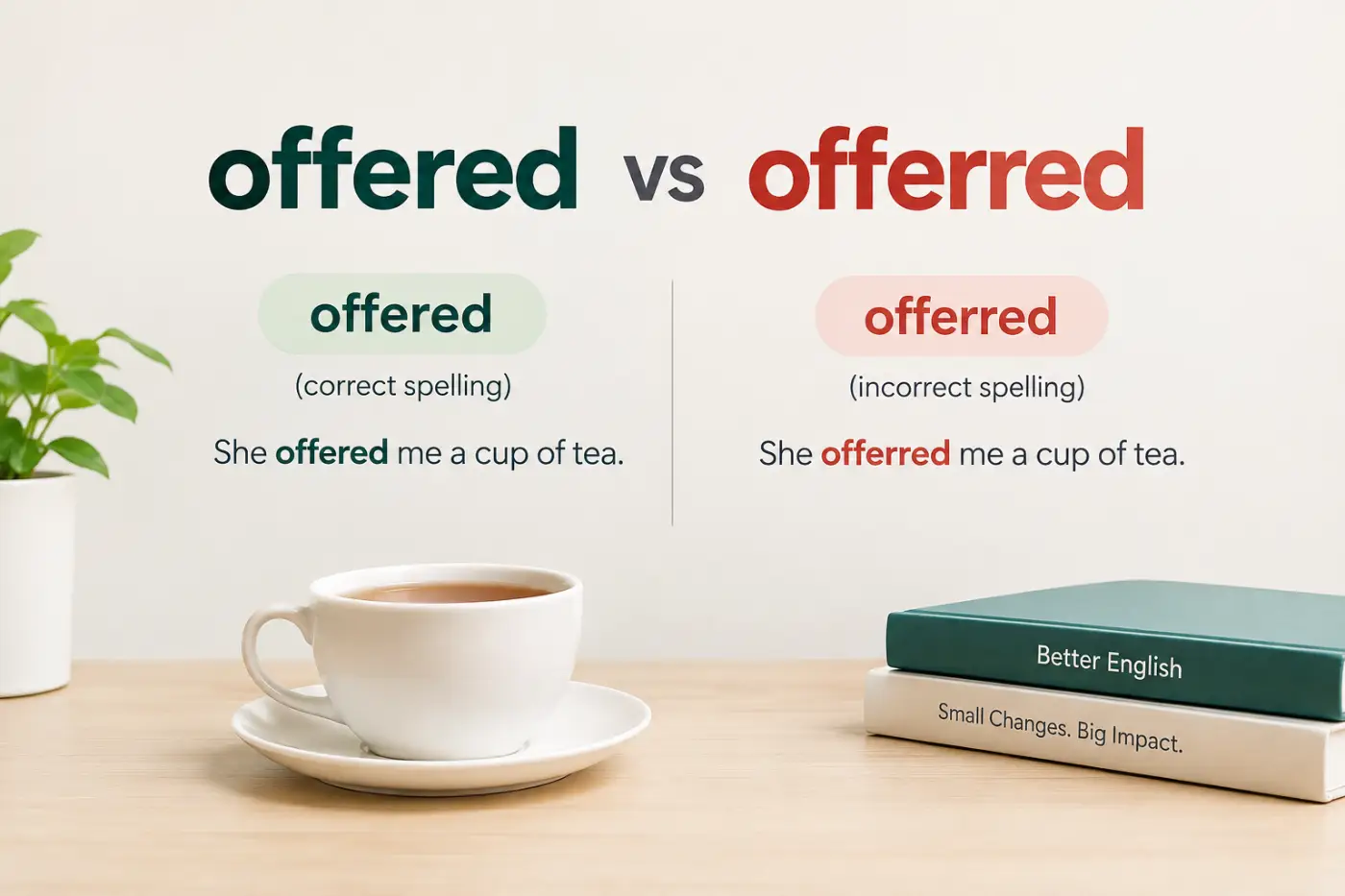
If you’ve ever stopped while typing and wondered if offered vs offerred is correct, you’re not alone. The two forms look almost identical, so the extra r can seem harmless. However, only one spelling belongs in standard English.
The correct form is offered. It is the past tense and past participle of the verb offer. The form offerred is a spelling mistake. Major dictionary sources list offered as the standard form and do not treat offerred as an alternative spelling. Cambridge identifies offered as both the past simple and past participle of offer. Collins gives the same past and participle form.
The confusion usually comes from other English verbs that double a final consonant before adding ed. Words such as preferred and referred can make offerred look believable. Yet English spelling rules depend on the structure and stress of the base word. You can’t apply one doubling pattern to every verb.
In this guide you’ll learn why offered is correct, why offerred is wrong, how the verb works in real sentences, and how to remember the spelling without second guessing yourself. You’ll also see practical examples from everyday speech, work, school, email, and formal writing.
Many readers also check Receiver Vs Reciever Which Spelling Is Correct 2026 Guide.
Quick Answer
Offered is the correct spelling. Offerred is incorrect in standard English. The verb offer forms its past tense and past participle by adding ed without adding another r. So the correct pattern is offer → offered. Use offered in everyday writing, professional communication, academic work, and formal documents.
Offered vs Offerred At A Glance
The difference is simple once you look at the base word.
| Feature | Offered | Offerred |
|---|---|---|
| Correct spelling | Yes | No |
| Base word | offer | offer |
| Past tense | Yes | No |
| Past participle | Yes | No |
| Part of speech | Verb form | Not a standard English verb form |
| Number of r letters | One | Two |
| Standard English | Yes | No |
| American English | Yes | No |
| British English | Yes | No |
| Academic writing | Correct | Incorrect |
| Professional writing | Correct | Incorrect |
| Everyday writing | Correct | Incorrect |
The correct spelling is:
offer → offered
The incorrect spelling is:
offer → offerred
That extra r has no place in the standard past form.
Cambridge lists offered as the past simple and past participle of offer. Collins also lists offered as both forms. Neither source presents offerred as an accepted regional spelling.
There is also no meaningful American versus British spelling difference here. Writers in both varieties use offered.
What Does Offered Mean
Offered is the past tense and past participle of offer.
The verb offer has several related meanings. In everyday English it can mean to present something for someone to accept. It can also mean to say that you’re willing to do something. Another common meaning is to provide or make something available. Cambridge and Collins both document these uses.
For example:
- She offered me a seat.
- He offered to drive us home.
- The company offered free delivery.
- They offered their support.
- The school offered extra classes.
- The store offered a discount.
In each sentence, offered describes something that happened in the past or something viewed as completed.
Offered As A Past Tense
When offered describes an action that happened in the past, it works as the simple past form of offer.
For example:
She offered me some coffee.
The action of offering happened in the past.
Another example is:
The manager offered me a promotion last week.
Here the offering happened at a particular time in the past.
Offered As A Past Participle
Offered also works as a past participle. You’ll often see it with forms of have or in passive constructions.
Examples include:
They have offered me a new position.
She had offered to help before I asked.
He was offered a place at the university.
We were offered several options.
This is why offered has two grammatical jobs. It functions as both the simple past and the past participle of the regular verb offer. Cambridge and Collins both identify these forms in their dictionary entries.
What Offer Can Mean
The meaning changes slightly with the context.
Offer something to someone means to present something for that person to accept or reject.
She offered him a glass of water.
Offer to do something means to say that you’re willing to do an action.
He offered to help with the move.
Offer a service means to provide that service.
The clinic offers free consultations.
Offer a price means to propose an amount of money.
They offered $5,000 for the car.
Collins lists these broad uses and also includes meanings connected with providing services, making proposals, giving support, and proposing a price.
So offered doesn’t have one narrow meaning. It carries the past form of a verb that appears in many everyday contexts.
Which One Is Correct
Offered is correct.
Offerred is incorrect.
The easiest way to understand the spelling is to start with the base verb:
offer + ed = offered
You don’t insert another r.
This gives you:
offer → offered
Not:
offer → offerred
The mistake often feels natural because English has many words with doubled consonants. For example:
- stop → stopped
- plan → planned
- refer → referred
- prefer → preferred
At first glance you might think the same pattern should produce offerred. It doesn’t.
The important lesson is that English does not double a consonant simply because a word ends in that consonant. Specific spelling conditions control the process.
The verb offer has stress on its first syllable. Cambridge gives the American pronunciation as /ˈɑː.fɚ/ and the British pronunciation as /ˈɒf.ər/. The first syllable carries the main stress in both varieties.
That helps explain why offer does not behave like verbs such as refer and prefer when forming the past tense.
Why Offer Becomes Offered
Think of the word as a base form followed by the regular past ending.
offer + ed
The result is:
offered
The existing spelling already contains two f letters. It needs only one r.
A useful visual reminder is:
offered
The word has:
- Two f letters.
- One r.
- The ending ed.
The incorrect form adds an unnecessary second r:
offerred
That is the entire spelling problem.
Is Offerred Ever Correct
No. Offerred is not a standard alternative spelling of offered.
It isn’t a British spelling. It isn’t an American spelling. It isn’t a formal variant. It isn’t an older spelling that you should use in historical writing.
If you see offerred in an email, article, assignment, website, or social media post, treat it as a spelling error.
The standard form is offered.
Examples Of The Correct Form
Here are some natural examples.
She offered to help me with my homework.
The company offered him a full time position.
My neighbor offered us some fresh vegetables.
The teacher offered extra help after class.
They offered a reasonable price for the house.
The hotel offered free breakfast to its guests.
He offered his seat to an older passenger.
The doctor offered several possible explanations.
We were offered a chance to revise the project.
The bank offered a lower interest rate.
Every example uses offered with one r.

Why People Confuse Offered And Offerred
The confusion has a clear source. English contains several spelling patterns that look similar but behave differently.
The most common problem comes from seeing words such as referred and preferred.
Compare these forms:
| Base verb | Correct past form |
|---|---|
| offer | offered |
| refer | referred |
| prefer | preferred |
| occur | occurred |
| stop | stopped |
| plan | planned |
At a quick glance, preferred, referred, and offered may seem to belong to the same spelling family. They don’t.
The final consonant doubling rule depends on the sound and structure of the base word. In many cases, stress also matters. That means writers need to look at the actual verb instead of copying the pattern from another familiar word.
Visual Similarity
The two spellings are separated by only one letter.
offered
offerred
That small difference makes the error easy to miss during proofreading. Your eyes can recognize the overall shape of the word before noticing the extra r.
This is especially common when you’re writing quickly.
Confusion With Referred
The word referred is a major source of confusion.
You write:
refer → referred
You do not write:
offer → offerred
The two verbs look similar because they both end in er. Their spelling behavior before ed is different.
The same issue appears with preferred.
prefer → preferred
But:
offer → offered
Learning the forms as complete words can help until the spelling rule becomes automatic.
Confusion From The Doubling Rule
Many English learners learn a useful rule that says a final consonant can double before ed or ing.
That rule is real. The problem starts when writers treat it as a universal rule.
For example:
stop → stopped
plan → planned
refer → referred
But:
offer → offered
English spelling has plenty of exceptions and condition based patterns. Good editing means applying the rule to the actual word rather than forcing every verb into the same mold.
Fast Typing
Sometimes there’s no deeper grammar issue at all.
A writer may simply type offerred because the hand or mind repeats the r. This kind of typo can survive if the writer doesn’t reread the sentence carefully.
It’s especially easy to miss because offerred still looks like an English word.
That’s why a quick visual check helps:
offered
One r.
Autocorrect And Online Writing
Digital writing can make spelling mistakes more visible and more confusing at the same time.
People encounter incorrect forms on websites, comments, social posts, forums, and user generated content. Seeing the same error several times can make it look familiar.
Familiarity doesn’t make a spelling correct.
When you’re unsure about a word, a reliable dictionary is a better guide than repeated appearances online. Cambridge and Collins both support offered as the standard form.
Internet Myths
One common myth is that offerred might be acceptable in one English speaking region.
It isn’t.
American English uses offered. British English uses offered. The same standard spelling applies in Canadian and Australian English.
Another myth is that doubling the r makes the word more consistent with preferred or referred.
Spelling doesn’t work that way. Each verb follows the conventions that apply to its own form.
The safest habit is simple. When the base verb is offer, the past form is offered.
Offered vs Offerred Grammar Rules
The spelling difference becomes easier to remember once you understand how offered works grammatically.
Offer is a regular verb. Its basic forms are:
| Verb form | Correct form |
|---|---|
| Base form | offer |
| Third person singular | offers |
| Present participle | offering |
| Simple past | offered |
| Past participle | offered |
The important point is that the past tense and past participle have the same spelling.
So you get:
offer → offered → offered
You don’t get:
offer → offerred → offerred
That extra r doesn’t belong in either past form.
Simple Past
Use offered when the action happened in the past.
Examples:
The manager offered me a new position.
She offered her opinion during the meeting.
The restaurant offered a special menu last Friday.
He offered to pick me up after work.
The verb can describe a completed action at a specific past time or an action that happened as part of a past event.
Present Perfect
Use offered after has or have when you form the present perfect.
Examples:
The company has offered several solutions.
They have offered to pay the remaining balance.
She has offered her support throughout the project.
The structure is:
has or have + offered
Not:
has or have + offerred
Past Perfect
Use offered after had for the past perfect.
Examples:
She had offered to help before I arrived.
The school had offered several courses that year.
He had already offered his apology.
The structure is:
had + offered
Again the spelling stays the same.
Passive Voice
Offered also appears frequently in passive sentences.
Examples:
I was offered a better position.
They were offered free tickets.
She was offered a place on the course.
The customer was offered a refund.
The structure is commonly:
be + offered
The word remains offered because it is the past participle of offer.
Offered In Different Sentence Patterns
The verb offer works in several useful structures. Understanding these patterns helps you use offered naturally.
Offer Someone Something
This structure means you give someone the chance to accept something.
She offered me a cup of tea.
The company offered employees a bonus.
He offered his friend some advice.
The person receiving the offer usually comes directly after the verb.
Offer Something To Someone
You can also place the thing first and use to before the recipient.
She offered a cup of tea to me.
The company offered a bonus to its employees.
He offered some advice to his friend.
Both structures are grammatical. The first often sounds more natural in everyday conversation.
Offer To Do Something
Use offer to + verb when someone volunteers or expresses willingness to perform an action.
She offered to drive me home.
He offered to fix the computer.
They offered to help with the project.
This pattern is extremely common in everyday English.
A common mistake is adding for before the verb.
Incorrect:
She offered for help.
Correct:
She offered to help.
Offer Something For Sale
Use offer something for sale when something is available for people to buy.
The store offered the furniture for sale.
The company offered the property for sale.
You can also see the phrase on offer in some varieties of English. In American English, on sale is often more familiar when talking about reduced prices.
Offer A Price
The verb can also describe a proposed amount of money.
They offered $10,000 for the car.
She offered a fair price for the house.
The buyer offered less than the asking price.
Here offered means proposed or presented an amount.
Offered In Formal And Informal Writing
Offered works comfortably across different levels of English.
You can use it in:
- Casual conversation.
- Text messages.
- Workplace emails.
- Business documents.
- Academic writing.
- News reports.
- Reports and presentations.
- Formal correspondence.
The word itself isn’t informal or overly formal.
For example:
My friend offered to help.
This sounds natural in conversation.
You can also write:
The study offered several possible explanations for the observed results.
That sentence fits academic writing.
The surrounding vocabulary and sentence structure create the level of formality. Offered itself works across the range.
Offered In American And British English
There is no standard spelling difference between American and British English here.
American English uses:
offered
British English uses:
offered
Canadian English uses:
offered
Australian English uses:
offered
So you don’t need to change the spelling based on your audience.
This differs from words such as color and colour or center and centre. Those words have recognized regional spelling differences. Offered does not.
That makes the answer especially straightforward for writers working with international English.
Offered Pronunciation Guide
The pronunciation of offered can vary slightly between major English varieties. The spelling stays the same.
Cambridge gives the pronunciation as approximately /ˈɒf.əd/ in British English and /ˈɑː.fɚd/ in American English. The first syllable carries the main stress.
You can think of the word as having two syllables:
OF fered
The first part receives the stronger stress.
The past ending isn’t pronounced as a separate full ed syllable like the ending in some words. In offered the ending has a softer sound.
Common Pronunciation Mistake
Some learners may pronounce the word as if it had three clear syllables.
That isn’t the usual pronunciation.
In natural speech the ending is reduced.
The safest approach is to listen to a trusted dictionary recording and repeat the word aloud. Cambridge provides both British and American audio pronunciations for the entry.
Why Referred Has Two Rs But Offered Does Not
This is one of the most useful comparisons to understand.
Consider these pairs:
refer → referred
prefer → preferred
offer → offered
Why does one group double the r while offer doesn’t?
English spelling rules look at several features of the base word. One important factor is the position of stress.
In refer, the second syllable receives the main stress:
reFER
In prefer, the second syllable receives the main stress:
preFER
In offer, the first syllable receives the main stress:
OFfer
That difference matters when applying consonant doubling patterns.
You shouldn’t reduce the entire rule to a single shortcut. English spelling has several conditions and exceptions. Still, stress gives you a useful clue for understanding why these forms don’t behave identically.
Compare:
refer → referred
prefer → preferred
occur → occurred
with:
offer → offered
answer → answered
enter → entered
The spelling of offered follows the established standard form of the verb.
Spelling Rules For Offered
The easiest spelling rule is also the most practical:
Write offer + ed as offered.
Don’t add another r.
The word already ends with er:
offer
Add ed:
offered
This gives you:
o f f e r e d
There are two f letters and one r.
Why The R Does Not Double
The mistake often comes from treating r as if it followed the same pattern as the final consonant in stop.
But:
stop → stopped
does not mean:
offer → offerred
The spelling pattern depends on the word itself.
A good editor doesn’t mechanically double the final consonant of every verb before ed. The actual word form needs to be checked.
The F Is Already Doubled
Another useful visual clue is that offer already contains a doubled consonant.
Look closely:
offer
The two f letters appear together.
When you add ed, they remain:
offered
The word doesn’t need another doubled consonant at the end.
You can remember it visually as:
off + er + ed
That produces:
offered
Twenty Real Life Examples Of Offered
Seeing the word in different contexts is one of the best ways to make the spelling automatic.
Daily Conversation
- She offered me a ride home.
- He offered to make dinner tonight.
- My neighbor offered us some fresh fruit.
- They offered to watch the kids for an hour.
- I offered him the last piece of cake.
Workplace English
- The company offered her a full time position.
- My manager offered to review the report.
- The client offered several useful suggestions.
- The employer offered flexible working hours.
- The team offered a practical solution to the problem.
Email Writing
- Thank you for the assistance you offered during the project.
- I appreciate the opportunity you offered me.
- The supplier offered us a revised delivery date.
- She offered to answer any questions after the presentation.
Academic Writing
- The study offered a new explanation for the findings.
- The researchers offered several possible interpretations.
- The article offered useful evidence for the proposed theory.
Journalism
- The mayor offered condolences to the victims’ families.
- The organization offered financial support after the disaster.
Social Media And Informal Writing
- Someone finally offered to bring snacks to the party.
- My brother offered to drive because I was tired.
- The café offered free coffee to early customers.
- She offered the perfect solution in the comments.
- They offered to help before anyone even asked.
These examples show how flexible offered is. The word can describe a physical thing being presented. It can describe help or support. It can describe a proposal. It can also describe a service, opportunity, price, or explanation.
For another common grammar confusion, see Focussing Or Focusing Which Spelling Is Correct 2026 Guide.
Common Mistakes With Offered
The biggest mistake is simple:
offerred
Instead of:
offered
However, several related mistakes are worth knowing.
Mistake One Adding An Extra R
Incorrect:
The company offerred me a position.
Correct:
The company offered me a position.
The extra r is unnecessary.
Mistake Two Using Offered After A Modal
After modal verbs such as will, can, could, may, might, and should, use the base form offer.
Incorrect:
The company will offered me a position.
Correct:
The company will offer me a position.
The modal already controls the verb form.
Mistake Three Using Offered After Did
After did, use the base verb.
Incorrect:
Did she offered you help?
Correct:
Did she offer you help?
The same rule applies to negative sentences.
Incorrect:
She didn’t offered any explanation.
Correct:
She didn’t offer any explanation.
Mistake Four Confusing Offered And Offering
Offered is the past form.
Offering is the present participle.
Compare:
She offered to help yesterday.
She is offering to help now.
Both forms are correct. They simply perform different grammatical jobs.
Mistake Five Using Offerred In Formal Writing
An incorrect spelling can become especially noticeable in formal work.
Avoid offerred in:
- Job applications.
- Cover letters.
- Business emails.
- Academic assignments.
- Research papers.
- Reports.
- Resumes.
- Professional websites.
Use offered.
Memory Tricks For Offered
A good memory trick should be simple enough to use when you’re writing quickly.
Remember One R
Think:
Offer has one R at the end. Add ED.
offer + ed = offered
That’s enough for most writers.
Think Of The F Instead
Another useful visual trick is to focus on the doubled f.
offer
already has a repeated consonant:
ff
Then the word simply takes ed:
offered
If you’re tempted to write offerred, stop and look at the two f letters. The word already has its doubled consonant.
Compare Offer And Refer
Keep this pair in mind:
offer → offered
refer → referred
The two words look similar, but their past forms aren’t identical.
Don’t let referred pull an extra r into offered.
Say The Base Word First
When you’re unsure, say the base form:
offer
Then add the ending mentally:
offer + ed
That makes the correct spelling easier to see.
Related Words And Forms
Learning the whole word family can make the spelling more secure.
Offer
This is the base form.
They offer free delivery.
Offers
This is the third person singular present form.
The company offers free delivery.
Offered
This is the simple past and past participle.
The company offered free delivery.
The company has offered free delivery.
Offering
This is the present participle and gerund form.
The company is offering free delivery.
Offering free delivery helped attract customers.
These four forms create a useful pattern:
offer
offers
offered
offering
None of them requires offerred.
Synonyms For Offered
The best synonym depends on the context.
If offered means presented for acceptance, possible alternatives include:
- Presented.
- Provided.
- Gave.
- Supplied.
- Proposed.
If it means expressed willingness, you might use:
- Volunteered.
- Agreed.
- Proposed.
- Undertook.
If it means made available, alternatives can include:
- Provided.
- Supplied.
- Made available.
- Presented.
For example:
She offered to help.
can sometimes become:
She volunteered to help.
But the meanings aren’t always identical. Offered is broader and works in many situations where a more specific synonym would sound unnatural.
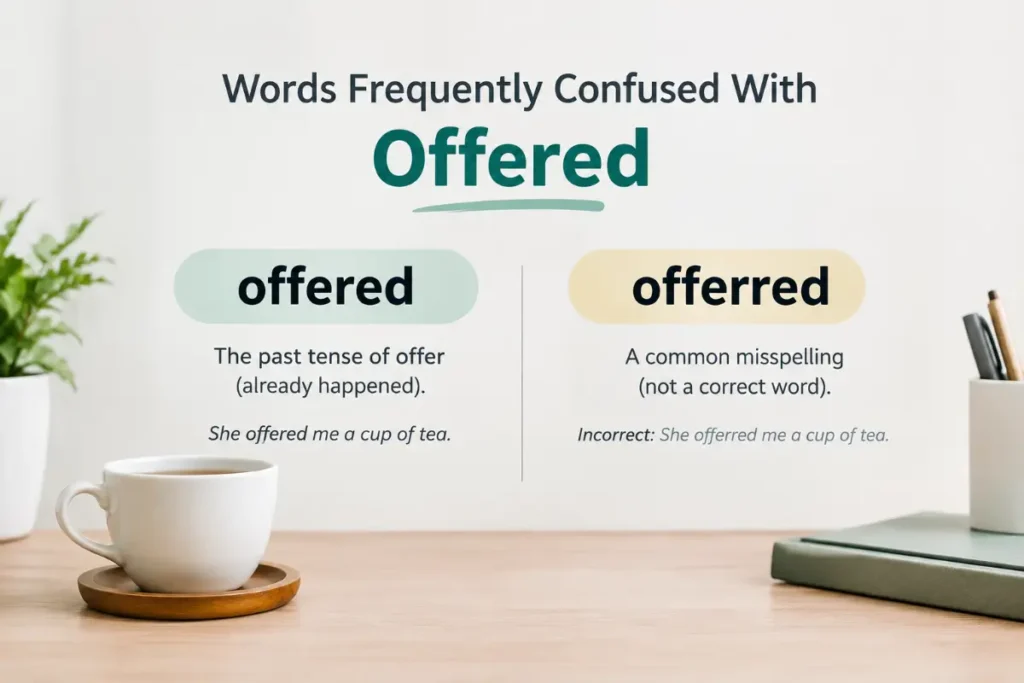
Words Frequently Confused With Offered
Several words can create confusion because they look or sound related.
Offered And Offered
There is no spelling variation to choose from here.
Offered is the standard form.
Offerred is an error.
Offered And Offering
These are different verb forms.
She offered help.
She is offering help.
The first describes a completed past action. The second describes an action in progress or a participial use.
Offered And Offers
These forms belong to different time structures.
She offers advice.
She offered advice.
The first is present tense. The second is past tense.
Offered And Offer
These forms also depend on the grammar around them.
They offer free delivery.
They offered free delivery.
They will offer free delivery.
After will, use offer, not offered.
Offered vs Offerred In Real Writing
The spelling choice becomes especially important when you move from isolated word exercises to real writing. A spelling mistake can be easy to miss in a short message because offerred looks plausible at first glance. In a professional document it can stand out much more clearly.
Offered In Emails
Use offered when writing to coworkers clients customers teachers or other professional contacts.
Examples include:
Thank you for the assistance you offered during the meeting.
I appreciate the opportunity you offered me.
The supplier offered us a better delivery date.
She offered to send the revised document this afternoon.
The spelling doesn’t change because the email is formal. It remains offered.
Offered In Academic Writing
Academic writers use offered in several ways.
For example:
The study offered a possible explanation for the results.
The researchers offered an alternative interpretation.
The theory offered a useful framework for understanding the issue.
Academic writing often favors precise verbs. In some sentences provided, suggested, or proposed might be more specific than offered. Still, when offer expresses the intended meaning, offered is the correct form.
Offered In Journalism
News writing also uses the word frequently.
Examples include:
The spokesperson offered no further explanation.
The organization offered financial assistance to affected residents.
The minister offered condolences to the families.
The company offered a response to the allegations.
Again, the standard spelling is offered.
Offered In Everyday Speech
The word is especially common in conversation.
He offered to pay.
She offered me a ride.
They offered us some food.
My friend offered to help.
Because the word appears so often in ordinary speech, learning its standard spelling gives you a useful everyday writing habit.
Offered And Sentence Structure
The verb can appear in several common sentence patterns. Knowing these patterns helps you avoid grammar mistakes as well as spelling mistakes.
Offered With An Object
You can use offered directly with a noun phrase.
She offered help.
He offered an explanation.
The company offered a discount.
Here the thing being offered follows the verb.
Offered With Two Objects
You can put the person receiving the offer before the thing being offered.
She offered me some advice.
He offered his friend a job.
The company offered customers a refund.
This pattern is common in everyday English.
Offered With To
You can also use to before the recipient.
She offered some advice to me.
The company offered a refund to customers.
This structure is grammatical and sometimes helps make a sentence clearer.
Offered To Plus A Verb
When someone volunteers to perform an action, use offered to + base verb.
He offered to help.
She offered to drive.
They offered to pay.
Don’t change the second verb into the past tense.
Incorrect:
He offered to helped.
Correct:
He offered to help.
The first verb carries the tense. The verb after to stays in its base form.
Offered And Punctuation
There is no special punctuation rule attached to offered itself.
Normal sentence punctuation applies.
For example:
She offered to help with the project.
He offered one suggestion, but the team chose another.
The manager offered a solution; however, the client wanted more options.
You don’t need an apostrophe or any unusual punctuation simply because the word is offered.
One useful point is worth remembering. Don’t confuse offered with a possessive form.
offered is a verb form.
offer’s is a contraction or possessive form involving offer.
They serve completely different purposes.
The Word Origin Of Offer
The modern English verb offer has a long history.
English received the word through French from Latin roots associated with presenting or bringing something forward. The Latin verb offerre meant to present or bring before someone. The modern English spelling developed through historical changes as the word passed through earlier forms of French and English.
The connection is still visible in related words such as offering.
The history also helps explain why modern English spelling can’t always be predicted perfectly from simple rules. English spelling reflects layers of linguistic history rather than one single spelling system.
For everyday writing you don’t need to know the full history to spell offered correctly. Still, understanding that English spelling developed over centuries can explain why similar looking verbs don’t always form their past tense in exactly the same way.
British American Canadian And Australian English
The spelling offered is standard across the major English varieties.
American English
The company offered me a position.
British English
The company offered me a position.
Canadian English
The company offered me a position.
Australian English
The company offered me a position.
There is no regional spelling such as offerred.
This point matters because English learners sometimes assume every spelling difference follows the same British and American pattern. It doesn’t.
Some words genuinely change spelling by region. Offered isn’t one of them.
Common Internet Searches About Offered
People often search for this spelling in slightly different ways.
Is Offerred A Word
No. Offerred isn’t the standard spelling of the past tense or past participle of offer.
Use offered.
Is Offered Spelled With Two Rs
No. Standard offered contains one r after the e.
The word has two f letters but only one r.
Why Is Offered Not Offerred
The past form is formed as offer + ed. English doesn’t simply double every final consonant before adding ed. The established standard form is offered.
Is Offered A Past Tense
Yes. Offered is the simple past form of offer.
She offered to help yesterday.
It is also the past participle.
She has offered to help.
Is Offered A Verb
Yes. Offered is a verb form. It is the simple past and past participle of the regular verb offer.
What Is The Difference Between Offer And Offered
Offer is the base form and present form used in several grammatical structures.
Offered is the past tense and past participle.
Compare:
They offer free delivery.
They offered free delivery yesterday.
Does British English Use Offerred
No. British English uses offered.
American English also uses offered.
Does Offered Need A Double R
No. The correct spelling is offered with one r.
Can I Use Offered In Formal Writing
Yes. Offered is completely appropriate for formal writing. It appears naturally in academic papers business documents reports journalism and professional correspondence.
What Is The Present Form Of Offered
The base form is offer.
Other forms include:
offer
offers
offering
offered
offered
The exact form depends on the grammar of the sentence.
Expert Editor’s Note
If I were proofreading a general article for an American audience, I’d use offered every time the writer means the past tense or past participle of offer.
I wouldn’t treat offerred as a regional variant. I also wouldn’t preserve it simply because it appears frequently in informal online writing. Repeated errors don’t become standard English through repetition.
Major learner dictionaries support the form offered. Cambridge lists it as the past simple and past participle of offer. Collins also gives offered as the past and participle form.
From an editing perspective, the practical rule is simple:
offer → offered
Don’t create offerred by copying the spelling pattern of referred or preferred.
If you’re editing student work, workplace writing, website copy, or formal documents, I’d correct offerred without hesitation.
Offered Vs Offerred Final Comparison
| Question | Answer |
|---|---|
| Which spelling is correct | Offered |
| Is offerred correct | No |
| Base verb | Offer |
| Past tense | Offered |
| Past participle | Offered |
| Present participle | Offering |
| Third person singular | Offers |
| Does the r double | No |
| Does the f remain doubled | Yes |
| American spelling | Offered |
| British spelling | Offered |
| Canadian spelling | Offered |
| Australian spelling | Offered |
| Formal writing | Offered |
| Informal writing | Offered |
The most useful pattern to memorize is:
offer → offers → offered → offering
Once that sequence becomes familiar, offerred starts to look as unusual as it actually is.
Frequently Asked Questions
Is Offered Or Offerred Correct
Offered is correct. Offerred is a misspelling. The verb offer forms its simple past and past participle by adding ed. The correct sequence is offer → offered. There is no standard English variety in which offerred is the accepted spelling.
Why Do People Spell Offered As Offerred
The mistake usually comes from confusion with verbs such as refer and prefer. Their past forms are referred and preferred. Because those words double the final r, writers sometimes apply the same pattern to offer. The standard past form is different: offer → offered.
Does Offered Have One R Or Two
Offered has one r. It has two f letters near the beginning and one r before ed. A useful visual pattern is offered. If you see offerred, the extra r is a spelling error.
Is Offerred Ever Correct In English
No. Offerred isn’t a standard spelling of the verb offer. It isn’t an accepted British or American variant. It also isn’t the normal spelling in Canadian or Australian English. For standard written English, use offered.
Is Offered The Past Tense Of Offer
Yes. Offered is the simple past form of offer.
For example:
She offered to help yesterday.
The company offered him a new position last month.
The same form also works as the past participle after auxiliary verbs.
She has offered to help.
Should I Write Offered To Help Or Offered To Helped
Write offered to help. After offered to, the verb that follows to stays in its base form. You don’t write offered to helped. The first verb already carries the past tense.
Is Offered A Regular Verb Form
Yes. Offer is a regular verb. Its past tense and past participle are both offered. The main forms are offer, offers, offering, and offered.
Is There A British Spelling Of Offerred
No. Offered is the standard spelling in British English as well as American English. There is no regional form offerred. This is a spelling issue rather than a British versus American English difference.
How Do You Pronounce Offered
In standard English offered is generally pronounced with two syllables. The first syllable receives the main stress. American and British pronunciations differ slightly in their vowel and final sounds but use the same spelling.
What Is An Easy Way To Remember Offered
Remember the simple formula offer + ed = offered. You can also remember that offer already contains the doubled f. There’s no need to add another r when forming the past tense.
For another common grammar confusion, see Whiny Vs Whiney Which Spelling Is Correct 2026.
Final Takeaway
The answer is straightforward:
Offered is correct.
Offerred is incorrect.
The word offered is the simple past and past participle of offer. It works naturally in casual conversation as well as professional and academic writing. It doesn’t change spelling between American British Canadian and Australian English.
The main trap is the spelling pattern of words such as referred and preferred. Those words can make an extra r seem tempting. Don’t let them lead you astray.
When you need the past form of offer, use this simple pattern:
offer → offered
One r is enough.
Once you remember that pattern, this small spelling trap becomes one less thing to second guess when you write.

Editorial Reviewer & Proofreader
Grace Mitchell reviews Gramlify’s articles for clarity, consistency, and readability. She is passionate about creating accurate, approachable content that helps English learners build confidence.