
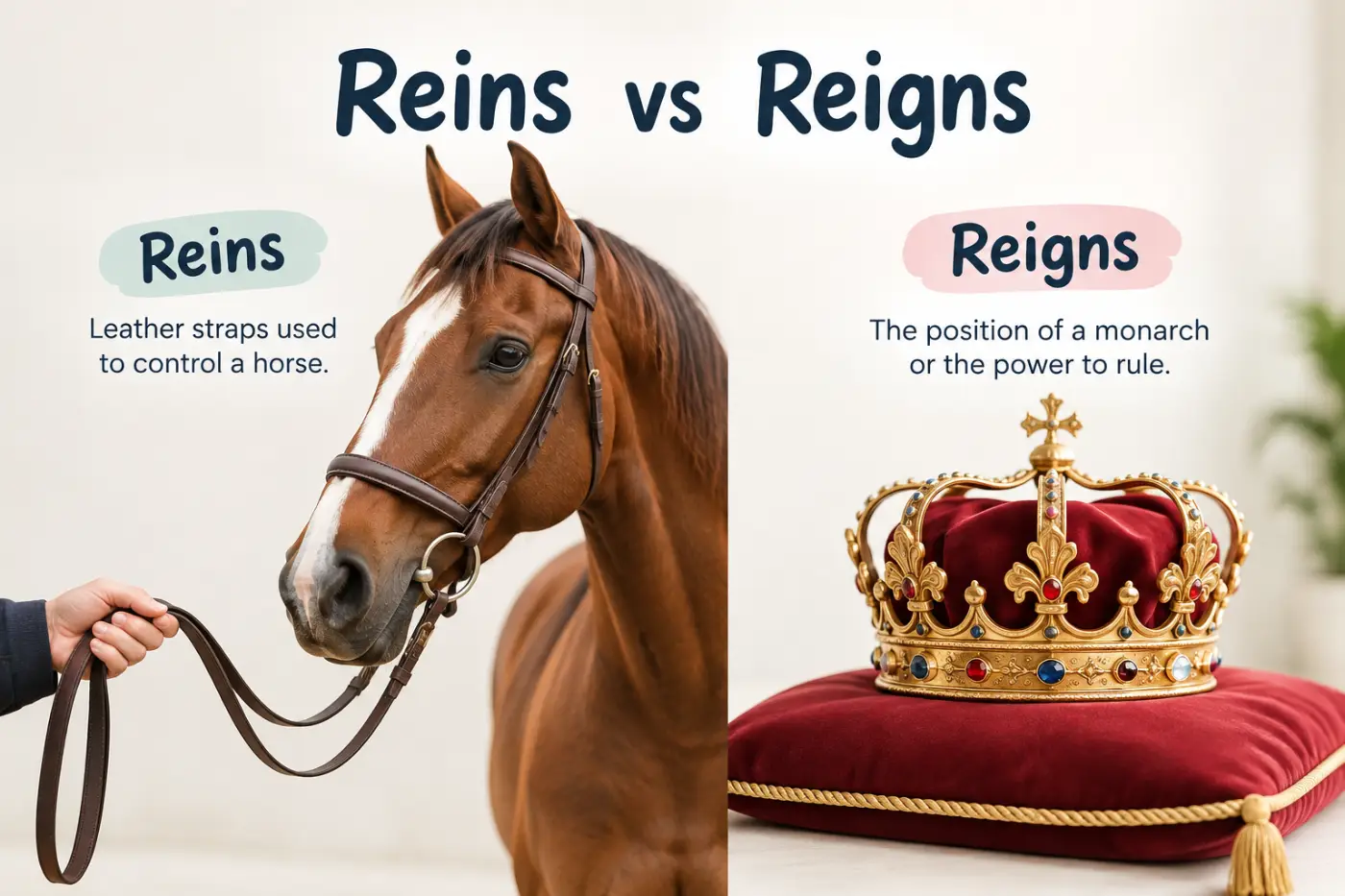
Reins vs reigns is a classic English word confusion because the two words sound exactly alike but have completely different meanings. If you write about riding a horse you need reins. If you write about a king or queen ruling a country you need reigns. The spelling changes the meaning completely.
The confusion comes from pronunciation. Both words are pronounced /reɪnz/. That means you can’t rely on sound alone when choosing the correct spelling. Context has to guide you.
This distinction matters in everyday writing as well as formal English. You might see phrases such as hold the reins and the king’s reign. You may also encounter figurative expressions such as take the reins or during her reign. Learning these common patterns makes the difference much easier to remember.
In this guide you’ll learn the exact meanings of reins and reigns. You’ll also see their grammar roles pronunciation spelling history common mistakes and practical examples. By the end you’ll know which word to choose without having to stop and think.
You may also want to read Deep Seated Vs Deep Seeded: Which One Is Correct (2026 Guide).
Quick Answer
Reins means the straps used to control a horse. Reigns is the plural of reign and refers to periods or acts of ruling. Both words sound the same but have different spellings meanings and uses. Use reins for horse control and reigns for royal or figurative rule.
Reins vs Reigns Comparison
| Feature | Reins | Reigns |
|---|---|---|
| Correct spelling | reins | reigns |
| Singular form | rein | reign |
| Basic meaning | Straps used to control a horse | Rule or period of rule |
| Part of speech | Usually plural noun | Plural noun or verb |
| Pronunciation | /reɪnz/ | /reɪnz/ |
| Main context | Horses and riding | Royal rule and leadership |
| Figurative use | Control or leadership | Rule or control |
| Common phrase | Hold the reins | During his reign |
| Related verb | Rein | Reign |
| Silent letter | No | g is silent |
| Common confusion | Sounds like reigns | Sounds like reins |
The easiest distinction is simple:
Reins are something a rider holds. Reigns are periods or acts of ruling.
What Does Reins Mean?
Reins is the plural form of rein. A rein is a long narrow strap attached to a horse’s bridle. A rider holds the reins to guide the horse and control its movement.
For example:
The rider pulled on the reins to slow the horse.
Here reins refers to actual riding equipment.
The word also has a common figurative meaning. In expressions about leadership and control the reins represent authority or responsibility.
For example:
Maya took the reins of the company after her father retired.
Maya isn’t holding horse straps. Instead the sentence compares leadership to controlling a horse. She has taken responsibility and authority.
This figurative use is extremely common in English. You can see it in business writing journalism conversation and everyday descriptions of leadership.
Reins As a Noun
Reins normally functions as a plural noun.
Examples include:
He dropped the reins during the ride.
She tightened the reins and guided the horse toward the gate.
The trainer handed the reins to the young rider.
The singular rein refers to one strap.
The rider adjusted one rein.
However people usually talk about the reins because a horse’s bridle normally has a pair of reins.
Reins In Figurative English
English often uses horse riding as a metaphor for control. That explains expressions such as:
Hold the reins means to be in control.
Take the reins means to take control or responsibility.
Hand over the reins means to give control to another person.
Keep a tight rein on something means to control something closely.
For example:
After the director retired Sarah took the reins.
The sentence doesn’t involve a horse. It describes Sarah taking control of an organization or project.
What Does Reigns Mean?
Reigns comes from the noun and verb reign.
As a noun reign means the period during which a monarch rules. It can refer to the time a king queen emperor or another sovereign holds power.
For example:
The queen’s reign lasted for several decades.
The plural reigns refers to more than one period of rule.
The museum displays portraits from the reigns of several kings.
Reigns can also be the third person singular form of the verb reign.
King Charles reigns as monarch.
Here reigns means rules.
That gives the word two important grammatical uses:
- Reigns as a plural noun means periods of rule.
- Reigns as a verb means rules.
This is one reason reigns can appear in sentences where reins would make no sense.
Reins vs Reigns Meaning
The meanings are completely different.
Reins relates primarily to controlling a horse. It also has a figurative meaning connected with control leadership and responsibility.
Reigns relates to ruling. It can describe a monarch’s period of power or the act of ruling.
Compare these sentences:
The rider pulled the reins.
The king reigns over the kingdom.
The first sentence concerns horse riding. The second concerns political or royal authority.
Now compare these figurative examples:
She took the reins of the project.
The new leader reigns over the organization.
The first sounds natural because take the reins is an established expression. The second can work in a poetic or figurative context but sounds much more dramatic because reign is strongly associated with monarchs and absolute authority.

Why People Confuse Reins and Reigns
The main reason is pronunciation.
Both words are pronounced /reɪnz/. They are homophones. Homophones are words that sound alike but have different meanings or spellings.
Other familiar homophones include:
right and write
there and their
brake and break
flower and flour
The same principle applies to reins and reigns. Your ear can’t tell you which spelling is correct.
Context does the work.
There are also several visual and language based reasons for confusion.
The Words Sound Identical
When someone says:
The king reigns.
and
Hold the reins.
you hear the same final sound.
That makes spelling especially important in writing.
The Words Share a Historical Connection to Control
Although the words have different modern meanings they can both appear in discussions about control. Reins can mean control through the figurative expression hold the reins. Reign means rule or authority.
That overlap can make the words feel related even when they aren’t interchangeable.
Autocorrect Cannot Always Understand Context
Spellcheck software may recognize both reins and reigns as valid words. It may not detect a mistake if you choose the wrong one.
For example:
The president took the reigns.
The sentence may pass a basic spelling check because reigns is a real English word. However the intended expression is took the reins.
This is why human understanding still matters. A spelling checker can confirm that a word exists. It can’t always determine that you’ve chosen the wrong word.
Which One Is Correct?
Both reins and reigns are correct words. The correct choice depends entirely on the meaning.
Use reins when you mean:
- Horse riding straps.
- Physical control of a horse.
- Figurative control or leadership.
Use reigns when you mean:
- Periods of royal rule.
- Multiple periods of leadership by monarchs.
- The verb meaning rules.
A quick test can help.
If you could replace the word with horse straps then choose reins.
If you could replace it with rules or periods of rule then choose reigns.
For example:
She held the reins tightly.
Could you say She held the horse straps tightly? Yes. So reins is correct.
Several kings had long reigns.
Could you say Several kings had long periods of rule? Yes. So reigns is correct.
This simple substitution test works surprisingly well.
Reins and Reigns Grammar
The grammar difference becomes easier once you look at the base words.
Rein is a noun.
Reins is its plural form.
Reign is both a noun and a verb.
Reigns can therefore be either a plural noun or a third person singular verb.
Rein As a Noun
The horse’s rein was loose.
Reins As a Plural Noun
The rider held the reins firmly.
Reign As a Noun
Her reign lasted fifty years.
Reigns As a Plural Noun
The reigns of the two monarchs were very different.
Reign As a Verb
The king reigns over the country.
This grammar distinction is important because reins does not normally function as a verb meaning rules.
You wouldn’t write:
The queen reins over the country.
You mean:
The queen reigns over the country.
Likewise you wouldn’t normally write:
He took the reigns.
The established expression is:
He took the reins.
Pronunciation Guide
Both words have the same pronunciation.
Reins: /reɪnz/
Reigns: /reɪnz/
Each word has one syllable.
The vowel sound is the same as the vowel sound in rain and reign.
The final sound is /nz/.
Because pronunciation doesn’t distinguish these words you can’t solve the spelling problem by saying them aloud. This is a textbook example of why English spelling can be tricky for learners.
A useful pronunciation group is:
rain
reign
rein
reins
reigns
These words have related or identical sounds but different meanings and spellings.
Reins vs Reigns Spelling Rules
There isn’t a complicated spelling rule that generates the two words. They are simply different words with different histories.
Rein is spelled with ei.
Reign is spelled with ei followed by gn.
The silent g in reign can cause trouble for English learners. The spelling looks more complex than the pronunciation suggests.
Compare:
rein → /reɪn/
reign → /reɪn/
reins → /reɪnz/
reigns → /reɪnz/
The g in reign is silent. The spelling reflects the word’s history rather than its modern pronunciation.
A Useful Spelling Pattern
Think of the words as two separate families.
Rein family
rein
reins
reining
Reign family
reign
reigns
reigned
reigning
This family approach helps prevent accidental mixing.
For example:
She is reining in the horse.
Here reining comes from rein.
But:
The king reigned for forty years.
Here reigned comes from reign.
The spelling difference remains even when the meanings are figurative.
Reins vs Reigns Word Origin
The two words have separate historical paths.
The Origin of Rein
Rein comes from Old French reine which developed from Latin retinere meaning to hold back or retain. The word entered English in the Middle English period in connection with horse riding.
That history fits its original physical meaning. A rein is something used to hold back guide or control a horse.
Over time English speakers developed a figurative sense of rein connected with restraint and control. That is why phrases such as rein in and hold the reins can now describe human behavior organizations and authority.
The Origin of Reign
Reign comes from Old French reigne and ultimately from Latin regnum meaning kingdom or royal power. It is related to Latin rex meaning king.
The history explains the word’s connection with monarchy government and authority.
English later developed figurative uses of reign. Writers can describe someone as reigning over a field or describe a champion’s reign as the period of dominance.
The two words therefore developed from different roots even though their modern pronunciation is identical.
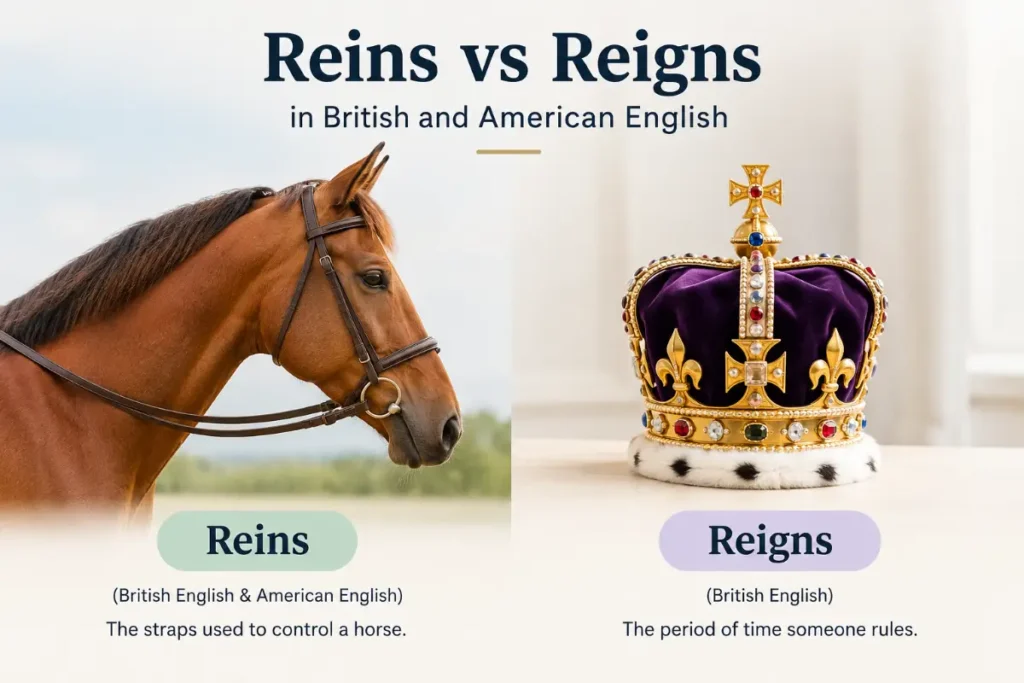
Reins vs Reigns in British and American English
The spelling difference is not a British versus American issue.
American English uses reins for horse riding and reigns for ruling.
British English does the same.
Canadian English and Australian English also use the standard distinction.
So you don’t need to memorize a regional spelling variation here.
For example both American and British writers would use:
The rider held the reins.
And:
The queen’s reign lasted for decades.
The main challenge is not regional spelling. It is choosing the correct word based on meaning.
Reins vs Reigns in Formal Writing
Formal writing requires the same distinction.
In academic history writing you will almost always see reign when the writer discusses a monarch’s period of power.
The reform was introduced during the king’s reign.
In business writing reins often appears in a figurative expression.
The new chief executive took the reins after the merger.
However editors should pay attention to tone. Take the reins is natural and familiar. It is also metaphorical. In highly formal academic writing a more direct phrase such as assumed leadership may be clearer.
That doesn’t make take the reins incorrect. It simply means the writer should consider the audience and purpose.
Reins vs Reigns in Figurative Language
The figurative uses are where advanced learners may encounter the greatest confusion.
Reins usually suggests control.
She took the reins of the campaign.
The image comes from a rider controlling a horse.
Reign usually suggests authority or dominance.
The company enjoyed a long reign as the market leader.
The image comes from a monarch ruling a kingdom.
The distinction can be summarized this way:
Reins suggest taking control.
Reign suggests exercising authority or enjoying dominance.
This isn’t an absolute rule because English has many creative uses. Still it provides a reliable mental framework.
A related grammar guide is Fair vs Good: What’s the Real Difference? (2026).
Common Mistakes With Reins and Reigns
Mistake One
She took the reigns of the company.
Incorrect when you mean the established expression about taking control.
Correct:
She took the reins of the company.
Mistake Two
The king began his reins in 1980.
Incorrect.
Correct:
The king began his reign in 1980.
Mistake Three
The queen reins over the kingdom.
Incorrect when you mean rules.
Correct:
The queen reigns over the kingdom.
Mistake Four
The rider pulled the reigns.
Incorrect.
Correct:
The rider pulled the reins.
Mistake Five
Several long reins shaped the nation’s history.
Incorrect.
Correct:
Several long reigns shaped the nation’s history.
Mistake Six
He handed over the reigns to his successor.
Incorrect in the common leadership expression.
Correct:
He handed over the reins to his successor.
Common Internet Misconceptions
One common misconception says that reins is the incorrect spelling and reigns is the proper version. That’s false. Both words are standard English words.
Another misconception says that reign is simply a fancy spelling of rein. It isn’t. The words have different meanings and different historical origins.
A third misconception is that pronunciation can reveal the correct spelling. It can’t. The two words are homophones.
A fourth misconception is that reigns always refers to a king or queen. The word is strongly associated with monarchy but English speakers can also use it figuratively to describe dominance.
For example:
She reigns as the world’s top scorer.
That sentence uses reigns metaphorically.
Reins vs Reigns Memory Tricks
A good memory trick should connect spelling with meaning rather than rely on a random rhyme.
Think Horse For Reins
Reins has the word rein at its core.
Picture a rider holding the reins of a horse.
You can remember:
Reins = riding.
Think Royal For Reigns
Reign is connected to kings queens and royal power.
You can remember:
Reigns = ruling.
Another useful connection is:
Reign sounds like rain.
Imagine a king ruling while rain falls over the kingdom. It isn’t a perfect linguistic mnemonic but the image can make the spelling easier to recall.
Use The Sentence Test
Ask yourself:
Am I talking about a horse or control?
Choose reins.
Ask:
Am I talking about ruling or a period of authority?
Choose reign or reigns.
This works better than memorizing isolated spellings.
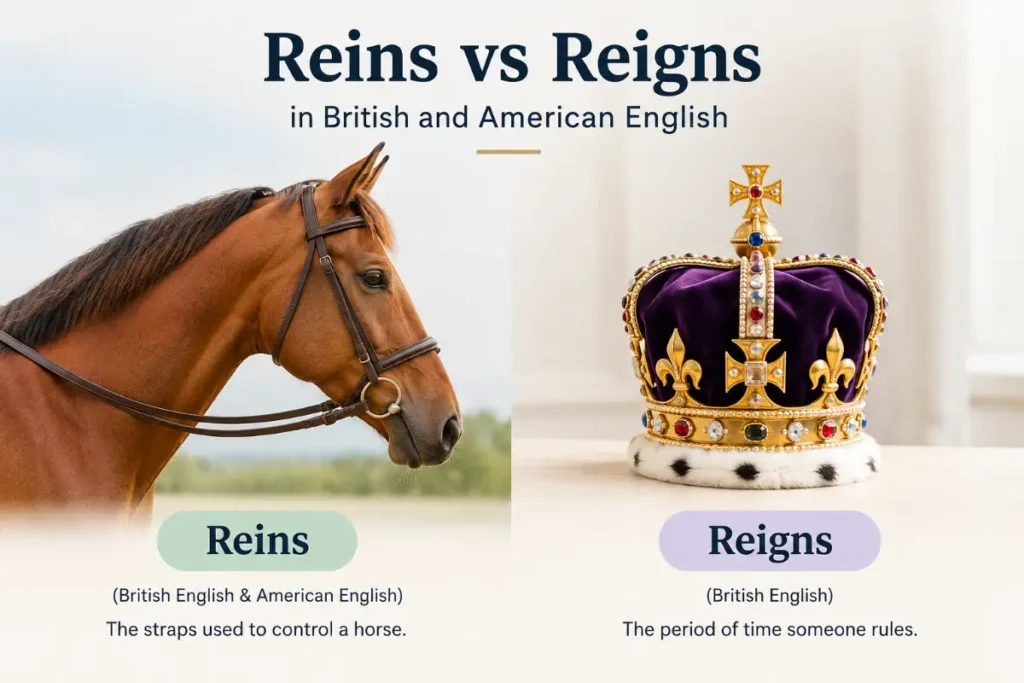
Reins vs Reigns and Related Words
Understanding nearby words can strengthen your vocabulary.
Words Related To Reins
rein
reins
reining
rein in
hold the reins
take the reins
hand over the reins
tight rein
The phrase rein in is especially useful. It means to control or limit something.
The company needs to rein in spending.
Notice that this phrase uses rein and not reign.
Words Related To Reign
reign
reigns
reigned
reigning
reign over
royal
monarch
kingdom
sovereign
ruler
For example:
She reigned for thirty years.
He reigns as champion.
The reigning champion defended the title.
The adjective reigning is especially common in sports.
Reins vs Reigns and The Word Rein In
Learners often confuse rein in with reign in.
The correct expression is rein in.
It comes from the physical idea of pulling on a horse’s reins to slow or control it.
For example:
The government needs to rein in inflation.
She tried to rein in her spending.
The manager had to rein in the team’s enthusiasm.
You don’t write reign in when you mean control or limit.
This is one of the most useful applications of the distinction because rein in appears frequently in news articles business writing and everyday English.
Reins vs Reigns and The Phrase Take The Reins
Take the reins means to take control or responsibility.
After the director resigned Maria took the reins.
The phrase can be used in leadership contexts such as business politics sports and family life.
For example:
His daughter took the reins of the family business.
The assistant coach took the reins after the manager left.
A new editor will take the reins next month.
You could replace the phrase with take control or assume leadership. However take the reins adds a vivid image and often sounds more conversational.
Reins vs Reigns and The Phrase During His Reign
During his reign refers to the time when a king or other ruler held power.
The country expanded rapidly during his reign.
The phrase is particularly common in historical writing.
The plural reigns is used when discussing multiple rulers or periods.
The museum covers the reigns of four monarchs.
Don’t use reins here. There is no connection to horse riding or the metaphor of taking control.
Reins vs Reigns in Literature
Writers often use both words because they carry strong imagery.
A literary writer might describe a character who takes the reins to show that the character becomes more confident or assumes control.
Another writer might describe a ruler’s reign to establish a historical setting.
The distinction is therefore more than a spelling issue. The words create different images.
Reins brings a horse and rider to mind.
Reign brings a ruler and kingdom to mind.
That mental picture is useful for both readers and writers.
Reins vs Reigns in Journalism
Journalists frequently use both words.
A political article might say:
The new leader took the reins after a difficult election.
A historical article might say:
The palace was built during the monarch’s reign.
A sports article might say:
The champion’s reign ended after a surprise defeat.
The sports example is figurative. It treats a champion like a ruler and a title like a kingdom.
Journalism favors these expressions because they communicate complex ideas quickly while adding vivid language.
Expert Editor’s Note
As an editor I’d treat reins and reigns as a context problem rather than a spelling problem.
Both spellings are legitimate. The question is which meaning the sentence requires.
When proofreading a manuscript I would first identify the intended meaning. If the sentence refers to horse equipment or uses the established metaphor of taking control then rein or reins is the right choice. If the sentence refers to royal rule a period of authority or dominance then reign or reigns is correct.
Major English dictionaries distinguish the words clearly. Standard dictionary definitions connect rein with a strap used to control a horse and with figurative control. They connect reign with ruling and a period of sovereignty.
Professional editors also pay attention to fixed expressions. Take the reins and rein in are established phrases. Replacing reins with reigns changes the spelling and creates an error.
Likewise during his reign and reigning monarch belong to the vocabulary of rule and authority.
The most reliable editing habit is simple. Don’t choose between these words by sound. Identify the meaning first and then choose the spelling.
A Simple Decision Guide
When you’re unsure which word to use ask these questions.
- Does the sentence involve a horse?
Use rein or reins.
- Does the sentence describe taking or maintaining control?
The figurative rein may be correct.
- Does the sentence describe a king queen monarch or period of rule?
Use reign or reigns.
- Does the sentence mean rules?
Use reigns for a third person singular subject.
- Does the phrase mean control or limit?
Use rein in.
- Does the sentence describe several periods of royal rule?
Use reigns.
This approach is faster and more reliable than trying to remember the spelling in isolation.
Reins vs Reigns In One Minute
If you only remember one part of this article remember these four forms.
Rein means a strap used to control a horse.
Reins means more than one rein and commonly refers to the pair used by a rider. It can also mean control in phrases such as take the reins.
Reign means rule or a period of rule.
Reigns can mean multiple periods of rule or can function as a verb meaning rules.
The pronunciation doesn’t help because reins and reigns sound exactly alike.
Meaning is the deciding factor.
Reins vs Reigns FAQs
Are reins and reigns pronounced the same?
Yes. Reins and reigns are homophones and are both pronounced /reɪnz/. The spelling changes but the pronunciation does not. This means you can’t hear the difference in ordinary speech. You need to use context to determine which spelling belongs in writing.
What is the difference between reins and reigns?
Reins refers to straps used to control a horse and can also mean control or leadership in figurative expressions. Reigns refers to periods of rule or acts of ruling. For example you hold the reins of a horse but a monarch reigns over a kingdom.
Is it take the reins or take the reigns?
The correct expression is take the reins. It comes from horse riding and means to take control or responsibility. Take the reigns is a common spelling mistake because reins and reigns sound identical. In professional writing always use take the reins.
Is it rein in or reign in?
The correct phrase is rein in. It means to control limit or reduce something. The expression comes from pulling on a horse’s reins to slow it down. For example you might say the company needs to rein in spending. Reign in is incorrect when you mean control or limit.
Is reign always related to a king or queen?
Not always. Reign is strongly associated with monarchs and royal rule but English also uses it figuratively. A sports champion can have a reign as title holder. A company can also be described as enjoying a long reign as an industry leader.
What does reigns mean in a sentence?
Reigns can have two main grammatical functions. It can be the plural noun meaning periods of rule as in the reigns of several kings. It can also be a verb meaning rules as in the queen reigns over the kingdom.
What does reins mean in a sentence?
Reins usually refers to the straps a rider uses to guide and control a horse. It also appears in figurative expressions. In she took the reins of the company the word means she took control. The phrase does not involve an actual horse.
Are reins and reigns British or American spellings?
Both reins and reigns are standard in British and American English. The distinction isn’t a regional spelling difference. British American Canadian and Australian English all use reins for horse equipment and reign for royal rule.
Can reigns be used as a verb?
Yes. Reigns is the third person singular present form of reign. For example the monarch reigns over the kingdom. The verb means rules or exercises sovereign authority. The past tense is reigned and the present participle is reigning.
Is reign related to royal?
Yes. The words are historically connected through the language of kingship and authority. Reign ultimately traces back to Latin terms associated with royal power and rule. Royal also has historical connections to the same broader family of words relating to kings and sovereignty.
How can I remember reins and reigns?
Use the simplest meaning connection. Think reins equals riding because a rider holds reins. Think reigns equals ruling because a monarch reigns. You can also remember rein in as the correct phrase for controlling or limiting something. These associations are more useful than trying to memorize spelling alone.
Two Useful Internal Linking Opportunities
After the introduction you could naturally link to an article about common English homophones and confusing words. That would help readers understand why words that sound alike can have different spellings and meanings.
Before the conclusion you could link to a related article about rein vs reign. That topic would give readers a closer look at the singular forms behind reins and reigns.
Need another quick comparison? Read Implicit Vs Complicit Differences Meanings And Correct 2026.
Conclusion
Reins and reigns are both correct English words. They simply do different jobs.
Use reins for horse riding and for figurative control. You’ll see it in expressions such as hold the reins, take the reins, and rein in.
Use reigns for multiple periods of rule or as the verb meaning rules. You’ll see it in phrases such as the reigns of several monarchs and the king reigns over the country.
The biggest trap is pronunciation. Both words sound exactly the same. That means your ears can’t solve the problem. Your understanding of the sentence has to do the work.
When in doubt picture the meaning. If you see a rider holding straps think reins. If you see a ruler exercising authority think reigns.
Remember the image and the spelling will follow.

Vocabulary & Language Research Writer
Ethan Parker researches English vocabulary, word meanings, slang, idioms, and commonly confused words. His goal is to help readers understand how English is actually used in everyday conversations and writing.