
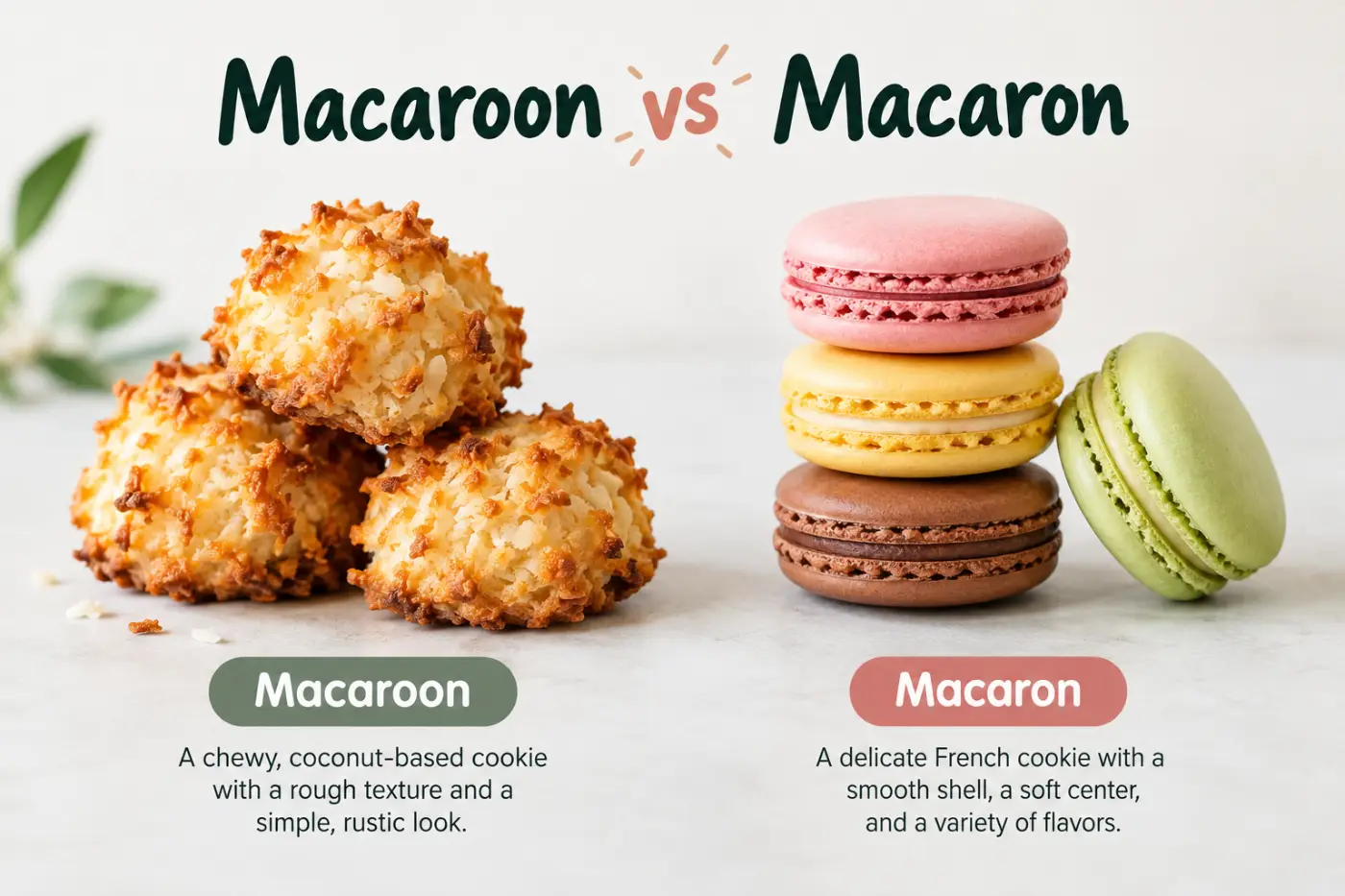
If you’ve ever wondered about macaroon vs macaron, you’re not alone. The two words look almost identical and share a long linguistic history. Yet in modern American English they usually refer to two different desserts. A macaron is the colorful sandwich cookie made from almond flour and meringue with a filling between two smooth shells. A macaroon is usually a rougher coconut based cookie or small cake.
The confusion gets worse because dictionaries sometimes use macaroon as a broader term and can even list the French style pastry as a meaning of the word. So the distinction isn’t as rigid in every variety of English as it may seem.
This guide explains the difference clearly. You’ll learn the correct spelling for each dessert, how to pronounce both words, where they came from, why people confuse them, how American English usually uses them, and which word to choose in recipes, menus, articles, and everyday conversation.
Learn the difference in Scrapped Or Scraped Which Word Is Correct 2026 Guide.
Quick Answer
Macaron usually means the French style sandwich cookie made with almond flour, egg whites, sugar, and a filling. Macaroon usually means a rough textured cookie made with coconut or almonds. Both spellings are correct, but they normally describe different desserts in modern American English.
Macaroon vs Macaron at a Glance
| Feature | Macaron | Macaroon |
|---|---|---|
| Correct spelling | macaron | macaroon |
| Main meaning | A French style sandwich cookie | A small coconut or almond cookie |
| Typical appearance | Two smooth round shells with filling | Rough textured mound or small cake |
| Common ingredient | Almond flour | Coconut or almonds |
| Texture | Crisp outside and chewy inside | Chewy and often moist |
| Filling | Usually yes | Usually no |
| Pronunciation | /ˌmæk.əˈrɑːn/ in US English | /ˌmæk.əˈruːn/ in US English |
| Part of speech | Noun | Noun |
| Common US usage | French style pastry | Coconut cookie |
| Origin | French culinary tradition | English form from French macaron |
| Plural | macarons | macaroons |
Cambridge gives macaron the meaning of a small light cake with two almond based halves and a creamy layer between them. It defines macaroon primarily as a biscuit or small cake with a rough texture made from ingredients such as coconut or almonds.
There is an important wrinkle. Cambridge also records macaroon as a term that can refer to the French style pastry. That broader use helps explain why you may see the words treated as synonyms in some dictionaries or older texts.
What Does Macaron Mean?
Macaron is a noun for a small French style pastry made from almond flour or finely ground almonds. Egg whites and sugar form the meringue based shells. Two round shells are usually joined with a filling such as buttercream ganache jam or another flavored cream.
In American English the word usually brings a very specific image to mind. Think of two smooth colorful shells with a creamy center.
You might see flavors such as:
- Pistachio.
- Raspberry.
- Chocolate.
- Vanilla.
- Lemon.
- Salted caramel.
- Coffee.
- Hazelnut.
Macarons can be tricky to make because the shells require careful mixing and baking. Small changes in technique can affect their texture shape and appearance.
For example:
I bought a box of chocolate macarons for the party.
Here macarons refers to the French style sandwich pastries.
Another example is:
The bakery sells pistachio macarons every Saturday.
Again the spelling macarons tells readers that you mean the small almond based sandwich pastry.
What Does Macaroon Mean?
Macaroon is a noun that usually refers to a small cookie or cake with a rougher texture. In American English the most familiar version is made with shredded coconut. Some versions contain almonds instead.
A traditional coconut macaroon often looks like a small mound rather than two perfectly shaped shells.
For example:
She brought a tray of coconut macaroons to the bake sale.
The word macaroons works because the cookies are the coconut based type.
You can also find chocolate dipped macaroons. Some recipes add condensed milk. Others use egg whites and sugar to create a lighter texture.
The key point is simple. Macaroon is usually associated with a coconut based cookie in American English.
Which One Is Correct?
Both macaron and macaroon are correct words.
The right choice depends on the dessert you mean.
Use macaron for the smooth French style sandwich pastry made from almond flour and filled between two shells.
Use macaroon for the rough textured cookie that is commonly made with shredded coconut.
For a US audience this distinction is especially useful because it matches the way many American readers understand the two terms.
Consider these examples:
I ordered six strawberry macarons.
Correct if you mean the colorful French style sandwich pastries.
I ordered six coconut macaroons.
Correct if you mean the coconut cookies.
The mistake isn’t usually that someone has invented a completely wrong word. The problem comes from choosing the wrong member of a very closely related pair.
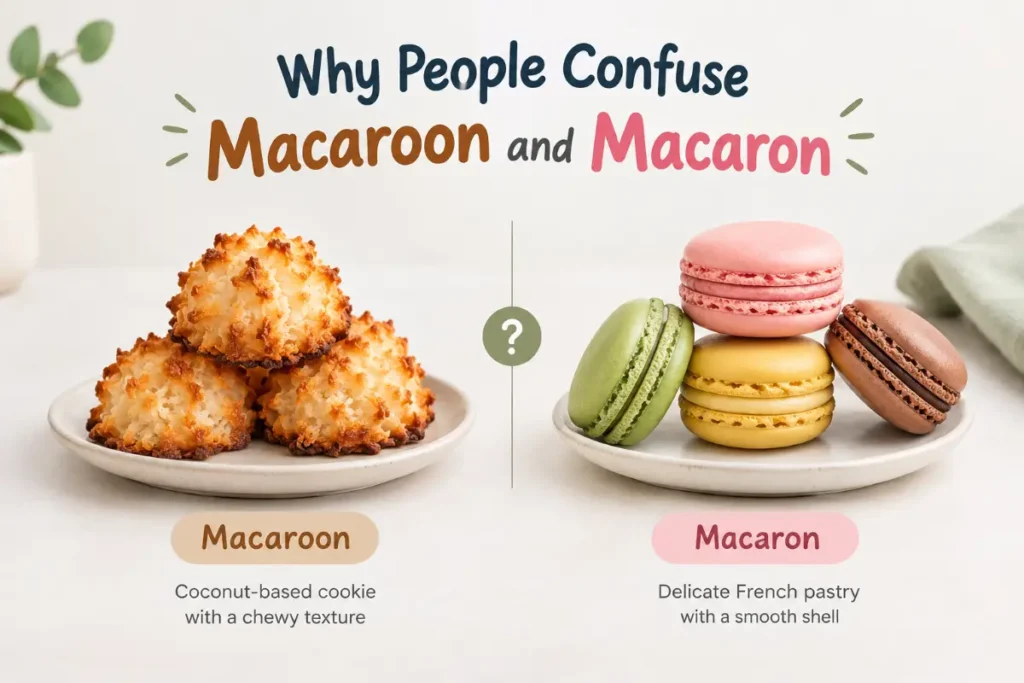
Why People Confuse Macaroon and Macaron
The confusion makes perfect sense once you look at the words.
They share the same opening letters.
macaron
macaroon
Only a small part of the spelling changes. The final vowel sound also changes. That makes the words easy to mix up when someone has heard them in conversation but hasn’t seen them written often.
There is another reason for the confusion. The two words are historically connected. Macaroon entered English from French macaron and ultimately traces back to an Italian word related to macaroni.
So these aren’t random words that happen to look alike.
They are linguistic relatives.
That shared history explains why dictionaries and historical sources don’t always present the distinction in exactly the same way modern American speakers do.
Visual Similarity
The spelling difference is tiny.
macaron ends in on.
macaroon ends in oon.
When you’re typing quickly it’s easy to add the extra o. The reverse mistake is also possible.
A writer might remember the sound of the word but not its spelling. That can lead to a form such as macaroon when the intended meaning is the French sandwich pastry.
Pronunciation Similarity
The words sound similar at the beginning.
Both start with something close to:
mack uh
The endings separate them.
macaron ends with an on sound.
macaroon ends with an oon sound.
Cambridge gives the US pronunciation of macaron as /ˌmæk.əˈrɑːn/ and macaroon as /ˌmæk.əˈruːn/.
That final sound is a useful clue.
Keyboard Mistakes
Typing can make the problem worse.
If you know the dessert but rarely write the word you may type the more familiar form automatically. Spellcheck may not catch the error because both macaron and macaroon are legitimate English words.
That’s an important editing lesson.
A spelling checker can tell you that a word exists. It can’t always tell you that you’ve chosen the wrong word for your meaning.
Internet Influence
Food blogs social media posts restaurant menus and recipe sites use both terms heavily. Readers may encounter inconsistent spelling from one page to another.
That can create the impression that macaron and macaroon are simply alternative spellings.
In some contexts they can overlap. In modern US usage however they usually point to different styles of dessert.
The Key Difference Between Macaron and Macaroon
The easiest way to remember the distinction is to focus on shape and texture.
A macaron usually has two smooth shells with filling in the middle.
A macaroon is usually a rougher cookie made with coconut.
That gives you a practical mental picture:
Macaron = smooth sandwich pastry.
Macaroon = coconut cookie.
The spelling follows the meaning in most modern American writing.
Macaron Appearance and Texture
A classic macaron has two rounded shells.
The outside should have a smooth surface. The edges may develop the characteristic ruffled base often called the feet. The inside tends to be soft and chewy while the outside provides a delicate shell.
The filling sits between the two halves.
This structure is one of the easiest ways to identify a macaron.
Macaroon Appearance and Texture
A typical macaroon has a much rougher appearance.
Shredded coconut often gives the cookie a textured surface. The cookie may be shaped into a mound and baked until the outside develops a light golden color.
The inside can remain soft and chewy.
Some macaroons are dipped in chocolate or drizzled with chocolate after baking.
So if you’re looking at a coconut mound rather than a colorful sandwich pastry you’re probably looking at a macaroon.
Macaron vs Macaroon Pronunciation
Pronunciation is another useful way to separate these words.
How to Pronounce Macaron
In US English Cambridge gives macaron as:
/ˌmæk.əˈrɑːn/.
You can think of it roughly as:
mack uh RON
The strongest stress falls toward the final syllable.
The word has three syllables:
mac a ron
The final sound is the important clue.
How to Pronounce Macaroon
Cambridge gives the US pronunciation of macaroon as:
/ˌmæk.əˈruːn/.
A simple approximation is:
mack uh ROON
Again there are three syllables:
mac a roon
The final sound is a long oo sound.
That gives you a handy listening test.
If the ending sounds like ron you probably mean macaron.
If it sounds like roon you probably mean macaroon.
Macaron vs Macaroon Grammar
Both words are nouns.
They normally refer to food items and can be used as countable nouns.
For one item:
I ate one macaron.
I ate one macaroon.
For multiple items:
I ate three macarons.
I ate three macaroons.
The plural is formed with the standard English ending s.
Singular Forms
The singular forms are:
macaron
macaroon
Both can appear after determiners such as a, one, this, and that.
Examples:
I bought a macaron.
She baked a macaroon.
That macaron has a raspberry filling.
This macaroon contains coconut.
Plural Forms
The plural forms are:
macarons
macaroons
Examples:
The bakery sells colorful macarons.
We made chocolate macaroons.
Notice that the spelling difference stays in the plural.
Don’t change macaron into macaroons unless you’re actually changing the word itself.
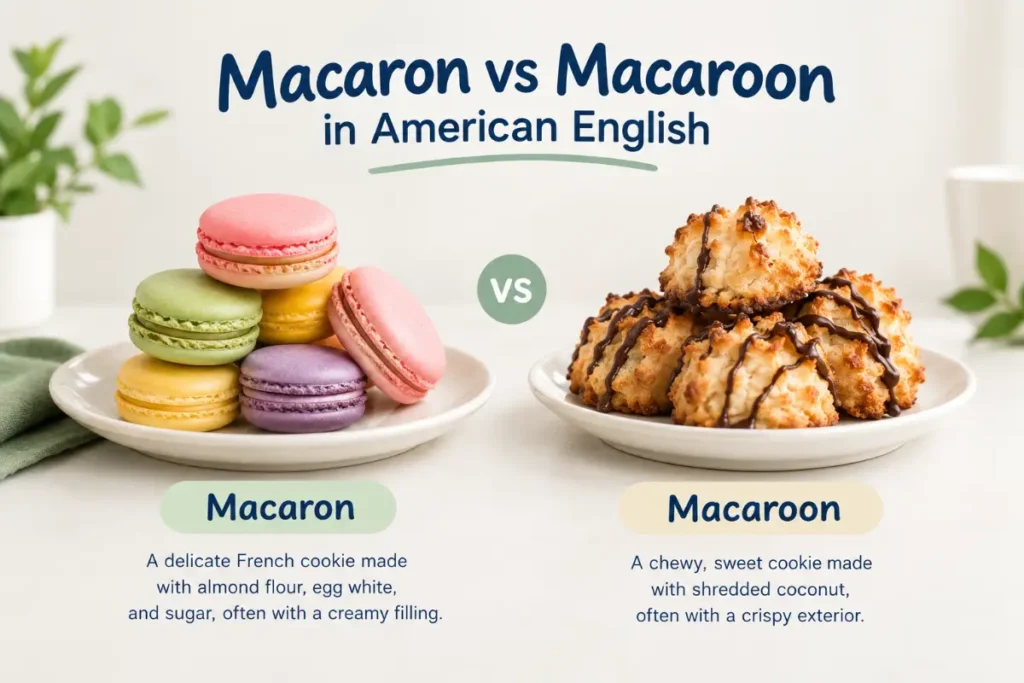
Macaron vs Macaroon in American English
For an American audience the distinction is fairly practical.
If you’re writing a recipe for the French style pastry use macaron.
If you’re describing a coconut cookie use macaroon.
American readers will generally understand the difference from context. Still, precise spelling makes the writing clearer.
For example:
Easy Chocolate Macaron Recipe.
This title suggests a recipe for the almond flour sandwich pastry.
Compare:
Easy Chocolate Coconut Macaroon Recipe.
The second title clearly describes the coconut cookie.
That extra precision matters in recipe titles because readers often search by the exact food they want to make.
Are Macarons French?
The modern macaron is strongly associated with French pastry culture.
The French word macaron refers to a small round almond based cake. Larousse traces the French word to the Venetian form macarone and defines the pastry as a small round cake made with ground almonds egg whites and sugar.
The modern French macaron became especially associated with pastry shops and regional traditions in France.
However, the history isn’t as simple as saying that France invented every form of the dessert in its modern shape.
The word has a much older and more complicated journey through European languages and food traditions.
Are Macaroons French?
The English word macaroon came through French macaron.
Etymonline dates the English noun macaroon to the 1610s and explains that it came from French macaron, which itself came from dialectal Italian maccarone.
This is one reason the two words look so closely related.
The English ending oon also played a role. Etymonline notes that oon was a conventional English spelling pattern used in earlier centuries when borrowing certain French nouns ending in stressed on.
In other words, the spelling macaroon wasn’t simply a modern mistake.
It has a genuine history in English.
Macaroon vs Macaron Etymology
The history of these words is surprisingly interesting.
The family tree reaches back through French and Italian.
The English word macaroon comes from French macaron. The French form is linked to dialectal Italian maccarone. Etymonline connects that Italian word with the history of macaroni.
The exact deeper origin is less certain.
Etymonline notes possible connections with an Italian verb meaning to bruise batter or crush. It also mentions a possible connection with Late Greek makaria, referring to food made from barley. The deeper origin remains uncertain.
That uncertainty is worth preserving in good language writing.
A responsible etymology doesn’t turn a possible connection into a proven fact.
From Italian to French
The historical path can be summarized like this:
Italian dialectal maccarone → French macaron → English macaroon
The food meanings also changed and developed along the way.
French macaron became associated with the almond based pastry.
English macaroon developed as the English form for a small sweet cake or cookie.
That history helps explain why today’s two words remain so close.
How Macarons and Macaroons Differ in Recipes
The ingredients provide another strong clue.
A classic macaron recipe typically relies on:
- Almond flour or finely ground almonds.
- Egg whites.
- Sugar.
- A filling.
The shells are carefully prepared so they form a smooth surface and a chewy interior.
A macaroon recipe often relies on:
- Shredded coconut.
- Egg whites.
- Sugar.
- Sometimes condensed milk.
- Sometimes almonds.
- Sometimes chocolate for dipping.
Recipes vary widely. Still, the almond flour shell and sandwich structure strongly point toward macaron, while the coconut mound strongly points toward macaroon.
A related grammar guide is Afterward Vs Afterword Which Word Is Correct 2026.
Macaron Ingredients
Almond flour plays a central role in the classic French style macaron.
The mixture must be handled carefully. Bakers often fold the ingredients to a specific consistency so the batter spreads properly without becoming too thin.
The shells are then piped into small rounds.
After baking the shells are paired and filled.
This process explains why macarons are often considered technically demanding.
Macaroon Ingredients
Coconut is the ingredient most strongly associated with American style macaroons.
The mixture usually has a more rustic consistency. You don’t need the same smooth shell structure or filling technique used for macarons.
That’s why macaroons often feel more homey and straightforward.
They may look imperfect.
That’s part of their charm.
Twenty Real Life Examples of Macaron and Macaroon
Seeing the words in natural sentences makes the difference easier to remember.
Daily Conversation
- I picked up a box of vanilla macarons on my way home.
- These coconut macaroons are surprisingly soft.
- Which macaron flavor do you like best?
- My grandmother used to make chocolate dipped macaroons.
- I tried a pistachio macaron for the first time yesterday.
Workplace and Business Writing
- The bakery introduced three new macaron flavors this month.
- We ordered assorted macaroons for the office event.
- The pastry chef demonstrated how to make French macarons.
- The product line includes coconut macaroons and chocolate cookies.
- Please label the raspberry macarons separately from the coconut macaroons.
Emails and Messages
- Could you bring a few macarons to the meeting?
- I left the macaroons in the kitchen for everyone.
- The client sent us a beautiful box of macarons.
- I’ll bring homemade coconut macaroons tomorrow.
Academic and Formal Writing
- The study examined consumer preferences for French style macarons.
- The recipe uses shredded coconut to produce traditional style macaroons.
- The two terms have related historical origins but different modern uses.
- The distinction between macaron and macaroon can create confusion for English learners.
Journalism and Food Writing
- The new pastry shop specializes in brightly colored macarons.
- The café serves toasted coconut macaroons with dark chocolate.
- The chef created a seasonal pumpkin spice macaron.
- The bakery’s almond macaroons have a crisp exterior and soft center.
These examples show something important.
You don’t need to memorize a long grammar rule. You need to connect each spelling with the dessert it normally describes.
Common Mistakes With Macaron and Macaroon
Using Macaroon for the French Sandwich Cookie
This is probably the most common mistake in modern US writing.
Someone may write:
I bought a box of French macaroons.
The sentence isn’t necessarily impossible. Dictionaries can use macaroon more broadly and some historical usage overlaps with macaron.
Still, if you’re writing for a contemporary American audience and mean the smooth almond based sandwich pastry, macarons is the clearer choice.
Using Macaron for a Coconut Cookie
The reverse mistake also happens.
For example:
Grandma made coconut macarons.
A reader may understand what you mean because coconut supplies strong context.
However, coconut macaroons is the conventional American expression for that dessert.
Treating the Words as Simple Spelling Variants
This is another common misunderstanding.
The words are historically connected and can overlap in some dictionary definitions. Yet modern usage often gives them separate culinary meanings.
So it’s better to think of them as related words with different common meanings rather than as two spellings of exactly the same thing.
Assuming the Extra O Is Always Wrong
The spelling macaroon isn’t a misspelling of macaron.
It’s an established English word with centuries of history. Etymonline records the English noun from the early 1600s.
The real question isn’t which spelling looks more correct.
The real question is which dessert you’re describing.
Macaron vs Macaroon in Dictionaries
Dictionary definitions deserve careful attention because they reveal why this pair can be confusing.
Cambridge defines macaron as the small almond based pastry with two round halves and a creamy layer.
For macaroon, Cambridge first gives the rough textured biscuit or small cake made from eggs sugar and coconut or almonds. It also records the French style pastry as another meaning and lists macaron as a synonym in that sense.
That means an editor shouldn’t claim that macaroon is always wrong for the French pastry.
That would be too absolute.
Instead, the practical editorial rule is this:
Use macaron for the French style sandwich pastry when writing for a modern US audience. Use macaroon for the coconut or almond cookie.
This approach respects both dictionary evidence and current usage.
British English and Macaron vs Macaroon
British English can show broader overlap between the terms.
The historical word macaroon has long been part of English. At the same time macaron is widely recognized for the French style pastry.
Cambridge’s British entry gives macaron as the almond based pastry and also records macaroon with both the rough cookie meaning and the French pastry meaning.
For writers the safest approach is still context.
If you’re discussing the modern French pastry use macaron.
If you’re discussing a coconut cookie use macaroon.
That distinction works clearly for international readers.
Canadian English and Australian English
English speaking regions can share the same general distinction while showing local variation in food terminology.
The French style pastry is commonly called a macaron in English language food writing.
The coconut cookie is commonly called a macaroon.
Regional dictionaries may differ in how broadly they define macaroon, but the spelling difference remains useful for clear writing.
For international content the most reader friendly approach is to describe the food when ambiguity matters.
For example:
French almond macarons with vanilla filling.
Or:
Coconut macaroons dipped in dark chocolate.
The added ingredient or style makes the meaning crystal clear.
Macaron vs Macaroon in Formal Writing
Formal writing benefits from precision.
If you’re writing an article menu recipe academic assignment or professional food description don’t rely on context alone when the distinction matters.
Use the standard term for the food you’re describing.
For example:
The bakery specializes in French macarons.
is clearer than:
The bakery specializes in French macaroons.
Likewise:
The recipe produces chewy coconut macaroons.
is clearer than:
The recipe produces chewy coconut macarons.
The first sentence in each pair gives the reader an immediate mental picture.
Macaron vs Macaroon in Informal Writing
Informal writing gives you more flexibility.
If someone says:
I got some macaroons from the bakery.
The listener can usually understand the general meaning from the conversation.
Food writers however have more reason to be precise.
Recipe searches product descriptions menu labels and food reviews depend on clear terminology. A small spelling difference can change what readers expect to receive.
Memory Tricks for Macaron and Macaroon
You don’t need a complicated mnemonic.
Try this one:
Macaron has one O near the end because it’s the smooth sandwich pastry.
Macaroon has two Os because it sounds like the longer oo sound at the end.
You can also connect the words to texture.
Macaron = smooth shells.
Macaroon = coconut texture.
Another useful trick is to remember:
Macaron sounds like ron.
Macaroon sounds like roon.
That final sound matches the spelling difference.
A Visual Memory Trick
Picture two desserts.
First picture two colorful circles joined by cream.
Label them:
macaron
Then picture a rough coconut mound.
Label it:
macaroon
The visual contrast is strong enough that you may remember the words without thinking about the spelling rules at all.
Related Words and Expressions
The macaron and macaroon family connects with several related food words.
Macaroni
Macaroni is a type of pasta shaped like small tubes. Cambridge defines it as pasta in the form of small tubes.
Despite the similar spelling the modern food is completely different from a macaron or macaroon.
For example:
We had macaroni and cheese for dinner.
Don’t confuse this with:
We had coconut macaroons for dessert.
The words share historical roots but refer to different foods.
Almond Cookie
Almond cookie is a broader description.
It can refer to several types of cookies made with almonds.
A macaron is a more specific pastry.
Need another quick comparison? Read Principal vs Principle (2026 Guide).
Coconut Cookie
Coconut cookie is also broader than macaroon.
A coconut macaroon is one type of coconut cookie.
This distinction can help in recipe writing.
Expert Editor’s Note on Macaron and Macaroon
If I were proofreading an article for a US audience I’d make the distinction based on meaning rather than treating one spelling as correct and the other as incorrect.
For the French style almond based sandwich pastry I’d use macaron.
For the coconut based cookie I’d use macaroon.
I’d also avoid telling readers that macaroon is simply the wrong spelling of macaron. Dictionary evidence doesn’t support such an absolute claim. Cambridge records broader usage for macaroon and even gives the French style pastry as one of its meanings.
Historical evidence supports that flexibility too. The English word macaroon has been established for centuries and came through French from an Italian source related to the history of macaroni.
So the strongest editorial advice is practical.
Match the spelling to the food and the audience.
For modern American food writing that usually means:
macaron for the French sandwich pastry.
macaroon for the coconut cookie.
That rule is clear accurate and easy for readers to apply.
What Dictionaries Say About the Difference
Dictionary evidence gives us a useful picture of modern usage.
Cambridge defines macaron as a small light cake made from egg white sugar and almonds with two round halves and a creamy layer between them.
Cambridge defines macaroon first as a biscuit or small cake with a rough texture made from eggs sugar and coconut or almonds. It also records a second meaning for the French style pastry.
Larousse defines French macaron as a small round cake made with ground almonds egg whites and sugar.
The historical evidence from Etymonline connects English macaroon with French macaron and dialectal Italian maccarone.
Together these sources show why the words are both related and distinct.
Good editing respects both sides of that story.
Why Macaron Is Usually Better for the French Pastry
Modern American readers increasingly expect macaron when a writer means the colorful French sandwich pastry.
That spelling is also more precise.
Consider a recipe title:
French Macaron Recipe.
A reader immediately expects almond based shells with filling.
Now compare:
French Macaroon Recipe.
The title may still be understood but it can create uncertainty because macaroon commonly refers to a coconut cookie in American English.
When clarity matters precision wins.
Why Macaroon Is Usually Better for Coconut Cookies
The same principle works in reverse.
If the recipe contains shredded coconut and forms small rough mounds then macaroon is the natural choice.
For example:
Easy Coconut Macaroons.
That phrase is immediately clear to an American reader.
You don’t need to explain the word.
You don’t need to add a long definition.
The conventional term does the work for you.
A Simple Decision Rule
When you’re unsure which word to use ask yourself one question:
What does the dessert look like?
If it has two smooth almond based shells with filling in the middle use macaron.
If you’re discussing historical English usage or a source that uses the terms more broadly then macaroon may appear for the French style pastry too.
This simple rule handles most modern writing situations.
Frequently Asked Questions
Is macaron or macaroon correct?
Both are correct words. Macaron usually refers to the French style sandwich pastry made with almond flour or ground almonds. Macaroon usually refers to a rough textured cookie made with coconut or almonds. The distinction is especially useful in modern American English. Some dictionaries also record macaroon as a broader term for the French style pastry.
Are macarons and macaroons the same thing?
They can refer to different desserts. A macaron usually has two smooth almond based shells with filling between them. A macaroon is usually a rougher cookie often made with coconut. The words share a historical connection so dictionary definitions can overlap. In modern US food writing however the two spellings usually help readers distinguish the desserts.
How do you spell the French cookie?
The usual spelling is macaron. The plural is macarons. The word describes the small French style pastry made from almond based shells with a filling between them. Cambridge uses macaron for this meaning and gives separate pronunciation information for the word.
How do you spell the coconut cookie?
The usual spelling is macaroon. The plural is macaroons. In American English this word commonly refers to a rough textured cookie made with coconut. Some versions contain almonds instead or include chocolate. Cambridge gives this coconut or almond cookie meaning as the main definition of macaroon.
Why are macaron and macaroon spelled differently?
The words have a shared history but developed into different English forms. Macaroon came into English through French macaron and ultimately traces back to an Italian form related to maccarone. The English oon ending reflects an older spelling pattern used in borrowed words.
How do you pronounce macaron?
In US English Cambridge gives macaron as /ˌmæk.əˈrɑːn/. A simple approximation is mack uh RON. The final sound is different from macaroon. British English has a different vowel in the final stressed syllable but follows the same basic distinction.
How do you pronounce macaroon?
In US English Cambridge gives macaroon as /ˌmæk.əˈruːn/. You can think of it as mack uh ROON. The long oo sound in the final syllable matches the spelling with oo.
Is macaroon an incorrect spelling of macaron?
No. Macaroon is an established English word with a long history. It isn’t simply a misspelling. It normally refers to a coconut or almond cookie in modern American usage. Some dictionaries also record the word for the French style pastry so the two terms have some overlap.
Why do people call macarons macaroons?
The words look and sound similar and share historical roots. In addition some dictionaries recognize overlapping meanings. That makes macaroon a natural substitution for people who know the dessert by sound but aren’t familiar with the modern spelling distinction. For precise US food writing macaron is the better choice for the French sandwich pastry.
Is a macaron made from coconut?
A classic macaron is based on almond flour or finely ground almonds rather than shredded coconut. Egg whites and sugar form the shells and a filling joins the two halves. Coconut is strongly associated with macaroons instead. Recipes can vary but the almond based French style pastry is the standard meaning of macaron.
Is a macaroon made from almonds?
It can be. Cambridge describes macaroons as cookies or small cakes made from coconut or almonds. In American usage coconut is the ingredient most people associate with the word. So an almond macaroon can be correct while still being different from the classic French style macaron.
Final Takeaway
The difference between macaron vs macaron is not a simple case of one spelling being right and the other being wrong.
The correct pair is:
Macaron = the French style almond based sandwich pastry.
Macaroon = the rougher cookie commonly made with coconut.
Both words are legitimate English. They also share a long linguistic history. Dictionary evidence shows that their meanings can overlap in some contexts so an absolute rule would be misleading.
For modern American writing however the practical choice is easy.
If you’re describing two smooth shells with filling use macaron.
If you’re describing a chewy coconut cookie use macaroon.
Once you connect each spelling with its shape and texture the confusion largely disappears.
Remember the dessert first and the spelling will follow.

Vocabulary & Language Research Writer
Ethan Parker researches English vocabulary, word meanings, slang, idioms, and commonly confused words. His goal is to help readers understand how English is actually used in everyday conversations and writing.