
Many English learners and writers pause when they see specialty or speciality because both spellings look correct. The confusion becomes stronger because both forms appear in dictionaries, professional writing, and everyday conversations.
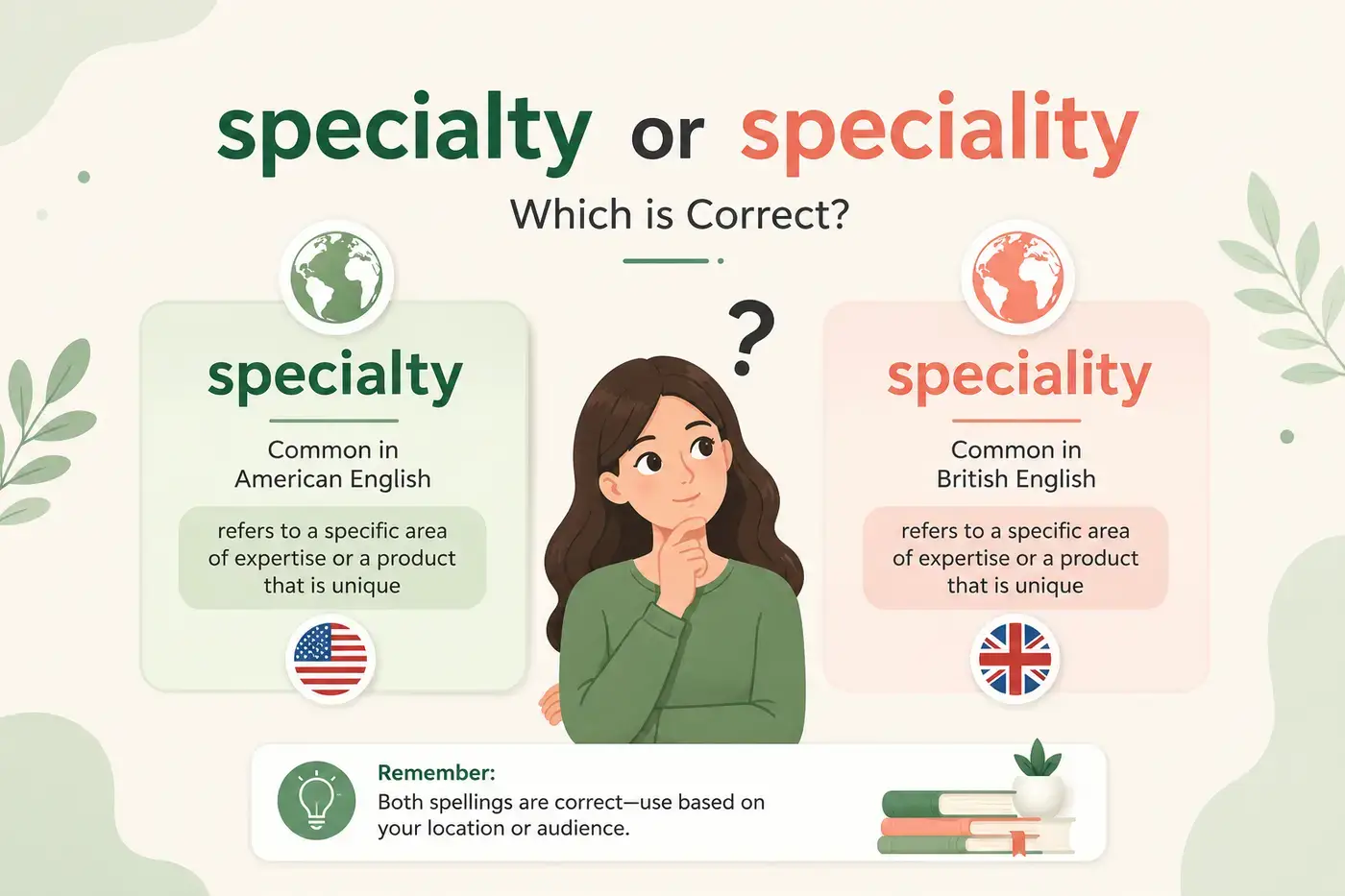
The good news is simple. Both specialty and speciality are correct English words. The main difference is where they are commonly used. Specialty is the preferred spelling in American English, while speciality is more common in British English and several other varieties of English.
The two words have the same basic meaning. They describe a special skill, area of knowledge, product, service, or subject where someone has extra expertise. The choice usually depends on the style of English you are writing or speaking.
In this guide, you’ll learn the difference between specialty or speciality, their meanings, grammar rules, pronunciation, word origins, regional usage, common mistakes, and examples that show native speakers use both forms naturally.
Many readers also check Passtime Or Pastime Which Spelling Is Correct 2026.
Quick Answer
Specialty and speciality are both correct spellings. American English usually prefers specialty, while British English often uses speciality. Both words mean a special area of skill, knowledge, or expertise. Choose the spelling that matches your audience and style of writing.
Specialty Or Speciality Comparison Table
| Feature | Specialty | Speciality |
|---|---|---|
| Correct spelling | Yes | Yes |
| Main region | American English | British English |
| Meaning | A special skill, product, field, or area of expertise | A special skill, product, field, or area of expertise |
| Part of speech | Noun | Noun |
| Pronunciation | Usually pronounced the same | Usually pronounced the same |
| Formal writing | Common in American writing | Common in British writing |
| Common contexts | Medicine, business, food, education | Medicine, business, food, education |
| Example | Cardiology is her specialty. | Cardiology is her speciality. |
What Does Specialty Mean
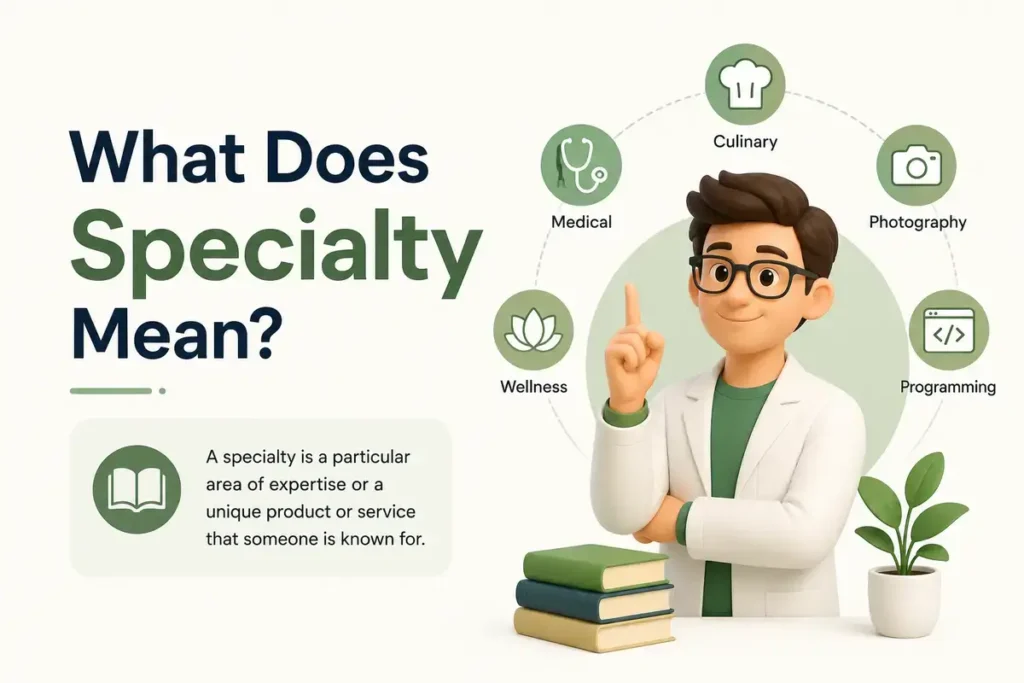
Specialty is a noun that refers to a particular area where someone has special knowledge, training, talent, or experience.
It can describe a person’s professional focus, a unique product, or something a place is known for.
Simple Definition
A specialty is something someone does especially well or a specific area of expertise.
Examples Of Specialty Usage
- Teaching is her specialty.
- The restaurant’s specialty is homemade pasta.
- Heart surgery is his medical specialty.
- Digital marketing has become my specialty.
- The bakery is famous for its chocolate cake specialty.
The word appears often in American English, especially in professional settings.
What Does Speciality Mean
Speciality has the same meaning as specialty. The difference is mainly spelling preference based on region.
British English speakers often use speciality when referring to a special skill, subject, or professional area.
Simple Definition
A speciality is a particular field, skill, or activity where someone has advanced knowledge or ability.
Examples Of Speciality Usage
- Surgery is her medical speciality.
- His speciality is environmental law.
- The shop sells regional food specialities.
- Cooking seafood is the chef’s speciality.
- The university offers several scientific specialities.
The meaning does not change. Only the spelling changes.
Which One Is Correct
Both specialty and speciality are correct.
The correct choice depends on the type of English you are using.
Use specialty when writing for an American audience.
Example.
Cardiology is Dr. Smith’s specialty.
Use speciality when writing for a British audience.
Example.
Cardiology is Dr. Smith’s speciality.
Neither spelling is wrong. The important thing is consistency. A writer should avoid switching between the two forms in the same document.
For example, an American medical article should normally use specialty throughout. A British academic paper should usually keep speciality throughout.
Why People Confuse Specialty And Speciality
The confusion happens because these words are almost identical. Only one letter separates them, but that small difference reflects a larger pattern in English spelling.
American And British Spelling Differences
English has many spelling differences between American and British forms.
Examples include:
- Color and colour.
- Center and centre.
- Theater and theatre.
- Specialty and speciality.
These differences developed over time as English changed in different regions.
Similar Appearance
The words share the same root and almost the same structure. When people read quickly, they may not notice the missing letter.
Dictionary Differences
Many learners become confused because online dictionaries often show both forms. This can make it seem like one version is a mistake.
In reality, dictionaries include both because both spellings are accepted in different English communities.
Professional Usage
Certain fields use one form more often than the other.
For example:
American medical writing often uses medical specialty.
British medical writing often uses medical speciality.
Autocorrect And Writing Tools
Typing tools sometimes suggest one spelling based on language settings. A computer set to American English may suggest specialty, while a British English setting may suggest speciality.
Key Differences Between Specialty And Speciality
The biggest difference is not meaning. It is regional spelling.
Meaning Difference
There is no major meaning difference.
Both words can describe:
- A professional area.
- A unique skill.
- A product someone is known for.
- A field of study.
Regional Difference
The main distinction is location.
American English:
Specialty.
British English:
Speciality.
Usage Difference
American writers commonly choose specialty.
British writers commonly choose speciality.
Canadian and Australian English may use both forms, though speciality is often seen more in British influenced writing.
Formality Difference
Both words are appropriate for formal writing.
The better choice depends on the language style guide being followed.
For example:
An American university paper may prefer specialty.
A British academic journal may prefer speciality.
Internal Link Opportunity
Suggested internal article: Difference Between Practice And Practise.
Grammar Explanation Of Specialty And Speciality
Understanding the grammar behind specialty or speciality is simple because both words function the same way.
Both are nouns. They name a specific area of knowledge, skill, study, or expertise.
Part Of Speech
Specialty and speciality are common nouns.
They can refer to:
- A professional field.
- A person’s strongest skill.
- A product or service that stands out.
- A subject someone studies deeply.
Examples.
- Medicine is her specialty.
- Medicine is her speciality.
- Cooking is his specialty.
- Cooking is his speciality.
The grammar does not change. Only the spelling changes.
Sentence Structure With Specialty And Speciality
These words usually appear after possessive words or linking verbs.
Common patterns include:
Subject Plus Be Verb Plus Specialty
Examples.
- Photography is my specialty.
- Surgery is her specialty.
- Research is his speciality.
Possessive Plus Specialty Or Speciality
Examples.
- This restaurant is known for its seafood specialty.
- The doctor explained his medical speciality.
- Their speciality is customer service.
Specialty As A Modifier
The word can also describe another noun.
Examples.
- Specialty coffee shops are becoming popular.
- Specialty medicine requires advanced training.
- Speciality products attract specific customers.
Both forms work the same way.
Plural Forms Of Specialty And Speciality
Both words become plural by adding s.
American English
Singular:
Specialty.
Plural:
Specialties.
Example.
The hospital offers several medical specialties.
British English
Singular:
Speciality.
Plural:
Specialities.
Example.
The university offers several scientific specialities.
A common spelling mistake happens with the plural form. Many writers forget that the ending changes from y to ies.
Incorrect:
Specialtys.
Correct:
Specialties.
Correct:
Specialities.
Possessive Forms
Both words can become possessive.
Examples.
- The chef’s specialty is Italian cuisine.
- The doctor’s speciality is heart surgery.
- The company’s specialty is software development.
The apostrophe rule stays the same.
Still confused? Compare Inbalance Or Imbalance Which Word Is Correct 2026 Guide.
Pronunciation Guide
The pronunciation of specialty and speciality depends slightly on regional accents, but they are usually pronounced very similarly.
Specialty
American pronunciation:
/ˈspeʃəlti/
Syllables:
Spe cial ty.
Stress:
The first syllable receives the strongest emphasis.
Speciality
British pronunciation:
/ˌspeʃiˈælɪti/
Syllables:
Spe ci al i ty.
Stress:
The stress may fall later in the word depending on the speaker.
Common Pronunciation Mistakes
Some learners pronounce every letter equally. English does not usually work that way.
Avoid saying each syllable with the same force.
Natural pronunciation gives more emphasis to the stressed syllable.
Listen for the rhythm rather than focusing only on spelling.
Spelling Rules Behind Specialty And Speciality
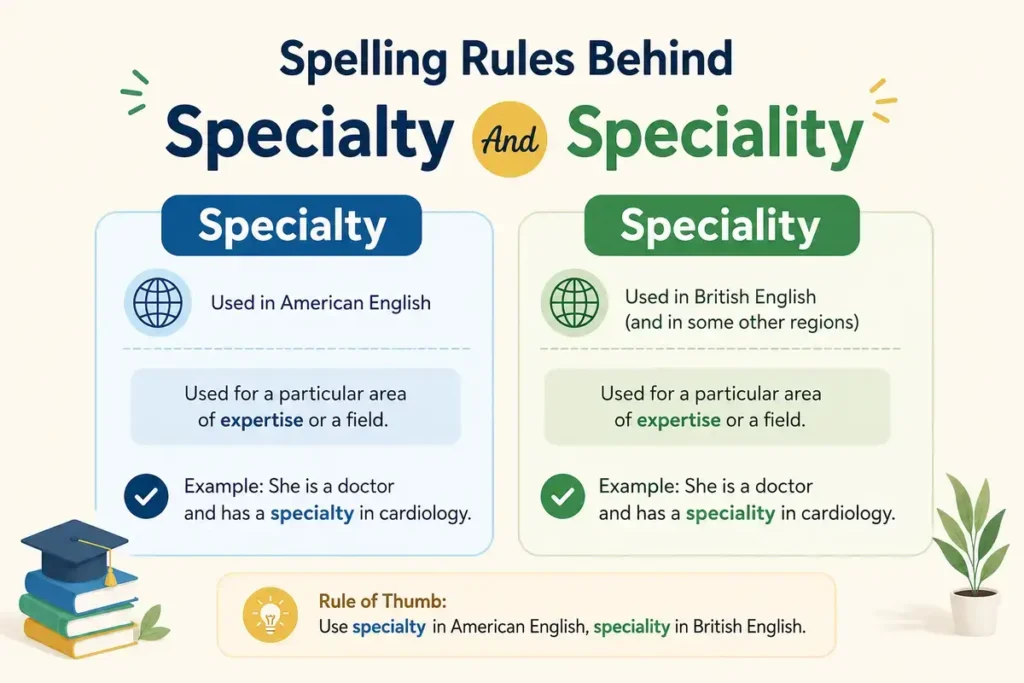
The difference comes from regional spelling patterns rather than grammar rules.
American English Often Removes Extra Letters
American English often uses shorter spellings.
Examples.
- Specialty.
- Defense.
- License.
- Practice.
British English Often Keeps Traditional Forms
British English often keeps spellings closer to older forms.
Examples.
- Speciality.
- Defence.
- Licence.
- Practise.
This pattern explains why American English usually prefers specialty while British English often prefers speciality.
Etymology And Word Origin
The history of these words explains why both forms exist.
The root comes from the Latin word specialis, meaning particular or distinct.
The word later moved through Old French into English.
Over time, English developed the noun specialty, meaning a special quality, area, or skill.
British English later developed and maintained the spelling speciality, following a pattern found in other words ending with similar sounds.
Both forms grew from the same historical source.
British And American English Differences
The main difference between specialty and speciality is regional preference.
American English
American writers usually choose specialty.
Examples.
- Her specialty is pediatric medicine.
- The restaurant’s specialty is barbecue.
- Computer security is his specialty.
British English
British writers usually choose speciality.
Examples.
- Her speciality is pediatric medicine.
- The restaurant’s speciality is barbecue.
- Computer security is his speciality.
Canadian English
Canadian English uses influences from both American and British English.
You may see both spellings, but specialty is common in many modern Canadian contexts.
Australian English
Australian English traditionally follows British spelling patterns, so speciality is often preferred.
However, specialty also appears, especially in business and medical contexts influenced by American usage.
Real Life Examples Of Specialty And Speciality
Seeing these words in different situations helps you understand their natural use.
Daily Conversation
- Baking cakes is my specialty.
- What’s your speciality?
- Her specialty is making people feel welcome.
- His speciality is solving difficult problems.
Workplace Examples
- Data analysis is her specialty.
- Marketing strategy is his speciality.
- Our company’s specialty is customized software.
- The consultant explained his area of speciality.
Medical Examples
- Cardiology is a popular medical specialty in the United States.
- Oncology is her medical speciality in the United Kingdom.
- Doctors often choose a specialty after years of training.
- The hospital offers many specialist specialities.
Academic Writing
- Linguistics is her area of specialty.
- The researcher focused on a narrow speciality within biology.
- The university provides courses in several academic specialties.
- His speciality is historical language studies.
Food And Business
- The restaurant’s specialty is fresh seafood.
- The bakery sells local specialities.
- Handmade products are the shop’s specialty.
- Regional specialities attract many visitors.
Common Mistakes With Specialty And Speciality
Thinking One Spelling Is Wrong
Mistake:
Speciality is incorrect.
Reality:
Both spellings are correct.
The choice depends on regional English.
Mixing Both Spellings In One Article
Mistake:
Using specialty in one paragraph and speciality in another without reason.
Better approach:
Choose one style and stay consistent.
Using The Wrong Plural Form
Mistake:
Specialtys.
Correct:
Specialties.
Correct:
Specialities.
Confusing Specialty With Special
These words are connected but have different meanings.
Special means unusual or important.
Specialty means an area of expertise or a unique product.
Examples.
- She is a special person.
- Teaching is her specialty.
Assuming Specialty Only Means A Profession
The word can describe more than careers.
Examples.
- A chef’s specialty.
- A store’s specialty product.
- A doctor’s specialty.
- A researcher’s specialty.
Memory Tricks To Remember Specialty And Speciality
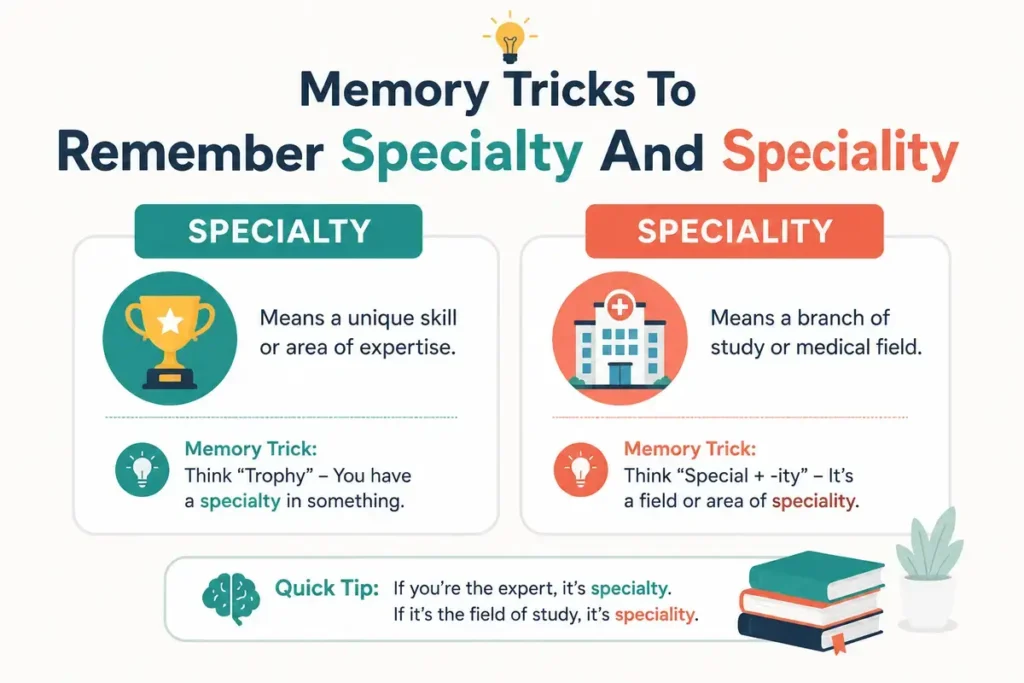
Remembering these two spellings becomes easy when you connect them with their regions.
Think Of The Audience
Specialty has a shorter American spelling.
Think:
American English often prefers shorter spellings.
Speciality has the extra letter pattern commonly found in British English.
Think:
British English often keeps traditional spellings.
Use The Location Trick
Ask:
Who am I writing for?
If your audience is mainly from the United States, choose specialty.
If your audience is mainly from the United Kingdom, choose speciality.
Remember The Meaning Stays The Same
The spelling changes.
The meaning does not.
Both words describe:
- A special skill.
- A professional area.
- A unique product.
- A specific field of knowledge.
A simple memory line:
Specialty in America. Speciality in Britain. Same meaning everywhere.
Related Words And Similar Expressions
Understanding related vocabulary helps you use these words more naturally.
Words Related To Specialty And Speciality
Specialist
A specialist is a person with advanced knowledge in a specific field.
Examples.
- She is a medical specialist.
- The company hired a cybersecurity specialist.
Specialize
To specialize means to focus on one specific area.
Examples.
- The doctor specializes in heart disease.
- This company specializes in online education.
Specialized
Specialized means designed for a specific purpose or area.
Examples.
- The hospital provides specialized care.
- They use specialized equipment.
Specialization
Specialization refers to the process of becoming highly skilled in one area.
Examples.
- Medical specialization requires years of study.
- His specialization is artificial intelligence.
Synonyms For Specialty And Speciality
Depending on the context, you can replace these words with:
- Expertise.
- Skill.
- Strength.
- Field.
- Area of knowledge.
- Profession.
- Focus.
- Talent.
- Niche.
- Special skill.
Example:
Teaching is her specialty.
Similar meaning:
Teaching is her area of expertise.
Opposite Ideas
There is no direct opposite of specialty or speciality, but these words express the opposite idea.
- General knowledge.
- Broad area.
- Common skill.
- Basic understanding.
- Lack of expertise.
Example:
He has a specialty in medicine.
Opposite idea:
He has general knowledge of many subjects but no focused expertise.
Expert Editor’s Note
Professional editors treat specialty and speciality as regional spelling choices, not as different words.
Major dictionaries recognize both forms. The important factor is consistency.
For American English content, editors usually choose specialty.
For British English content, editors usually choose speciality.
Style guides also recommend matching the spelling style of your audience. A document written for an American hospital, university, or company should normally use specialty. A British publication should usually use speciality.
Native speakers rarely see one form as incorrect. They simply notice if the spelling does not match the expected regional style.
A good editor does not ask which word is better. A good editor asks which spelling fits the reader.
Frequently Asked Questions
Is Specialty Or Speciality The Correct Spelling?
Both spellings are correct. Specialty is preferred in American English, while speciality is commonly used in British English. They have the same meaning and refer to a special skill, field, product, or area of expertise.
What Is The Difference Between Specialty And Speciality?
The difference is mainly regional spelling. American English usually uses specialty, while British English often uses speciality. The meaning, grammar, and pronunciation are almost the same.
Is Specialty Used More In The United States?
Yes. American English strongly prefers specialty in everyday writing, professional documents, medical fields, and business communication.
Is Speciality Wrong In American English?
No. Americans understand speciality, and it is not incorrect. However, specialty is the more common choice in American writing.
How Do You Pronounce Specialty And Speciality?
Both words have similar pronunciation. Specialty is commonly pronounced as SPEH shul tee in American English. Speciality may have a slightly different rhythm in British English but remains easily understood.
What Is The Plural Of Specialty?
The American plural is specialties.
Example:
The hospital offers many medical specialties.
The British plural of speciality is specialities.
Example:
The university offers several scientific specialities.
Should I Use Specialty Or Speciality In Formal Writing?
Use the spelling that matches your audience. American formal writing usually prefers specialty, while British formal writing usually prefers speciality.
Are Specialist And Specialty Related Words?
Yes. Both come from the same root. A specialist is a person with expert knowledge, while a specialty is the area where that person has expertise.
A related grammar guide is Sentence Or Sentance Which Spelling Is Correct 2026 Guide.
Conclusion
The difference between specialty or speciality is not about correctness. Both spellings are accepted English words with the same meaning.
The main difference is location. American English usually prefers specialty, while British English often uses speciality.
The biggest mistake writers make is treating one spelling as wrong or mixing both forms in the same piece of writing. Choose one style and stay consistent.
If you are writing for a global audience, pick the spelling that matches your main readers. Clear and consistent language always makes your writing stronger.

Editorial Reviewer & Proofreader
Grace Mitchell reviews Gramlify’s articles for clarity, consistency, and readability. She is passionate about creating accurate, approachable content that helps English learners build confidence.
1 thought on “Specialty Or Speciality Which Spelling Is Correct 2026 Guide”