
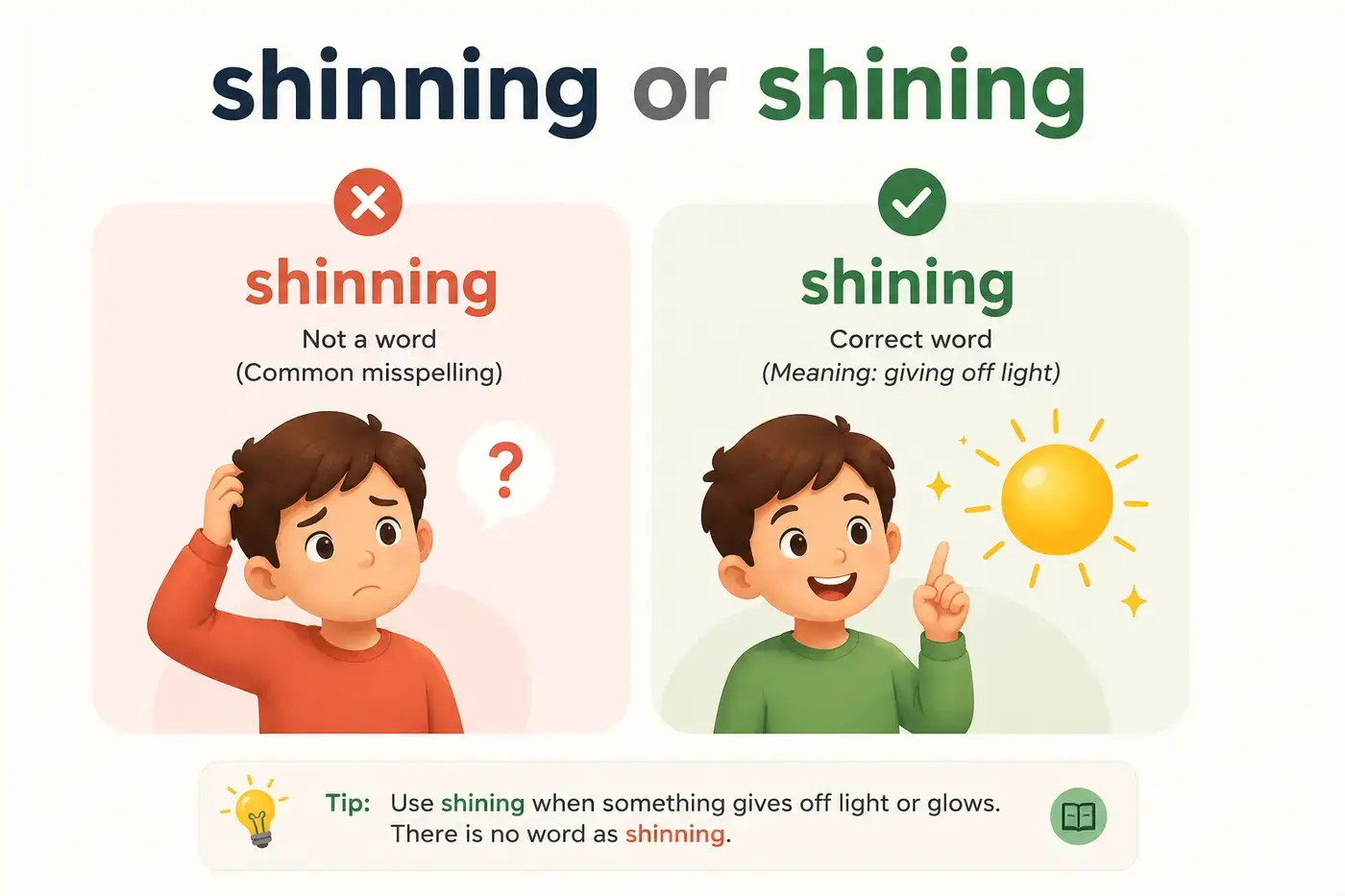
Have you ever paused while writing shinning or shining because both spellings looked right? You’re not alone. Many English learners and even native speakers make this mistake. Since both words come from the verb shine, it’s easy to assume they can be used interchangeably. They cannot.
The confusion usually starts with the way English forms verb endings. Some verbs double the final consonant before adding ing, while others do not. If you are unsure which rule applies to shine, you may end up writing shinning when you actually mean shining.
The good news is the answer is simple once you understand the difference. Shining is the correct spelling when you mean giving off light, standing out, or performing brilliantly. Shinning is also a real English word, but it has a completely different meaning. It refers to climbing by gripping something with your hands and legs, such as shinning up a tree or a rope.
In this guide, you’ll learn the correct spelling, grammar rules, meanings, pronunciation, real life examples, common mistakes, and expert editing tips. By the end, you’ll know exactly when to use each word with confidence.
Still confused? Compare Bellies Vs Bellys Which Spelling Is Correct 2026 Guide.
Quick Answer
If you are talking about light, brightness, success, or something sparkling, shining is the correct word.
Shinning is a different verb that means climbing a pole, tree, or rope by using your hands and legs. Although both words are correct English spellings, they have different meanings and should not be used interchangeably.
Shinning Or Shining Comparison Table
| Feature | Shining | Shinning |
|---|---|---|
| Correct spelling for giving off light | Yes | No |
| Correct English word | Yes | Yes |
| Meaning | Emitting light or standing out | Climbing using hands and legs |
| Part of speech | Present participle and adjective | Present participle |
| Common usage | Very common | Rare |
| Formal writing | Common | Rare except in specific contexts |
| Everyday conversation | Very common | Uncommon |
| Example | The sun is shining brightly. | The child is shinning up the tree. |
Which One Is Correct
The answer depends on what you want to say.
If you mean giving off light, looking bright, being excellent, or standing out, the correct spelling is shining.
Examples.
- The stars are shining tonight.
- She has a shining smile.
- His shining performance impressed everyone.
Use shinning only when talking about climbing by wrapping your arms and legs around something.
Examples.
- The boy was shinning up the tree.
- The firefighter practiced shinning up a training pole.
For almost every everyday situation, shining is the word you need.
What Does Shining Mean
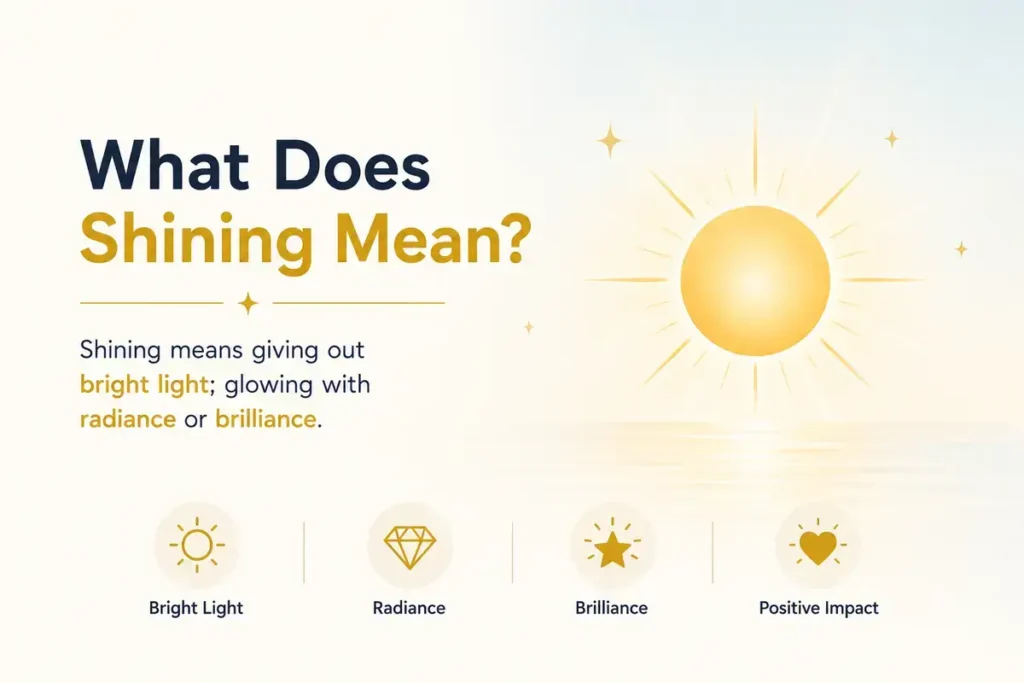
Shining is the present participle of the verb shine. It can also work as an adjective.
Simple Definition
Shining means giving off light, reflecting light, looking bright, or standing out because of excellence or beauty.
Common Meanings
- Producing or reflecting light.
- Looking clean or polished.
- Showing great talent or success.
- Being outstanding among others.
Examples Of Shining
- The moon is shining over the lake.
- Her shoes were shining after she polished them.
- He gave a shining example of kindness.
- The trophy was shining under the lights.
- She has a shining future ahead.
Shining In Different Contexts
Daily conversation.
The sun is shining today.
Workplace.
She delivered a shining presentation.
Academic writing.
The researcher made a shining contribution to the field.
Journalism.
The athlete had a shining moment during the championship.
Literature.
The castle stood beneath a shining sky.
What Does Shinning Mean
Shinning is the present participle of the verb shin.
Simple Definition
Shinning means climbing a tree, pole, rope, or similar object by gripping it with your hands and legs.
This word has existed in English for centuries, but people use it far less often than shining.
Examples Of Shinning
- The child was shinning up the tree.
- The sailor practiced shinning up the mast.
- The monkey kept shinning along the branch.
- He learned shinning techniques during rescue training.
- The climber finished shinning up the pole in seconds.
Because this meaning is very specific, most English learners encounter shining thousands of times before they ever see shinning.
Key Differences Between Shinning And Shining
| Feature | Shining | Shinning |
|---|---|---|
| Root verb | Shine | Shin |
| Main meaning | Giving off light or being outstanding | Climbing using hands and legs |
| Frequency | Extremely common | Rare |
| Used in everyday English | Yes | Occasionally |
| Describes brightness | Yes | No |
| Describes climbing | No | Yes |
The easiest way to remember the difference is simple.
If you are talking about light, choose shining.
If someone is climbing a tree or pole, choose shinning.
Grammar Explanation
Understanding the grammar removes almost all confusion.
Shining Comes From Shine
The verb shine ends with a silent e.
When a verb ends with a silent e, English usually drops the e before adding ing.
Examples.
- Shine becomes shining.
- Smile becomes smiling.
- Write becomes writing.
- Dance becomes dancing.
This is why shining has only one n.
Shinning Comes From Shin
The verb shin means to climb by using your hands and legs.
Since shin ends with a consonant after a short vowel sound, English doubles the final consonant before adding ing.
Examples.
- Shin becomes shinning.
- Run becomes running.
- Sit becomes sitting.
- Swim becomes swimming.
These are two completely different verbs that simply happen to look similar.
Why People Confuse Shinning And Shining
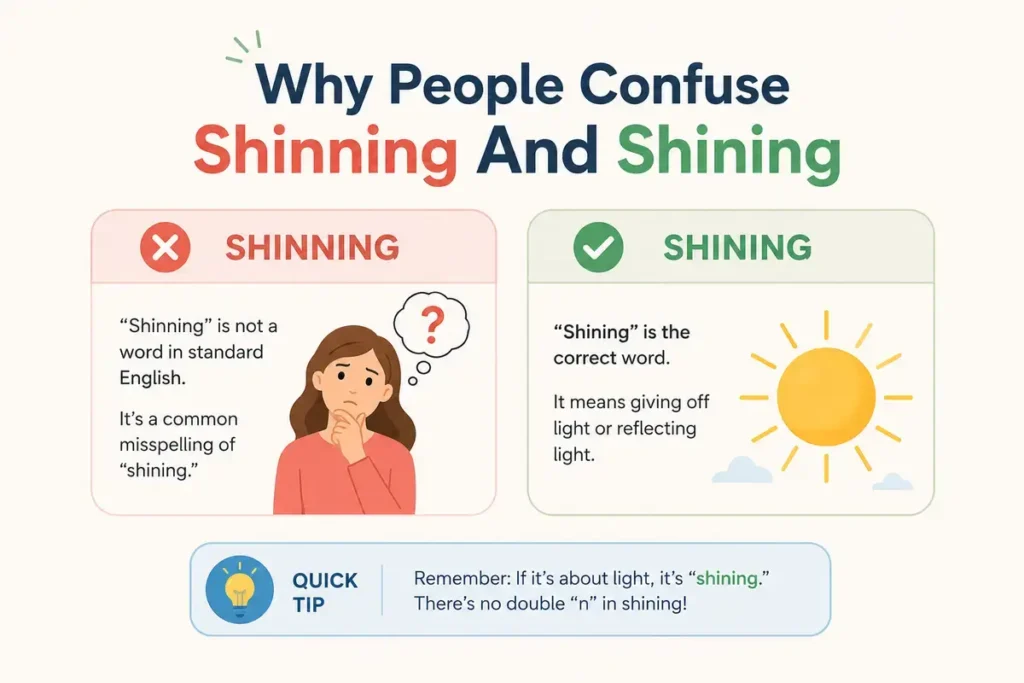
At first glance, shinning and shining appear almost identical. Since both come from words that begin with shin, many writers assume one spelling is simply an alternative form of the other. That isn’t true.
Here are the main reasons people confuse them.
Similar Appearance
The only visible difference is one extra n. During fast typing or proofreading, it’s easy to overlook.
Spelling Rule Confusion
Many people know that some verbs double the final consonant before adding ing, but they are not always sure which rule applies.
For example.
- Run becomes running.
- Sit becomes sitting.
- Shine becomes shining.
- Shin becomes shinning.
Since both verbs exist, the spelling depends entirely on the original verb.
Pronunciation
Both words begin with the same sound, so they can sound similar in quick speech. Most listeners rely on context to understand the intended meaning.
Autocorrect And Spell Check
Some writing tools fail to flag shinning because it is a legitimate English word. As a result, writers may not realize they selected the wrong spelling.
Internet And Social Media
Online posts often contain spelling mistakes. When readers repeatedly see shinning used for brightness, they begin to think it is acceptable. In standard English, it is not.
Spelling Rule That Makes The Difference
Understanding one simple spelling rule will help you avoid this mistake forever.
Rule One
If a verb ends with a silent e, remove the e before adding ing.
Examples.
- Shine becomes shining.
- Smile becomes smiling.
- Write becomes writing.
- Hope becomes hoping.
The final consonant does not double.
Rule Two
If a one syllable verb ends with a short vowel followed by a single consonant, double the consonant before adding ing.
Examples.
- Run becomes running.
- Sit becomes sitting.
- Swim becomes swimming.
- Shin becomes shinning.
The difference comes from the base verb, not from the ending.
Learn the difference in Using or Useing Which Spelling Is Correct.
Pronunciation Guide
Although the meanings are very different, the pronunciation is quite similar.
Shining
IPA
American English.
/ˈʃaɪ nɪŋ/
Syllables
Shin ing.
Stress
The first syllable receives the primary stress.
Shinning
IPA
American English.
/ˈʃɪn ɪŋ/
Syllables
Shin ning.
Stress
The first syllable also receives the primary stress.
Notice one important difference.
Shining comes from the word shine, so the vowel sounds like the word eye.
Shinning comes from shin, so the vowel sounds like the word sit.
This small pronunciation difference helps native speakers tell the words apart.
Word Origin
Looking at the history of both words explains why they developed differently.
Origin Of Shine
The verb shine comes from Old English scinan, meaning to give light, glow, or sparkle.
Over time, its meaning expanded to include excellence and success.
Examples.
- Her talent continues to shine.
- The stars shine brightly every night.
Origin Of Shin
The climbing verb shin appeared later in English.
It originally referred to climbing by gripping with the arms and legs. Some language experts believe it developed because the shins often rubbed against the object being climbed.
Although uncommon today, the word still appears in dictionaries and specialized writing.
British American Canadian And Australian English
There is no spelling difference between major English varieties.
American English uses shining for brightness.
British English also uses shining.
Canadian English follows the same rule.
Australian English follows the same rule as well.
The climbing verb shinning exists in all major varieties of English, although most speakers rarely use it.
This is not a regional spelling difference. It is simply the difference between two separate verbs.
Real Life Examples
Seeing the words in context makes them much easier to remember.
Daily Conversation
- The sun is shining through the window.
- Her eyes were shining with excitement.
- The child started shinning up the tree before anyone noticed.
- The polished floor kept shining all afternoon.
Workplace
- Your report is a shining example of clear writing.
- The company had a shining year with record sales.
- Safety instructors demonstrated shinning techniques during the training session.
- The award was shining under the stage lights.
Emails
- Thank you for your shining contribution to the project.
- The office windows were shining after the cleaning crew finished.
Academic Writing
- The poem describes the shining moon as a symbol of hope.
- Historical records mention sailors shinning up the ship’s mast.
Journalism
- The athlete had another shining performance.
- Witnesses saw children shinning up nearby trees during the festival.
Literature
- The knight walked beneath a shining sky.
- The castle walls looked shining after the rain.
- The pirate quickly began shinning up the mast.
- The shining river reflected the morning sun.
Social Media
- Keep shining every single day.
- My little brother spent the afternoon shinning up every tree in the park.
Common Mistakes
Writers often make the same errors because the spellings look so similar.
Using Shinning For Brightness
Incorrect.
The stars were shinning all night.
Correct.
The stars were shining all night.
Using Shining For Climbing
Incorrect.
The firefighter was shining up the training pole.
Correct.
The firefighter was shinning up the training pole.
Believing Shinning Is Always Wrong
Many people think shinning is simply a misspelling.
It is a correct English word. It is just much less common because the action it describes does not come up very often.
Assuming Every Verb Doubles The Final Letter
English spelling rules depend on the original verb.
Learning the base form first makes choosing the correct spelling much easier.
Memory Tricks To Remember The Correct Spelling
A simple memory trick can save you from making this mistake again.
Think About The Base Word
Ask yourself which verb you started with.
If the base word is shine, the correct form is shining.
If the base word is shin, the correct form is shinning.
Remember What Each Word Does
Shining is connected with light, brightness, success, and beauty.
Shinning is connected with climbing.
Picture someone climbing a tree. That image makes shinning much easier to remember.
Use This Quick Test
If you can replace the word with glowing, sparkling, or bright, choose shining.
If you can replace it with climbing, choose shinning.
Related Words
Learning related words helps you build a stronger vocabulary.
Words Related To Shining
- Bright.
- Glowing.
- Sparkling.
- Radiant.
- Brilliant.
- Gleaming.
- Luminous.
- Polished.
Words Related To Shinning
- Climbing.
- Scaling.
- Ascending.
- Scrambling.
- Clambering.
Frequently Confused Words
- Shining and glowing.
- Shine and polish.
- Bright and brilliant.
- Gleaming and sparkling.
- Climber and climbing.
Understanding these words makes choosing the correct spelling much easier.
Expert Editor’s Note
Professional editors almost always replace shinning with shining because most spelling errors involve brightness, not climbing.
Major dictionaries clearly distinguish the two words.
Use shining for light, reflection, success, excellence, or beauty.
Use shinning only for climbing by gripping with your hands and legs.
If you are editing an article, email, report, or school assignment, double check the intended meaning before changing the spelling. Since shinning is a real English word, spell check may not catch the mistake.
A careful proofreader always checks the meaning, not just the spelling.
Frequently Asked Questions
Is Shinning A Correct Word?
Yes. Shinning is a correct English word. It is the present participle of shin, which means climbing a tree, rope, pole, or similar object using your hands and legs.
Which Is Correct Shinning Or Shining?
If you mean producing light or looking bright, shining is correct. Use shinning only when describing the act of climbing.
Why Do People Write Shinning Instead Of Shining?
Many writers confuse the spelling rules for adding ing. Others assume every verb doubles its final consonant. Since shinning is a real word, spell check may not flag the mistake.
Is Shining The Present Participle Of Shine?
Yes. Shining is the present participle and gerund form of the verb shine. It follows the standard spelling rule by dropping the silent e before adding ing.
Is Shinning Used In Modern English?
Yes, but it is uncommon. You may find it in books about climbing, sailing, rescue training, or historical writing. Most people rarely need this word in everyday conversation.
How Do I Remember The Difference?
Think about the meaning first. If something gives off light, use shining. If someone climbs a tree or pole, use shinning. This simple rule works almost every time.
Do British And American English Spell These Words Differently?
No. American, British, Canadian, and Australian English all use shining for brightness and shinning for climbing. The meanings stay the same across these varieties of English.
Learn the difference in Immerse Vs Emerse Which Word Is Correct 2026 Guide.
Conclusion
The answer to shinning or shining depends on the meaning you want to express.
Use shining when talking about light, brightness, success, beauty, or something that stands out. This is the spelling you’ll use in almost every everyday situation.
Use shinning only when describing someone climbing a tree, pole, rope, or another object by gripping it with their hands and legs.
The biggest mistake is assuming shinning is another spelling of shining. They come from different verbs and describe completely different actions.
The next time you write the word, remember the base verb first. That one small step will help you choose the correct spelling every time.

Editorial Reviewer & Proofreader
Grace Mitchell reviews Gramlify’s articles for clarity, consistency, and readability. She is passionate about creating accurate, approachable content that helps English learners build confidence.
1 thought on “Shinning Or Shining Which Spelling Is Correct 2026 Guide”