
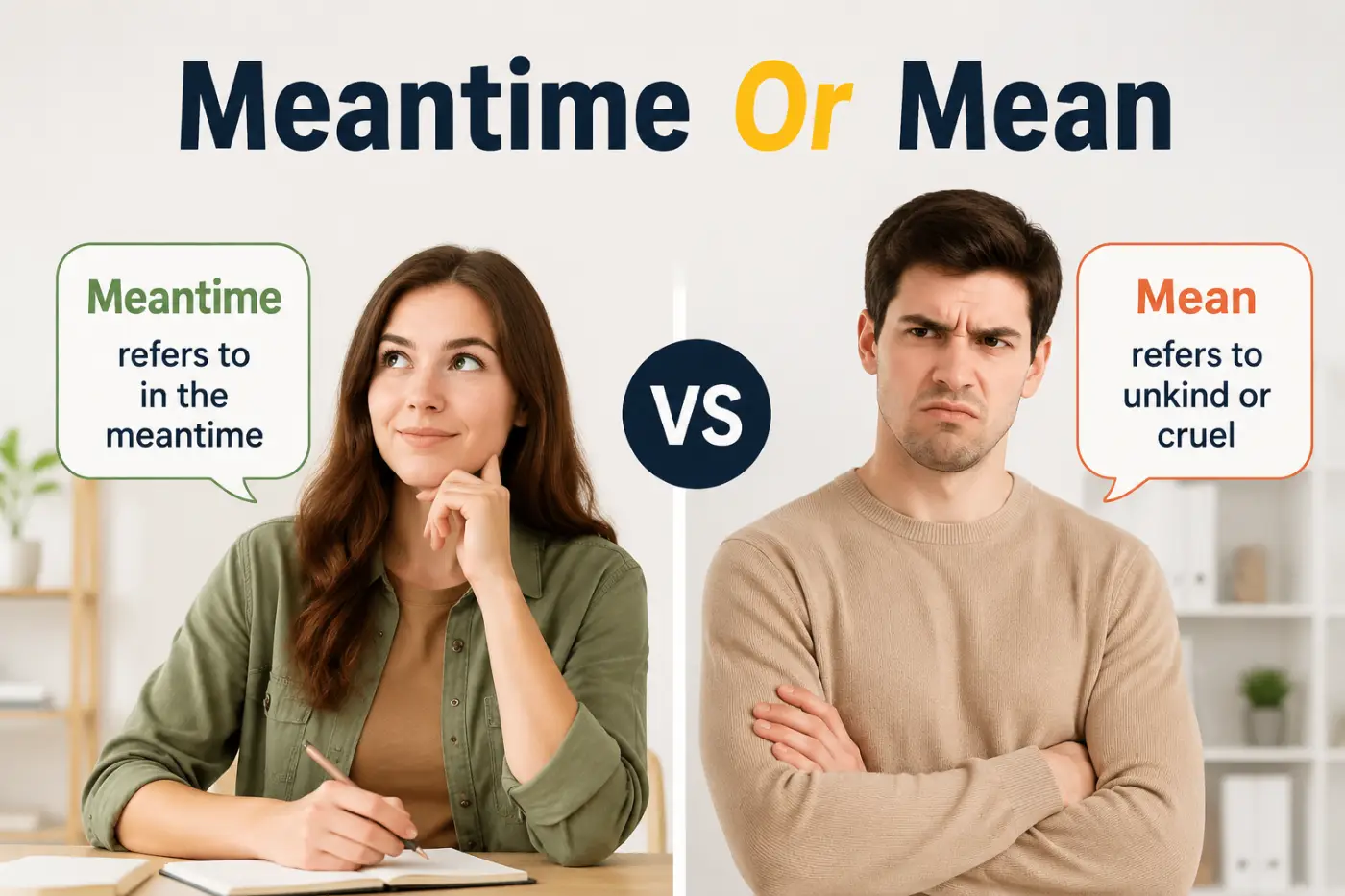
Writing meantime or mean time can feel like a tiny spelling choice until you’re in the middle of an email or an important sentence. Both forms exist in English. The important part is knowing that they don’t usually do the same job.
In most everyday writing meantime is the word you want when you mean the period before something else happens. You might say that you’ll finish the report in the meantime or ask someone to wait in the meantime. The word can also appear in the expression meanwhile.
Mean time is different. It is normally a literal combination of the adjective mean and the noun time. In mathematics and science it can refer to an average or intermediate time. In some technical contexts it has a specific meaning.
The confusion comes from the fact that meantime sounds exactly like mean time when spoken. English also contains many words that began as separate words and later developed into compounds. That makes this pair especially easy to mix up.
This guide explains the difference clearly. You’ll learn the correct spelling, grammar, pronunciation, word history, common expressions, real life examples, and the simple test that can help you choose the right form every time.
For another common grammar confusion, see Arised Or Arose Which Word Is Correct 2026 Guide.
Quick Answer
Meantime is usually the correct choice when you mean the period between two events. The common expression is in the meantime, meaning during the period before something else happens. Mean time is a separate phrase used when mean and time keep their individual meanings, especially in technical or mathematical contexts.
Meantime Or Mean Time Comparison
| Feature | Meantime | Mean time |
|---|---|---|
| Spelling | One word | Two words |
| Main meaning | The intervening period | A literal mean or average time |
| Part of speech | Noun or adverbial noun | Adjective plus noun |
| Common expression | In the meantime | Mean time |
| Everyday use | Very common | Less common |
| Formal writing | Common | Context dependent |
| Pronunciation | Usually pronounced as one unit | Usually the same in ordinary speech |
| Example | I’ll call you in the meantime. | The mean time was calculated from the results. |
| Common mistake | Writing it as two words | Using it when you mean the intervening period |
The most important distinction is meaning rather than sound.
If you mean during the period before something happens, use meantime.
If you genuinely mean mean or average time, write mean time as two words.
What Does Meantime Mean
Meantime refers to the period between two events or the time during which something else is happening before a particular event takes place.
It often appears in the phrase in the meantime.
For example:
The doctor will call tomorrow. In the meantime, try to get some rest.
The sentence means that you should rest during the period before the doctor calls.
Meantime As A Noun
Traditionally meantime functions as a noun. It refers to an intervening period.
Consider this sentence:
The repairs will take three days. In the meantime, we’ll stay with friends.
The word describes the three day period before the repairs finish.
Another example is:
She was preparing dinner. In the meantime, the children played outside.
Here in the meantime means during that intervening period.
Meantime In Everyday English
You’ll most often encounter meantime in the fixed expression in the meantime.
Examples include:
- I’ll finish the report in the meantime.
- The store opens at nine. In the meantime, we can grab coffee.
- Your order should arrive tomorrow. In the meantime, you can track it online.
- We’re waiting for the results. In the meantime, there’s nothing else to do.
- The mechanic is checking the car. In the meantime, I’ll wait in the lobby.
This expression is natural in both spoken and written English.
What Does Mean Time Mean
Mean time is a two word phrase. It consists of the adjective mean and the noun time.
Here mean doesn’t mean unkind or average in the general conversational sense. It can mean average.
For example:
The mean time for all participants was 42 minutes.
Here the writer means the average time calculated from several results.
This is a genuine use of mean time as two words.
Mean Time In Mathematics
In mathematics and statistics, mean often means an average.
Suppose five runners finish a race in these times:
30 minutes
32 minutes
34 minutes
36 minutes
38 minutes.
The mean time is 34 minutes.
In this context, writing mean time makes sense because mean modifies time.
You could replace mean with average:
The average time was 34 minutes.
That replacement test is useful. If average time makes sense, mean time may also be appropriate.
Mean Time In Technical Writing
You may encounter mean time in scientific or technical material where researchers calculate an average duration.
For example:
Researchers recorded the mean time required to complete the task.
The phrase doesn’t mean during the intervening period. It means the average amount of time required.
That distinction is crucial.
Which One Is Correct
Both meantime and mean time are correct. They simply have different functions.
Use meantime when you mean the period between now and a future event or the period during which another event happens.
Use mean time when mean means average and time is the thing being averaged.
Compare these sentences:
I’ll wait here in the meantime.
The mean time for the procedure was twenty minutes.
The first sentence describes an intervening period.
The second describes an average duration.
They look similar on the page but express completely different ideas.
The Fastest Test
Replace the expression with during that period.
If the sentence still makes sense, meantime is probably correct.
I’ll wait in the meantime.
I’ll wait during that period.
The meaning stays intact.
Now try the same test with mean time:
The mean time was twenty minutes.
The during that period was twenty minutes.
The second version makes no sense.
Instead, replace mean with average:
The average time was twenty minutes.
That works perfectly.
So remember:
Meantime = during the intervening period.
Mean time = average time.
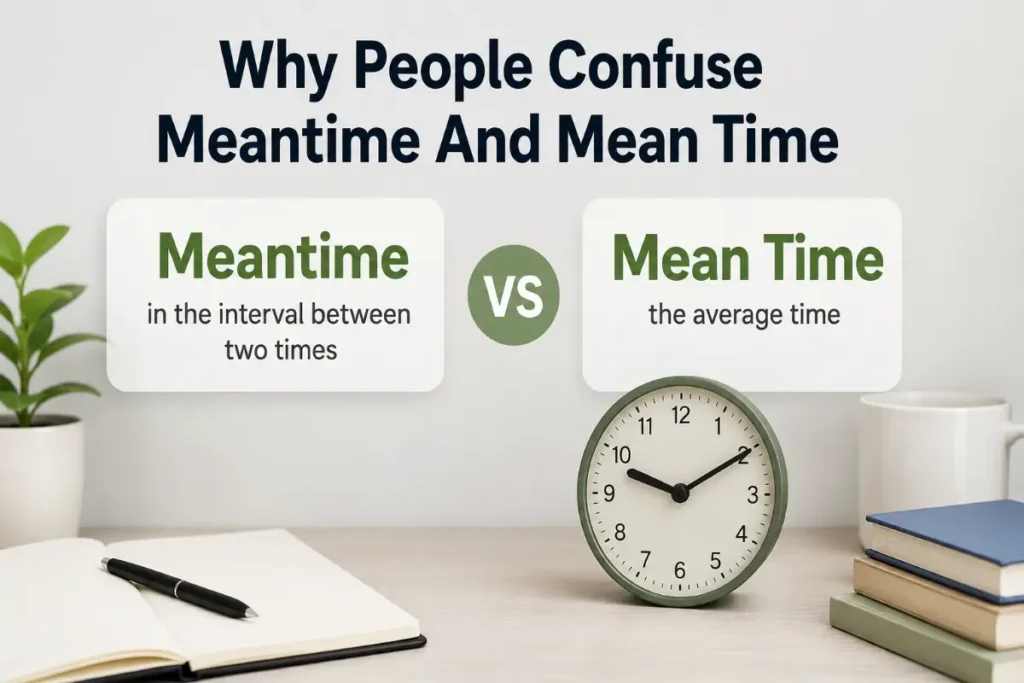
Why People Confuse Meantime And Mean Time
The confusion isn’t surprising. The two forms have the same basic sounds and contain exactly the same letters with spaces removed.
They Sound The Same
In normal speech meantime and mean time can sound identical.
A listener can’t see the spelling. Context has to do the work.
For example, if someone says:
I’ll do it in the meantime.
You know from the sentence that the speaker means the intervening period.
If someone says:
The mean time was fifteen minutes.
The surrounding words tell you that mean means average.
This is why the problem usually appears in writing rather than conversation.
They Look Nearly Identical
The visual difference is just a space.
Meantime
Mean time
That tiny difference can cause mistakes when people write quickly.
The Phrase In The Meantime Is Familiar
Most people learn in the meantime as a fixed expression. They may later encounter mean time in technical writing and assume the two forms are spelling variations.
They’re not.
The word boundary changes the grammatical structure and often changes the meaning.
Keyboard And Typing Habits
Fast typing creates another problem.
A writer may instinctively separate a compound word because mean and time are both familiar words. Another writer may combine them because they’ve seen in the meantime many times.
Spell checkers don’t always solve the problem because both forms are legitimate English.
A spelling checker can recognize the words. It can’t always determine what you intended to say.
Internet Writing Can Reinforce The Confusion
Search results social posts comments and informal articles contain both forms. Some uses are correct while others are simple spelling mistakes.
Seeing mean time used in place of meantime doesn’t make the two forms interchangeable.
A useful rule is to judge the sentence by meaning and grammar rather than by how often you see a particular spelling online.
The Most Common Expression Is In The Meantime
If you’re talking about waiting or doing something during an intervening period, the expression you probably need is in the meantime.
It means during the time before something else happens.
Examples:
- The bus arrives in twenty minutes. In the meantime, let’s sit inside.
- Your application is being reviewed. In the meantime, you can prepare the required documents.
- Dinner won’t be ready for another hour. In the meantime, have a snack.
- We’re waiting for Sarah. In the meantime, we can start the meeting.
- The project won’t launch until June. In the meantime, the team is testing the software.
The expression works because meantime acts as the noun naming the intervening period.
Is In The Meantime Redundant
No.
Some writers worry that in and meantime create unnecessary repetition. They don’t.
In the meantime is a well established English expression.
It works much like other time expressions such as:
In the morning.
In the evening.
In the interim.
During the interval.
You can also use meanwhile in many situations.
I’ll make dinner. In the meantime, you can set the table.
I’ll make dinner. Meanwhile, you can set the table.
Both sentences are natural.
Meantime And Meanwhile Are Closely Related
Meantime and meanwhile often express similar ideas but they aren’t always interchangeable in exactly the same grammatical position.
Meantime
Meantime commonly appears after in the.
In the meantime, I’ll check the schedule.
Meanwhile
Meanwhile can work independently as an adverb.
I’ll check the schedule. Meanwhile, you can call the office.
You can often replace in the meantime with meanwhile without changing the main idea.
For example:
The train is delayed. In the meantime, passengers can wait in the lounge.
The train is delayed. Meanwhile, passengers can wait in the lounge.
Both are natural.
There is a slight difference in style. Meanwhile can sound more direct and compact. In the meantime often emphasizes the period between two events.
Meantime In Sentence Structure
Understanding where meantime appears in a sentence makes the word easier to use.
At The Beginning Of A Sentence
In the meantime, we’ll continue with the next lesson.
A comma usually follows the introductory phrase.
In The Middle Of A Sentence
The manager will arrive soon, and in the meantime, we can review the documents.
Here the expression sits inside a longer sentence.
At The End Of A Sentence
I’ll stay here in the meantime.
This structure is also natural.
The fixed phrase in the meantime is far more common than using meantime by itself in ordinary American English.
Meantime And Formal Writing
In the meantime works well in professional and formal writing.
You can use it in emails reports instructions and business communication without sounding careless.
For example:
We expect the replacement equipment to arrive Friday. In the meantime, please use the backup system.
That’s clear and professional.
You don’t need to replace the expression with something more complicated just to sound formal.
Good writing doesn’t mean using the longest phrase available. It means choosing the clearest one.
Meantime In Academic Writing
Academic writers may use in the meantime when describing events that occur during an intervening period.
For example:
The final data are expected next month. In the meantime, the researchers will review the preliminary findings.
However, academic writing may favor more precise alternatives such as during this period when the timing needs special emphasis.
The choice depends on the sentence rather than a rigid rule.
Mean Time In Academic Writing
Mean time is more likely to appear in research or statistical writing.
For example:
The mean time to completion was 18.6 minutes.
Here mean has a specific statistical meaning.
Another example:
The researchers compared the mean time required by each group.
This is completely different from:
The researchers worked in the meantime.
The first sentence discusses an average.
The second discusses an intervening period.
That difference is worth learning because it appears often in scientific and academic writing.
Pronunciation Guide
The pronunciation of the two forms is another reason this pair causes trouble.
Meantime
A common American English pronunciation is:
/ˈmiːnˌtaɪm/
It has two syllables.
mean time
The primary stress usually falls on the first part.
Mean Time
The phrase mean time is normally pronounced with the same individual sounds:
/ˈmiːn taɪm/
In ordinary speech the difference can be almost impossible to hear.
That means pronunciation won’t reliably tell you which spelling to use.
Context remains the best guide.
Word Origin Of Meantime
The history of meantime helps explain why English treats it as one word.
The word developed from the idea of mean time in the older sense of an intervening or middle period. English has a long history of turning frequently used word combinations into compounds.
The word mean itself has several historical senses. In meantime, the older sense relates to something intermediate or in the middle.
Over time the combined expression became established as the single word meantime.
Modern speakers don’t normally analyze the word as mean + time. They recognize meantime as a complete lexical item.
That history also explains why the two word form can still appear in English when mean has its separate modern meaning of average.
How The Meaning Changed Over Time
English vocabulary often develops this way.
A phrase gets used repeatedly. Speakers begin treating it as a unit. Eventually dictionaries recognize the compound as a separate word.
Other familiar English examples include:
Somewhere.
Sometimes.
Nowadays.
Meanwhile.
Nevertheless.
The spelling doesn’t always stay the same across history. English has many compounds that moved from separate words to hyphenated forms and finally to solid compounds.
Meantime is an established solid compound in modern English.
British And American English
There is no major spelling difference between American and British English for meantime.
Both varieties use meantime as one word.
Both also use mean time when mean has its independent meaning.
The same applies broadly to Canadian and Australian English.
You don’t need to change the spelling based on your regional audience.
The important distinction is semantic.
If you’re writing for an American audience the safest everyday form is still in the meantime when you mean during the intervening period.
Meantime Or Mean Time In Real Life
The easiest way to master meantime or mean time is to see how each form behaves in real sentences. The surrounding words usually reveal the intended meaning.
In everyday English meantime appears most often in the phrase in the meantime. It connects two events and tells the reader what happens during the waiting period.
Mean time has a narrower use. It normally appears when mean means average.
Daily Conversation Examples.
- The movie starts at eight. In the meantime, let’s grab some food.
- Your sister is on her way. In the meantime, you can relax.
- I’ll finish the dishes in the meantime.
- The repair should be done tomorrow. In the meantime, we’ll use the other car.
- The kids are getting ready. In the meantime, I’ll pack the bags.
These sentences all describe an intervening period. Meantime is the natural choice.
Workplace Examples.
- The manager will review your request. In the meantime, please continue with the current process.
- We’re waiting for the client to respond. In the meantime, I’ll update the draft.
- The new equipment arrives next week. In the meantime, employees can use the existing machines.
- The hiring decision hasn’t been made yet. In the meantime, the team will continue interviewing candidates.
- The website is being updated. In the meantime, customers can contact support by phone.
Notice how in the meantime works naturally in professional communication. It isn’t limited to casual conversation.
Email Examples.
- Thanks for sending the documents. In the meantime, I’ll review the information you provided.
- We expect an answer by Friday. In the meantime, please keep the original files available.
- The meeting has been moved to Monday. In the meantime, I’ll send everyone the updated agenda.
- Your account is being reviewed. In the meantime, you can still access your saved documents.
These sentences are clear and professional without sounding stiff.
Academic Examples.
- The final results will be published next month. In the meantime, researchers are analyzing the preliminary data.
- The study is still underway. In the meantime, the available evidence supports the original hypothesis.
Now compare those examples with mean time:
- The mean time for participants to complete the test was 14 minutes.
- Researchers calculated the mean time for each experimental group.
- The mean time between measurements was five minutes.
Here mean means average. That is why the phrase stays as two separate words.
Journalism Examples.
- The storm is expected to reach the coast tonight. In the meantime, residents are being urged to stay indoors.
- Officials are still investigating the cause. In the meantime, the building remains closed.
Journalists often use in the meantime to connect a developing event with something happening during the waiting period.
Social Media Examples.
- The concert isn’t until Friday. In the meantime, I’m listening to the album on repeat.
- My order arrives tomorrow. In the meantime, I’m checking the tracking page every five minutes.
Social media uses are usually informal. Still, the grammar doesn’t change.
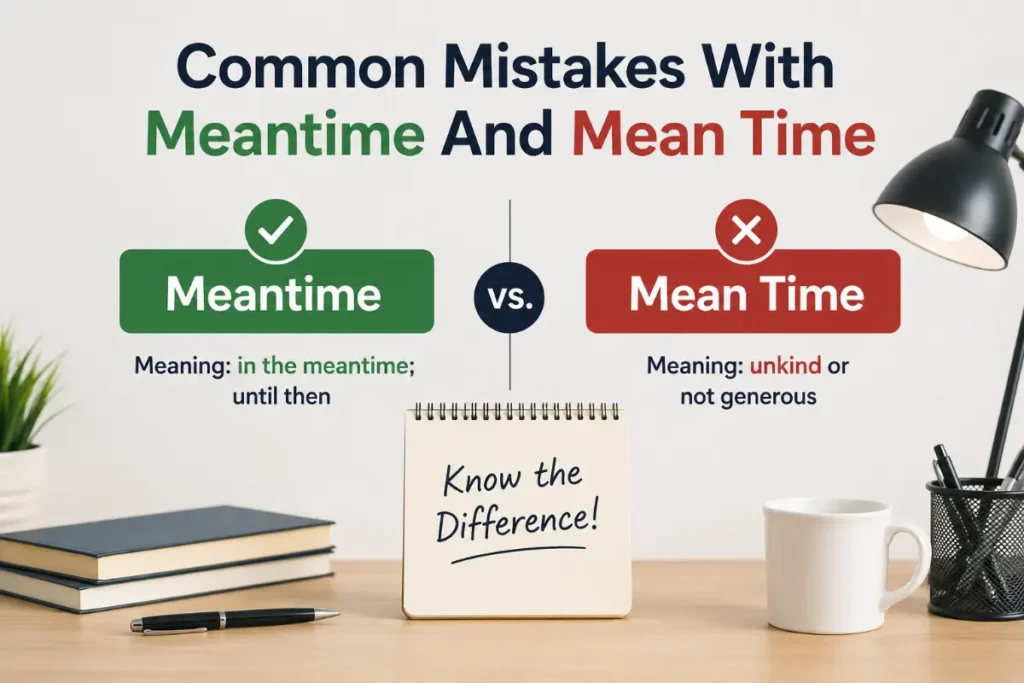
Common Mistakes With Meantime And Mean Time
The biggest mistakes come from treating the two forms as simple spelling alternatives.
They aren’t.
Mistake One
I’ll wait in the mean time.
In standard modern English this should be:
I’ll wait in the meantime.
The expression in the meantime is normally written as three words with meantime as one word.
Mistake Two
The average time was called the meantime.
This changes the meaning.
If you mean an average duration, write:
The mean time was 25 minutes.
Or use the simpler phrase:
The average time was 25 minutes.
Mistake Three
In the mean time, we’ll continue.
This is a common spacing error.
The accepted everyday expression is:
In the meantime, we’ll continue.
Mistake Four
I’ll contact you mean time.
This doesn’t work because mean time cannot replace in the meantime.
Correct:
I’ll contact you in the meantime.
Mistake Five
Assuming meantime always means mean time.
The modern word meantime has its own established meaning. You shouldn’t split it simply because the word contains the familiar words mean and time.
Spelling Rules For Meantime
There isn’t a complicated spelling rule to memorize.
Meantime is normally written as one word when it means an intervening period.
The standard expression is:
in the meantime
Not:
in the mean time
The two word form has a different grammatical structure when mean functions separately as an adjective.
Compound Word Pattern
English contains many compounds that function as single words.
For example:
- Sometimes.
- Somewhere.
- Somehow.
- Meanwhile.
- Meantime.
You don’t need to analyze every part of a compound word when using it. Treat the established word as a single vocabulary item.
Is Meantime Ever Hyphenated.
Modern standard English normally writes meantime as one word.
You don’t need to write:
mean time
or:
mean time
when you mean the intervening period.
You also don’t need a hyphen.
The safest modern form is simply meantime.
Meantime Vs Meanwhile
This is one of the most useful comparisons because learners often encounter both words in the same context.
Meantime usually appears in in the meantime.
Meanwhile can stand alone as an adverb.
Compare:
The food will be ready soon. In the meantime, set the table.
The food will be ready soon. Meanwhile, set the table.
Both sentences work.
When Meantime Sounds Better.
Use in the meantime when you want to highlight the period before another event.
Your appointment is tomorrow. In the meantime, avoid strenuous activity.
The phrase clearly points to the waiting period.
When Meanwhile Sounds Better.
Use meanwhile when you’re shifting attention to another action or event.
John prepared the presentation. Meanwhile, Maria contacted the clients.
The focus moves from one action to another.
Both expressions overlap. The difference is mainly one of sentence structure and emphasis.
Meantime Vs In The Interim
In the interim has a similar meaning to in the meantime.
For example:
The permanent manager starts next month. In the interim, Sarah will lead the department.
You could also say:
The permanent manager starts next month. In the meantime, Sarah will lead the department.
Both are correct.
The difference is tone.
In the meantime sounds natural and conversational.
In the interim sounds more formal and is common in legal business and administrative writing.
For most everyday situations, in the meantime is the better choice.
Meantime Vs During
Sometimes you don’t need either expression.
You can simply use during.
Compare:
In the meantime, I’ll review the report.
During this period, I’ll review the report.
The first sounds more conversational.
The second sounds more formal and precise.
Good writers choose based on the surrounding sentence rather than forcing a particular expression.
Mean Time Vs Average Time
In technical writing mean time often has the same basic idea as average time.
Suppose a group of people completes a task in different amounts of time. You add all the times together and divide by the number of observations.
The result is the mean time.
For example:
Five employees completed the task in 10 12 14 16 and 18 minutes.
The total is 70 minutes.
Divide 70 by five and the mean time is 14 minutes.
So:
Mean time = average time.
This use has nothing to do with meantime.
Mean Time In Statistics.
Statistics uses mean in a precise mathematical sense.
You might see sentences such as:
The mean time to completion was 12.4 minutes.
The treatment group had a lower mean time than the control group.
Researchers reported the mean time and standard deviation for each group.
These are technical uses of mean time.
A related grammar guide is Has Been Vs Have Been Which One Is Correct (2026).
Mean Time In Science And Engineering
The phrase mean time can also appear in scientific and engineering contexts.
For example:
The mean time between failures was calculated for the equipment.
Here mean refers to an average.
You may also encounter established technical expressions such as mean time between failures and mean time to repair.
In these phrases mean remains an independent adjective. That’s why the words stay separate.
This is an important distinction for technical writers. Don’t change mean time to meantime just because the two forms sound alike.
A Useful Context Test
When you’re unsure about meantime or mean time, look at the words around it.
Test One
Can you replace the phrase with during the waiting period?
If yes, choose meantime.
In the meantime, I’ll wait.
During the waiting period, I’ll wait.
The meaning works.
Test Two
Can you replace mean with average?
If yes, use mean time.
The mean time was 20 minutes.
The average time was 20 minutes.
Both make sense.
This simple test is more reliable than trying to remember a spelling rule.
Meantime In Formal Writing
In the meantime is completely acceptable in formal English.
You can use it in:
- Business emails.
- Reports.
- News articles.
- Academic prose.
- Instructions.
- Professional correspondence.
For example:
The committee will review the proposal next week. In the meantime, members may submit additional comments.
There’s no need to replace a clear phrase with complicated wording.
Meantime In Legal Writing
Legal writing may use in the interim more often because it has a formal tone.
Still, in the meantime is grammatically correct.
The important point is precision. If the sentence refers to a period before a future event, meantime fits the meaning.
Meantime In Informal Writing
Informal English uses in the meantime constantly.
You might hear:
I’ll be home soon. In the meantime, order whatever you want.
Or:
The game starts in an hour. In the meantime, let’s get some coffee.
These sentences sound completely natural to American English speakers.
You can also use meanwhile for a shorter and more relaxed style.
When Not To Use Meantime
Knowing when not to use a word is just as useful as knowing when to use it.
Don’t use meantime when you mean average time.
Incorrect for a statistical meaning:
The meantime for the group was 18 minutes.
Correct:
The mean time for the group was 18 minutes.
Also don’t use meantime when you simply mean time.
For example:
The meantime of the meeting was two hours.
That sentence doesn’t make sense.
If you’re describing duration use time or a more specific expression such as average time or total time.
Memory Tricks For Choosing The Right Form
A good memory trick should be quick enough to use while you’re writing.
Think Of Waiting
When you see in the meantime, picture yourself waiting for a bus.
The bus hasn’t arrived yet.
You’re standing there in the meantime.
So:
Waiting period = meantime.
Think Of Math
When you see mean time, picture a calculator.
If you’re calculating an average, keep the words separate.
So:
Average = mean time.
Remember The Fixed Phrase
Don’t memorize just meantime.
Memorize the complete expression:
in the meantime
That is the form you’ll use most often.
Use The Average Test
Ask:
Can I replace mean with average?
If yes:
mean time
If no and you’re talking about an intervening period:
meantime
It’s a tiny test but it catches most errors.
Related Words You Should Know
Understanding nearby words can prevent other timing mistakes.
Meanwhile
Means during the same period or at the same time.
Meanwhile, the team continued working.
Interim
Means the period between two events or temporary period before something permanent happens.
She served as interim director.
In the interim, the assistant handled the office.
During
Refers to a period when something happens.
During the meeting, he took notes.
Eventually
Means at some point in the future after a period of time.
Eventually, the project was completed.
Temporarily
Means for a limited period.
The road is temporarily closed.
Average
Means the typical central value calculated from a group of numbers.
The average time was 30 minutes.
These words overlap around the idea of time but they don’t have identical meanings.
Real Life Examples Of Meantime And Mean Time
The difference between meantime or mean time becomes much clearer when you see the words in complete situations. Context does most of the work.
Everyday Conversation.
- The pizza will be ready in twenty minutes. In the meantime, let’s watch an episode.
- Mom will be home soon. In the meantime, we can clean the kitchen.
- The store doesn’t open until ten. In the meantime, let’s get breakfast.
- Your friend is running late. In the meantime, grab a seat.
- I’ll finish the laundry in the meantime.
Workplace Communication.
- The client will respond tomorrow. In the meantime, we’ll prepare the revised proposal.
- The new employee starts Monday. In the meantime, I’ll handle the additional workload.
- The software team is working on a fix. In the meantime, users can follow the temporary instructions.
- The director is reviewing the application. In the meantime, please don’t make any changes to the file.
- The meeting has been postponed. In the meantime, I’ll send everyone the updated schedule.
Professional Emails.
- Thanks for your patience. In the meantime, we’re reviewing your request.
- We expect the shipment to arrive Friday. In the meantime, please keep the original order information available.
- The final approval should come next week. In the meantime, you can begin preparing the necessary paperwork.
- We’re waiting for the accounting team to confirm the figures. In the meantime, I’ll finish the rest of the report.
Academic And Research Writing.
- The final survey results will be available next month. In the meantime, researchers are reviewing the preliminary responses.
- The experiment will continue for another two weeks. In the meantime, the team is monitoring the participants.
- The mean time required to complete the first task was 11 minutes.
- The researchers compared the mean time for each group.
- The mean time between observations was approximately five hours.
- Participants had a shorter mean time to completion after the training session.
The first two examples describe an intervening period. The final four use mean time in the statistical sense of average time.
Common Mistakes With Meantime Or Mean Time
Even experienced writers can make this mistake because both forms are legitimate. Spell checkers don’t always catch it because neither form is automatically wrong.
Writing In The Mean Time.
A common mistake is:
I’ll call you in the mean time.
For the usual time related expression this should be:
I’ll call you in the meantime.
The issue isn’t pronunciation. It’s the meaning of the expression.
Using Meantime For An Average.
Another mistake is:
The meantime for the participants was 15 minutes.
If you mean the average amount of time the participants needed, write:
The mean time for the participants was 15 minutes.
Or use the more familiar:
The average time for the participants was 15 minutes.
Assuming Mean Time Is Always Wrong.
The two word form isn’t an error by itself.
Consider:
The mean time to complete the test was 12 minutes.
That sentence is correct because mean means average.
The mistake happens when someone writes mean time simply because they don’t know that meantime is a standard compound word.
Treating Both Forms As Interchangeable.
You can’t swap the forms freely.
In the meantime, we’ll wait.
Correct.
In the mean time, we’ll wait.
Not the normal modern spelling for this expression.
But:
The mean time was 25 minutes.
Correct.
The meantime was 25 minutes.
Incorrect if you’re talking about an average.
Meantime Vs Mean Time In Grammar
The grammatical difference is small but important.
Meantime Is A Noun.
In in the meantime, the word meantime functions as a noun referring to an intervening period.
The preposition in introduces the phrase.
The article the identifies the particular period being discussed.
So the structure is:
in + the + meantime
For example:
In the meantime, we’ll continue working.
Mean Time Is An Adjective And Noun Combination.
In mean time, mean acts as an adjective and time acts as a noun.
Here mean can mean average.
For example:
The mean time was 18 minutes.
You can replace mean with average:
The average time was 18 minutes.
That grammatical test makes the difference easy to spot.
Punctuation With In The Meantime
When in the meantime begins a sentence, a comma usually follows the introductory phrase.
In the meantime, we’ll wait for the results.
When it appears later in a sentence, punctuation depends on the sentence structure.
I’ll review the file in the meantime.
No comma is needed there.
You may also see:
The team is waiting for approval and in the meantime is preparing the next stage.
The exact punctuation depends on the sentence’s structure. Don’t add commas simply because you’ve memorized the phrase.
Is Meantime A Formal Word.
Yes.
Meantime is a standard English word and in the meantime works in formal writing.
You can use it in a professional email such as:
We expect the documents next week. In the meantime, please keep your current records available.
There’s nothing incorrect or overly casual about the phrase.
Still, style matters.
In highly formal academic or legal writing, expressions such as during this period or in the interim may sometimes sound more precise.
That doesn’t make in the meantime wrong. It simply gives writers another stylistic option.
Is Mean Time More Formal Than Meantime.
Not exactly.
The two forms aren’t different levels of formality. They have different meanings.
Meantime is a normal word used across casual and formal English.
Mean time is often more specialized because it appears in statistics science engineering and research.
For example:
In the meantime, the technicians continued working.
This is perfectly professional.
The mean time between failures was calculated over a twelve month period.
This is more technical because of the subject matter.
The context creates the difference in tone rather than the spelling itself.
Meantime And The Expression In The Meantime
If you’re an English learner, it’s useful to memorize in the meantime as a complete expression.
It means:
during the period before something happens.
For example:
The doctor will see you shortly. In the meantime, please have a seat.
The speaker refers to the period between now and the doctor’s arrival.
Another example:
Your package should arrive tomorrow. In the meantime, you can check the tracking information.
The waiting period is the meantime.
Can Meantime Be Used Without In The.
Yes. Meantime can appear without in the in some contexts, although the phrase in the meantime is much more common in modern everyday English.
You may encounter constructions such as:
Meantime, the investigation continued.
Here meantime works as an adverbial form meaning meanwhile.
This use is grammatical but can sound more literary or formal than in the meantime.
For most everyday writing, especially for learners, in the meantime is the safest and most natural choice.
Meantime Vs Meanwhile In American English
American English uses both expressions naturally.
Compare:
In the meantime, I’ll finish the report.
Meanwhile, I’ll finish the report.
Both can work, although the first version more clearly emphasizes the intervening period.
Meanwhile can also introduce a separate event:
Sarah prepared the presentation. Meanwhile, Tom contacted the clients.
For simple everyday writing, choose the expression that fits the rhythm of your sentence.
Don’t force a difference where none is needed.
Meantime Vs In The Interim
These expressions share a similar meaning.
The permanent manager starts next month. In the meantime, Alex will lead the team.
The permanent manager starts next month. In the interim, Alex will lead the team.
Both are correct.
The second version has a more formal tone.
In the meantime sounds warmer and more conversational.
In the interim often appears in business documents legal writing and official communication.
If you’re writing for a general American audience, in the meantime will usually feel more natural.
What Dictionaries And Editors Say
Major English dictionaries treat meantime as an established word. They define it around the idea of an intervening period and commonly give in the meantime as a standard expression.
Dictionary treatment also supports the separate phrase mean time when mean carries its ordinary adjective meaning such as average.
That distinction matters for editing.
A professional editor doesn’t correct mean time simply because meantime exists. The editor first checks what the writer intends.
If the sentence means during the period before something else happens, the solid form meantime is appropriate.
If the sentence means average time, the open form mean time is appropriate.
This is a good example of why spelling can’t always be judged without context.
An Editor’s Practical Rule
When proofreading a sentence, use this three step check.
- Find the intended meaning.
- Replace meantime with during the intervening period.
- Replace mean time with average time.
One replacement should make the intended meaning obvious.
For example:
I’ll finish the work in the meantime.
Try:
I’ll finish the work during the intervening period.
It works.
Now:
The mean time was 16 minutes.
Try:
The average time was 16 minutes.
It works.
This method is more reliable than simply memorizing spelling.
Memory Tricks That Actually Work
A complicated mnemonic isn’t necessary here.
Remember two simple pictures.
Picture A: Waiting.
Imagine you’re waiting for a friend.
The friend is late.
You check your phone.
In the meantime, you get coffee.
So:
Waiting = meantime.
Picture B: Calculator.
Now imagine a calculator adding several completion times.
You calculate an average.
The result is the mean time.
So:
Average = mean time.
This mental shortcut is quick and practical.
Related Words And Expressions
Several words sit close to meantime in meaning.
Meanwhile.
During the same period.
Meanwhile, the team continued working.
In The Interim.
During the period between two events.
In the interim, the assistant handled the office.
During This Time.
A straightforward alternative to in the meantime.
During this time, the researchers collected additional data.
For Now.
Means temporarily or at the present stage.
For now, we’ll use the older system.
Until Then.
Refers to the period before a specific future point.
The appointment is Friday. Until then, continue taking notes.
These expressions aren’t exact substitutes in every sentence. Still, knowing them helps you choose the clearest wording.
Frequently Asked Questions
Is Meantime One Word Or Two Words.
Meantime is one word when it means the period between two events. The common expression is in the meantime. Mean time is written as two words when mean functions separately and usually means average. For example, The mean time was 20 minutes refers to an average duration.
Is In The Meantime Correct Grammar.
Yes. In the meantime is a standard and widely used English expression. It means during the period before another event happens or while waiting for something else. It works naturally in American English in casual conversation professional emails journalism academic writing and many other settings.
Should I Write In The Mean Time.
Usually no. If you mean during the intervening period, the standard spelling is in the meantime. The two word form mean time is correct when mean means average. For example, The mean time was 30 minutes is correct in a statistical context.
What Is The Difference Between Meantime And Meanwhile.
Both can refer to something happening during an intervening period. In the meantime is commonly used as a phrase that emphasizes the period before another event. Meanwhile works as an adverb and often shifts attention to another action happening during the same period.
Does Meantime Mean Average Time.
No. Meantime means an intervening period. Mean time can mean average time when mean has its mathematical or statistical sense. For example, I’ll wait in the meantime refers to a waiting period. The mean time was 15 minutes refers to an average.
Is Meantime Used In British English.
Yes. Meantime is standard in British English as well as American English. Canadian Australian and other major varieties of English also recognize the word. There is no major regional spelling difference. The main issue is meaning and context rather than geography.
Can Meantime Start A Sentence.
Yes. You can write Meantime, the investigation continued, although this construction is less common in everyday American English. In the meantime, the investigation continued sounds more natural for most readers. Meanwhile, the investigation continued is another common option.
Is Mean Time Used In Science.
Yes. Mean time can appear in scientific statistical and engineering writing when researchers describe an average duration or interval. Technical phrases such as mean time between failures use mean in its mathematical sense. In these contexts, separating the words is essential because the meaning differs from meantime.
For another common grammar confusion, see Any Problem Or Any Problems Which One Is Correct 2026.
Final Thoughts On Meantime Or Mean Time
The correct choice depends on what you mean.
Use meantime when you’re talking about the period between two events.
In the meantime, I’ll finish the report.
Use mean time when you’re talking about an average amount of time.
The mean time was 18 minutes.
The most useful phrase to remember is in the meantime. If you’re describing something that happens while you wait for another event, that is almost certainly the form you need.
The common mistake is to separate meantime simply because the word contains mean and time. Modern English treats meantime as an established word when it refers to an intervening period.
So keep one final rule in mind.
When you’re waiting, use meantime. When you’re calculating an average, use mean time.
That small distinction can save you from a surprisingly common English mistake.

Senior Grammar Editor
Olivia Reynolds is a grammar editor and language writer who enjoys making complex English rules easy to understand. She specializes in grammar, punctuation, sentence structure, and everyday writing tips, helping readers write with greater confidence and clarity.