
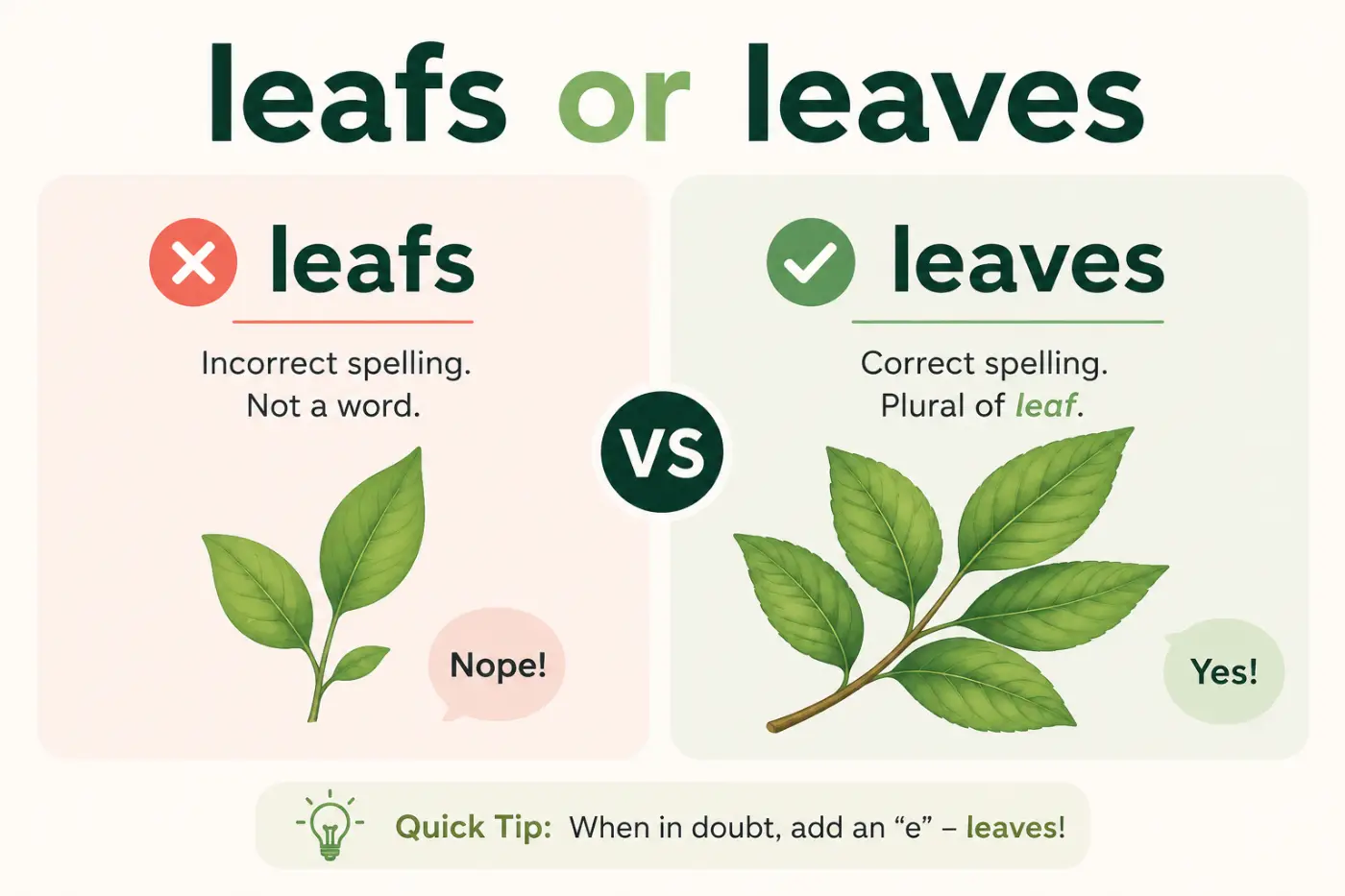
If you’ve ever paused before writing leafs or leaves, you’re not alone. It looks like a simple plural, but English has a habit of surprising us. Some words add s to become plural, while others change their spelling completely. Leaf is one of those words that often causes confusion.
The good news is the rule is easy once you understand it. In most situations, leaves is the correct plural of leaf. The word leafs also exists, but it has a completely different meaning and is used in specific contexts, not when talking about the green parts of trees and plants.
This confusion often appears in school assignments, emails, blog posts, social media captions, and even professional writing. Many people assume leafs is simply another acceptable spelling, but that’s rarely true.
In this guide, you’ll learn the correct plural form, why English changes leaf to leaves, when leafs is actually correct, common grammar mistakes, pronunciation tips, and plenty of real life examples. By the end, you’ll know exactly which word to use every time.
A related grammar guide is Any Time Vs Anytime Which One Is Correct.
Quick Answer
Leaves is the correct plural of leaf when referring to the flat green parts of a plant or tree. Leafs is only correct as a verb, meaning to flip through pages quickly, or in a few proper names. For almost every writing situation, leaves is the word you need.
Leafs Or Leaves Comparison Table
| Feature | Leafs | Leaves |
|---|---|---|
| Correct for the plural of leaf | No | Yes |
| Part of speech | Verb or proper noun | Noun and verb |
| Meaning | Turns pages quickly or appears in certain names | More than one leaf or the verb leave |
| Common use | Rare | Very common |
| Formal writing | Rarely used | Standard English |
| Everyday English | Uncommon | Preferred |
| Example | She leafs through the magazine. | The leaves turned bright red. |
Which One Is Correct
If you’re talking about more than one leaf, the correct word is leaves.
Correct examples.
✔ The leaves covered the sidewalk after the storm.
✔ We collected colorful leaves during our hike.
Using leafs in these sentences is incorrect because leafs is not the plural form of the noun leaf.
The only time leafs is correct is when it works as a verb.
For example.
✔ He leafs through the newspaper every morning.
In this sentence, leafs means flips through pages quickly. It does not refer to plant leaves.
What Does Leaf Mean
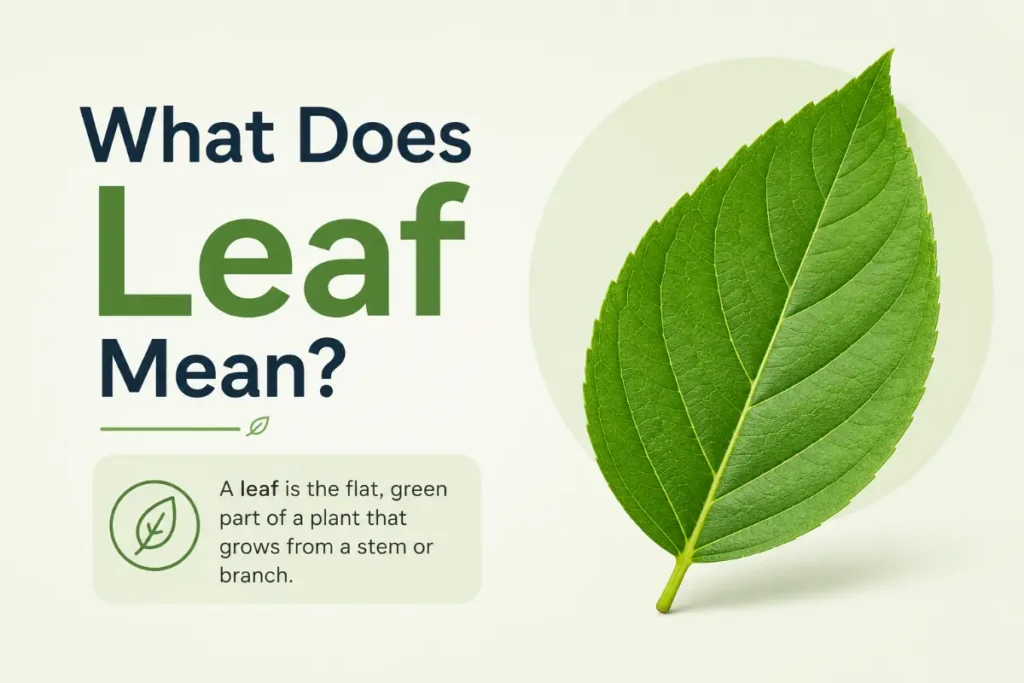
A leaf is the flat green part of a plant or tree. Leaves help plants make food through photosynthesis and play an important role in their growth.
The word also has several extended meanings.
- A page in a book.
- A thin sheet of metal such as gold leaf.
- A movable part of a table or door.
Context tells readers which meaning is intended.
Examples Of Leaf
- A single leaf floated across the pond.
- The maple leaf fell onto the path.
- She pressed a leaf inside her notebook.
- Every leaf on the tree shimmered in the sunlight.
- The insect rested on a large leaf.
What Does Leaves Mean
Leaves is the standard plural form of the noun leaf.
It also serves as the third person singular form of the verb leave.
Examples.
As A Plural Noun
- The leaves are turning yellow.
- We swept the leaves from the driveway.
- Fresh leaves covered the forest floor.
As A Verb
- She leaves work at five every evening.
- The train leaves in ten minutes.
- My brother always leaves the lights on.
Because leaves has two different grammar functions, the surrounding sentence makes the meaning clear.
Why People Confuse Leafs Or Leaves
English spelling rules are not always predictable, and leafs or leaves is a good example.
Several reasons cause the confusion.
Most Plurals Simply Add S
Words like book, car, and table become books, cars, and tables.
People naturally expect leaf to become leafs.
The F Changes To V
Some English nouns ending in f change the f to v before adding es.
Examples include.
- Leaf becomes leaves.
- Wolf becomes wolves.
- Shelf becomes shelves.
- Calf becomes calves.
Since not every word follows this pattern, many learners second guess themselves.
The Verb Leafs Exists
People sometimes see sentences like this.
He leafs through the magazine.
This makes it seem as if leafs could also be the plural noun. It cannot.
Autocorrect And Fast Typing
Typing quickly often leads people to write leafs by mistake. Some grammar checkers catch the error, while others miss it if the sentence is incomplete.
Key Differences Between Leafs And Leaves
| Feature | Leafs | Leaves |
|---|---|---|
| Grammar role | Verb | Noun and verb |
| Refers to plant foliage | No | Yes |
| Standard plural of leaf | No | Yes |
| Means turning pages | Yes | No |
| Common in everyday writing | Rare | Very common |
| Accepted in dictionaries | Yes in limited contexts | Yes |
The easiest way to remember the difference is simple.
If you’re talking about trees, plants, flowers, or nature, choose leaves.
If someone is flipping through the pages of a book or magazine, leafs may be the correct verb.
Grammar Rule Behind Leafs And Leaves
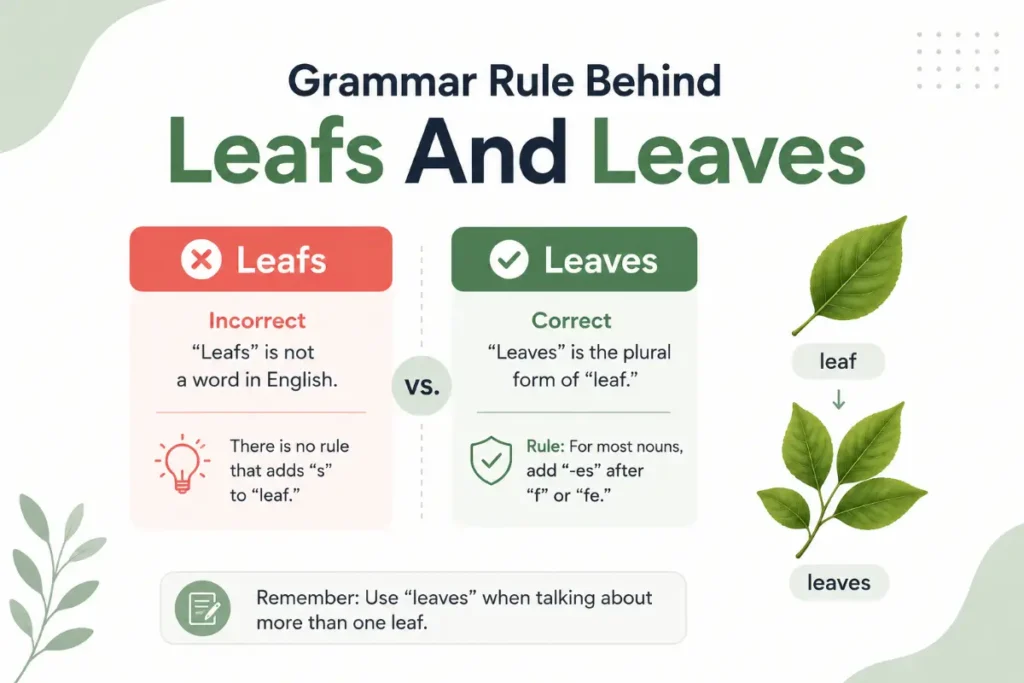
The reason leaf becomes leaves comes from a common English spelling rule.
Many nouns ending in f or fe change the f to v before adding es to form the plural.
Examples include.
| Singular | Plural |
|---|---|
| Leaf | Leaves |
| Wolf | Wolves |
| Knife | Knives |
| Shelf | Shelves |
| Calf | Calves |
| Life | Lives |
| Loaf | Loaves |
| Thief | Thieves |
This pattern developed over centuries as English pronunciation changed. Today it remains the accepted spelling in modern English.
Keep in mind that not every word ending in f follows this rule.
For example.
| Singular | Plural |
|---|---|
| Roof | Roofs |
| Chief | Chiefs |
| Belief | Beliefs |
| Safe | Safes |
| Cliff | Cliffs |
This is one reason English learners often hesitate when writing leafs or leaves.
Many readers also check Woman Vs Women Which Word Should You Use 2026 Guide.
Pronunciation Guide
Although the spelling changes, the pronunciation remains easy to learn.
Leaf
IPA
American English
/liːf/
Syllables
Leaf.
Leaves
IPA
American English
/liːvz/
Syllables
Leaves.
Notice how the f sound changes to a v sound in the plural.
Leafs
IPA
American English
/liːfs/
When used as a verb, leafs keeps the f sound.
Examples.
He leafs through the catalog every weekend.
The editor leafs through each manuscript before the meeting.
Listening to the sound difference can help you remember the correct spelling.
Word Origin
The word leaf has existed in English for more than a thousand years.
It comes from the Old English word lēaf, which referred to the green part of a plant. Its roots go back even further to the Germanic languages, where similar words described foliage and plant growth.
As English evolved, many words ending in f developed plurals with a v sound. That is why leaf eventually became leaves instead of leafs.
The verb leaf, meaning to turn pages, appeared much later. It comes from the idea that each page of a book resembles a leaf.
British American Canadian And Australian English
There is no regional difference for the plural of leaf.
English speakers in the United States, the United Kingdom, Canada, Australia, and New Zealand all use leaves as the standard plural noun.
Examples.
American English.
The leaves are already changing color.
British English.
The leaves covered the garden after the storm.
Canadian English.
The maple leaves looked beautiful in October.
Australian English.
The eucalyptus leaves stayed green all year.
The verb leafs is also recognized across these varieties of English, although many writers prefer phrases like flips through in everyday writing.
Real Life Examples
The easiest way to master leafs or leaves is to see the words in real situations.
Daily Conversation
- The leaves are falling earlier this year.
- We gathered colorful leaves for the art project.
- A single leaf landed on my shoulder.
- The wind carried the leaves across the yard.
Workplace
- The gardener removed the dead leaves before the meeting.
- Our landscaper recommended clearing the leaves every week.
- He leafs through the company handbook before training begins.
Emails
- Please remove the leaves from the entrance before tomorrow.
- She always leafs through the report before sending feedback.
Academic Writing
- Scientists studied how leaves absorb sunlight.
- Plant leaves play a key role in photosynthesis.
- The researcher examined damaged leaves under a microscope.
Literature
- Golden leaves danced in the autumn breeze.
- The old oak dropped its leaves one by one.
Journalism
- Strong winds scattered leaves across downtown streets.
- Experts say healthy leaves help plants produce energy.
Social Media
- Nothing beats walking through colorful autumn leaves.
- I love hearing dry leaves crunch under my feet.
- She leafs through old photo albums every holiday.
- The park looks magical with bright red and orange leaves.
These examples show that leaves almost always refers to plants, while leafs appears only when someone turns pages.
Common Mistakes
Many writers make the same errors when using leafs and leaves.
Writing Leafs As The Plural
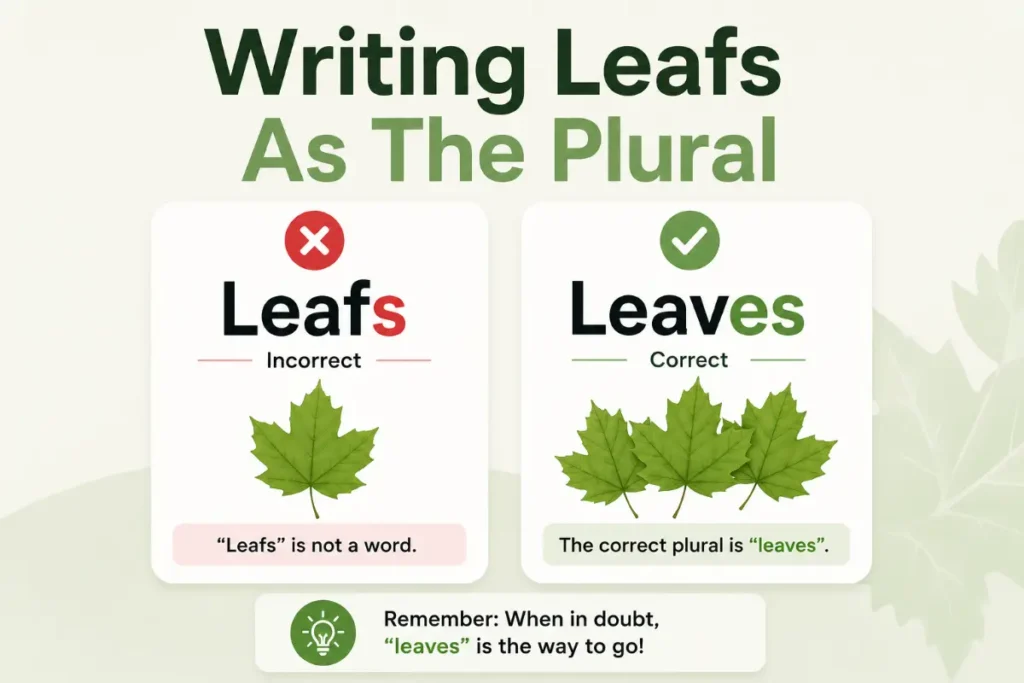
Incorrect.
The tree has green leafs.
Correct.
The tree has green leaves.
Using Leaves As The Verb
Incorrect.
He leaves through the magazine every evening.
Correct.
He leafs through the magazine every evening.
Assuming Every F Word Changes To Ves
Many learners overapply the rule.
Incorrect.
There are many beliefs becomes believes.
Correct.
There are many beliefs.
Learning which words change and which do not takes practice, but leaf is one of the common words that always becomes leaves as a plural noun.
Memory Tricks
These simple tricks can help you remember the correct form.
Think About Trees
Trees have leaves, never leafs.
Picture a tree full of green leaves every time you write the plural.
Remember The V
Many nature words ending in f change to v in the plural.
Leaf becomes leaves.
Wolf becomes wolves.
Knife becomes knives.
Use The Page Test
Ask yourself one question.
Am I talking about plants or pages?
If the answer is plants, write leaves.
If someone is turning pages, the verb leafs may be the correct choice.
These quick checks make the right spelling much easier to remember.
Related Words
Expanding your vocabulary makes it easier to remember the difference between leafs and leaves.
Synonyms For Leaf
- Foliage.
- Blade.
- Frond.
- Needle.
- Petal. (In some plant related contexts.)
Related Plant Words
- Branch.
- Stem.
- Root.
- Blossom.
- Flower.
- Tree.
- Shrub.
- Seed.
Related Grammar Topics
- Singular and plural nouns.
- Irregular plurals.
- Countable nouns.
- Verb forms.
- Subject verb agreement.
If you’re learning English, these topics often appear together and help build a stronger understanding of grammar.
Expert Editor’s Note
Professional editors almost never use leafs as the plural noun because it is incorrect in standard English.
Major dictionaries and style guides agree that leaves is the accepted plural of leaf. The only common exception is when leafs functions as a verb meaning turns pages.
In professional writing, choosing the correct plural matters because it immediately shows strong grammar skills. A single spelling mistake like leafs instead of leaves can distract readers and reduce credibility.
If you’re ever unsure, remember this simple rule.
Plants have leaves.
People leaf through books.
That one sentence solves the confusion in almost every situation.
Frequently Asked Questions
Is Leafs Ever Correct?
Yes. Leafs is correct as the third person singular form of the verb leaf, meaning to turn pages quickly. It is not the plural form of the noun leaf.
Why Is The Plural Of Leaf Not Leafs?
English has a group of nouns ending in f that change the f to v before adding es. That is why leaf becomes leaves instead of leafs.
Is Leaves Always The Correct Plural?
Yes. When referring to more than one plant leaf, leaves is always the standard plural in modern English.
Why Do Some Words Ending In F Add Only S?
English developed from several languages, so plural rules are not completely consistent. Words like roof, chief, and belief simply add s, while words like leaf, wolf, and knife change to ves.
Does British English Use Leafs?
No. British English uses leaves as the plural noun just like American English. The same rule also applies in Canadian and Australian English.
Can Leaves Be A Verb?
Yes. Leaves is also the third person singular form of the verb leave.
Example.
She leaves home at seven every morning.
The meaning depends on the sentence.
How Can I Remember The Difference?
Picture a tree covered with green leaves. Then picture someone leafing through a magazine. The image makes it much easier to choose the correct word.
Need another quick comparison? Read On To Vs Onto Which One Is Correct (2026).
Conclusion
The answer to leafs or leaves is straightforward once you know the grammar.
Use leaves when talking about the plural of leaf. This is the correct spelling in school, business, professional writing, and everyday conversation.
Use leafs only as a verb that means to turn the pages of a book, magazine, or document. It is not the plural form of the noun.
The easiest way to remember the rule is this.
If it grows on a tree, write leaves.
If someone flips through pages, they leafs through a book.
Learning this small difference will make your writing more accurate and more natural every time.

Senior Grammar Editor
Olivia Reynolds is a grammar editor and language writer who enjoys making complex English rules easy to understand. She specializes in grammar, punctuation, sentence structure, and everyday writing tips, helping readers write with greater confidence and clarity.