
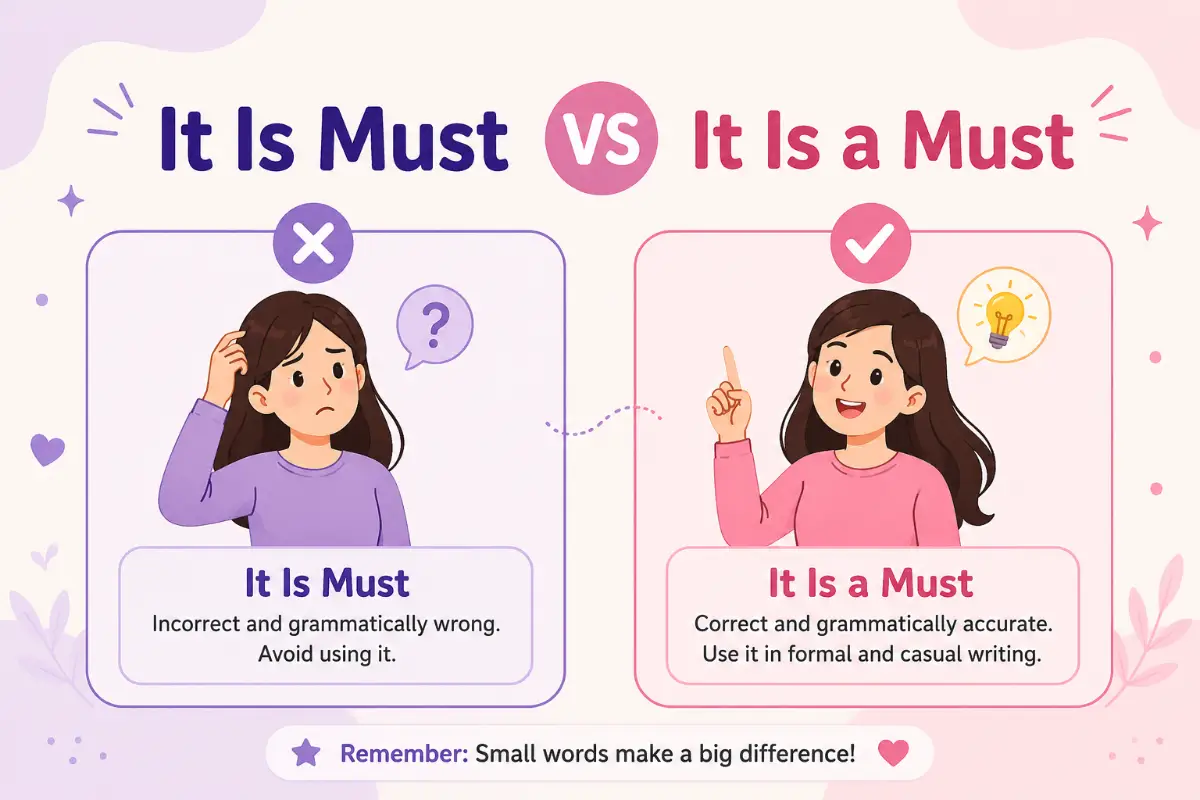
If you have ever written a sentence such as “it is must to learn English” or “it is a must to learn English,” you may have wondered about it is must vs it is a must, and which version is correct.
The short answer is simple:
“It is a must” is grammatically correct when must is being used as a noun. “It is must” is not standard English in this structure.
However, there is an important detail that makes this question slightly more interesting. The word must can function as a modal verb, a noun, and part of several fixed expressions. That is why you cannot simply add or remove a whenever you see the word.
For example:
- You must study regularly. — correct
- Regular practice is a must. — correct
- It is a must for every student. — correct
- It is must for every student. — incorrect in standard English
- It must be important. — correct, but must is functioning as a modal verb
- It is necessary. — correct and often more natural in formal writing
The distinction becomes much easier once you understand what role must is playing in the sentence.
A related grammar guide is Loose Vs Lose Which Word Is Correct 2026.
Quick Answer
When you are deciding between “it is must” and “it is a must,” choose “it is a must.”
The reason is grammatical: in this construction, must is functioning as a singular countable noun meaning something that is essential, necessary, or highly recommended. Singular countable nouns generally need a determiner such as a, an, the, this, or that.
So:
A good dictionary is a must for serious language learners.
Here, must means something essential or necessary.
By contrast, must also works as a modal auxiliary verb:
You must check your spelling before submitting the essay.
In that sentence, must is not a noun. It directly precedes the base form check, so it does not take a.
This difference explains most of the confusion.
What Does “It Is a Must” Mean?
“It is a must” means that something is considered necessary, essential, or strongly recommended.
The expression is commonly used when a person wants to emphasize that something should not be skipped.
For example:
If you want to improve your pronunciation, listening to native speakers is a must.
The sentence does not necessarily mean that listening is a legal requirement. It means that it is extremely important if your goal is better pronunciation.
Similarly:
A passport is a must when traveling internationally.
Depending on the context, this can mean that having a passport is an essential requirement.
Another example:
For anyone visiting the city, the old market is a must.
Here, the phrase means that visiting the market is strongly recommended because it is an important or worthwhile experience.
The expression can therefore describe either a true necessity or something that the speaker considers essential or highly desirable.
That distinction matters.
Why “It Is Must” Is Incorrect
The problem with “it is must” is that the sentence tries to use must as though it were an adjective.
English does not normally use must that way.
Consider these sentences:
It is important.
It is necessary.
It is essential.
In each case, the word after is is an adjective.
But must is not an adjective in the expression being discussed.
If you want to use must as a noun after is, the normal structure is:
It is a must.
The article a signals that must is being used as a noun.
You can see the same basic pattern with other singular countable nouns:
It is a requirement.
It is a necessity.
It is a priority.
It is a must.
The meanings are not identical in every context, but the grammatical pattern is similar.
This is why leaving out the article produces a sentence that sounds incomplete or unnatural in standard English.
The Two Different Uses of “Must”
A major reason this question causes confusion is that must has more than one grammatical function.
1. Must as a modal verb
As a modal verb, must expresses strong obligation, necessity, or logical deduction.
Examples include:
You must wear a seat belt.
Students must submit their assignments on time.
We must leave before sunset.
She must be tired after such a long journey.
In these sentences, must is part of the verb phrase.
It is followed by a base-form verb:
- must go
- must study
- must leave
- must finish
- must check
You do not put a before it.
For example:
You must study.
Not:
You a must study.
This is a completely different grammatical construction from the noun phrase a must.
2. Must as a noun
Must can also function as a noun meaning something that is essential, indispensable, or strongly recommended.
For example:
Comfortable shoes are a must for this trip.
Here, must is a noun.
It means something like:
an essential thing
or:
something you really need or should have
Other examples:
A reliable internet connection is a must for remote work.
Good communication skills are a must in this profession.
Sunscreen is a must during a beach vacation.
This book is a must for anyone studying modern history.
In each sentence, must acts as a noun rather than a modal verb.
Cambridge’s English thesaurus lists “be a must” among expressions related to necessity and gives examples where the expression means something necessary or especially desirable.
Is “It Is a Must” Formal or Informal?
“It is a must” is grammatically correct, but it is generally more conversational and emphatic than alternatives such as “it is essential” or “it is necessary.”
You will often encounter the expression in:
- everyday conversation
- travel writing
- recommendations
- reviews
- lifestyle articles
- marketing
- entertainment writing
- informal advice
For example:
This restaurant is a must if you love authentic Italian food.
That sounds natural in a recommendation.
In a formal report, however, you might prefer:
This restaurant is highly recommended.
Or:
Visiting the restaurant is strongly recommended.
Or:
The restaurant is considered an important destination for visitors.
The choice depends on the audience and purpose.
There is nothing grammatically wrong with the noun expression. It simply has a somewhat more conversational flavor.
“It Is a Must” vs. “It Is Necessary”
These expressions overlap, but they are not always interchangeable in tone.
It is a must
This is emphatic and often sounds like a recommendation.
Trying the local dessert is a must.
The speaker is expressing a strong opinion that the experience should not be missed.
It is necessary
This sounds more neutral and formal.
A valid identification document is necessary for registration.
The statement focuses on an actual requirement.
It is essential
This is also formal and emphasizes importance.
Accurate records are essential for effective project management.
It is required
This usually indicates an external rule, condition, or formal requirement.
A valid passport is required for entry.
These alternatives can help you choose language that fits the situation rather than simply repeating the same expression.
“It Is a Must” in a Sentence
One of the most common searches surrounding this expression is how to use it naturally in a sentence.
Here are several examples across different situations.
Everyday English
Drinking enough water is a must during extremely hot weather.
A good night’s sleep is a must before an important examination.
Checking the weather before a long drive is a must.
Saving your work regularly is a must when using important documents.
These examples treat must as a noun meaning something essential.
Education
Regular revision is a must for students preparing for competitive exams.
Reading widely is a must if you want to develop a strong vocabulary.
Proofreading is a must before submitting an academic assignment.
Understanding the basics is a must before moving on to advanced topics.
In educational writing, however, alternatives such as essential, important, and necessary may sound more precise in formal contexts.
Travel
Comfortable walking shoes are a must for exploring the old town.
Carrying a reusable water bottle is a must on a long hiking trip.
Checking visa requirements is a must before international travel.
Early booking is a must during the peak holiday season.
These sentences use the expression naturally because the noun refers to something the speaker considers essential.
Work
Clear communication is a must for successful teamwork.
Backing up important files is a must for every business.
Meeting the deadline is a must if the project is to stay on schedule.
Good time management is a must in a fast-paced workplace.
Again, the expression emphasizes importance rather than merely stating a neutral fact.
“It Is Must to…”: Why This Pattern Causes Problems
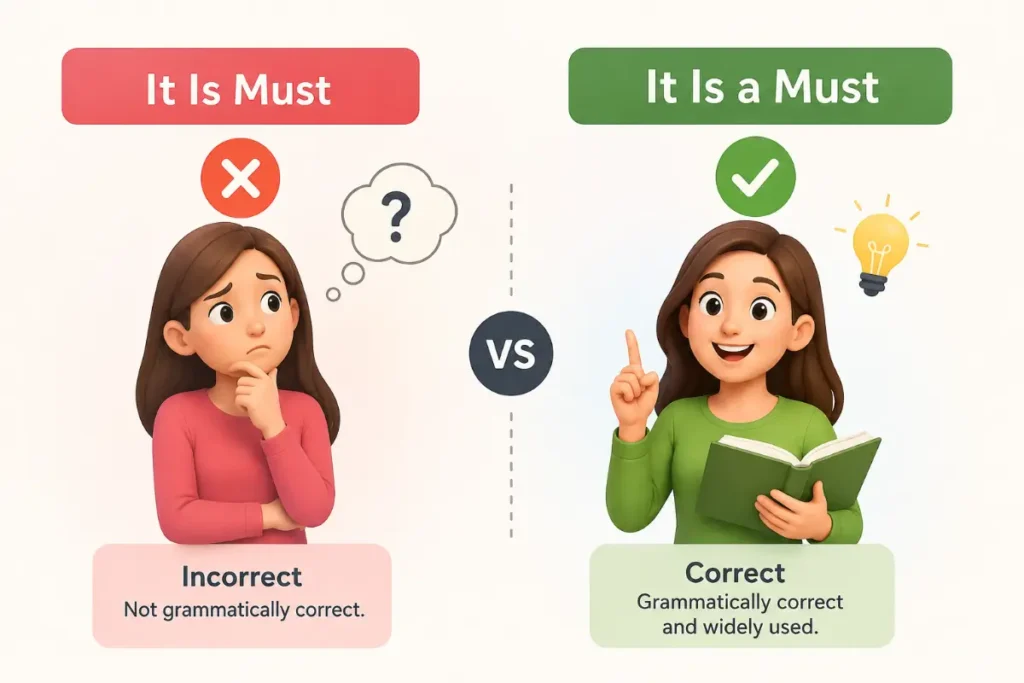
A particularly common mistake is writing:
It is must to study English every day.
This structure is not standard English.
A learner may be trying to combine:
You must study English every day.
with:
It is necessary to study English every day.
But these two structures work differently.
With the modal verb
You must study English every day.
The subject is you, and must is the modal verb.
With “necessary”
It is necessary to study English every day.
The subject it is used in an introductory structure, while necessary is an adjective.
With the noun “must”
Studying English every day is a must.
Here, must is a noun.
You can also say:
It is a must for serious learners.
The key is not to treat must as though it were an adjective.
Better Alternatives to “It Is Must”
If you have written “it is must”, the best correction depends on what you are trying to say.
If you mean “something is necessary”
Use:
It is necessary.
Example:
It is necessary to check the instructions first.
If you mean “something is essential”
Use:
It is essential.
Example:
It is essential to back up your files.
If you mean “someone is required to do something”
Use:
You must…
Example:
You must complete the form before submitting your application.
If you mean “something is strongly recommended”
Use:
It is highly recommended.
Example:
It is highly recommended that you arrive early.
If you want the noun expression
Use:
It is a must.
Example:
For serious photographers, a backup battery is a must.
This approach is much more useful than memorizing a single correction because it teaches you how to select the right construction according to meaning.
For another common grammar confusion, see Symptomatology Vs Symptomology Which Spelling Is Correct 2026.
“Must” vs. “Have to”
Another useful distinction involves must and have to.
Both can express obligation, but the choice can depend on context and emphasis.
Cambridge explains that must is commonly used for strong obligation and necessity, while have to is frequently used when the obligation comes from an outside situation, rule, or circumstance.
Compare:
I must finish this report tonight.
This can present the obligation as coming from the speaker.
Now consider:
I have to finish this report tonight because my manager needs it tomorrow.
The second sentence makes the external reason clearer.
In everyday conversation, have to is extremely common.
For example:
I have to leave early tomorrow.
In a rule or instruction, must can sound stronger:
Visitors must present identification.
Both constructions are useful, but they should not be confused with the noun phrase a must.
“Must” vs. “Should”
The distinction between must and should is also important.
Must
Usually indicates strong necessity or obligation.
You must submit the application before Friday.
The speaker presents the deadline as a firm requirement.
Should
Usually indicates advice, expectation, or a recommendation.
You should submit the application before Friday.
This sounds less forceful.
It suggests that submitting before Friday is advisable, but it does not necessarily establish the same level of obligation.
Now consider:
Visiting the museum is a must.
This is an emphatic recommendation.
A softer version would be:
Visiting the museum is highly recommended.
Understanding these shades of meaning makes your English sound more natural because you are choosing vocabulary according to the strength of the message.
“A Must” Does Not Always Mean a Legal Requirement
This is an important point for learners.
When someone says:
A warm jacket is a must for this trip.
they are usually not saying that a law requires you to own a jacket.
They mean:
You really should have one.
Likewise:
This book is a must for beginners.
does not mean that students are legally required to buy it.
It means the speaker considers the book extremely useful or important.
The surrounding context determines whether must expresses actual necessity, strong advice, or enthusiastic recommendation.
This is one reason why the expression appears frequently in reviews and recommendation articles.
For example:
This documentary is a must-watch.
Here, the speaker is strongly recommending it.
Common Mistakes With “Must”
Learning the correct phrase becomes easier when you recognize the most common errors.
Mistake 1: Leaving out the article
Incorrect:
It is must for beginners.
Better:
It is a must for beginners.
Or, more naturally:
It is essential for beginners.
Mistake 2: Adding “to” after modal must
Incorrect:
You must to practice every day.
Correct:
You must practice every day.
Cambridge specifically identifies this as a common grammatical error: must as a modal verb is followed directly by the base form of the verb, without to.
Mistake 3: Using “must” like an adjective
Incorrect:
It is must to understand the basics.
Better:
It is necessary to understand the basics.
Or:
You must understand the basics.
Or:
Understanding the basics is a must.
Each corrected sentence uses a different grammatical structure.
Mistake 4: Confusing “must not” with “do not have to”
These expressions have very different meanings.
You must not enter this room.
means:
You are prohibited from entering.
But:
You do not have to enter this room.
means:
Entering is not necessary.
The first expresses prohibition; the second expresses absence of obligation.
Cambridge highlights this distinction in its explanation of must and have to.
Can You Say “This Is a Must”?
Yes. In many situations, “this is a must” is actually more natural than beginning with “it is a must.”
For example:
This book is a must for anyone learning English.
This feature is a must for professional photographers.
This stop is a must if you are visiting the area.
A backup plan is a must when organizing an outdoor event.
The demonstrative this makes the reference clear.
Compare:
It is a must for travelers.
This is grammatical, but the reader needs to know what it refers to.
If you have already mentioned the subject, that is fine:
The old castle is just outside the city. It is a must for history lovers.
But if the subject is new, this is a must or a direct noun phrase can sometimes be clearer.
“A Must” With Plural Subjects
You may also see sentences such as:
Good communication skills are a must.
This can look unusual because skills is plural while a must is singular.
But grammatically, the structure can still work because a must is functioning as a noun phrase describing the quality or requirement being discussed.
You may also choose a more formal alternative:
Good communication skills are essential.
For professional or academic writing, the second version may be preferable because it is more direct and less conversational.
“A Must-Have” vs. “A Must”
Another closely related expression is must-have.
Compare:
A reliable laptop is a must.
and:
A reliable laptop is a must-have for remote workers.
Must-have is commonly used as a noun or adjective-like compound to describe something considered essential or highly desirable.
Examples:
Noise-canceling headphones are a must-have for frequent travelers.
A backup drive is a must-have for photographers.
Comfortable shoes are a must-have for long walking tours.
The expressions overlap, but must-have often focuses on an item or feature that someone strongly recommends owning.
“Must-See,” “Must-Read,” and Similar Expressions
English has many compounds built around must.
You may encounter:
- must-see
- must-read
- must-have
- must-visit
- must-try
- must-watch
- must-do
For example:
The museum is a must-see attraction.
This novel is a must-read for mystery fans.
The local dessert is a must-try.
The mountain trail is a must-visit destination.
These compounds are especially common in travel, entertainment, shopping, and recommendation content.
They communicate strong enthusiasm or recommendation in a compact way.
Is “It Is a Must” Always the Best Choice?
No.
Grammar and natural style are two different considerations.
A sentence can be grammatically correct while another version sounds more appropriate for the context.
For example:
Regular exercise is a must for maintaining good health.
This is understandable and grammatical.
But in a formal health or academic article, you might prefer:
Regular exercise is important for maintaining good health.
Or:
Regular physical activity is essential for maintaining good health.
The alternative is not necessarily “more correct.” It is simply better suited to a formal context.
Similarly, in a travel article:
Visiting the old harbor is a must.
sounds perfectly natural because the writer is making a recommendation.
Good writing is not about using the strongest possible expression every time. It is about matching the expression to the audience, purpose, and context.
Examples: Correct and Incorrect
Here is a quick comparison.
| Incorrect or awkward | Better alternative |
|---|---|
| It is must for students. | It is a must for students. |
| It is must to practice. | It is necessary to practice. |
| You must to practice. | You must practice. |
| It must to be important. | It must be important. |
| Reading is must. | Reading is a must. |
| Reading is necessary. | Reading is necessary. |
| You must read this book. | You must read this book. |
| This book is a must. | This book is a must. |
Notice that there are several different correct structures. The right choice depends on whether must is functioning as a modal verb or a noun.
A Simple Rule to Remember
If must comes before another verb, it is usually functioning as a modal verb:
You must study.
We must leave.
They must finish.
She must check.
Do not put a before it.
If must is being used as a noun meaning something essential, the expression is:
a must
For example:
This guide is a must.
A passport is a must.
Good preparation is a must.
This simple distinction solves most cases.
Why Articles Matter in English
The issue also illustrates a broader feature of English grammar: articles matter.
English often requires a determiner before a singular countable noun.
Compare:
It is book. ❌
It is a book. ✅
Similarly:
It is requirement. ❌
It is a requirement. ✅
And:
It is must. ❌
It is a must. ✅
The reason is that must, when used as the noun in this expression, behaves as a singular countable noun.
This is not because the word must always requires a. It does not.
The article is required because of the grammatical role must is playing in that particular sentence.
That distinction is crucial.
Why Native Speakers May Avoid the Phrase in Some Situations
Although “it is a must” is correct, native speakers do not necessarily use it every time they want to express necessity.
Depending on the context, they may say:
- It is essential.
- It is necessary.
- You need to…
- You have to…
- You should…
- You must…
- It is highly recommended.
- This is essential.
- This is something you need.
For example, instead of:
It is a must to check your passport before traveling.
a natural speaker might say:
You must check your passport before traveling.
Or:
It is important to check your passport before traveling.
Or:
You need to check your passport before traveling.
The noun construction a must is often more natural when describing a thing, feature, activity, or experience:
Comfortable shoes are a must.
This restaurant is a must.
A backup plan is a must.
That is why blindly inserting the phrase into every sentence can make writing feel unnatural.
When to Use “Must,” “Need To,” “Have To,” or “Should”
Choosing among these forms can be easier with a simple scale.
Must
Use it for strong obligation or necessity.
You must wear protective equipment.
Need to
Use it for practical necessity.
You need to charge your phone before leaving.
Have to
Use it commonly for external obligations or circumstances.
I have to attend a meeting at nine.
Should
Use it for advice or recommendation.
You should arrive early.
A must
Use it as a noun when describing something considered essential or highly desirable.
Arriving early is a must for this event.
These expressions are related, but they are not interchangeable in every sentence.
Frequently Asked Questions
Is “it is must” grammatically correct?
No, not in standard English when you are trying to say that something is necessary or essential. The normal noun expression is “it is a must.” Another option is to restructure the sentence using must as a modal verb, such as “You must do it.”
What does “it is a must” mean?
It means that something is considered necessary, essential, or strongly recommended. The exact strength depends on context.
Is “it is a must” formal English?
It is correct English, but it often has a conversational or recommendation-oriented tone. In highly formal writing, necessary, essential, or required may be more appropriate.
Can I say “this is a must”?
Yes. “This is a must” is a natural expression when referring to something essential or highly recommended.
For example:
This guide is a must for new writers.
Can I say “it is must to do”?
No. Use one of these instead:
It is necessary to do it.
You must do it.
Doing it is a must.
The best version depends on what you want to emphasize.
Is “must” a noun?
Yes. Must can function as a noun meaning something that is necessary or essential.
For example:
A first-aid kit is a must on a long hiking trip.
However, must is also commonly used as a modal verb.
What is the difference between “must” and “a must”?
Must can be a modal verb:
You must leave.
A must is a noun phrase:
A passport is a must.
The grammatical structures are different.
What is the synonym of “a must”?
Depending on context, alternatives include:
- necessity
- requirement
- essential
- essential item
- something indispensable
- priority
- prerequisite
- recommendation
However, these are not perfect substitutes in every sentence. A must can carry a stronger sense of personal recommendation or enthusiasm.
Is “must” stronger than “should”?
Generally, yes. Must usually communicates stronger obligation or necessity, while should normally expresses advice, expectation, or a recommendation.
For example:
You must submit the form today.
sounds like a requirement.
You should submit the form today.
sounds more like advice.
Can “a must” describe an experience?
Absolutely.
For example:
Visiting the old town is a must.
Trying the local food is a must.
Watching the sunset from the hill is a must.
In these cases, the phrase means that the writer strongly recommends the experience.
A Useful Editing Checklist
Before publishing or submitting a sentence containing must, ask yourself three questions.
1. Is “must” a modal verb?
If it is followed by a base-form verb, it probably is.
You must learn.
We must go.
They must finish.
2. Is “must” being used as a noun?
If you mean “something essential,” use:
a must
For example:
Good preparation is a must.
3. Would another expression sound more natural?
Sometimes necessary, essential, required, important, need to, or have to communicates your meaning more clearly.
Good English is not simply about choosing a grammatically permissible structure. It is about choosing the structure that expresses the intended meaning naturally.
Final Verdict
When comparing “it is must” with “it is a must,” the standard choice is “it is a must.”
The difference comes down to grammar.
When must is a modal verb, it is followed by the base form of another verb:
You must study.
You must leave.
You must check.
When must is functioning as a noun meaning something essential or highly recommended, it takes the article a:
It is a must.
This book is a must.
Good preparation is a must.
However, you do not always need to use the noun expression. In many situations, a sentence such as “It is necessary,” “It is essential,” “You must,” “You need to,” or “You have to” will sound more natural.
The most important lesson is therefore not simply to memorize one phrase. Understand what grammatical job the word must is doing.
If it is the modal verb, use it directly with the base verb:
You must act.
If it is the noun meaning something essential, use the noun phrase:
Taking action is a must.
And if you want a more neutral or formal style:
Taking action is necessary.
That small distinction will help you avoid a common error while also making your writing clearer, more precise, and more natural.
Learn the difference in Home Made Or Homemade Which One Is Correct 2026 Guide.
In One Line
Use “a must” when must is a noun; use “must + base verb” when must is a modal verb. “It is must” is not the standard form.

Senior Grammar Editor
Olivia Reynolds is a grammar editor and language writer who enjoys making complex English rules easy to understand. She specializes in grammar, punctuation, sentence structure, and everyday writing tips, helping readers write with greater confidence and clarity.