
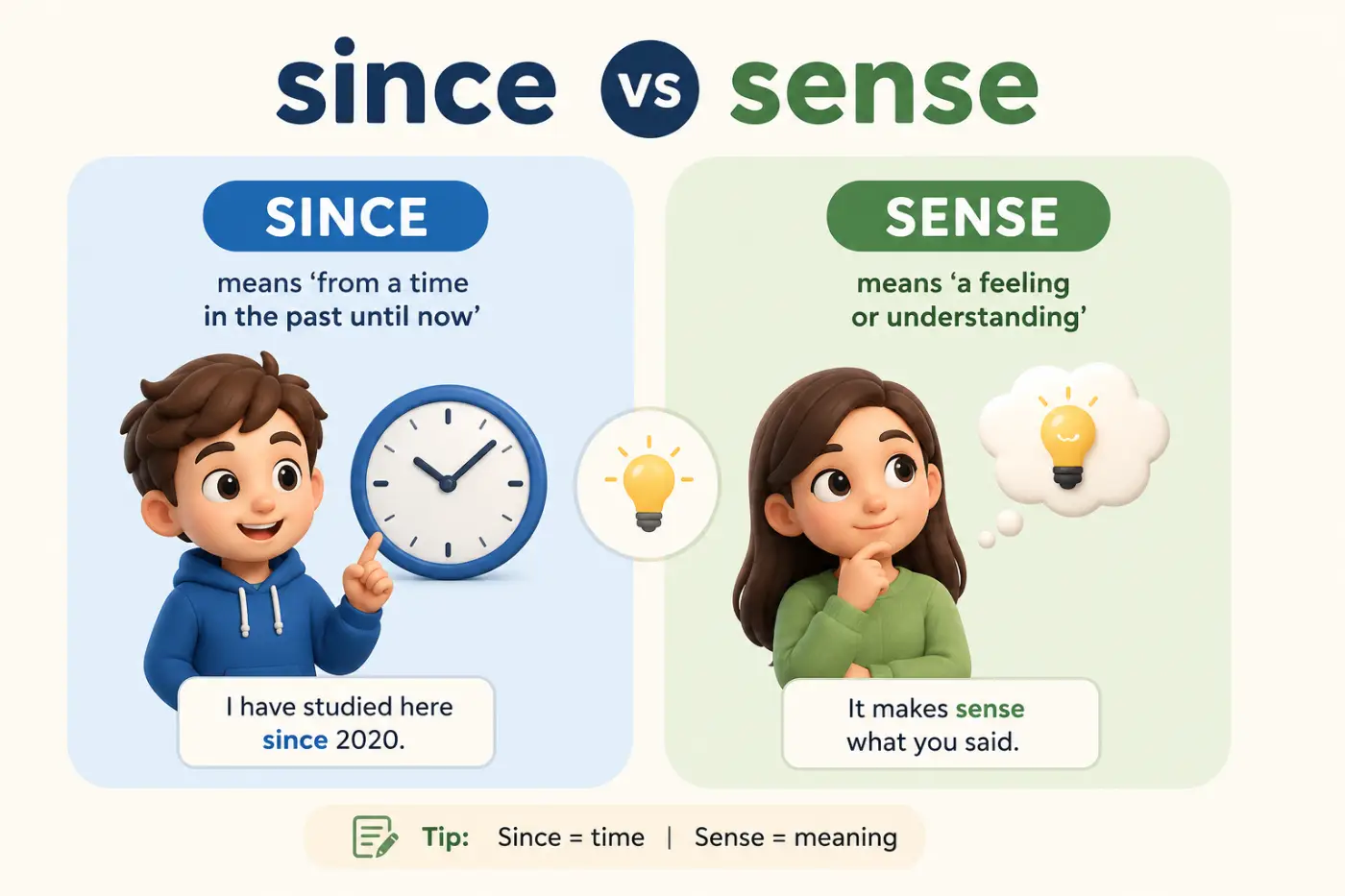
Many English learners pause when writing since or sense. The two words sound almost identical in everyday speech, but they have completely different meanings and grammar. A single letter changes the word, yet choosing the wrong one can make a sentence confusing or incorrect.
The good news is the difference is easy to learn. Since usually talks about time or gives a reason. Sense refers to understanding, meaning, awareness, or one of the five senses. Once you know the job each word does, you’ll rarely mix them up again.
The confusion often comes from pronunciation. In many accents, since and sense sound almost the same. Spellcheck may not catch the mistake because both are valid English words. That makes it important to understand their meanings instead of relying on how they sound.
This guide explains the difference between since vs sense with simple definitions, grammar rules, pronunciation, comparison tables, real examples, common mistakes, and practical memory tricks. By the end, you’ll know exactly which word belongs in every sentence.
Still confused? Compare Rug Vs Rag Key Differences Explained 2026 Guide.
Quick Answer
Since is used to show time or give a reason. Sense refers to understanding, meaning, awareness, or one of the five physical senses. Both words are correct English words, but they are never interchangeable because they perform different grammatical functions.
Since Vs Sense Comparison Table
| Feature | Since | Sense |
|---|---|---|
| Part of speech | Preposition conjunction adverb | Noun verb |
| Main meaning | From a point in time or because | Understanding feeling meaning awareness |
| Correct spelling | Yes | Yes |
| Common use | Time cause and effect | Knowledge emotions perception |
| Formal writing | Very common | Very common |
| Everyday conversation | Very common | Very common |
| Can replace the other | No | No |
| Example | I have lived here since 2022. | That makes sense. |
What Does Since Mean
Since is one of the most common words in English. It usually connects ideas about time or reason.
Simple Definition
Since means from a particular time until now or because.
Since Referring To Time
When since refers to time, it tells us when something started.
Examples.
- I have lived in Chicago since 2020.
- She has worked here since January.
- We haven’t spoken since last summer.
- He’s been interested in photography since childhood.
- The restaurant has been open since Monday.
Notice that since often appears with the present perfect tense because it connects the past to the present.
Since Meaning Because
Since can also explain the reason for something.
Examples.
- Since it’s raining, we’ll stay indoors.
- Since everyone agreed, the meeting ended early.
- Since you finished your work, you can leave now.
- Since the road is closed, we’ll take another route.
- Since nobody answered, I left a message.
In this meaning, since is similar to because, although because often sounds stronger and more direct.
What Does Sense Mean
Sense has several meanings, but they all relate to understanding, awareness, perception, or meaning.
Simple Definition
Sense means the ability to understand, feel, recognize, or perceive something.
Sense As Understanding
One of the most common uses appears in the expression make sense.
Examples.
- Your explanation makes sense.
- That answer doesn’t make sense.
- His decision made perfect sense.
- The instructions finally make sense.
- I couldn’t make sense of the map.
Sense As One Of The Five Senses
Sense also refers to the body’s natural abilities to experience the world.
Examples include.
- Sense of sight.
- Sense of hearing.
- Sense of smell.
- Sense of taste.
- Sense of touch.
Example sentences.
- Dogs have a strong sense of smell.
- Her sense of hearing is excellent.
- Babies develop their sense of touch early.
Sense As Good Judgment
Sense can also describe wisdom or practical thinking.
Examples.
- She has a good sense of humor.
- He showed great business sense.
- Use your common sense before making a decision.
- They admire her sense of responsibility.
- His sense of direction helped us find the trail.
Which One Is Correct
Both since and sense are correct English words.
The correct choice depends entirely on your meaning.
Choose since if you’re talking about time or giving a reason.
Choose sense if you’re talking about understanding, meaning, judgment, awareness, or one of the five senses.
Compare these examples.
✔ I’ve known her since college.
✔ Since you’re here, let’s begin.
Now look at incorrect examples.
✘ I’ve known her sense college.
✘ Sense it’s getting late, let’s leave.
These mistakes happen because the words sound alike, not because they share the same meaning.
Since Vs Sense In Grammar
The easiest way to tell them apart is to understand the job each word performs.
Since Can Be A Preposition
As a preposition, since introduces a starting point in time.
Examples.
- I’ve worked here since May.
- They’ve been friends since high school.
Since Can Be A Conjunction
As a conjunction, since connects two ideas and often means because.
Examples.
- Since you’re ready, we’ll start.
- Since traffic was heavy, we arrived late.
Since Can Be An Adverb
Sometimes since stands alone to refer to the time after a particular event.
Examples.
- He moved away and hasn’t returned since.
- I met her years ago and haven’t seen her since.
Sense Is Usually A Noun
Most often, sense names an idea, feeling, ability, or understanding.
Examples.
- That makes sense.
- She has excellent fashion sense.
- His sense of timing is impressive.
In less common situations, sense also works as a verb meaning to detect or become aware of.
Examples.
- I sensed something was wrong.
- Animals can sense danger quickly.
In the next section, you’ll learn why these words are so easy to confuse, how native speakers naturally use them, pronunciation tips, word origins, and more than twenty real life examples from everyday English, work, academic writing, journalism, and social media.
Why People Confuse Since And Sense
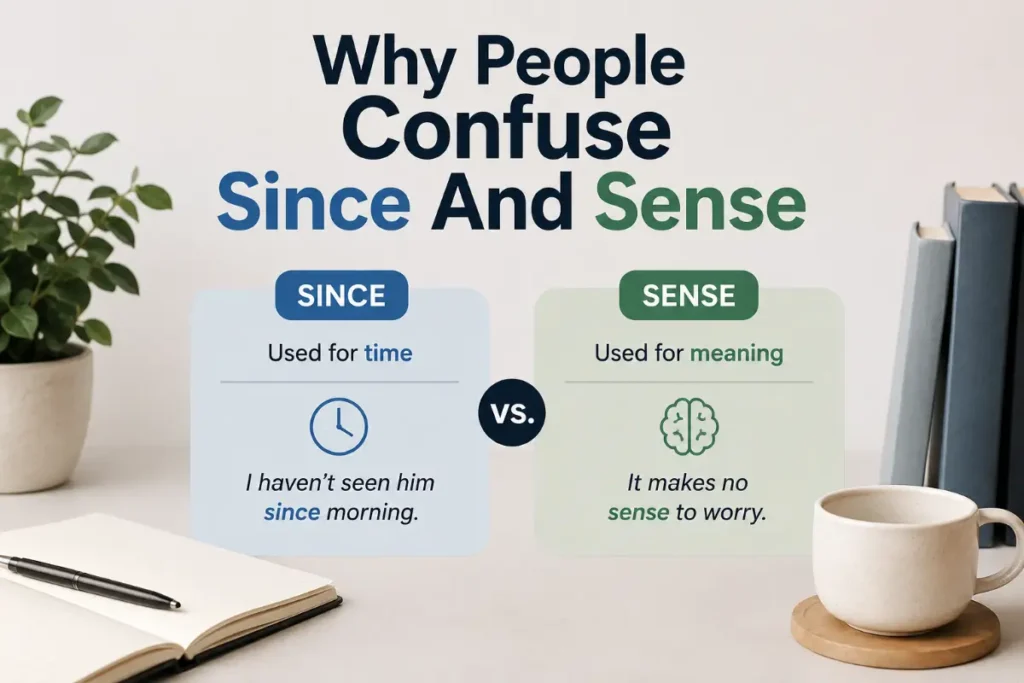
Many people confuse since and sense because they sound almost identical in everyday English. They are classic homophones. Even fluent speakers occasionally type one when they mean the other.
Here are the main reasons the confusion happens.
Similar Pronunciation
In American English, since and sense are pronounced almost the same. When people write from memory instead of thinking about the meaning, they often choose the wrong spelling.
Both Are Common Words
Unlike many spelling mistakes, both words are correct English words. Spellcheck usually accepts both, so it may not catch the error.
For example.
✘ That makes since.
The sentence contains a spelling mistake, but many spellcheck tools won’t flag it because since is a valid word.
Fast Typing
People often type quickly in emails, messages, and social media posts. Small spelling mistakes are easy to miss during proofreading.
Learning English By Sound
Many English learners hear these words long before they see them written. Since they sound alike, it’s natural to connect them to the wrong spelling.
Internet Habits
The mistake makes since appears online so often that some learners assume it is correct. It is not. The correct expression is makes sense.
Since Vs Sense Key Differences
| Feature | Since | Sense |
|---|---|---|
| Main purpose | Shows time or gives a reason | Expresses understanding awareness or perception |
| Part of speech | Preposition conjunction adverb | Noun verb |
| Answers which question | From when or why | What meaning or understanding |
| Common expressions | Since yesterday since you asked | Make sense common sense sense of humor |
| Used with time | Yes | No |
| Used with understanding | No | Yes |
Think of it this way.
Since connects events.
Sense connects ideas.
Grammar Rules You Should Know
Understanding the grammar makes these words much easier to remember.
Since Shows Time
When since introduces a starting point in time, it usually works with the present perfect tense.
Examples.
- I’ve lived here since 2018.
- She’s worked remotely since March.
- We have been friends since childhood.
This pattern connects something that started in the past and continues today.
Since Can Mean Because
As a conjunction, since introduces the reason for an action.
Examples.
- Since you’re already here, let’s begin.
- Since the weather improved, we went hiking.
- Since everyone finished early, the meeting ended ahead of schedule.
This use is common in both speaking and writing.
Sense Is Usually A Noun
Most of the time, sense names an idea or ability.
Examples.
- Your answer makes sense.
- He has excellent business sense.
- She has a strong sense of responsibility.
Sense Can Also Be A Verb
As a verb, sense means to notice or detect something.
Examples.
- I sensed a problem immediately.
- Animals can sense danger before humans do.
- She sensed that something had changed.
This verb form is less common than the noun but appears frequently in books and formal writing.
Spelling Tips
There is no spelling rule connecting these words because they developed separately. The best approach is to remember the meaning of each one.
A simple trick helps.
The word sense contains sens, just like sensitive. Both relate to feeling or awareness.
The word since contains sin, which can remind you of a point in time that started in the past.
The memory trick does not explain the history of the words, but it helps many learners remember the correct spelling.
Learn the difference in Tear Vs Tare Which Word Is Correct 2026 Guide.
Pronunciation Guide
Since
IPA
American English
/sɪns/
Syllables
Since.
Stress
Single syllable.
Sense
IPA
American English
/sɛns/
Syllables
Sense.
Stress
Single syllable.
Are They Pronounced The Same
Many American speakers pronounce these words almost identically in everyday conversation.
Some speakers produce a slight vowel difference.
Since
Sounds closer to sins.
Sense
Sounds closer to sens.
The difference is very small, so listeners usually understand the intended word from the sentence instead of the pronunciation.
Word Origin
Learning where these words came from explains why they have different meanings.
Since
Since comes from Old English and originally referred to time. Over the centuries, English speakers also began using it to introduce reasons, giving it the additional meaning of because.
Sense
Sense comes from the Latin word sensus, meaning feeling, perception, or understanding.
This root also appears in English words such as.
- Sensitive.
- Sensible.
- Sensation.
- Sensory.
All of these words relate to perception or awareness, making the connection easy to remember.
British American Canadian And Australian English
There is no spelling difference between these varieties of English.
American English, British English, Canadian English, Australian English, and New Zealand English all use since and sense with the same meanings and grammar.
The only noticeable difference may be pronunciation. Some regional accents make the two words sound slightly more distinct, while others make them almost identical.
The spelling and usage remain the same across all major English speaking countries.
Real Life Examples
Seeing these words in different situations helps you remember them naturally.
Daily Conversation
- I’ve known her since middle school.
- Since you’re cooking, I’ll wash the dishes.
- That explanation makes perfect sense.
- He has a great sense of humor.
Workplace
- We’ve used this software since last year.
- Since the deadline changed, everyone updated the schedule.
- Her suggestion made sense to the entire team.
- Good business sense helped the company grow.
Emails
- I’ve been waiting since Monday for your reply.
- Since you’ve approved the draft, I’ll send the final version.
- Your comments make sense, and I’ll update the document.
- We appreciate your sense of professionalism.
Academic Writing
- Researchers have studied the topic since the early twentieth century.
- The results make sense when viewed together.
- Students develop a better sense of responsibility through practice.
Journalism
- The city has expanded rapidly since the new bridge opened.
- The editorial argues that the proposal makes economic sense.
Social Media
- Since everyone is sharing travel photos, here’s mine.
- That review actually makes sense.
- She has an incredible sense of style.
- I’ve followed this creator since their first video.
- His advice made more sense after I tried it myself.
These examples show that since usually introduces time or a reason, while sense almost always relates to understanding, perception, or judgment.
Common Mistakes
Even native English speakers occasionally mix up since and sense because the words sound so similar. The mistakes are easy to avoid once you understand the meaning of each word.
Writing Makes Since
This is one of the most common spelling mistakes in English.
Incorrect.
✘ That makes since.
Correct.
✔ That makes sense.
The phrase makes sense means something is logical or easy to understand.
Using Sense To Show Time
Incorrect.
✘ I’ve lived here sense 2021.
Correct.
✔ I’ve lived here since 2021.
Use since when talking about a starting point in time.
Using Since Instead Of Sense
Incorrect.
✘ She has a great since of humor.
Correct.
✔ She has a great sense of humor.
Whenever you mean understanding, awareness, or perception, choose sense.

Using Since Instead Of Because
Many writers overuse since when they really mean because.
Example.
✔ Because the roads were icy, school closed early.
✔ Since the roads were icy, school closed early.
Both are correct, but because often sounds clearer when you want to emphasize the reason instead of the timing.
Memory Tricks
A quick memory trick can save you from making the same mistake again.
Think About Time
The word since almost always points to time or explains why something happened.
Example.
I’ve worked here since June.
Think About Understanding
The word sense relates to your mind or your body.
Examples.
- Common sense.
- Sense of humor.
- Sense of smell.
- Make sense.
If you can replace the word with understanding, feeling, or awareness, the correct spelling is sense.
Remember The Popular Expression
The phrase makes sense appears everywhere in English.
If you remember this expression, you’ll avoid one of the most common spelling mistakes online.
Related Words
Learning related vocabulary makes it easier to remember the difference.
Related To Since
- Because.
- After.
- Before.
- During.
- From.
- Until.
Related To Sense
- Understanding.
- Meaning.
- Awareness.
- Perception.
- Feeling.
- Judgment.
Frequently Confused Words
- Since and for.
- Since and because.
- Sense and cents.
- Sense and scents.
- Then and than.
- Affect and effect.
Studying these word pairs helps improve both spelling and grammar.
Expert Editor’s Note
Professional editors rarely confuse since and sense because they focus on meaning instead of pronunciation.
Every major dictionary recognizes both words as correct English. The important step is choosing the one that fits the sentence.
Use since for time or cause.
Use sense for understanding, awareness, perception, or judgment.
One expression deserves extra attention. Makes sense is always correct. Makes since is always a spelling mistake.
During proofreading, search your document for since. If it follows the verb make, double check the sentence. In almost every case, the correct word is sense.
Frequently Asked Questions
Is Since Or Sense Correct?
Both words are correct. Since refers to time or gives a reason. Sense refers to understanding, awareness, perception, or one of the five senses. They have different meanings and cannot replace each other.
Why Do People Write Makes Since?
People usually write makes since because since and sense sound almost the same. The correct expression is makes sense, which means something is logical or easy to understand.
Can Since Mean Because?
Yes. Since can introduce a reason.
Example.
Since everyone arrived early, we started the meeting.
In some situations, because sounds stronger and removes any possible confusion with time.
What Is The Difference Between Since And For?
Since introduces a starting point in time.
Example.
I’ve lived here since 2022.
For shows a length of time.
Example.
I’ve lived here for three years.
Can Sense Be A Verb?
Yes. Although sense is usually a noun, it also works as a verb meaning to notice or detect something.
Example.
The dog sensed danger before anyone else.
Do British And American English Use These Words Differently?
No. American English, British English, Canadian English, and Australian English all use since and sense in the same way. Pronunciation may vary slightly across accents, but the spelling and grammar stay the same.
How Can I Remember The Difference Quickly?
Think of since as the word for time and reasons. Think of sense as the word for understanding and perception. If the sentence could use the phrase make sense, the correct spelling is always sense.
Many readers also check Extensible Vs Extendible Which Word Is Correct 2026.
Conclusion
Understanding since vs sense is easier than it first appears.
Use since when talking about a point in time or giving a reason.
Use sense when referring to understanding, awareness, judgment, meaning, or one of the five senses.
The most common mistake is writing makes since. Remember that the correct expression is makes sense because it refers to understanding, not time.
When you stop relying on pronunciation and focus on meaning, choosing the correct word becomes second nature.

Vocabulary & Language Research Writer
Ethan Parker researches English vocabulary, word meanings, slang, idioms, and commonly confused words. His goal is to help readers understand how English is actually used in everyday conversations and writing.